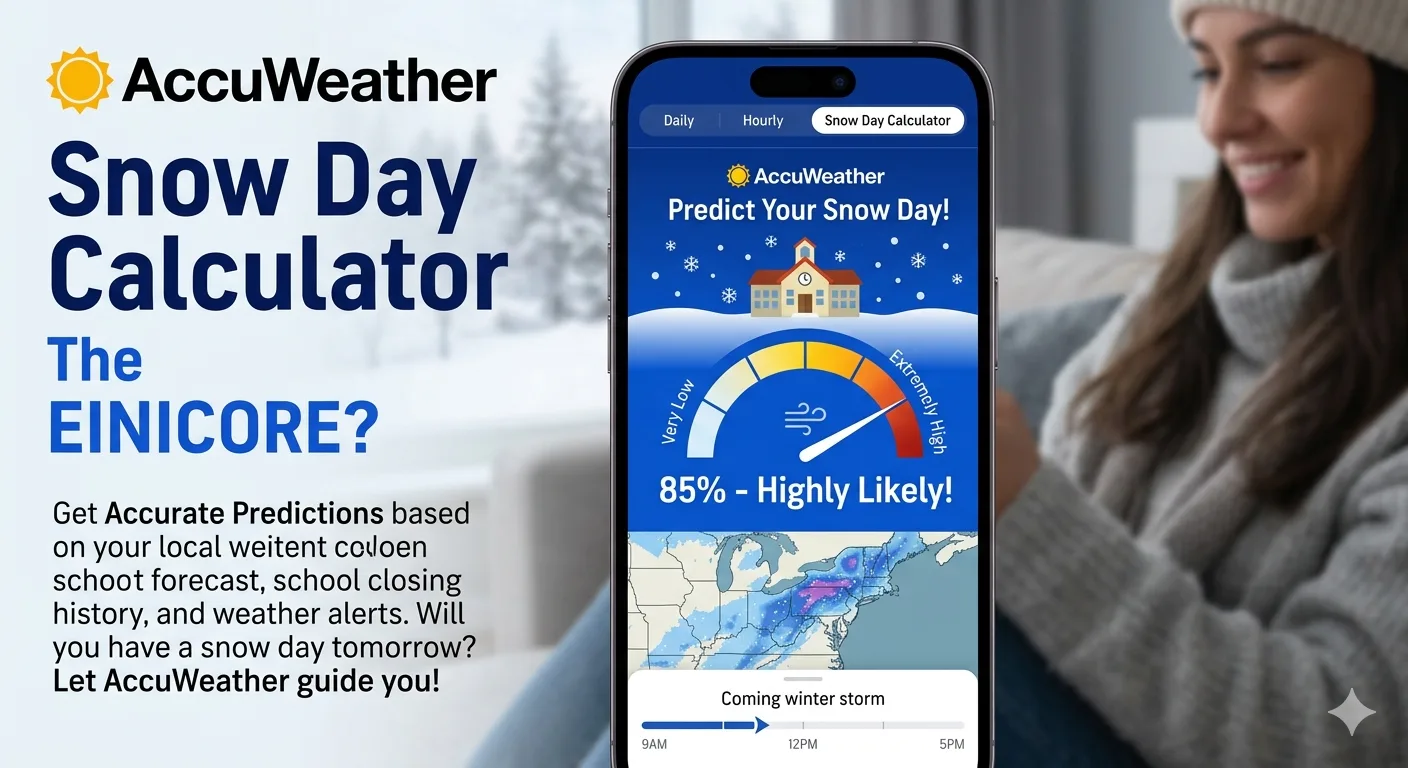
It's 9:40 p.m. The forecast says four to six inches by morning, your phone just buzzed with a winter storm watch, and someone in your house is asking the only question that matters: is there school tomorrow?
So you search "AccuWeather snow day calculator" and hope for a clean yes or no. What you find is a lot of confident percentages and very little explanation of where they come from, or how far to trust them.
This guide fixes that. You'll learn what a snow day calculator really measures, what it can't see, and how to turn a percentage into a plan for tomorrow morning. When you're ready to run tonight's numbers, our snow day calculator is a quick place to start.
What People Mean by "AccuWeather Snow Day Calculator"
When someone searches this phrase, they usually want two things at once: a weather source they trust, and a prediction about school. Those are related, but they aren't the same job.
Major forecast brands like AccuWeather are excellent at the weather half. They tell you how much snow to expect, when it starts, whether ice is in the mix, and how cold the wind will feel. What a forecast can't tell you is how your district reacts to that weather.
That's the gap a snow day calculator fills. It takes the forecast and asks a different question: when conditions like these showed up before, did schools like yours close?
Forecast, calculator, or announcement?
Each of these answers a different question, and using them together works far better than picking one.
| Source | What it tells you | Best for | Limitation |
|---|---|---|---|
| Weather forecast | Snowfall, timing, ice, wind chill | Understanding the storm | Doesn't know your district's habits |
| Snow day calculator | A percentage chance of closure | Deciding how worried to be tonight | An estimate, never a decision |
| District announcement | The actual call | The final answer | Often arrives after you're asleep |
How Snow Day Predictions Work
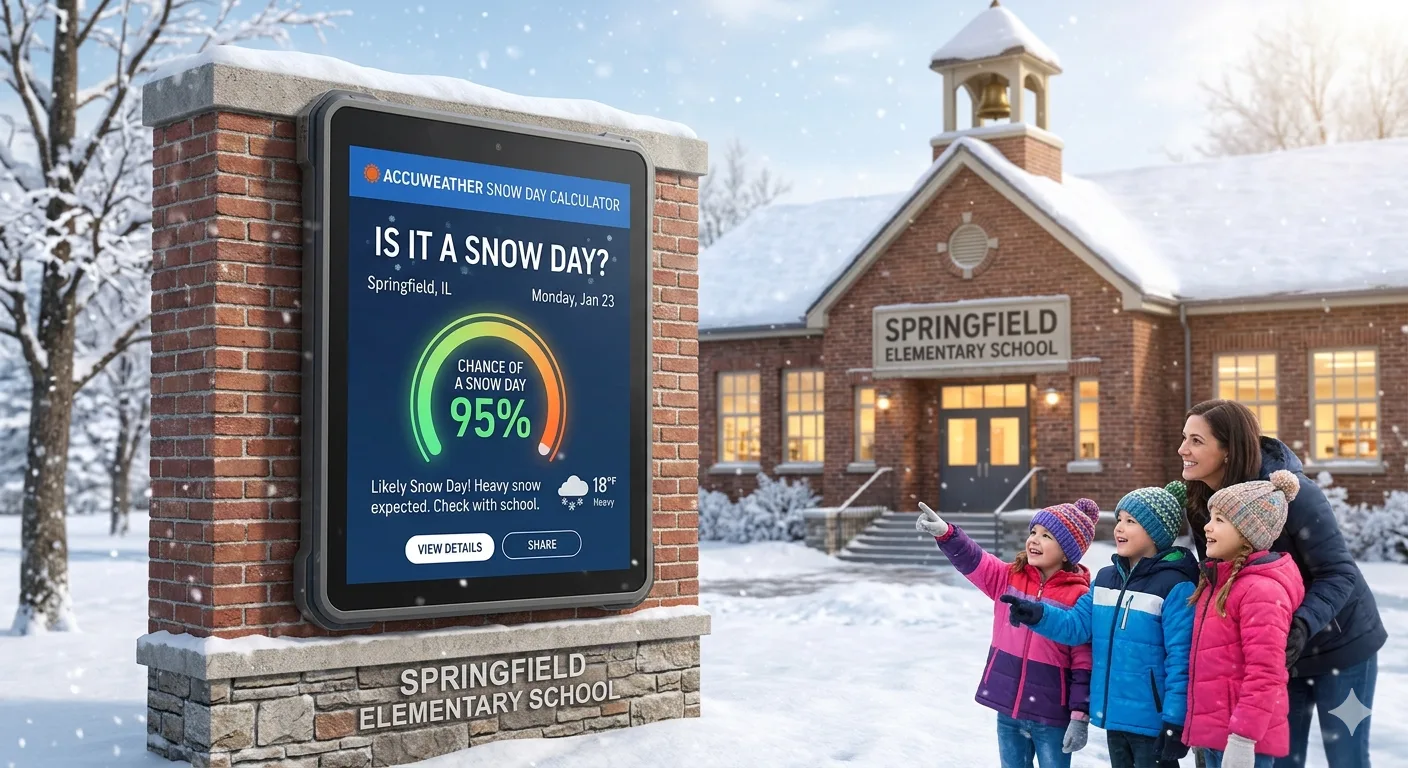
The details vary from tool to tool, but the core idea is the same. A calculator compares tomorrow's forecast with the kind of weather that has closed schools in your area, then turns the match into a percentage.
Timing matters more than total snowfall
This is the factor people underestimate most. Twelve inches on a Saturday barely affects a school district. Three inches landing between 4 a.m. and 6 a.m. on a Monday can shut everything down, because buses and commuters hit the roads right in the middle of it.
So don't stop at the snowfall total. Open the hourly forecast and check when the heaviest snow arrives relative to the morning commute.
Your region sets the bar
A dusting can close schools in Texas. In Minnesota, you'd need a real storm. That's why 70% means something different depending on where you live, and why a good prediction accounts for local norms instead of using one national formula.
Ice and cold count too
You don't need heavy snow to get a closure. Freezing rain is often worse than snow because it glazes roads and sidewalks. Dangerous wind chill can also close schools, since kids wait outside at bus stops. Some districts publish a wind chill cutoff, and commonly cited numbers fall between −15°F and −25°F, but check your own district's policy.
Your district's habits
Two towns can get identical snow and make opposite decisions. Rural districts with long bus routes on back roads often cancel earlier than compact city districts. Some administrators are cautious by nature, and some tough it out. Local history is the closest thing a calculator has to a read on that personality.
What No Calculator Can See: How Schools Really Decide
Here's the part no calculator can show you. The decision usually comes down to a person, not a weather model, and that person has information no website has.
Superintendents and transportation staff often start work in the middle of the night. Some begin talking with bus companies and public safety officials as early as 3:30 a.m. Many drive the roads themselves, sometimes splitting a district into zones so each person checks a different area.
Then there's everything beyond the pavement:
- Neighboring districts. Superintendents talk to each other. If the big district next door closes, smaller ones often follow.
- Plow crews. Main roads may be clear while side streets and hills are still packed.
- The buildings themselves. A heating failure or an unplowed parking lot can close a school even when the roads are fine.
- Kids' safety outdoors. Some administrators weigh whether students without warm coats can safely wait for a bus in dangerous cold.
None of that lives in a dataset. It's the main reason even the best prediction is an educated guess rather than a verdict.
Closure, Delay, Early Dismissal, or Remote Day?
"Snow day" used to mean one thing. Now there are four likely outcomes, and your plan changes with each:
- Full closure: no school, no assignments.
- Delayed start: usually one or two hours, often to give crews time to treat the roads.
- Early dismissal: common when a storm is due to arrive during the school day.
- Remote or flexible learning day: school goes online instead of being cancelled.
Remote days have become much more common, but the rules depend on where you live. In one Pennsylvania example, local superintendents said they lean toward remote learning when roads are the problem, and a traditional snow day when widespread damage or outages make online school unrealistic. Some states also limit how many virtual days count toward the required school year.
The practical takeaway: learn your district's policy before the storm. Find out whether it uses remote days, how many it gets, and how it announces them. If your district often goes remote, "will school close?" isn't quite the right question, and a plain closure percentage may overstate your odds of a day off.
How Accurate Are Snow Day Predictions?
Let's be straight about this, because plenty of pages aren't. Accuracy numbers advertised across the industry range from the low 80s all the way up to "100% in many locations." Treat any figure like that as self-reported unless it comes with published testing.
What you can count on is the general pattern. Predictions made 12 to 24 hours ahead are meaningfully better than ones made five days out. Clear-cut storms are easier to call than borderline ones.
Predictions are strongest when:
- A well-defined storm is already on the radar.
- You're checking the evening before, not days ahead.
- Your district has a consistent track record under similar conditions.
They struggle when:
- The storm track is still shifting.
- Rain, sleet, and snow are mixing and the rain-snow line sits over your town.
- Conditions are borderline and a superintendent could reasonably go either way.
A Simple Routine for Checking Your Snow Day Odds
Here's a process that works better than refreshing one page every ten minutes.
- Get the early heads-up (3–5 days out). Look at your regular weather forecast to see whether a storm is even in play. Treat it as a reason to pay attention, not a prediction.
- Read the forecast, not just the percentage (evening before). Note the expected snowfall, ice risk, wind chill, and above all the hour the precipitation starts and peaks.
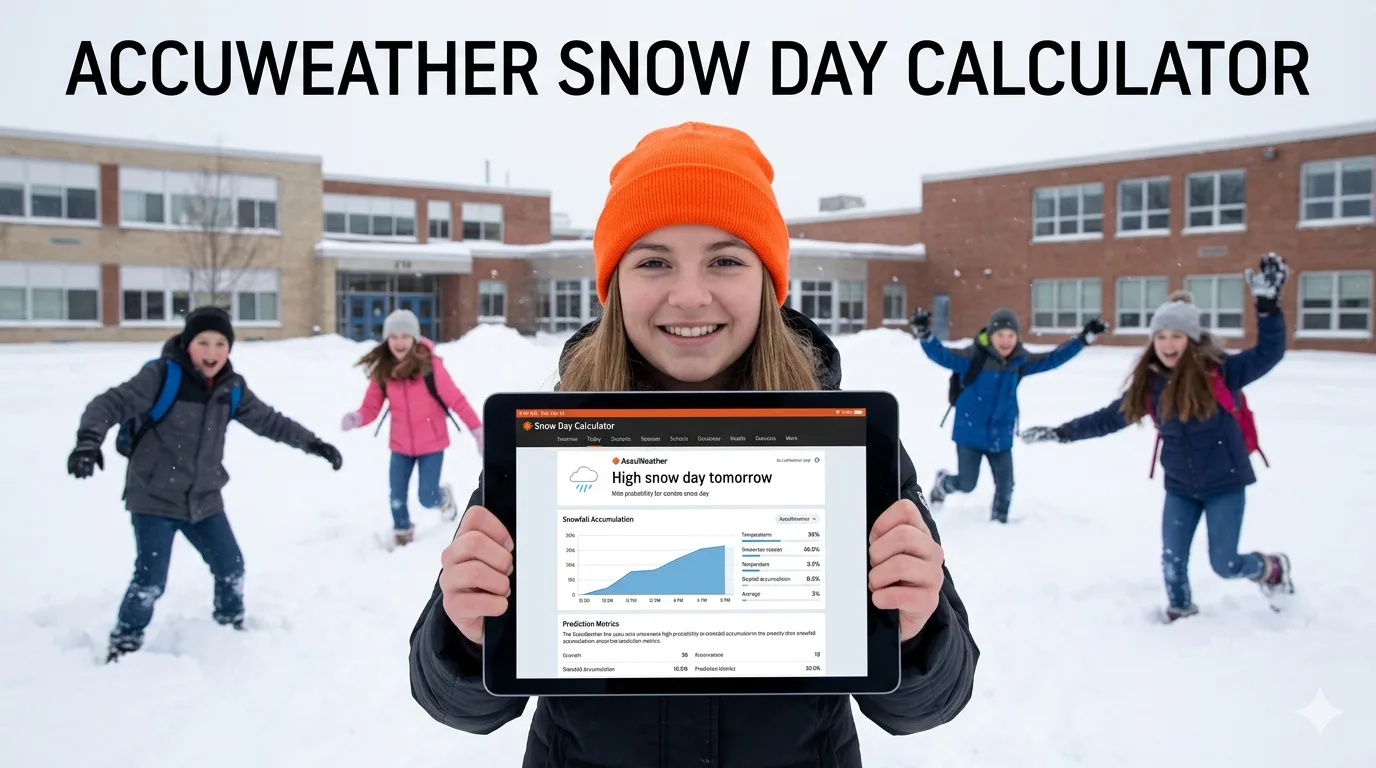
- Run the numbers. Enter your location into our snow day calculator and compare the result with what the hourly forecast is telling you. If they point in the same direction, you can trust the trend.
- See what neighbors are doing. Local news, community groups, and nearby districts' announcements are a useful signal.
- Set up your district's alerts. Make sure your phone number and email are current in the school's notification system so the real announcement finds you.
- Check again early in the morning. Many decisions land before 6 or 7 a.m. Set your alarm as if there's school, and let the official message change your plans.
What to do with the percentage
This is my own rule of thumb, not an official scale. The point is to match your effort to the risk:
- Under 30%: assume school is on. Pack the bags and go to bed.
- 30–60%: genuinely uncertain. Line up a backup plan for care and work, but don't cancel anything yet.
- Over 60%: likely enough to prepare. Charge devices, sort out childcare, and find out whether a remote day is possible.
Even at 90%, wait for the official word. A high number is still a probability.
Practical Plans for Parents, Students, and Teachers
If you're a parent
Decide your fallback the night before, not at 5:45 a.m. Who can work from home? Is there a neighbor or relative who can cover? If the school might go remote, make sure laptops are charged and log-ins work. That ten-minute check saves a rough morning.
If you're a student
Finish tonight's homework anyway. Snow days have a habit of arriving right before a quiz, and a delay or remote day doesn't mean you're off the hook.
If you're a teacher
Keep a "storm folder" ready: a lesson or assignment that works on paper or online. When the call comes at 5 a.m., you'll be glad it exists.
Winter 2026–27: What the Outlook Means for Your Snow Day Odds
This winter has an unusual backdrop. Forecasters are tracking a strong El Niño that some outlooks describe as potentially historic. NOAA's Climate Prediction Center shows the usual El Niño fingerprints for December through February: the highest odds of a warmer-than-normal winter across the northern tier, and a wetter lean across the southern U.S. Major forecasters are also expected to publish their own winter outlooks through October, so watch for updates as the season gets closer.
What does that mean for snow days? A few reasonable expectations, with the caveat that seasonal outlooks deal in odds, not promises:
- Northern states: a milder winter could mean fewer classic deep-freeze snow days, but mild winters still produce dangerous ice and the occasional big storm.
- The Northeast and mid-Atlantic: a stormier pattern without enough cold air can mean the rain-versus-snow gamble that makes every prediction wobble. Expect more borderline calls.
- The South: wetter conditions plus one cold-air outbreak can mean rare snow or ice, and even small amounts close schools where the infrastructure isn't built for it.
The takeaway is simple. In a winter with more mixed precipitation, "how much snow?" matters less than "what type of precipitation, and when?" Read every forecast with that in mind, and recheck the night before, since borderline storms can change quickly.
Common Mistakes That Lead to Bad Snow Day Calls
- Trusting a five-day number. It's a rough sketch. Recheck the night before.
- Ignoring timing. Snow at 3 a.m. and snow at noon are different problems.
- Reading 60% as a promise. Four out of ten times, you're still going to school.
- Forgetting delays. A delayed start is often more likely than a full closure.
- Skipping the official source. A prediction is a planning tool. Only your district makes the decision.
Future of Snow Day Prediction Technology
The field continues to evolve with emerging technologies:
Upcoming Innovations:
- IoT sensors on roads for real-time condition updates
- AI systems with advanced predictive analytics
- Interactive map layers for visual planning
- Integration with smart home systems
- Global expansions for international schools
Climate Change Considerations: Climate experts note that climate change is tilting odds away from dependable midwinter powder toward more mixed precipitation and temperature swings, potentially making predictions more complex but also more valuable.
Important Disclaimers
While snow day calculators provide valuable insights, users should remember:
- The forecast is not intended as a replacement for official school closing notices, which come directly from school districts
- Calculators should never be used as a reason not to prepare for school
- Weather conditions can change rapidly
- Individual school districts make final decisions based on multiple factors beyond weather
- Calculators provide probabilities, not certainties
Conclusion
AccuWeather snow day calculators and similar prediction tools have transformed how families, students, and educators prepare for winter weather disruptions. By combining sophisticated weather forecasting with historical data analysis and machine learning, these tools provide reliable probability estimates that help millions plan ahead.
Whether you're using AccuWeather's official Snow Days Forecast, the popular SnowDayCalculator.com platform, or regional prediction tools, remember that these calculators are planning aids, not crystal balls. Always verify with official school district communications and maintain backup plans for both closure and normal school days.