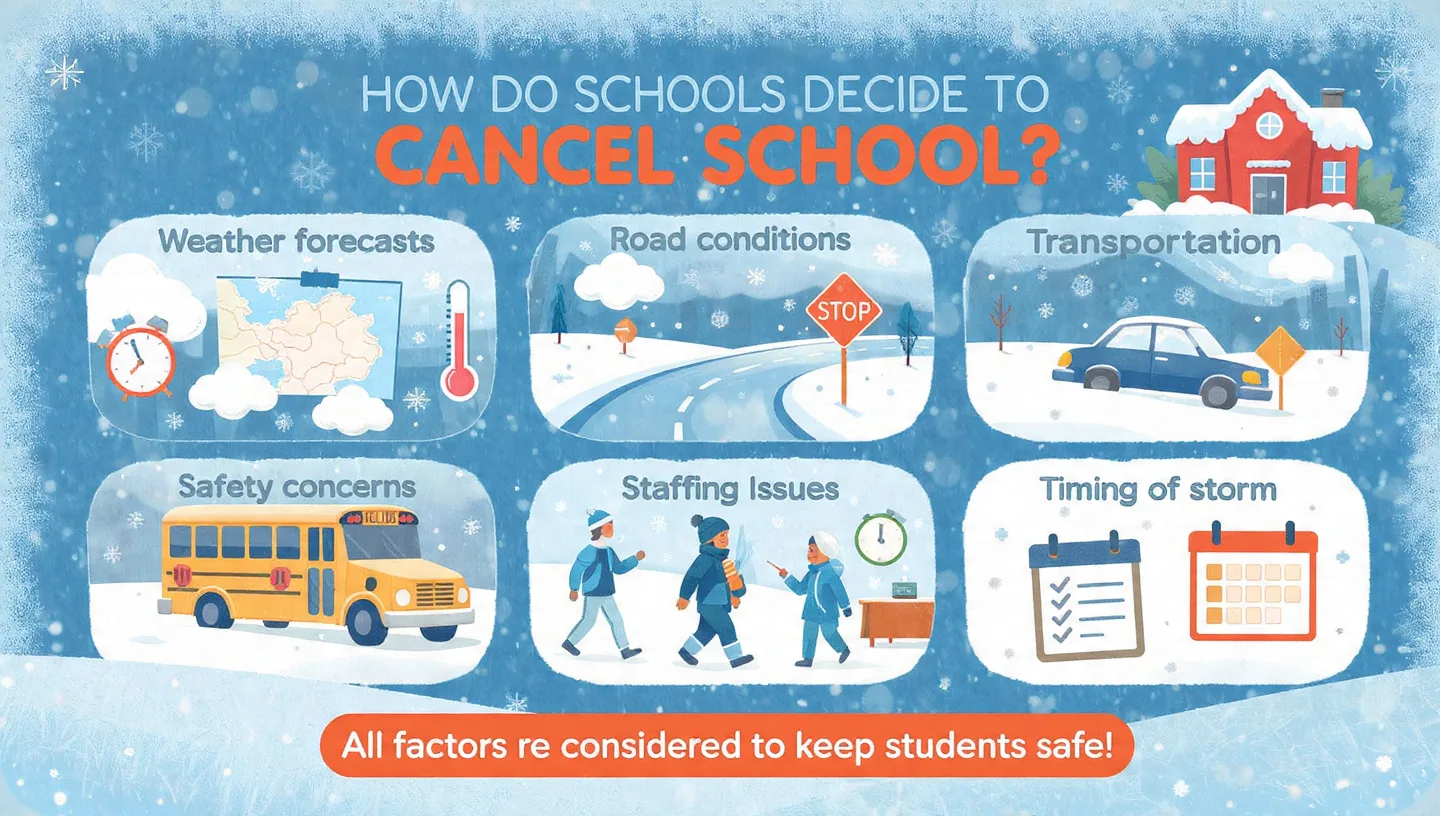
It's 9:47 PM. You're refreshing the district website for the fourth time. The forecast says " accumulation," which is meteorologist-speak for "we genuinely don't know." Your kid is already lobbying hard for a snow day. And somewhere across town, a superintendent is doing the exact same thing you are staring at the same radar, waiting for one more data point before making a call that will annoy roughly half the town no matter what they decide.
So how does that decision actually get made? Not the textbook version the real one, with the 4 AM truck convoys, the group texts between superintendents, and the surprisingly petty politics of "well, the district next door already closed."
I pulled apart how this process actually works, from the superintendents who've talked about it publicly to the transportation directors who are out on the roads before sunrise. Here's the version that actually explains why your school closed and your cousin's, forty minutes away, didn't.
Who Actually Makes the Call?
One person signs off on it: the superintendent. It's not a vote, it's not a committee decision, and it's rarely made from someone's back porch squinting at the sky despite what one Vermont superintendent has joked people assume.
But that superintendent isn't working alone. By the time they make the final call, they've usually talked to:
- The transportation director who has people physically driving the worst routes before dawn, often starting around 3:30 AM.
- Facilities staff checking whether the boilers are working, the parking lots are cleared, and the building actually has heat and water.
- Local police and public works for real-time reads on road treatment and plowing progress.
- The National Weather Service office covering their region not a generic app forecast, but the actual local forecast office.
- Neighboring superintendents an informal phone or text chain that keeps closures roughly consistent across a region.
One Iowa superintendent put it simply: he doesn't trust a screenshot. He's in his truck at 4:15 AM, personally driving the roads his buses will use, because he doesn't want to rely on somebody else's read on conditions. That's fairly typical. The people making this call are, more often than not, awake and outside long before most of the district is.
The Factors That Actually Move the Needle
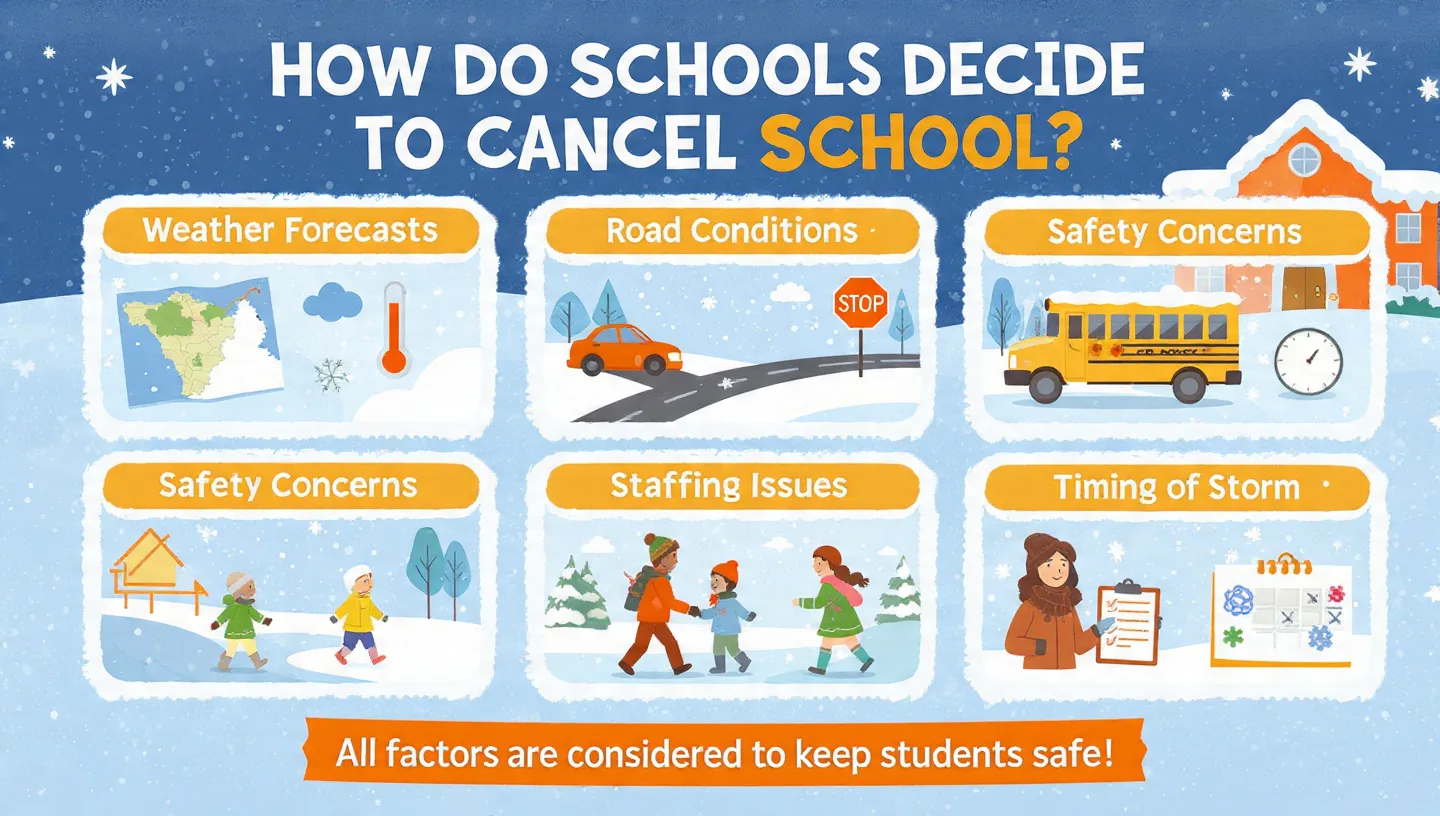
There's no formula. No "6 inches equals closed." A superintendent in Vermont has said flatly that 6 inches at the wrong moment can shut a district down, while 18 inches that plow crews stay ahead of might not close anything at all. Here's what's actually being weighed.
1. Can the buses actually run their routes?
This is the single biggest factor almost everywhere. Not "is it snowing," but specifically: can a 40-foot bus safely navigate the district's worst rural roads, steepest hills, and shadiest ice patches? Heavy snow doesn't just make roads slick it narrows them, and two buses can't always pass each other on a road that's lost four feet of width to snowbanks.
2. What kind of snow, and how fast is it falling?
Wet, heavy snow brings down power lines and tree limbs. Light, dry snow blows and drifts, which can be just as dangerous for visibility even with a smaller total accumulation. And if snow is falling faster than about an inch an hour, plow crews simply can't keep up, no matter how good the infrastructure is.
3. Wind chill, not just temperature
Wind chill, not just temperature
In the upper Midwest and northern Plains, this is often the actual trigger not snow at all. When wind chills drop to around -25°F, frostbite on exposed skin can set in within 5 to 10 minutes. For a kid standing at a bus stop, that's not a hypothetical risk. Some districts have a hard internal line, like -25°F windchill, where school simply doesn't happen, regardless of how clear the roads are. If cold is the bigger concern where you live, our Wind Chill Calculator can show you how close your area is to that danger zone.
4. When the storm hits
Superintendents talk about a "bus window" roughly 5 to 7 AM. A storm that dumps 12 inches starting at noon and tapers off by midnight might be a total non-event the next morning, because overnight crews had hours to clear it. That same storm arriving at 2 AM is a completely different problem by 6 AM.
5. Is the building itself safe?
Heat, water, electricity, cleared parking lots, and passable bus lanes all matter. A building with no heat in a cold snap is a closure regardless of what the roads look like.
6. Power outages
No power means no lights, no heat or air conditioning, no working security systems and. Importantly. No working kitchen. In California utility-triggered Public Safety Power Shutoffs during wind, high-fire-risk conditions have become a recurring non-weather reason schools close. Districts now routinely file state waivers to protect attendance-based funding when that happens.
7. Regional infrastructure and what the community is used to
An inch of snow does almost nothing in Minneapolis and shuts down Atlanta. That's not about toughness it's about plow fleets, salt reserves, and whether drivers have any practice navigating ice. A district with three salt trucks for 200 miles of road has a fundamentally different risk calculation than one with thirty.
8. What closing actually costs vulnerable students
This is the factor people underestimate. For a meaningful share of students, the school cafeteria is their most reliable meal of the day one Indiana superintendent has noted that in his district, roughly three-quarters of students qualify for free or reduced lunch. Kids with IEPs lose access to services. Parents without paid sick leave face a genuine financial hit. Closing school is never a free decision, and superintendents talk about this weight constantly.
9. What the district next door is doing
Superintendents are texting each other throughout a storm event. If a big neighboring district closes and a smaller one stays open, you get parents driving kids to one school while buses from the other district sit idle which creates its own traffic hazard. This "chain call" habit is one of the main reasons closures often cluster regionally, even when the actual weather varies street to street.
10. How much the forecast can actually be trusted
At 24 to 48 hours out, precipitation timing and totals still carry real uncertainty. That's the tension every superintendent lives with: call it the night before and give families more notice, or wait until 4:30 AM for better data and give them less time to plan. Most districts try to do the former when the picture is clear enough, and fall back on the latter when it isn't.
What a Snow Day Decision Actually Looks Like, Hour by Hour
This isn't a morning scramble it's a process that starts well before the first flake falls.
- 48–72 hours out: The superintendent and transportation team start watching the extended forecast and flag known problem routes.
- ~24 hours out: Calls go out to the transportation director, facilities manager, and neighboring superintendents. Private weather services and NWS hourly forecast graphs get pulled up.
- The evening before: If the picture is clearly bad, the call gets made often by 9 or 10 PM so families get maximum notice.
- 3:30–4:30 AM: If it's still a toss-up, road spotters physically drive the worst routes and report back in real time.
- 4:30–5:30 AM: The superintendent makes the final call closed, delayed, or normal and it goes out to media, the district site, text/call systems, and social media.
- 5:30–6:30 AM: Mass notification hits every channel at once, with the goal of reaching families before the first bus leaves the lot.
If you've ever wondered why some districts announce the night before and others make you wait until 5 AM, this is why — it usually comes down to how confident they are in the forecast, not how organized the district is.
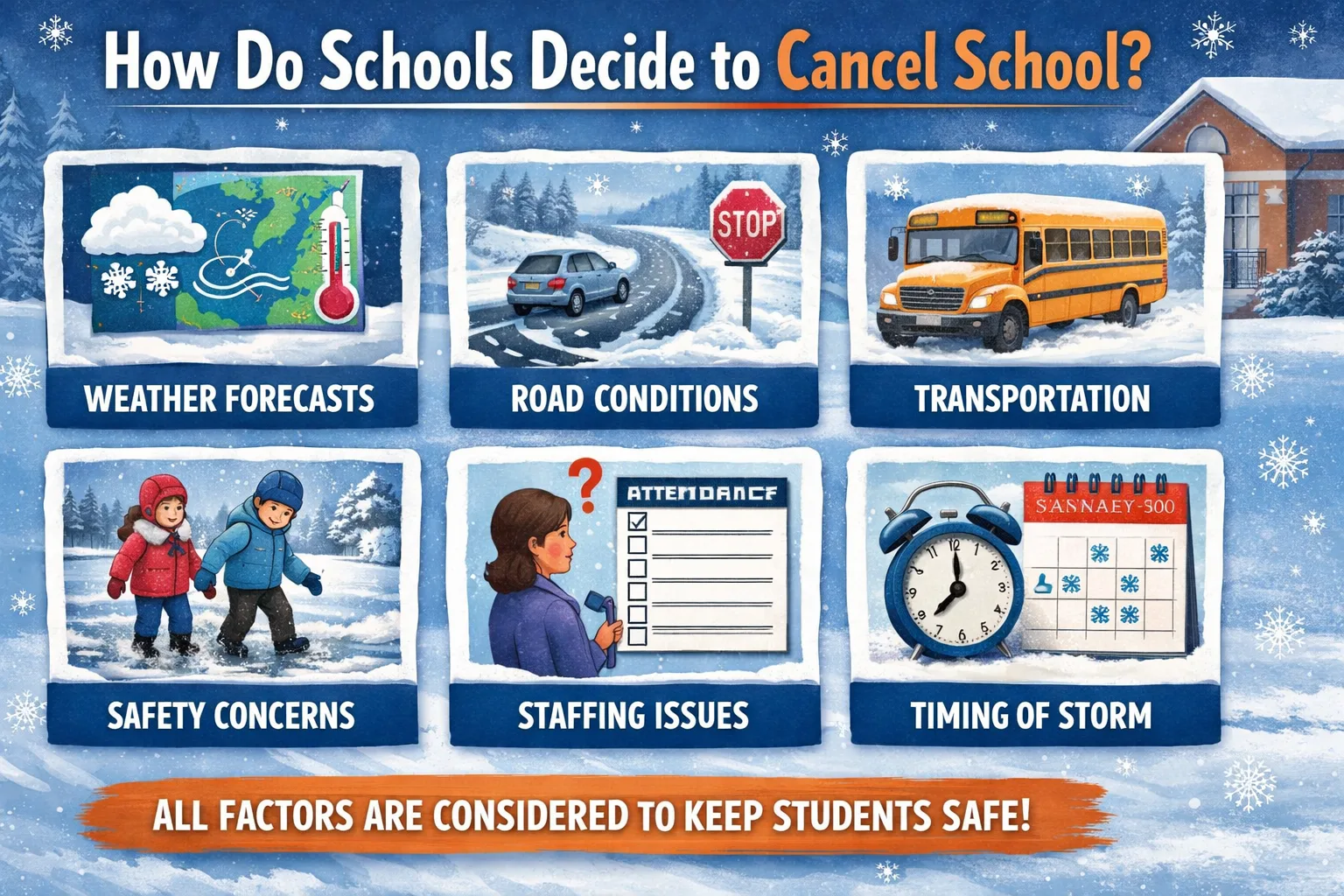
It's Not Just Snow: Why Schools Close in 2026
Winter weather gets all the attention, but it's actually not the leading cause of prolonged school closures nationally natural disasters are. Here's the fuller picture of what shuts districts down these days.
Natural disasters
Hurricanes, tornadoes, major flooding and earthquakes can close schools for days or weeks at a stretch. These events are concentrated heavily in the Gulf Coast, the Midwest and California.
Wildfire smoke and air quality
This has become a routine late-summer and fall issue in the western half of the country. In August 2026 wildfire smoke pushed air quality to levels across parts of the Pacific Northwest forcing schools, community centers and outdoor programs in the Portland area to close or move activities indoors. When the Air Quality Index climbs into " Unhealthy" or "Hazardous" territory even a buildings ventilation system can become the problem since standard HVAC just recirculates smoky outside air. This is no longer a once-a-decade event for a lot of districts. It's a planning consideration.
Extreme heat
Older buildings without air conditioning are increasingly forcing early dismissals or full closures during heat waves. Some districts now have formal heat-threshold protocols that mirror their cold-weather ones.
Public health situations
Flu clusters and other outbreaks still occasionally force short, localized closures, though districts are generally far more targeted about it post-2020 than they were during the pandemic itself.
Facility emergencies
A burst water main, a gas leak, or a heating failure can close one building on a perfectly clear day while every other school in the district runs normally.
Safety threats and labor actions
Security threats and teacher strikes or budget disputes can also trigger closures sometimes for weeks, in the case of prolonged labor actions.
Snow Day or Just a Delay? The Logic Behind Each
A lot of parents assume a delay is the "safe middle option." It's actually a specific bet: that conditions will meaningfully improve in a couple of hours. If a delay is on the table where you live, our Rain Delay Calculator can give you a quicker read on whether a delay or a full closure is more likely for your morning.
Delays tend to make sense when:
- The storm is winding down and roads should be mostly clear by mid-morning
- The core problem is pre-dawn ice that's expected to melt off
- A couple of extra hours gives plow crews real time to finish key routes
Full cancellations tend to make sense when:
- Conditions are expected to get worse through the day, not better
- Road crews can't realistically catch up even with extra time
- Building temperatures are dangerously low
- A delay wouldn't meaningfully change the safety picture
One New York superintendent explained the trade-off well: a delay still counts as a full instructional day on the calendar, so those hours are gone for good. A full closure, by contrast, usually gets made up later so when it's genuinely a toss-up, some districts will lean toward canceling, specifically because it protects instructional time in the long run rather than quietly eroding it.
How Many Snow Days Does a District Actually Get?
Most districts build 3 to 7 emergency days into the calendar every year. Here's what happens on either side of that number:
- Don't use them all? Districts often hand the extra days back as bonus time off an extended long weekend, an early start to spring break, or an earlier end to the school year.
- Use more than the built-in allotment? That instructional time has to be recovered somehow shortened breaks, added minutes to remaining days, a later end date, or converting early-release days into full ones.
Some states are strict about this New Jersey generally requires make-up time for every day beyond the built-in allotment. Others grant waivers in genuinely extreme years, the way Texas did after Winter Storm Uri in 2021.
Whatever Happened to Remote Learning Days?
For a years after 2020 a lot of districts leaned hard on "eLearning days" as a way to preserve instructional time during storms instead of cancelling outright. By 2026 that enthusiasm has cooled considerably and for reason:
- Home internet access still isn't universal, and asking every family to be online at once during a storm assumes a level of connectivity a lot of districts can't guarantee
- Winter storms cause power outages which makes remote learning impossible for exactly the families who need it most
- Kids genuinely benefit from an actual break sometimes, not another screen day
- Ad-hoc remote days, sprung on families with little warning, tend to strain relationships between teachers and parents rather than help anyone
Most districts now treat a true snow day as a snow day again a real day off, not a disguised school day at the kitchen table.
Read More : Will There Be a Snow Day Tomorrow?
Why Your District Closed and the One Next Door Didn't
This is the most common source of frustration for parents, and it usually comes down to a handful of concrete differences rather than one district being "too soft" or "too strict":
- Geography within one district. Large districts can easily see 2 inches in one zone and 7 in another, but the superintendent has to make one call for the whole district.
- Infrastructure and budget. More salt, more plows, better-maintained buildings wealthier districts simply have more capacity to stay open through the same storm.
- Route complexity. A district full of rural roads with steep grades and no guardrails carries a different risk profile than a dense urban district where kids mostly walk or take public transit.
- What the community is used to. An inch of snow is a much bigger deal in Virginia than in Maine, and superintendents make calls based on their community's actual experience driving in it not some national standard.
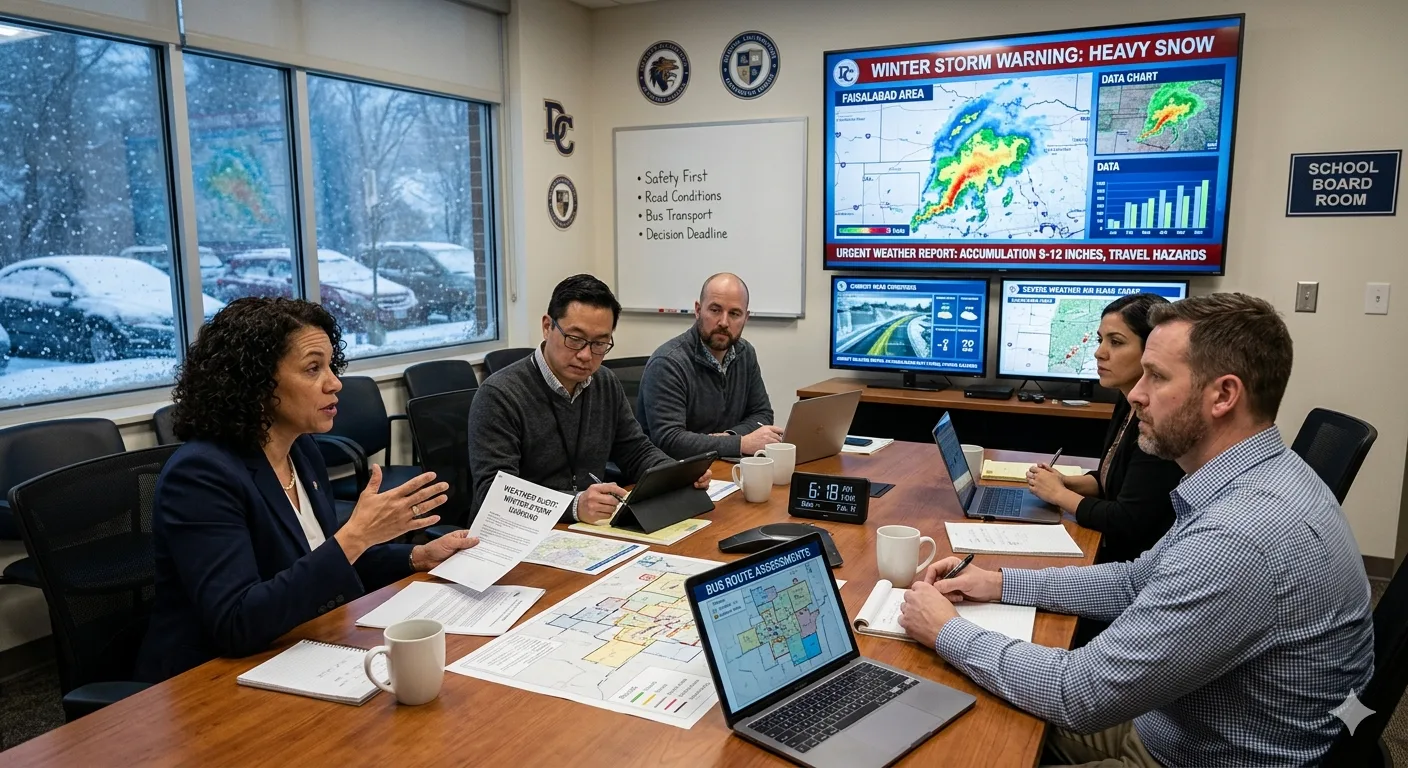
What You Can Actually Do With This Information
Understanding the process doesn't just satisfy curiosity it helps you plan better, faster.
- Watch the same signals the superintendent is watching. A local live plow-tracking map and your area's National Weather Service hourly forecast graph are both public and both more useful than a generic weather app.
- Pay attention to the biggest district near you. If it closes smaller neighboring districts are statistically more likely to follow.
- Always have a plan. When districts try to give notice by 9 or 10 PM the night before it doesn't always happen. Having a neighbor drop-in option, in your back pocket removes a lot of the stress.
- Know that you have say, too. Even when school is technically open most districts allow a parent-excused absence if you genuinely feel conditions are unsafe.. Just call the school to report it.
- Sign up for every notification channel your district offers text, email, app, and social media since districts often push updates in whichever channel is fastest, not necessarily the one you're already checking.
If you'd rather not wait around for the official text, you can get ahead of the guesswork entirely. Punch your zip code and the coming forecast into the Snow Day Calculator and you'll get a realistic probability estimate based on the same kinds of factors snowfall, timing, wind chill, and local norms that superintendents are actually weighing before they make the call.
The Bottom Line
There's no snow-total threshold, no secret formula, and no single weather app that gets it right every time. A school closure decision is really a judgment call made under real time pressure, balancing bus safety, building conditions, regional norms, and the genuine hardship a closure creates for families who rely on school for meals, childcare, and services their kids can't get anywhere else.
That's exactly why the superintendent who closes school when your driveway barely has a dusting, and the one who keeps it open when yours has six inches, can both be making the right call for their own district. They're not reading the same storm they're reading the same storm through very different roads, buildings, and communities.
Also Checkout :