
Every December I make the same promise to myself. "This year I'll review everything over break." And every January I'm sitting in the first class of the semester, staring at a formula I definitely knew in November, wondering who wrote it.
If that sounds painfully familiar you're in the place. This is a guide on how to study during winter break that doesn't ask you to give up your holidays wake up at 6 AM or turn your living room into a library. It's built around real life: relatives, leftovers, long car rides, and a brain that wants to do absolutely nothing.
Why Bother Studying During Winter Break at All?
Fair question. You just survived a whole semester. Resting is not laziness.
But here's what usually happens. Three weeks of zero contact with your subjects, and the details start to slip. Not everything, just enough that your first week back feels like jogging uphill. Names, formulas, grammar rules, the little steps in a proof. They're all still in there somewhere, just harder to reach.
A small amount of studying fixes this surprisingly well. I'm talking 20 to 40 minutes, a few days a week. That's less time than one episode of whatever you're bingeing right now.
The goal isn't to get ahead. It's to not fall behind, and to walk into January feeling like you still belong in the room.
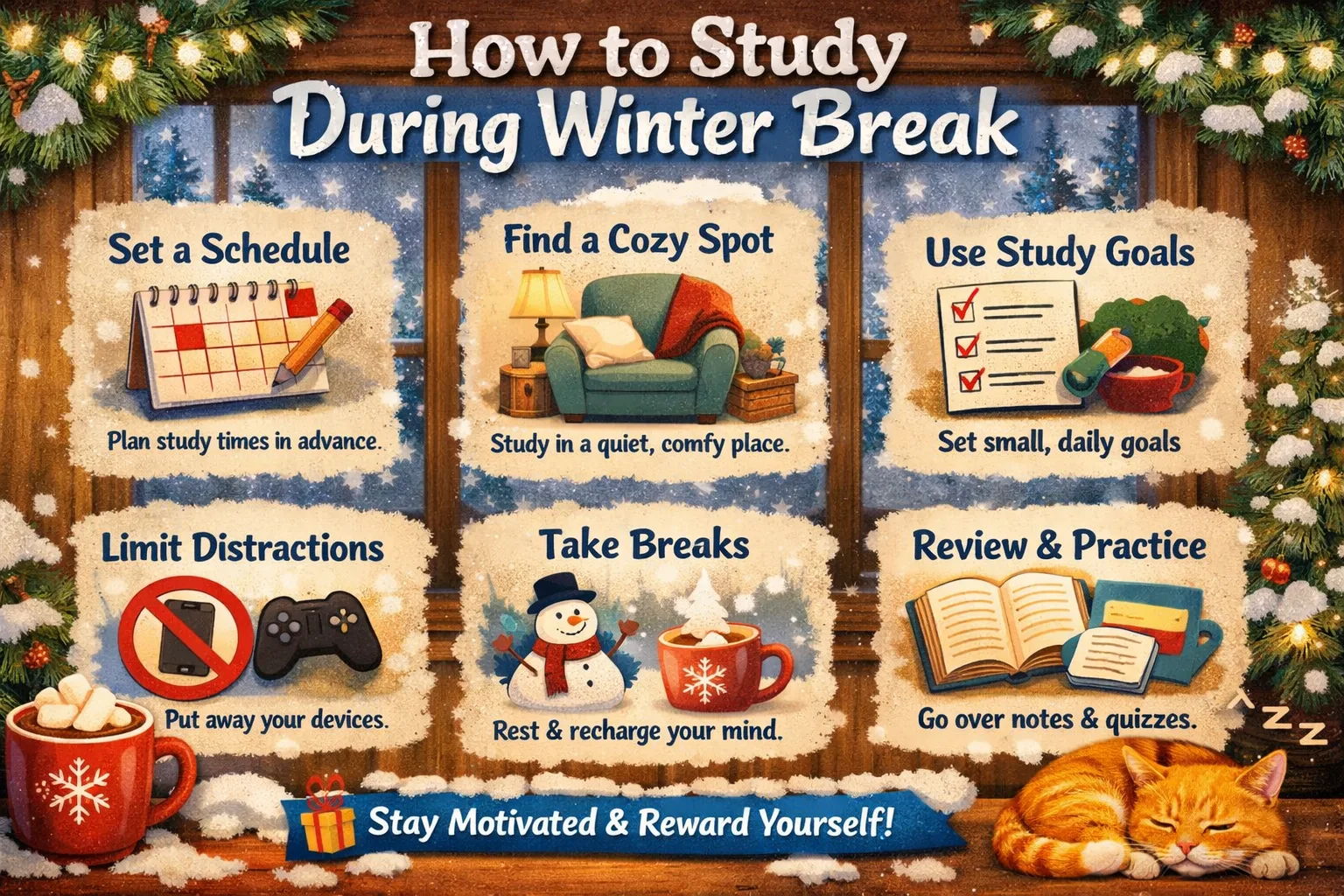
Think of Break as a Bridge, Not a Switch
Most people treat break like a light switch. Semester on, semester off. Then they feel weirdly guilty for two weeks and cram on the last night.
A better picture is a bridge. You're crossing from one semester to the next, and you only need to touch the ground now and then so you don't forget the way. A single short session counts. Skipping a day costs you nothing.
Once I started thinking this way, the guilt mostly went away, and weirdly, I ended up studying more.
How to Build a Winter Break Study Plan That Survives Christmas Week
Most study plans die around December 26th. They assume you're free all day, every day, in a quiet house. You're not.
So start with what's actually happening in your life. Do you have exams right after break? Are you traveling? Is there a brutal course starting in week one? Your answers decide how much structure you need.
Then pick one study window. Just one. Mid-morning works for a lot of people, after breakfast and some movement. Night owls can take an hour after dinner. What matters is that it's the same slot most days, so your brain gets used to it.
Finally, give your days a loose shape instead of a strict timetable. This is the rotation I like best, because it removes the "I missed yesterday, so I've failed" feeling:
| Day | What you do | Time |
|---|---|---|
| Review day | Go back to last semester's weak spots. Quiz yourself instead of re-reading. | 45 min |
| Preview day | Skim the syllabus or read the first chapter of a new course. | 30 min |
| Skill day | Writing, math drills, coding, vocabulary. Something that feels a bit like play. | 30 min |
| Rest day | No academics. Seriously. Sleep, see people, go outside. | 0 min |
Rotate in any order. If a family trip wipes out four days, you just start again where you left off. Nobody's keeping score.
What a Realistic Day Looks Like
On a day it goes something like this. You sleep a bit late have a breakfast and take a short walk. Test yourself don't reread. Around 11 you sit down for 45 minutes with one task and your phone in another room. Then you're done. The rest of the day belongs to you.
That's it. It doesn't look impressive, and it isn't supposed to. Over three weeks it still adds up to around ten hours of focused review, which is more than most students do in the entire break.
Study Methods That Actually Work (and the One That Doesn't)
Let's start with the one that doesn't. Re-reading your notes feels great. Everything looks familiar, so your brain whispers, "yep, I know this." But recognizing something on a page isn't the same as being able to pull it out of your head on exam day.
What works better is making your brain struggle a little. Close the notebook and write down everything you remember about a chapter. Then open it and see what you missed. It's annoying, and that's the point.
Test yourself, don't reread
Use flashcards in recall mode redo exam questions or explain a concept out loud to anyone who'll listen. A younger cousin is a brutal but fair audience. If they look confused, so are you.
Spread things out
Fifteen minutes on Monday, Wednesday and Saturday beats one Sunday session. Your memory likes repetition with gaps in between. Flashcard apps with spaced repetition handle the scheduling for you, which is a nice bonus when your brain is in holiday mode.
Give yourself ridiculously small goals
"Study biology" is a terrible goal. It's vague, so you avoid it. "Do ten practice questions on cell respiration" is something you can start in two minutes. Write it on a sticky note the night before, so you're not deciding anything when motivation is low.
Use the Feynman technique on your worst topic
Pick the concept that confused you most this semester. Explain it in simple words, as if to a 12-year-old. Wherever you get stuck or start waffling, that's the gap. Go back to your notes and fix only that part.
It sounds too simple to work. Try it once and you'll see how much you thought you knew but didn't.
Clean up your notes
Break is the best time to deal with the mess: screenshots, half-finished notebooks, random voice memos. Turn them into one study guide per course. Key ideas, formulas, and the questions you got wrong.
The sneaky benefit is that organizing is already studying. By the time you finish, you've reviewed the whole course without really noticing.
Do a quick semester reflection
Grab a notebook and spend an hour on honest questions. What study habits actually raised my grades? What did I keep putting off? What do I want from next semester? Most of us skip this step and repeat the same mistakes in spring, so it's worth doing once.
Peek at your spring syllabi
Just skim the first two weeks. You're not learning yet, only removing surprises. A familiar syllabus is a lot less scary on day one.
Study with a friend, even from home
A weekly video call to quiz each other works well. Even a silent session, where you both just work with cameras on, makes starting easier. Having another person on the screen is a weirdly strong motivator.
Match Your Plan to Your Situation
A high school student prepping for midterms and a grad student writing a thesis shouldn't study the same way. Here's how I'd adjust.
High school students: Think 3 to 5 hours in total across the week. Focus on the subject you're most behind in, and use old tests for practice.
College students with finals after break: An hour or two on study days is plenty. Take a rest day after every two study days and start with the course you're most nervous about.
Test prep (SAT, ACT, GRE, AP): This is the one case where longer sessions make sense. Do a timed section every days review every mistake and still keep a day off each week.
Grad students and thesis writers: Protect one writing or reading block even just 60 minutes. Long projects lose momentum quickly when you stop.
Totally burned out: Take the week off completely. Then start with 20 minutes a day. That still. Its a better start than a heroic plan you drop after three days.
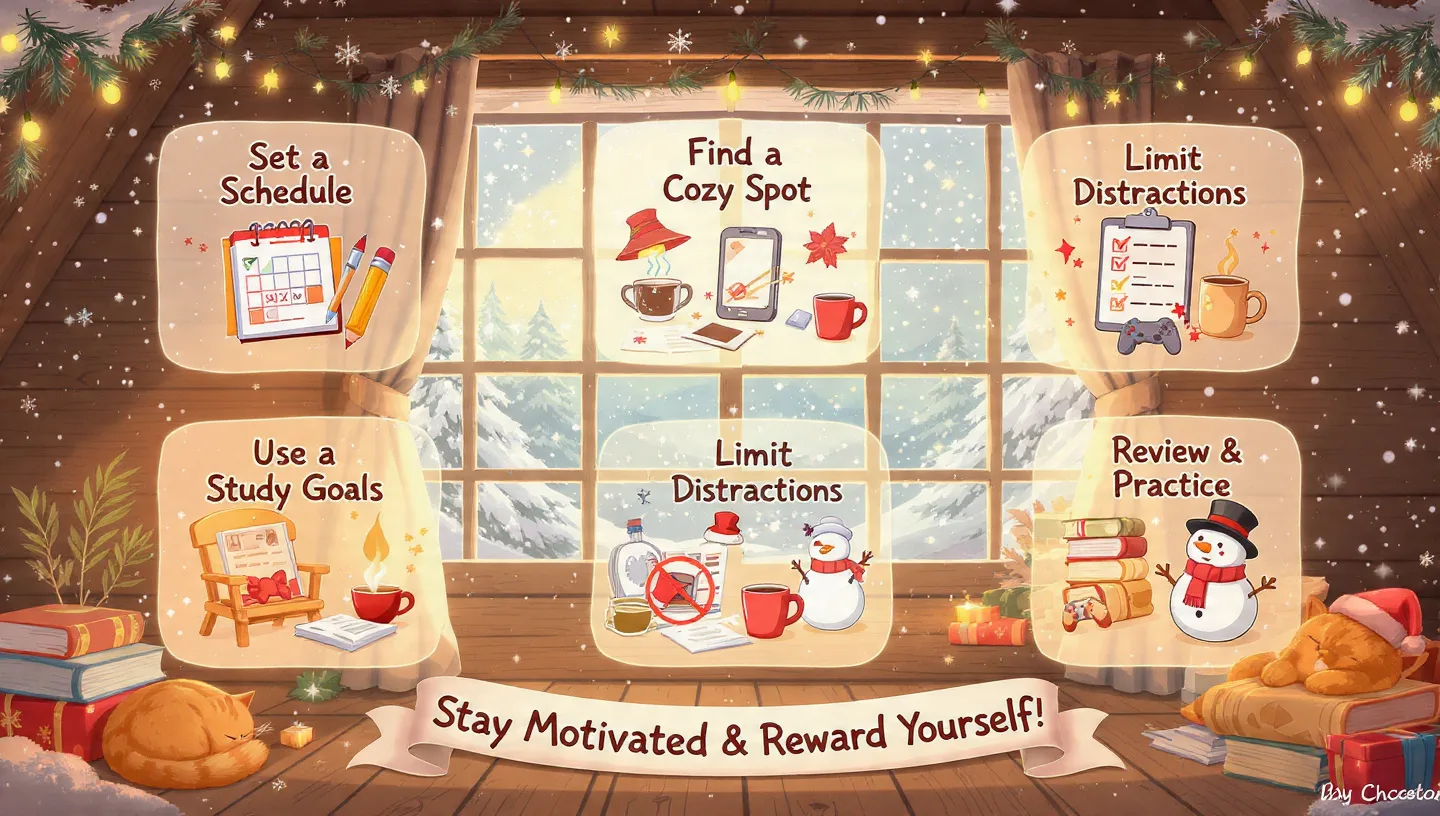
Winter-Specific Problems (and What I'd Do About Them)
The sluggish, dark-afternoon feeling
Winter makes you tired in a way summer doesn't. Study in the morning when theres daylight near a window if you can. Stepping outside first helps a lot for ten minutes. If it's freezing, check the wind chill calculator before you go, because what the air actually feels like matters more than the number on your phone.
Travel and weather chaos
Delayed flights, icy roads and eight-hour car rides can swallow a day. Before you leave download your flashcards and a couple of lectures so you can study offline. If rainy weather is wrecking your plans, the rain delay calculator gives you a rough idea of how long a wet-weather hold-up could last, so you can plan study time around it instead of just waiting around.
And if you're spending the holidays somewhere warm, the heat index calculator helps you decide whether studying outside makes sense or whether its smarter to stay in the shade.
A noisy house
Tell your family your study window early. Most people are happy to give you 45 quiet minutes when they know it's coming. Headphones help, and so does a cafe or library when home is just too loud.
A snow day right after break
Sometimes the new semester starts and the weather cancels it anyway. If you're a student, parent, or teacher trying to guess what's coming, you can check the odds with our snow day calculator. It takes a few seconds and saves a lot of guessing.
Study Tools That Are Worth Your Time in 2026
You really don't need much. A flashcard app with spaced repetition, a free video course platform, a note app for your study guides, and a site blocker for your study window will cover almost everything.
AI study assistants are everywhere in 2026, and I think they're genuinely useful if you treat them like a practice partner. Paste in your own notes and ask for practice questions, or have it quiz you out loud. Ask it what's missing from your summary.
What I wouldn't do is let it write the summary for you. If all you do is read AI-generated notes, you've just found a fancier way to reread. And always check facts against your textbook, because these tools still get things wrong with total confidence.
If you like having handy planning tools around, you can browse our full list of free calculators for weather and everyday planning.
Don't Ignore Sleep and Rest
This is the boring part, and it matters most. Your memory gets sorted while you sleep. Studying on five hours of rest is mostly wasted time.
Aim for 7 to 9 hours even if the schedule slides a bit later than usual. Eat real meals between the cookies. Walk every day if you can. See actual people.
If you notice headaches, irritability or that foggy "I've read this paragraph four times" feeling that's not a sign to push harder.
Read More : Snow Day Snacks and Food
Mistakes I'd Skip This Year
Treating break like a normal school week. It won't survive the first weekend.
Studying every single day. Rest days aren't a reward. They're part of how learning sticks.
Building the perfect color-coded schedule. If you spend two hours planning, that's procrastination wearing a nice outfit.
Comparing yourself to other people. Social media will tell you everyone is either studying nine hours a day or doing nothing at all. Neither is true.
Forgetting the last few days. Which brings me to my favorite part.
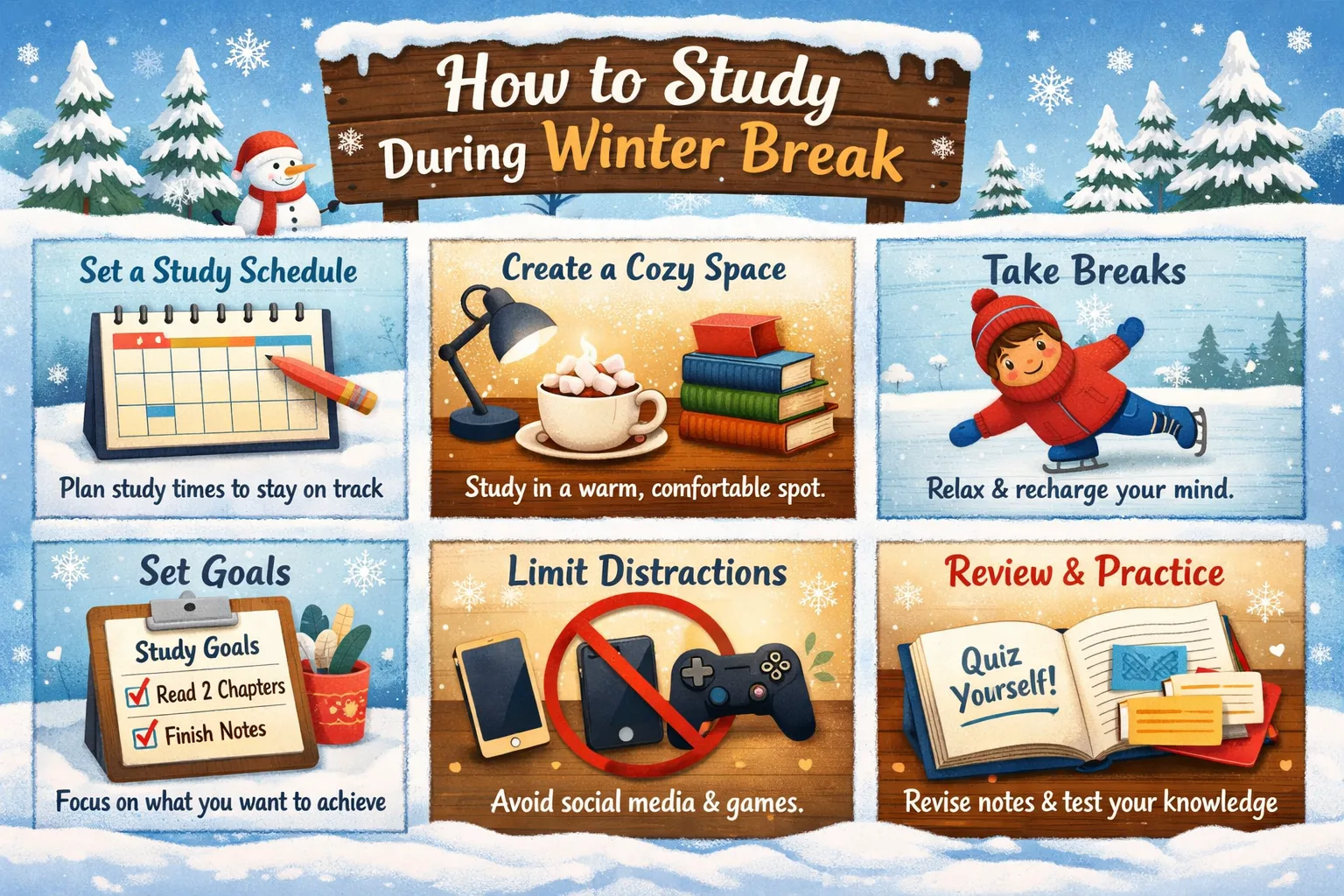
Your Last 72 Hours Before Classes Start
If you only take one thing from this guide, take this. The final three days of break are the time to get ready for week one and it takes less than two hours, in total.
-
Print each syllabus and note the first deadlines.
- Put every due date into your calendar.
- Tidy your desk, or wherever you'll be studying.
- Flip through the table of contents of your new textbooks.
- Move your bedtime earlier by about 15 minutes each night.
- Pack your bag the night before day one.
It's not exciting, but it changes how the first week feels. You'll walk in calm instead of scrambling.
Final Thoughts
You don't need a perfect plan to study well over winter break. You need one small, flexible habit: a single study window, a loose rotation, honest rest days, and a smart final three days before class.
Start tomorrow with something tiny. Twenty minutes of quizzing yourself on your hardest subject is plenty. A few weeks from now, those short sessions will add up, and January won't catch you off guard.
If you want a hand with the practical side of winter planning, visit The Snow Day Calculators to check your snow day chances, and explore our free weather and planning calculators to organize the rest of your break. Enjoy the holidays, rest well, and good luck next semester.
Also Checkout :