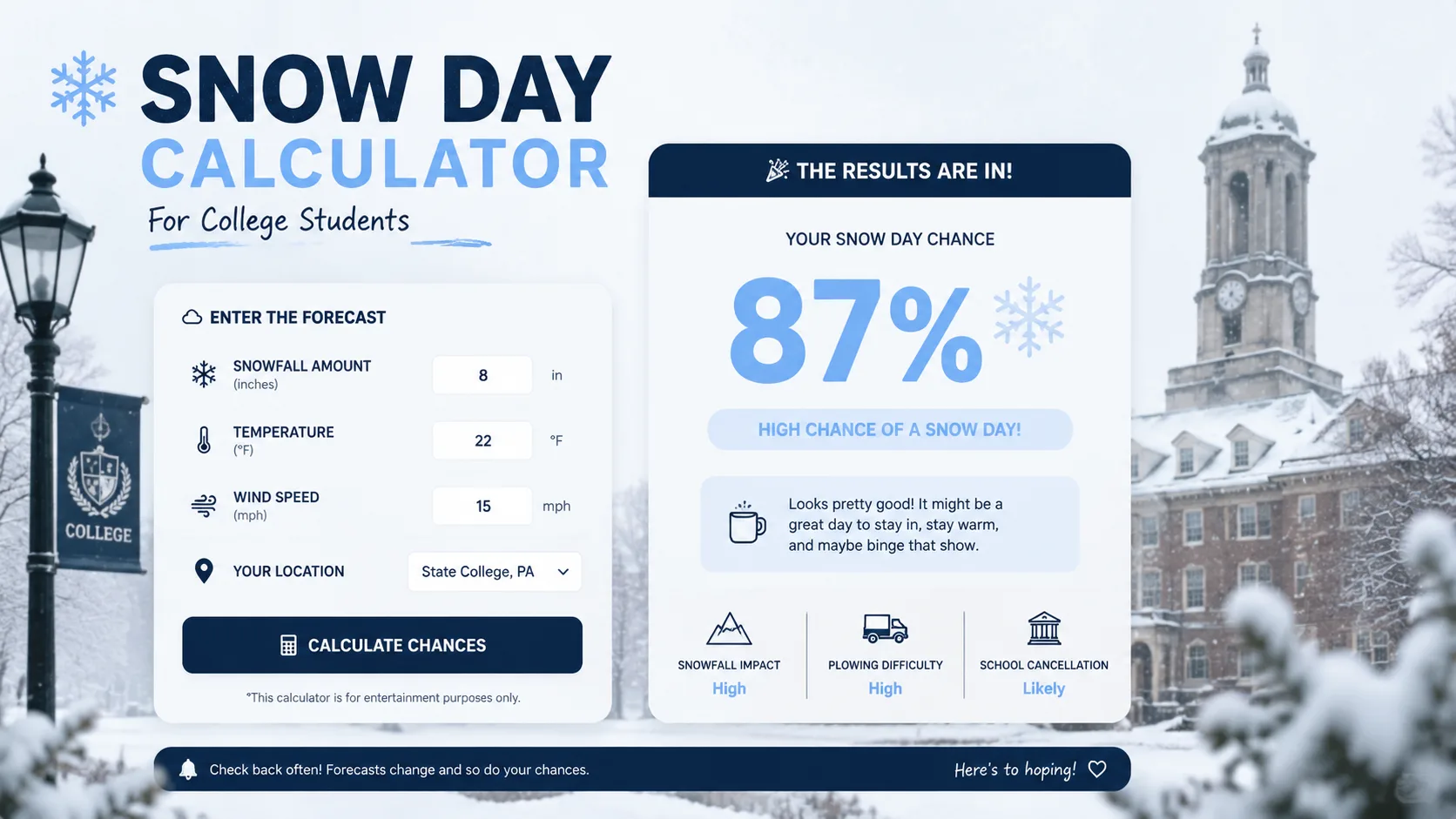
A snow day calculator for college students estimates the odds that your university will cancel or delay classes during winter weather. Unlike a basic K-12 tool, it needs to account for commuter percentages, exam schedules, and campus housing patterns, not just inches of snow. You can run your own numbers right now with our snow day calculator, then come back here to understand exactly what the percentage means.
College closures do not work like grade-school closures. Universities are large operations with dining halls, research labs, and residence halls that never fully shut down, so the threshold for cancelling class is usually higher and harder to predict from weather data alone. This guide breaks down how the calculator works, how to read your result, and the mistakes that trip up most students.
What Is a Snow Day Calculator for College Students
A snow day calculator for college students is a prediction tool that converts live weather data into a closure probability specific to higher education. It looks different from a K-12 tool because colleges weigh factors that grade schools simply do not have.
Most versions pull in:
- Forecast snowfall and timing, especially how much falls before the first class block
- Wind chill and freezing rain, which often matter more than raw snow totals
- Campus type, meaning residential versus commuter
- Academic calendar position, since finals week changes everything
- Historical closure behavior for that specific institution or region
The output is usually a percentage, a risk label like "low," "moderate," or "high," or both. That number is a probability estimate, not a promise. Only your university's administration makes the final call, and they will always confirm it through official email or a campus alert system.
How Does a Snow Day Calculator for College Students Work
A college snow day calculator works by scoring current and forecast weather conditions against known institutional behavior, then weighting that score based on campus type, academic calendar, and prior closure history. The result is a single probability that reflects both the storm and the school's tendency to cancel.
Here is what actually moves that number.
Weather Inputs
The tool starts with raw conditions for your ZIP code: expected snowfall, timing relative to your first class, wind speed, and temperature. Freezing rain and black ice typically push the probability up faster than snow alone, because ice is harder for grounds crews to manage and more dangerous for walking and driving. You can check exact conditions with our wind chill calculator if the forecast includes a cold snap alongside the snow.
Campus Type
Residential campuses, where most students live within walking distance of class, set a much higher bar for cancellation. Administrators reason that students do not need to drive anywhere. Commuter campuses and community colleges behave far more like K-12 districts, since a large share of students and staff have to navigate unplowed roads to arrive at all.
Academic Calendar Position
Colleges are notoriously reluctant to cancel during final exams or the first week of the semester. A storm that would shut down a campus in mid-October might only trigger a delayed opening during finals week, because rescheduling exams creates its own logistical headache.
Institutional History
Some schools have a documented pattern of closing early and often. Others almost never cancel, even in significant storms, because of tuition contracts, research commitments, or a simple institutional culture of staying open. A well-built calculator adjusts its baseline for each school rather than applying one national formula.
Snow Day Calculator Formula and Calculation Logic
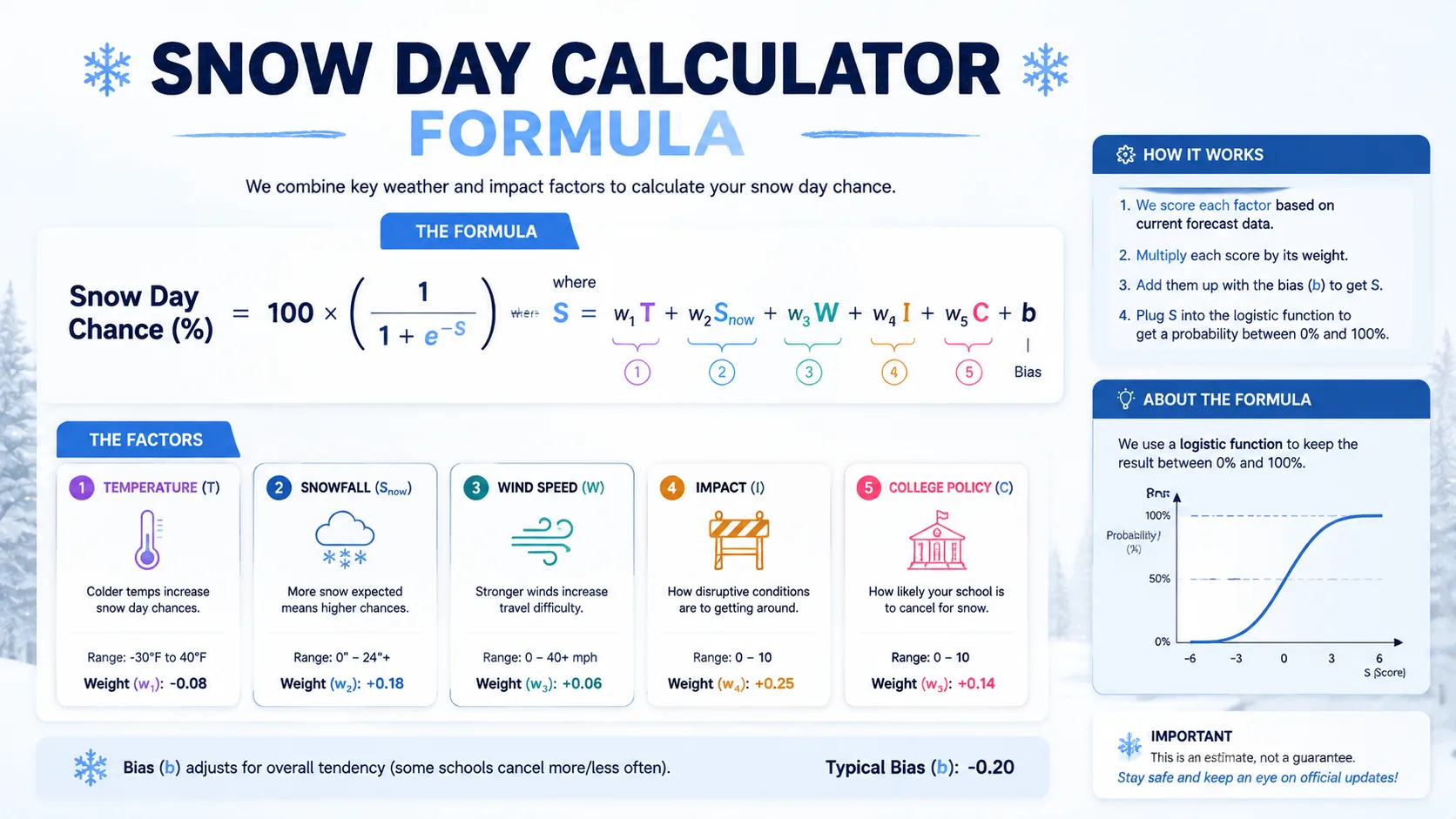
There is no single public formula that every college snow day calculator uses, and any tool that claims a secret magic number should be treated with some skepticism. What reputable tools do instead is combine several weighted variables into one blended score.
A simplified version of the logic looks like this:
- Base weather score: snowfall, wind chill, and ice are each scored on their own scale, then combined
- Timing adjustment: the score is increased if the worst conditions overlap with the morning commute window
- Campus type multiplier: commuter-heavy schools get a higher multiplier applied to the base score, residential campuses get a lower one
- Calendar adjustment: the score is reduced during exam periods and increased during regular weeks
- Historical calibration: the adjusted score is compared against that institution's past closure pattern, when that data is available
The final number you see is a probability estimate built from that stack, not a guarantee. Treat anything above roughly 70 percent as meaningful closure risk worth planning around, and anything under 30 percent as a normal school day with a small chance of a delay.
Step-by-Step Guide to Using the College Snow Day Calculator
Getting an accurate read takes less than a minute once you know what to enter.
- Enter your ZIP code or campus city. Location drives the base forecast, so use your actual campus address, not your hometown.
- Select "college" or "university" as the institution type if the tool offers that toggle. This applies the higher closure threshold instead of the K-12 model.
- Check the wind chill and ice readings, not just the snowfall total, since these often decide the outcome.
- Note your school's academic calendar position. If you are in finals week, mentally discount the percentage, since colleges rarely cancel exams.
- Compare against your campus type. Subtract roughly 15 to 25 points from the estimate if you attend a primarily residential school with most students living on campus.
- Recheck the night before and the morning of. Forecasts shift, and most tools update hourly as new data comes in.
- Confirm through official channels. Use the calculator to set expectations, then wait for your university's actual email, text alert, or website banner before treating a closure as final.
You can run through this process directly on our full calculator directory, which includes region-specific tools if your state has particularly unpredictable winter patterns.
Why Colleges Rarely Cancel Class
It helps to understand the business side of a university before trusting any percentage. Cancelling classes is not as simple as flipping a switch, and administrators weigh costs that a K-12 superintendent typically does not have to consider.
- Dining halls and residence life still have to operate every day, regardless of weather, since students living on campus still need to eat and have working utilities.
- Research labs often run experiments that cannot simply pause for a snow day, particularly in the sciences, where equipment and live samples require continuous monitoring.
- Tuition and academic contracts create pressure to hit a set number of instructional days per semester, so cancelling one class period can mean rescheduling headaches later.
- Legal and safety liability works differently for adults than for minors, which is part of why colleges assume students can make their own judgment calls about walking in moderate snow.
None of this means colleges never close. A severe enough storm, a declared state of emergency, or a dangerous wind chill warning will still push most institutions to cancel or delay class. It simply means the bar sits higher than most first-year students expect after years of K-12 snow days.
Benefits and Use Cases
Even with its limits, a snow day calculator for college students is genuinely useful in a few specific situations.
- Planning your morning routine. A high-probability reading means it is reasonable to set a backup alarm instead of your normal 6 a.m. wake-up.
- Deciding whether to leave early for an 8 a.m. class. If the calculator flags a wind chill warning during your commute window, leaving extra time or working remotely for the morning is a safer call.
- Coordinating with roommates or study groups. A shared probability number gives everyone the same baseline before deciding whether to meet in person.
- Reducing anxious checking. Instead of refreshing your email every ten minutes during a storm, one reliable number lets you check less often.
- Comparing regional risk. Our state-by-state predictions page is useful if you are choosing between schools in different climates or planning travel during a storm-prone week.
Real-World Examples With Numbers
These scenarios are illustrative composites based on common patterns across many campuses, not predictions for any specific named school.
Example 1: The residential flagship. A large public university with 85 percent of undergraduates living on campus faces a forecast of 6 inches of snow overnight, with light wind. A generic weather-only tool might show 70 percent closure odds. Adjusted for the residential campus type, the realistic figure is closer to 40 to 45 percent, since most students never have to leave their dorm.
Example 2: The commuter campus. A regional commuter college in the same storm, with over 70 percent of students driving in from surrounding counties, sees its odds climb rather than fall. The same 6-inch forecast might push the probability to 75 to 80 percent, close to what a K-12 district in that area would show.
Example 3: The finals week storm. A campus with a strong track record of closing for 4+ inches of snow faces that exact forecast, but it lands during the last week of exams. The calculator's calendar adjustment might cut the raw weather-based probability nearly in half, from around 65 percent down to the low 30s, because the school strongly prefers to avoid rescheduling exams.
Example 4: The wind chill closure with no snow. A campus in the upper Midwest sees only 1 inch of snow forecast, which alone would suggest low closure odds. However, wind chill is projected at minus 25°F during the morning commute. The wind chill component alone can push the probability above 60 percent, even though the snowfall number looks unremarkable.
Read More : Snow Day Calculator Free
Common Mistakes and Pro Tips
Most students misread these tools in one of a few predictable ways.
Common Mistakes
- Ignoring campus type entirely and treating the raw percentage as final, without adjusting for residential versus commuter status
- Checking only once, usually the night before, instead of rechecking closer to the actual commute window when forecasts firm up
- Focusing only on snowfall totals and missing wind chill or freezing rain, which frequently matter more for actual closure decisions
- Assuming a high percentage means a full closure, when a delayed opening or a partial closure affecting only early classes is far more common at the college level
- Skipping the official confirmation step and making plans based purely on the calculator, rather than waiting for the university's own alert
Pro Tips
- Read closure alerts carefully. "Classes before 10 a.m. cancelled" does not cancel your 11 a.m. lecture.
- If your local K-12 district closes and you attend a commuter college, treat that as a strong signal, since the two often track closely.
- If you attend a residential campus, mentally discount any prediction above 70 percent unless the forecast includes a declared state of emergency or a wind chill warning.
- Bookmark the calculator rather than relying on a single search each storm. Our blog also tracks seasonal patterns if you want more context before a big storm system arrives.
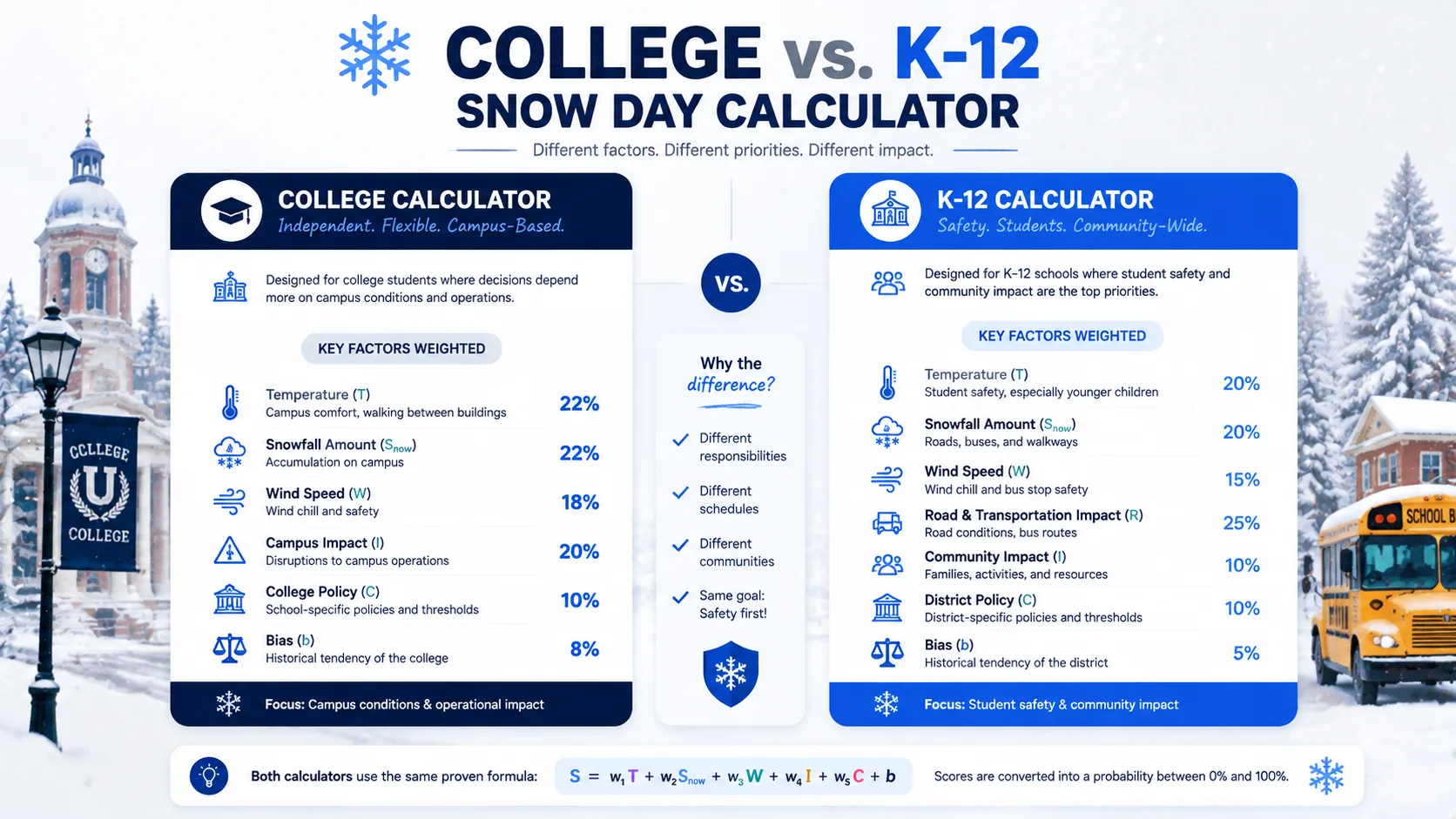
College vs. K-12 Snow Day Calculator: What's Different
The table below summarizes the biggest differences between a college-focused tool and a standard K-12 snow day calculator.
| Factor | K-12 Snow Day Calculator | College Snow Day Calculator |
|---|---|---|
| Typical snowfall trigger | 2 to 4 inches often enough | Usually 4 to 8+ inches, higher for residential campuses |
| Commute factor | Always relevant, buses and young children | Depends heavily on residential vs. commuter status |
| Exam period sensitivity | Not a major factor | Strongly reduces closure odds during finals |
| Common outcome | Full closure or two-hour delay | Partial closure, evening cancellation, or delayed opening |
| Wind chill weighting | High, due to bus stop exposure | High, due to longer outdoor walk times between buildings |
If you want to see how these differences play out in your own region, our homepage calculator lets you toggle between K-12 and college modes for a direct side-by-side comparison.
Regional Differences in College Snow Day Thresholds
Where your campus sits on the map changes the entire calculation. A calculator that does not adjust for region is guessing, because the same storm means something very different depending on how prepared a school and its surrounding community are for winter weather.
Cold-Climate, Storm-Prepared Regions
Campuses in the Great Lakes region, the interior Northeast, and much of the upper Midwest deal with frequent snow and invest heavily in plows, salt trucks, and grounds crews. These schools typically need 8 or more inches, a declared state of emergency, or an extreme wind chill warning before cancelling class. A routine 4-inch storm barely moves the needle here.
Moderate-Snow Regions
Mid-Atlantic and parts of the Midwest see periodic winter storms but do not have year-round infrastructure built around them. Colleges in these areas tend to close in the 4 to 8 inch range, especially when ice accompanies the snowfall or the storm arrives during the morning commute.
Low-Snow-Tolerance Regions
Campuses in the South, coastal areas, and parts of the Pacific Northwest often lack the equipment and road-treatment infrastructure to handle winter weather safely. Even 1 to 3 inches of snow, or a thin coating of ice, can be enough to shut down an entire campus for a day or more, since untreated roads and hills become genuinely hazardous.
Because thresholds vary this much by geography, checking a national average is far less useful than checking a regional or campus-specific estimate. Our state-by-state predictions page breaks these thresholds down further if you want to compare your school against others in a similar climate zone.
What Campus Contributors Say
"The single most common mistake we see is students reading a college percentage the exact same way they read a K-12 one," says Maya Chen, campus weather data contributor at The Snow Day Calculators. "A 70 percent reading at a residential flagship and a 70 percent reading at a commuter college represent two very different realities on the ground."
"Wind chill gets overlooked constantly," adds Jordan Reyes, a former campus operations coordinator who now advises on the site's closure modeling. "Students fixate on the snow total in the forecast and miss that a minus 20-degree wind chill during the walk between buildings is often the real safety trigger for administrators."
Conclusion
A snow day calculator for college students works best when you understand what it is actually weighing: forecast weather, your campus type, the academic calendar, and your school's own closure history. Treat the percentage as a starting point, adjust it based on whether you commute or live on campus, and always confirm with your university's official alert before changing your plans. Try the calculator above to see your current odds, and check back as the forecast updates closer to your commute window.