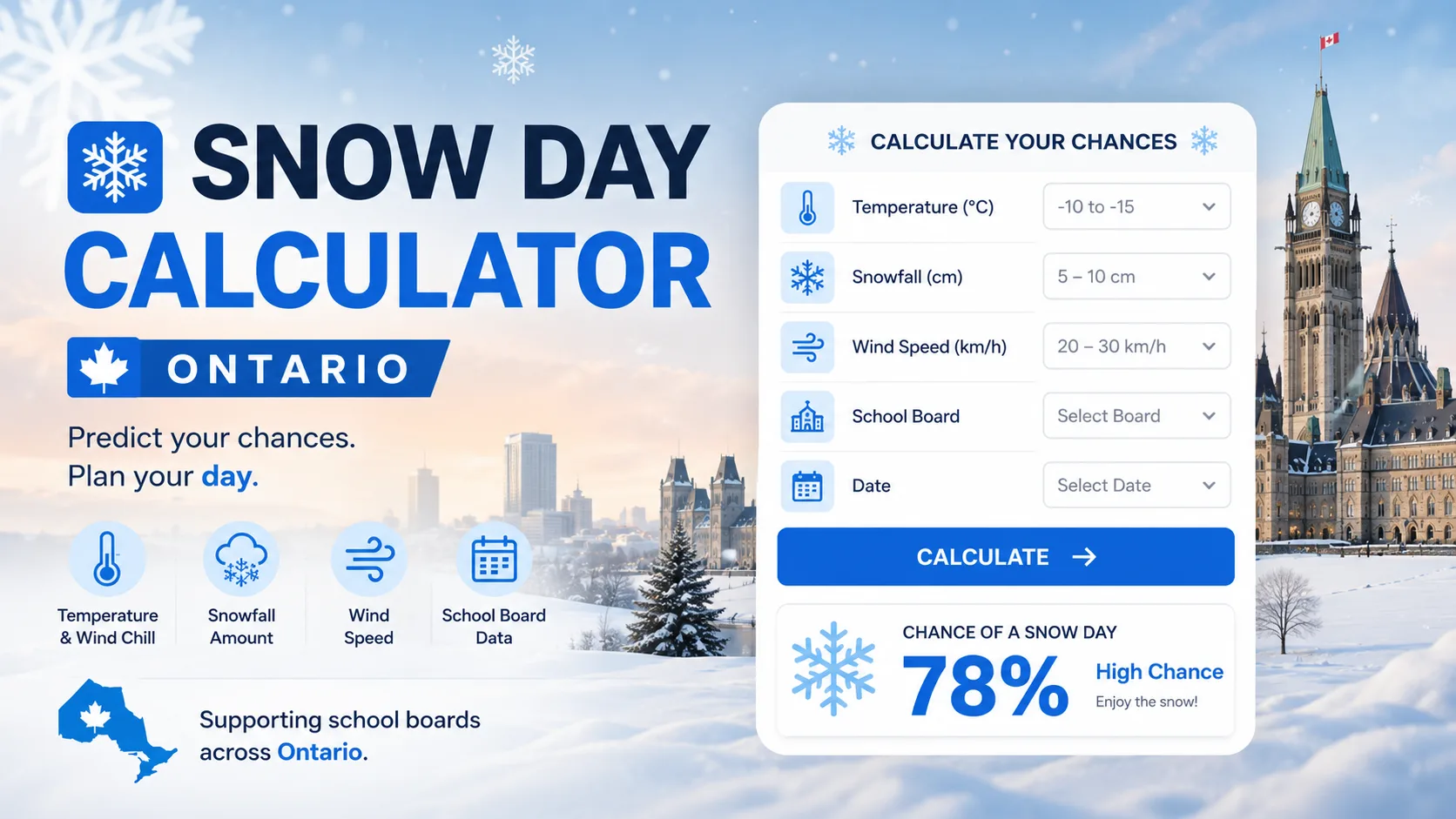
If you have ever refreshed the weather app at 11 p.m. hoping for a snow day calculator Ontario result that says "closed," you are not alone. Every winter, thousands of Ontario parents, students and teachers try to guess whether school will be cancelled before their local board even makes the call.
This guide explains exactly how a snow day calculator works, what Ontario boards like the TDSB, TCDSB, Peel and Halton actually look at, and how you can use a calculator plus real board data to get the most accurate picture possible, without needing to check five different apps at once.
What Is a Snow Day Calculator (Ontario)?
A snow day calculator Ontario tool is a weather-based predictor that estimates the likelihood schools or school buses will be cancelled due to snow, ice or extreme cold. It takes forecast data from sources like Environment Canada and runs it through a scoring model built around how Canadian school boards historically respond to winter storms.
Unlike a plain weather forecast, a snow day calculator does not just tell you how much snow is coming. It tries to translate that forecast into an answer to the question every parent actually wants answered: is my kid's school going to be closed tomorrow?
Most tools present the result as a percentage, for example "72% chance of a snow day in Barrie," rather than a simple yes or no, because closure decisions depend on so many local factors.
Why Snow Day Calculators Became So Popular in Canada
The idea of predicting a snow day online is not new. It traces back to an early snow day predictor built by a student named David Sukhin in 2007, which turned into a small internet trend across North American schools. Canadian versions eventually followed, adapted for provinces like Ontario, Quebec, British Columbia and Alberta, each with different closure habits.
Ontario adoption grew quickly because the province is genuinely inconsistent when it comes to winter weather response. Southern cities like Windsor rarely see closures, while snow belt communities near Georgian Bay can lose several school days in a single winter. A generic weather app cannot capture that difference, but a calculator built specifically around Ontario boards can get much closer.
Today, a snow day calculator Ontario search brings up tools built for specific boards such as the TDSB, OCDSB, Peel and Simcoe County, along with province-wide tools that let you switch between cities like Toronto, Ottawa, Barrie, Hamilton, London and Windsor.
How Does a Snow Day Calculator Work in Ontario?
Behind the scenes, a snow day calculator combines several weather inputs with regional calibration. Ontario is treated differently from, say, Texas or upstate New York, because Canadian boards are used to routine winter weather and only cancel school for conditions that genuinely threaten road and bus safety.
Key Factors Ontario Boards Actually Consider
- Snowfall accumulation total centimetres expected overnight and during the morning commute.
- Timing of the storm snow that peaks during bus pickup hours matters more than snow that falls overnight and stops by 5 a.m.
- Wind chill and extreme cold some boards, like Halton District School Board, apply special indoor-recess rules once wind chill hits -20°C, and extreme cold alone can trigger bus cancellations.
- Freezing rain and ice often more disruptive than snow, since ice on roads and sidewalks is harder for buses and pedestrians to manage safely.
- Road and route safety rural and semi-rural routes with long, exposed stretches of highway are cancelled far more often than short urban routes.
- Visibility blowing snow that cuts visibility on highways is treated as seriously as raw snowfall totals.
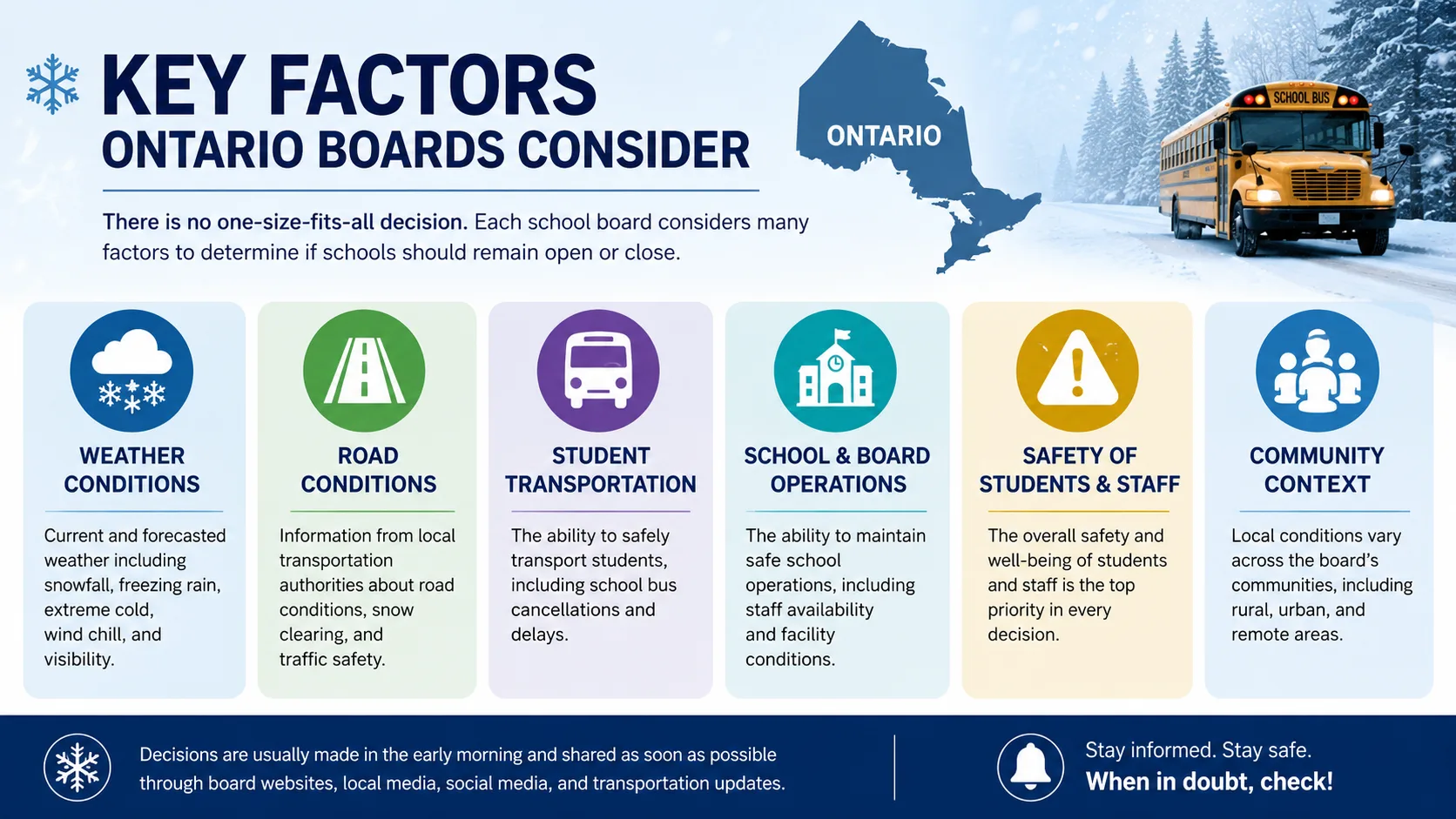
The Snow Day Probability Formula (Simplified)
Most public calculators use a weighted point system rather than a single fixed formula, but the general logic looks like this:
| Factor | Approximate Weight | Trigger Point |
|---|---|---|
| Snowfall accumulation | Up to 60% | 20+ cm overnight = high impact |
| Temperature / wind chill | Up to 25% | Below -18°C to -20°C |
| Timing (rush-hour overlap) | Up to 10% | Peak snowfall 5–8 a.m. |
| Freezing rain / ice risk | Up to 5%+ | Any freezing rain warning |
The scores are added together and capped at 100%, giving you a single probability. This is a helpful starting point, but it is a simplified public version of what school boards actually decide, since boards also weigh things like driver availability, plow coverage and staff attendance that a calculator cannot see.
How Ontario School Boards Really Decide on Snow Days
Every Ontario board runs its own process, which is exactly why a single snow day calculator can never be 100% precise on its own. Here is how some of the largest boards actually operate.
| School Board | Decision Time | Typical Approach |
|---|---|---|
| Toronto District School Board (TDSB) | ~6:00 a.m. | Director-led team reviews forecast and roads; buses cancelled more often than full closures. |
| Toronto Catholic District School Board (TCDSB) | ~6:00 a.m. | Monitors Environment Canada alerts overnight with the Toronto Student Transportation Group. |
| Peel District School Board (PDSB) | ~6:15 a.m. | Uses "weather zones"; a cancelled route only affects schools inside that specific zone. |
| Halton District School Board (HDSB) | ~6:30 a.m. | Applies a -20°C wind chill indoor rule; separate calls for transportation vs. full closure. |
| York Region District School Board (YRDSB) | ~6:00 a.m. | All buses and specialized vehicles cancelled together for the full day when triggered. |
| Durham District School Board (DDSB) | Early morning | Bus routes may be cancelled while schools themselves stay open. |
Notice the pattern: a bus cancellation is not the same thing as a school closure. Full closures are relatively rare across Ontario and are typically reserved for genuinely dangerous conditions, such as major winter storms, blizzard warnings or ice storms.
What Happens When Schools Actually Close
When an Ontario board does move to a full closure, it usually affects more than just the school day itself. Both in-person classes and remote e-learning support are typically paused, since staff also need to manage the same weather conditions on their own commutes.
This is different from a bus-only cancellation day, where in-person and e-learning classes continue as scheduled for anyone who can safely get to school. Understanding this distinction matters, because a high snow day calculator percentage often reflects the chance of a bus cancellation, not necessarily a full closure.
Rural Versus Urban: Why the Same Storm Hits Differently
Two students in the same Ontario city can have completely different snow day odds depending on where their route sits. Rural and semi-rural bus routes cover long stretches of highway with less consistent plowing, so they are cancelled at lower snowfall thresholds than short urban routes through a dense downtown core.
This is also why province-wide predictions are risky. A generic "Ontario" percentage will always be less accurate than one calibrated to your specific board and, ideally, your specific bus zone, especially for boards like Peel that officially split cancellations into separate weather zones.
How to Use a Snow Day Calculator for Ontario
Using a snow day calculator correctly takes less than a minute. Follow these steps for the most accurate read on your local chances.
- Enter your city or postal code. Ontario results vary a lot between regions, so always use your specific town rather than "Ontario" broadly.
- Check the forecast window. Look at the overnight-to-morning snowfall total, since that is the window that matters most for bus and road decisions.
- Note the temperature and wind chill. Extreme cold alone can cancel buses even without heavy snow.
- Read the probability, not just the label. A 55% chance is meaningfully different from an 85% chance, even if both round to "likely."
- Recheck early the next morning. Forecasts shift overnight, and most boards do not confirm anything until 6:00–6:30 a.m.
- Confirm with your board's official channel. Treat the calculator as your early warning system, and your board's website or app as the final word.
Real-Life Examples With Calculations
Here is how the scoring logic plays out with real winter scenarios.
Example 1: Toronto, Light Urban Snowfall
- Forecast: 8 cm overnight, temperature -6°C, no wind chill warning
- Snowfall score: 20/60
- Temperature score: 5/25
- Timing score: 3/10 (snow tapering off before rush hour)
- Estimated probability: around 25 to 30%, likely a bus delay at most, schools open
Example 2: Barrie, Lake-Effect Snow Squall
- Forecast: 25 cm localized snow squall, temperature -12°C, low visibility
- Snowfall score: 58/60
- Temperature score: 14/25
- Timing score: 9/10 (heaviest snow during morning commute)
- Estimated probability: 80 to 90%, buses very likely cancelled, possible full closure
Example 3: Ottawa, Extreme Cold Without Heavy Snow
- Forecast: 3 cm snow, wind chill of -32°C
- Snowfall score: 8/60
- Temperature score: 24/25 (extreme cold trigger)
- Timing score: 5/10
- Estimated probability: 55 to 65%, cold-related bus cancellation is realistic even with minimal snow
Example 4: Windsor, Freezing Rain Instead of Snow
- Forecast: 2 cm snow mixed with freezing rain, temperature -2°C
- Snowfall score: 6/60
- Temperature score: 3/25
- Freezing rain bonus: high, since ice is treated as a serious safety risk on its own
- Estimated probability: 45 to 55%, despite a very low snowfall total
These examples show why raw snowfall totals alone are misleading. A calculator that only counts centimetres will miss extreme-cold cancellations and freezing rain risk entirely, which is exactly the kind of gap a good snow day calculator Ontario tool needs to account for.
Read More : Snow Day Calculator Michigan
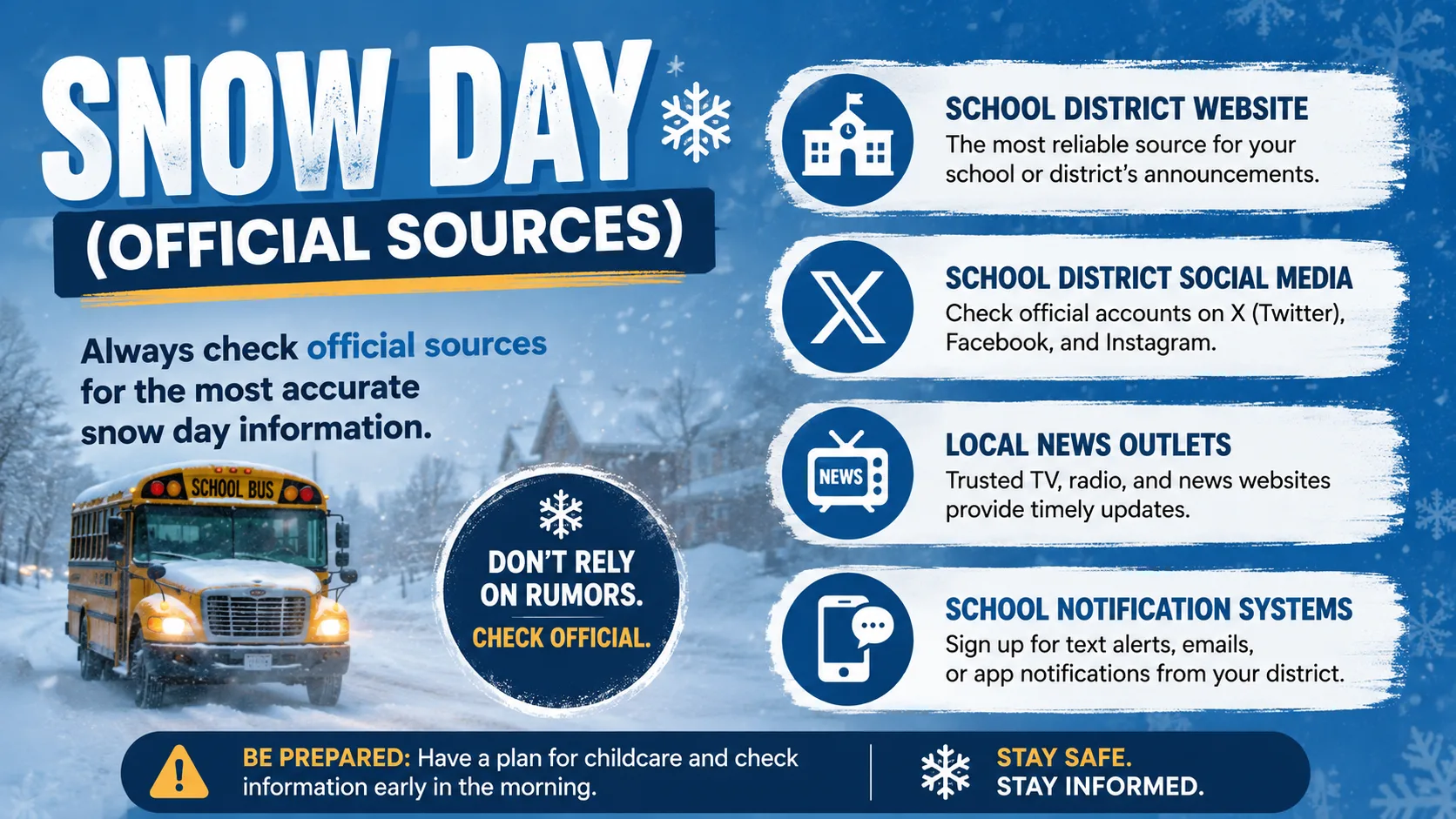
Where to Verify a Snow Day (Official Sources)
A calculator is a planning tool, not the final word. For the most reliable confirmation, always cross-check with official sources alongside your prediction:
- Environment and Climate Change Canada for live winter storm warnings, snowfall totals and freezing rain alerts in your region.
- Your school board's official website, such as the TDSB, TCDSB, Peel, Halton, York Region or Durham severe weather pages, which post the confirmed decision each morning.
- Your board's transportation consortium, for example the Toronto Student Transportation Group, which manages bus cancellations across multiple boards at once.
- Board social media and SchoolMessenger-style alert systems, which many families rely on for the fastest real-time notification.
Using a calculator alongside these official channels gives you the best of both worlds: an early heads-up the night before, and a confirmed answer once your board actually makes its call.
Benefits and Use Cases
A snow day calculator is genuinely useful for more people than just students hoping for a day off. Here is how different groups get value from checking one before a storm.
- Parents can line up backup childcare, rearrange work meetings or shift a work-from-home day the night before, instead of scrambling once a 6 a.m. announcement lands.
- Students get a realistic sense of whether it is worth finishing tonight's homework or studying for tomorrow's test, without relying on rumours from group chats.
- Teachers and education staff can decide in advance whether to prep an in-person lesson plan or have e-learning materials ready to go.
- Bus drivers and rural families get an early warning for routes that are historically cancelled first, especially in townships with long, exposed highway stretches.
- Commuters managing school drop-offs and pickups can plan alternate routes or leave earlier around likely road closures and reduced visibility.
- Small business owners and daycare operators near schools can anticipate lower foot traffic or higher demand for emergency childcare on high-probability days.
Even when the prediction turns out to be wrong, the planning benefit remains. Knowing there is a 70% chance of disruption is still more useful than being caught off guard at 6:15 a.m. with no backup plan.
Common Mistakes to Avoid
- Assuming a bus cancellation means school is closed. In most Ontario boards, schools stay open even when buses are cancelled.
- Ignoring wind chill. Extreme cold cancels buses just as often as heavy snow, especially in Eastern and Northern Ontario.
- Comparing your town to Toronto. A calculator tuned for downtown Toronto will underestimate risk in Barrie, rural Simcoe or Eastern Ontario.
- Checking only the night before. Forecasts change quickly; always recheck close to 6 a.m.
- Treating the calculator as an official source. Only your board's website, app or social media confirms a real closure.
Pro Tips for the Most Accurate Results
- Bookmark your specific school board's snow day or transportation page for instant confirmation.
- Sign up for board text or email alerts so you are not relying on the calculator alone.
- Check both the snowfall total and the wind chill reading, not just one number.
- If you live on a rural route, expect bus cancellations to come more often and more easily than full school closures.
Conclusion
A snow day calculator Ontario tool will not replace your school board's official announcement, but it gives you a genuine head start. By understanding the real factors, snowfall, wind chill, storm timing and your board's specific policy, you can read a probability score with far more confidence than simply guessing from the weather app.
Use the calculator the night before a storm to plan ahead, recheck it close to 6 a.m., and always confirm with your board's official channel before making final decisions for your family. Stay warm, stay safe, and check back all winter for updated Ontario snow day odds.
Also Checkout :