Snow day activities for kids are the difference between a chaotic, screen-addicted day and a memory your child will talk about for years. Whether you have a spirited toddler, a curious 8-year-old, or a creative tween at home, this guide has age-appropriate, research-backed ideas for every energy level and every inch of your home and yard.
The text alert hits your phone at 6 a.m.: school's closed. Five minutes later, your kids are downstairs in their pajamas, already asking "what are we doing today?" and you have absolutely no plan.
Here's the good news: a snow day doesn't have to turn into eight hours of tablet time and sibling squabbles. With a little structure, it can be one of those days your kids actually bring up years later "remember when we built that fort and made snow ice cream?"
This guide pulls together 75+ snow day activities for kids, sorted by age and energy level, so you're not scrambling to fill hours. We've covered outdoor play, indoor crafts, hands-on science, baking projects, and a few ideas built for how families actually plan snow days in 2026 including how to know a snow day is coming before it's announced.
Before you start planning, it helps to know whether school is actually closing. If you're not sure yet, run your zip code through our Snow Day Calculator to get a quick prediction based on your local forecast it saves you from prepping a whole day of activities only to find out school's on a two-hour delay.
Why Snow Day Activities Actually Matter
It's tempting to treat a snow day as a scheduling problem to survive rather than an opportunity. Doctors who work with kids and people who study how children grow have been saying for years that free play. Especially when its outside. Helps kids in real ways with their bodies and their brains.
Playing in weather helps build big movement skills because it takes more effort to move around: walking through snow pulling a sled making a snowball all take more work than just walking in the yard. It also helps get rid of the energy that can make kids upset at 3 o'clock if they don't have a way to burn it off.
There's a mental side to it too. Kids who get regular unstructured outdoor time tend to self-report calmer moods and better focus afterward something most parents notice anecdotally long before they read a study confirming it. A quiet, snow-covered yard is about as low-stimulation and calming an environment as you'll find, which is exactly what an overstimulated kid sometimes needs.
And academically, a snow day isn't necessarily a "lost" day. Kids who get regular free play tend to do just as well sometimes better than kids whose days are wall-to-wall structured. A well-run snow day, mixing movement, creativity, and a little science, can accomplish in six hours what a packed classroom schedule takes a week to do.
How to Actually Structure the Day
Before diving into the activity list, a quick word on pacing this is the part most snow day guides skip, and it's the part that actually saves your sanity.
- Start outside, early. Fresh snow and full energy tanks pair well together. Get the big physical activity out of the way before lunch.
- Build in a warm-up break. After 30–45 minutes outside, everyone comes in for cocoa and dry socks, whether they ask for it or not.
- Alternate energy levels. Follow an active outdoor stretch with something quiet a craft, a book, a baking project.
- Set up 2 to 3 places in the house where kids can move from one to another by themselves. This helps stop the "I'm bored" feeling a lot.
- Save screens for a genuine lull, not as the default. An hour of downtime screen time after a full day of play hits differently than screens from 8 a.m. onward.
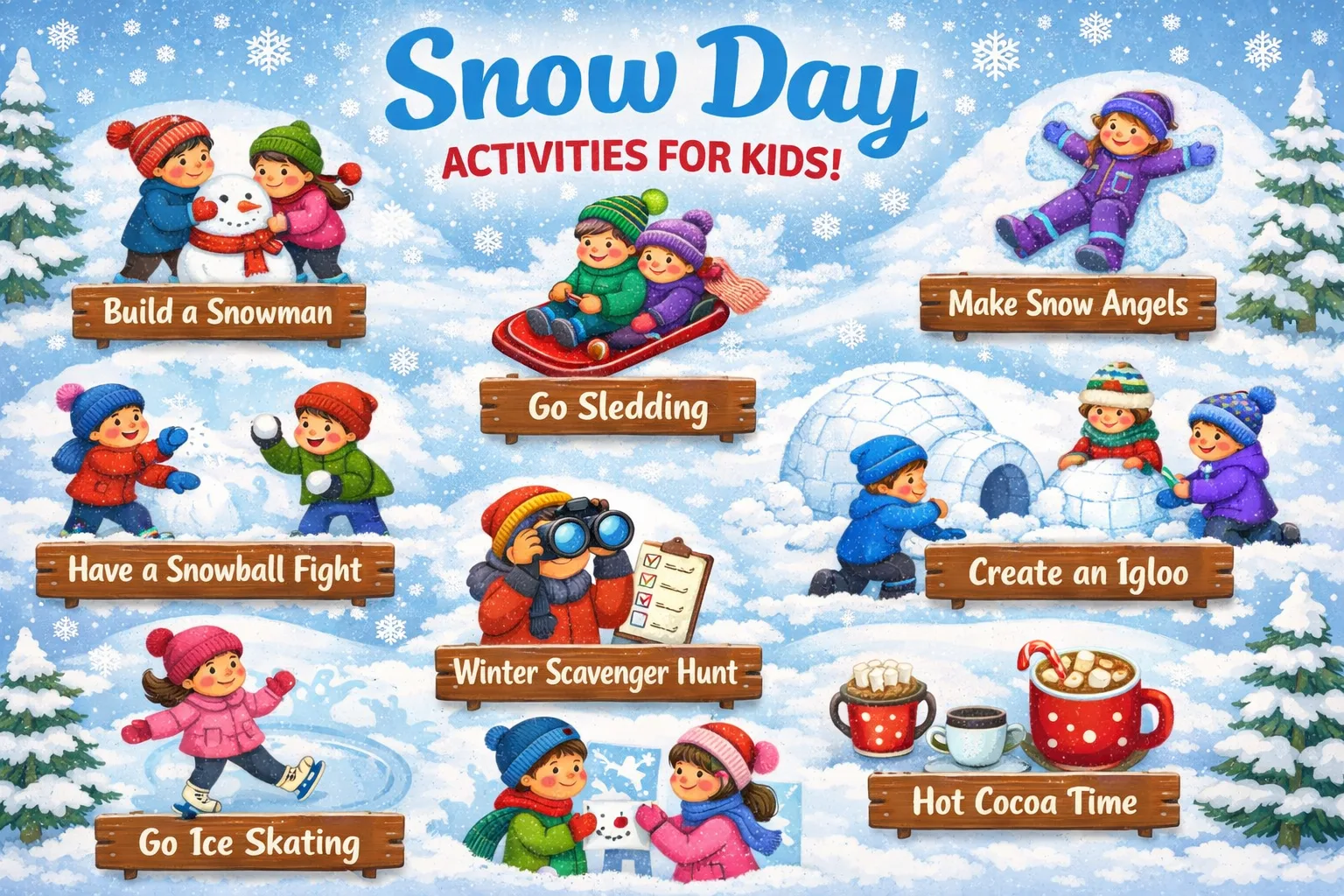
Outdoor Snow Day Activities for Kids
Getting kids outside even for 30 minutes pays off. Dress them in waterproof layers, with one more layer than you'd wear yourself; kids lose body heat faster than adults do. Then let them loose.
Classic Snow Builds
- Make a snow creature, not a snowman. Ask the kids to build a snow dinosaur, a snow cat or a "snow dragon" with a tail made from a stick and pinecones. Using things from nature. Like berries, pieces of bark and sticks. Makes it feel more special than the snowman made of three balls.
- Snow fort construction. Packing snow into brick shapes (an empty shoebox or a loaf pan works well) teaches planning and spatial reasoning better than almost any indoor activity. Add sticks and a tarp for a roof.
- Snow angel photo gallery. Make a whole lineup of snow angels, then photograph them from above a porch, a step stool, or a second-floor window works. Print them in black and white. Let the kids add hair, faces and clothes with markers later.
- Snow. Quinzhee (for older kids). Pile up a pile of snow let it sit for about two hours so it gets hard then dig it out. It takes time it is a workout and it is the kind of thing that becomes a story that a family tells for years.
Active Snow Games
- Snowball target practice. Line up empty bottles or cardboard at different distances and let kids compete for accuracy.
- Snow obstacle course. Piles to jump, mounds to crawl under, a path to hop through. Time each kid and let them chase their own personal best.
- Long jump in the snow. Draw a start line and measure jumps by footprint. Simple, and surprisingly competitive.
- Snow hot potato. Pack one firm snowball, pass it around a circle to music, and whoever's holding it when the music stops is out.
- Sledding relay race. Two teams, one sled, a gentle slope race down and tag the next teammate.
- Sled tug-of-war. Tie two sleds together with a rope. Have two groups pull in opposite directions. It's silly. Everyone ends up laughing in the snow.
Creative Outdoor Snow Art
- Snow painting. Fill spray bottles with water. A few drops of color and let kids paint on the snow. It is good for learning about mixing colors and using muscles and it looks great in pictures.
- Snow maze. Stomp or shovel a winding path into fresh snow younger kids navigate it, older kids can design one and challenge a sibling to solve it.
- Track detective. Look for animal or bird tracks in the fresh snow and turn it into a story whose tracks are these, and where were they headed?
- Ice lanterns. Fill a balloon with water let it freeze outside then take off the balloon and put a small light inside. It is a way to light up the night and it costs nothing.
A few safety tips for weather that are important to remember: wear warm clothes that keep water out take a break to warm up every 30 to 45 minutes stay away from roads and open water when sledding and change into dry clothes as soon as kids come inside. Wet clothes take away body heat quickly even if it doesn't feel that cold.
Indoor Snow Day Activities for Kids
Once everyone's warmed up or if it's simply too cold or icy to stay out long these indoor activities keep the momentum going without defaulting to screens.
Crafts and Art Projects
- Paper snowflake cutting. Fold coffee filters or square paper and snip patterns every one comes out different. Tape them to a window for a nice light effect.
- Handprint winter art. Turn handprints into penguins, polar bears, or snowmen on cardstock. Write the date and age on the back these are the keepsakes grandparents actually keep.
- Puffy paint snowman. Mix shaving cream with glue to make a paint that feels different and dries with a raised snow-like surface.
- Watercolor snow scenes. Paint on paper then sprinkle salt on the wet paint to make it look like frost. It looks much better than the work it takes.
- Sock puppet theater. Use socks that don't match to make winter characters then have the kids write and act out a short play. It is a way to practice talking and telling stories.
Blanket Fort Headquarters
A well-built blanket fort still beats most store-bought entertainment. Use cushions, chairs and sheets to make a nice "base " then give it a theme. Like an arctic research center a polar bear cave or a secret snow lab.
-
Give them missions: draw a map of the "area " write a report. Draw imaginary animals they find along the way.
- Add string lights and a speaker with sounds to make it feel right.
- Put in flashlights, books and a snack plate so no one has to leave for an hour.
Indoor Games and Movement
- Indoor snowball fight. Roll up white socks into balls, split into teams, and battle across a taped center line. Whoever has fewer "snowballs" on their side when the timer goes off wins.
- Painter's tape obstacle course. Tape out a hopscotch grid, balance beam, and jump zones right on the floor zero equipment needed.
- Freeze dance, winter edition. Play winter songs. When the music stops everyone freezes in a snowman pose.
- Minute-to-win-it games. Stack marshmallows, balance a cotton ball on a spoon move "snowballs" (which are cotton balls) using only a straw.
- Snow day bingo. Make custom cards with activities, treats, or sounds and check them off as the day unfolds.
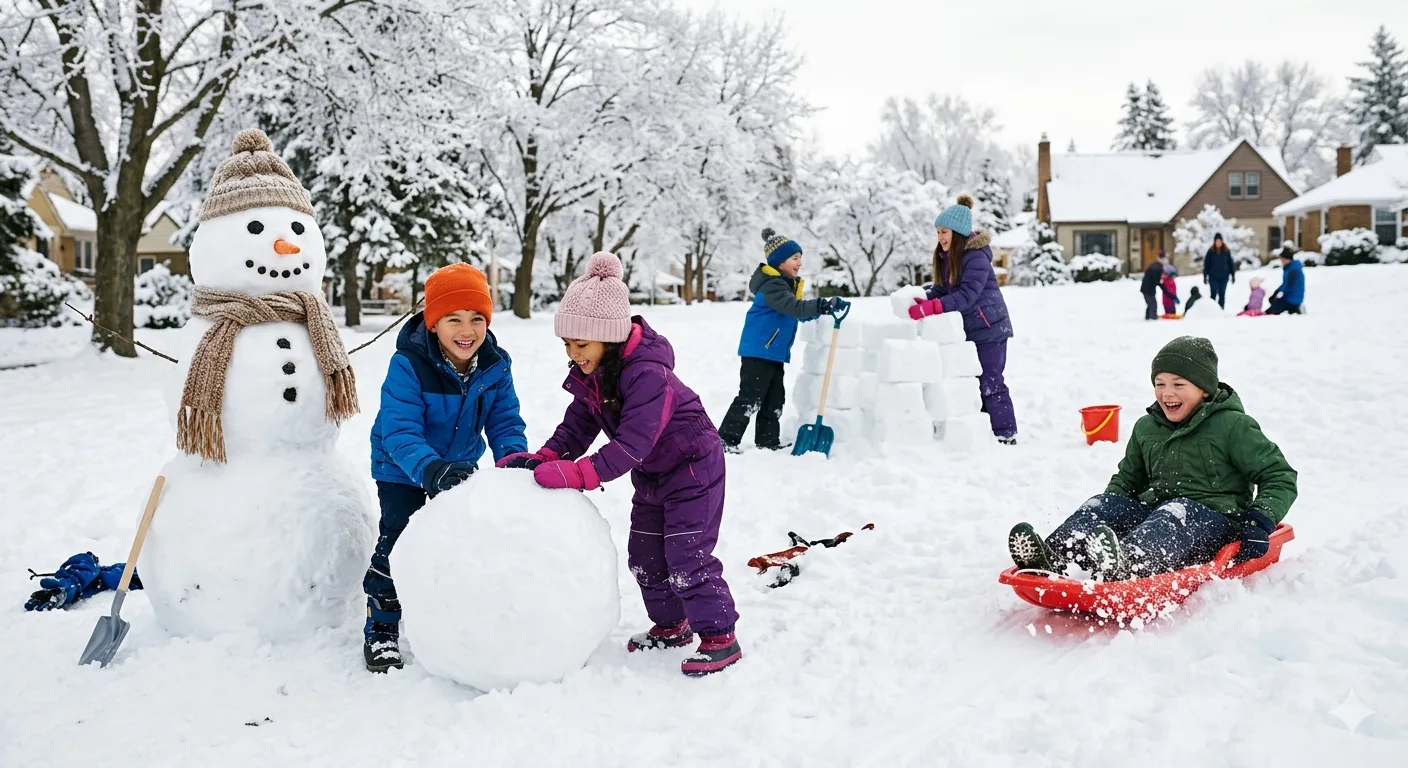
Snow Day STEM Activities for Kids (By Age)
Snow is one of the best free science labs a kid will ever get access to. These are grouped by age so you can grab something that actually matches your kid's attention span.
Ages 3–6: Beginner Snow Science
- Watch snow melt. Bring a bowl of snow inside, ask "what do you think will happen?", and time how long it takes. An easy first lesson in states of matter.
- Sink or float. Drop objects into a tub of water, then add ice. Does it float? Why? Let the questions lead.
- Snowflake catching. Catch flakes on dark paper or cold black felt and examine them with a magnifying glass before they disappear.
- Oobleck "snowman." Mix. Water (about two parts cornstarch to one part water) with a little white food coloring for a squishy fun activity that toddlers can play with for a long time.
Ages 7–12: Intermediate Experiments
- Grow crystal snowflakes. Twist a pipe cleaner into a six-pointed shape, suspend it in a jar of hot water saturated with borax, and check back in 24 hours. Genuinely stunning results for very little effort.
- Snow density lab. Fill identical cups with snow from different spots fluffy versus packed melt them, and compare water levels. A simple, visual lesson in density.
- Freeze race. Set out small cups of water, juice, milk, and salt water outside or in the freezer, then check hourly to see what freezes first and why.
- Build a snow insulator. Wrap one ice cube in a snow "cocoon" and leave another exposed. Whichever melts slower demonstrates why igloos actually work.
Ages 10+: Advanced Challenges
- Engineer a snow bridge. Build a small bridge from sticks and string, then test how much weight it holds before it fails an easy intro to load-bearing structures.
- Weather station journal. Track temperature, snowfall depth, cloud cover, and wind direction through the day. Builds real observational discipline.
- Homemade barometer. A jar, a balloon, and a straw can track air pressure shifts as the storm moves through a surprisingly accurate little instrument.
Snow Day Cooking and Baking Projects
Cooking together checks a lot of boxes at once measuring builds math skills, heat and reactions build science understanding, and everyone gets to eat the results.
No-Bake Treats
- Snow ice cream. Mix 8 cups of clean, fresh snow with 1 cup whole milk, ½ cup sugar, and 1 teaspoon vanilla. Stir until it reaches ice cream consistency and serve right away this one never fails to be a hit.
- Hot cocoa bar. Set out mugs, a pot of hot chocolate, and toppings marshmallows, crushed candy cane, cinnamon, whipped cream. Let each kid build their own mug.
- Frozen fruit popsicles. Pour juice or a smoothie into ice cube trays or popsicle molds and set them outside to freeze a built-in lesson on freezing points.
Baking Projects
- Snowman sugar cookies. Decorate with frosting, candy eyes and pretzel stick arms. Turn it into a decorating contest.
- Homemade bread. A simple bread made with yeast fills the house with a smell for hours and quietly teaches about how bread is made and how it works.
- Winter spiced granola. Oats, honey, cinnamon, ginger and nuts baked slowly. It is easy, healthy and something kids will actually eat because they made it.
Educational Snow Day Activities (That Don't Feel Like School)
Literacy and Writing
- Write a snow day story. Prompt: "A snowflake lands on the nose of a sleeping bear. What happens next?" Add chapters, illustrations, a cover page.
- Winter would-you-rather journal. "Would you rather be a polar bear or a penguin, and why?" is opinion writing in disguise.
- Letter to future self. Have kids describe the day what they did, how they felt seal it, and open it in five years.
- Design a newspaper front page. "The Big Blizzard of 2026" headlines, articles, illustrations, the whole layout.
Math and Logic
- Snowflake symmetry art. Fold and cut paper snowflakes, then identify lines of symmetry younger kids count points, older kids calculate angles.
- Measure the snowfall. Use a ruler at a few spots around the yard, average the results, and graph the depth over the day.
- Strategy board games. Chess, Scrabble, Uno genuinely good for pattern recognition and focus, and nobody needs convincing to play.
Snow Day Activities by Age: Quick Reference
| Age Group | Best Outdoor Activities | Best Indoor Activities | Best STEM/Learning |
|---|---|---|---|
| Toddlers (2–4) | Snow angels, sensory snow play, short sled rides with a parent | Playdough snowmen, sensory bins, handprint art | Watching snow melt, oobleck play |
| Preschool (4–6) | Snowball targets, snow painting, snowman building | Blanket forts, paper snowflake cutting, cookie decorating | Snowflake catching with a magnifier, freeze/melt experiments |
| Elementary (6–10) | Snow fort, sled races, obstacle courses | Sock puppet theater, indoor snowball fight, board games | Crystal snowflakes, snow density lab, weather journaling |
| Tweens (10–13) | Quinzhee building, snow sculpture contests, photography | Baking projects, creative writing, building challenges | Weather station, bridge engineering |
| Teens (13+) | Snowshoeing, skiing, ice skating, shoveling for the neighbors | Ambitious cooking, filming a short project, learning a new skill | Independent research project, an online course, advanced experiments |
Virtual and Hybrid Snow Days in 2026
Plenty of districts now treat snow days as remote learning days rather than true closures, which puts parents in the odd spot of managing schoolwork and snow-day fun in the same afternoon. A few ideas that work well alongside a lighter virtual school load:
- Winter writing prompts for a quick, low-effort creative writing block between classes.
- Virtual museum tours a winter-themed art walk or a look at polar research through a museum's online collection.
- Beginner coding with a winter theme building a simple snowstorm animation or a snowman game is a fun way to pair screen time with actual skill-building.
- A documentary afternoon on Arctic wildlife or mountain expeditions, followed by a discussion or a drawing session.
And if there's any doubt about whether tomorrow will bring another one, it's worth checking a snow day prediction the night before so you can actually plan around it instead of guessing.
Read More : How Do Schools Decide to Cancel School?
Snow Day Survival Tips for Parents
Snow days are, honestly, harder on parents than they are on kids. A few things that make the day easier to manage:
- Sketch a loose schedule. Outdoor time, snack, craft, lunch, free play, movie a rough shape prevents the "I'm bored" spiral without feeling like a school day.
- Set up a few activity stations. Two or three stations around the house give kids autonomy and cut down on needing you to referee every five minutes.
- Let the mess happen. Snow day crafts are messy by nature. A tablecloth and a plan to clean up together at the end goes a long way.
- Use an earn-your-screen-time system. One activity or project earns 30 minutes of screen time. Kids stay engaged, and you get a genuine break.
- Prep the night before. If snow's in the forecast, pull together craft supplies, baking ingredients, and game pieces so you wake up ready instead of scrambling.
Your Snow Day Success Checklist
- Get outside for at least 30–60 minutes even brief cold-air exposure has real benefits.
- Rotate between active, creative, and learning activities to keep energy and boredom in check.
- Use the snow itself as a free science lab it's endlessly interesting and right outside the door.
- Cook or bake something together at least once it builds real skills and a little pride.
- Capture the day in photos or writing these are the memories kids bring up years later.
- Check the forecast the night before with a quick snow day calculator so you can prep with confidence instead of guessing.
Final Thoughts
Snow day activities for kids don't need to be elaborate, expensive, or Pinterest-perfect to work. The best ones usually come down to something simple: the smell of cookies baking, the crunch of fresh snow underfoot, a blanket fort that took longer to build than expected, and a parent who decided to actually be present for a few hours instead of just surviving the day.
Also Checkout :