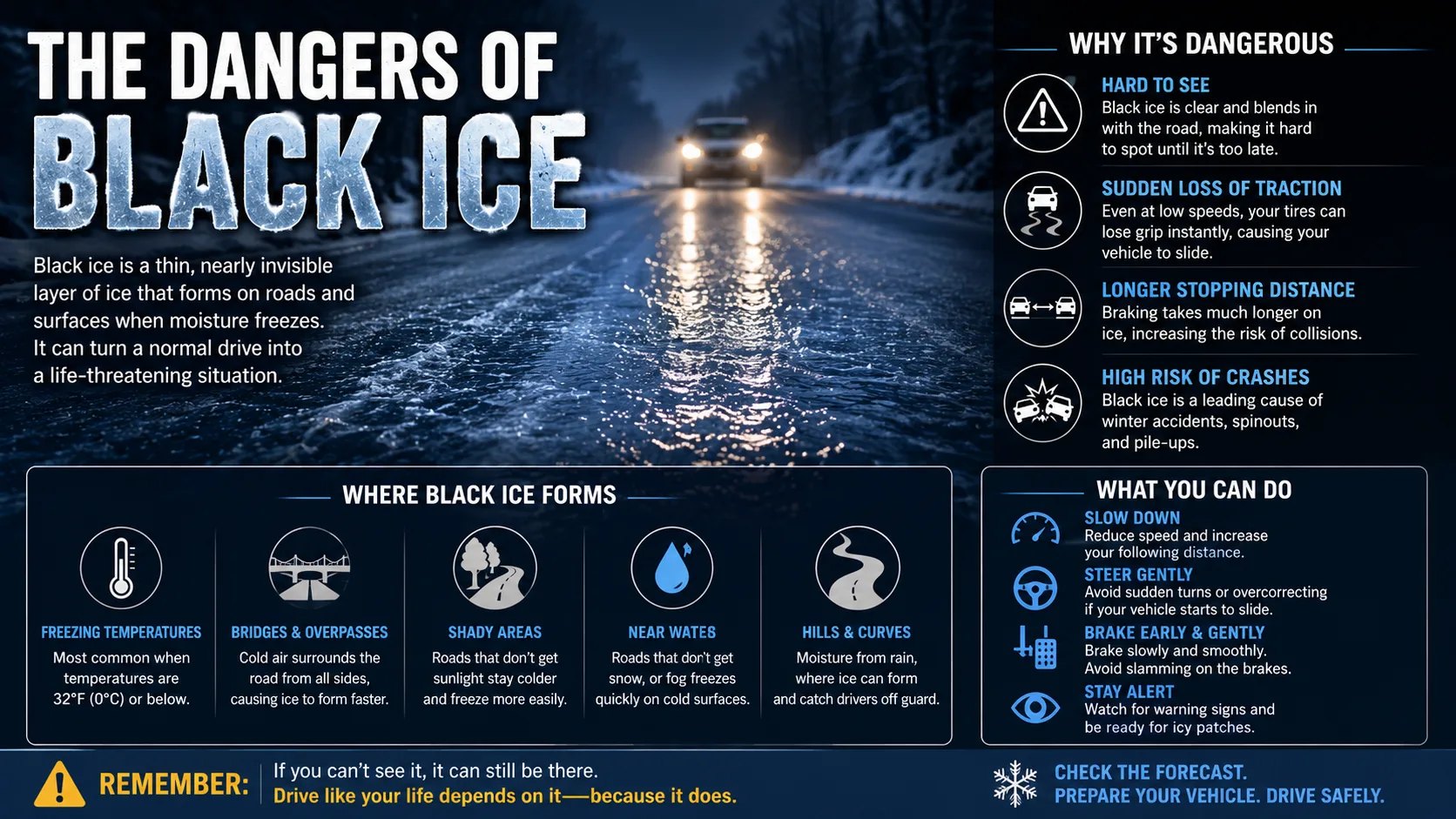
Black ice dangers come down to one brutal fact: you usually cannot see the hazard until your tires are already sliding on it. Black ice is a thin, nearly transparent layer of frozen moisture that forms on roads, sidewalks, bridges, and driveways, and it looks almost identical to a plain wet surface. Because drivers cannot spot it in time to slow down, black ice is responsible for a disproportionate share of winter crashes, injuries, and slip-and-fall accidents every year.
This guide breaks down what black ice actually is, why it forms where it does, how much longer it takes to stop on it, and the exact steps to take if your vehicle starts to slide. You will also find a quick way to check your local freeze risk using the Snow Day Calculator before you head out the door.
What Is Black Ice
Black ice is a thin coating of clear ice that forms on pavement and other surfaces. It gets its name not because the ice itself is black, but because it is transparent enough that the dark road surface shows straight through it. That transparency is exactly what makes it so hazardous.
Unlike snow or frost, black ice does not change the color or texture of the road in any obvious way. A stretch of highway coated in black ice can look identical to a stretch of ordinary wet pavement. Most drivers only discover it is there once their tires lose grip.
Black ice is not limited to roads. It regularly forms on sidewalks, steps, decks, parking lots, and building entrances, which makes it a hazard for pedestrians as much as it is for drivers.
How Black Ice Forms
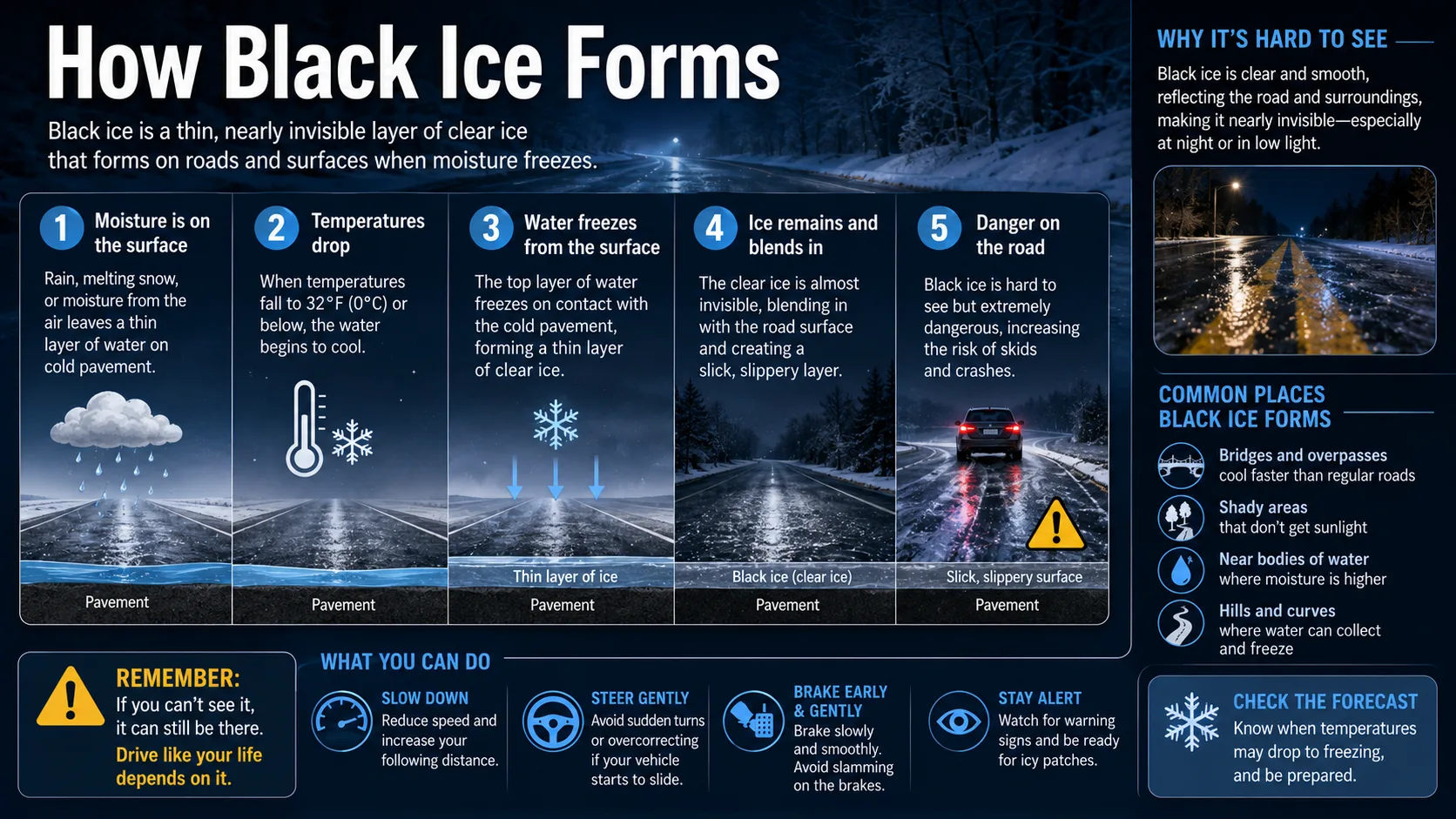
Black ice forms when a thin film of water on a surface freezes rapidly, usually overnight or in the very early morning when temperatures are at their lowest. There are three common setups that lead to it:
- Melt and refreeze: Daytime sun melts snow or frost, and the resulting water refreezes once the sun goes down and temperatures fall below 32°F (0°C).
- Light rain or drizzle on a cold surface: Even a small amount of rain falling on pavement that is already at or near freezing can turn to ice almost instantly.
- Fog or dew freezing directly on contact: On very cold, humid nights, moisture in the air can condense on the road and freeze without any precipitation ever being recorded.
That third scenario is part of what makes black ice so unpredictable. Black ice can appear even when no rain or snow has fallen at all, which means a completely clear, dry-looking forecast can still hide a dangerous morning commute.
Road Surface Temperature vs. Air Temperature
One reason black ice surprises so many drivers is that the temperature on your phone is not the temperature of the road. Air temperature is measured several feet above the ground, while pavement loses and gains heat at its own rate depending on material, shade, and moisture.
As a rough guide, meteorologists use this relationship to estimate freeze risk:
- Air temperature above 38°F (3°C): Road surfaces are usually still too warm to hold ice, even overnight.
- Air temperature between 32°F and 38°F (0°C to 3°C): This is the highest-risk window. The air feels only mildly cold, but shaded or elevated surfaces like bridges can already be at or below freezing.
- Air temperature below 32°F (0°C): Any moisture on the road is likely frozen or will freeze quickly, especially without direct sunlight.
This gap between air and surface temperature is exactly why a forecast reading of 34°F can still mean an icy bridge deck at 30°F. The safest habit is to treat any reading below about 38°F as a signal to slow down and watch for ice, rather than waiting for the forecast to confirm freezing.
Why Black Ice Is So Dangerous
Black ice is dangerous for a simple reason: it removes friction almost entirely, and it does so without warning. A dry road gives your tires strong grip. Black ice can drop that grip to a fraction of normal, meaning your car can slide even during routine driving, like easing off the gas at a light or steering gently around a curve.
The numbers make the risk clear. Icy and snowy road conditions are linked to close to 2,000 traffic deaths and well over 130,000 injuries in the United States every winter season. Roughly 70 percent of the country lives in regions that regularly see snowy or icy weather, so the exposure to this hazard is widespread rather than limited to a handful of states.
The danger is not only about driving. Icy sidewalks and steps send close to a million people to emergency rooms each year in the United States for slip-and-fall injuries, and a portion of those falls are fatal. Black ice on foot can be just as unforgiving as black ice under a tire.
Key takeaway: Black ice is dangerous because it is invisible, forms fast, and can appear even without rain or snow in the forecast. Treat any cold, wet-looking road below freezing as a possible ice hazard, especially before sunrise.
A meteorologist with NOAA's National Weather Service has explained that black ice can develop even when the sky is completely clear, which means drivers get none of the usual visual warning signs they rely on before a storm. That single fact is why black ice causes so many more surprise crashes than heavier, more visible snow events.
Where Black Ice Forms Most Often
Black ice does not form evenly across a road network. Certain locations lose heat faster than the surrounding pavement and freeze first, sometimes hours before nearby stretches of road show any sign of ice at all.
| Location | Why It Freezes First |
|---|---|
| Bridges and overpasses | Exposed to cold air on top and underneath, so they lose heat far faster than roads sitting on insulated ground |
| Underpasses and tunnels | Shaded from the sun, so surface temperatures never warm up during the day |
| Shaded or tree-lined roads | Sunlight cannot reach the pavement to melt frost or refreeze it later in the day |
| Curves and off-ramps | Water pools toward the outer edge of the curve and freezes there first |
| Low-lying areas and valleys | Cold air sinks and settles, trapping moisture and dropping surface temperatures |
| North-facing slopes | Receive the least direct sunlight of any orientation, so they stay cold the longest |
If you know you are approaching one of these spots on a cold morning, the safest assumption is that ice is present, even if the rest of your drive looked perfectly clear.
How to Spot Black Ice Before You Hit It
You cannot always see black ice directly, but you can watch for the clues around it:
- Check the temperature, not just the sky. If it is at or below freezing and the road looks wet, treat it as icy until proven otherwise.
- Watch the road surface for a dull, matte sheen rather than the bright shine you would expect from standing water.
- Watch traffic ahead of you. Sudden braking, fishtailing, or cars slowing well before a curve is often the first real sign of ice on the road.
- Assume ice on bridges, overpasses, and shaded roads any time the temperature is near or below freezing, regardless of how the rest of the road looks.
- Listen to your tires. A sudden change from road noise to near silence can mean your tires have lost contact with the pavement surface.
What to Do If You Hit Black Ice
Panic is the biggest risk multiplier on ice. If your vehicle starts to slide, the goal is to stay smooth and let the car regain traction on its own.
- Stay calm and keep your eyes up. Look toward where you want the car to go, not at the obstacle you are worried about hitting.
- Ease off the accelerator. Do not brake hard and do not try to speed away from the slide.
- Steer gently in the direction you want the front of the car to travel. Avoid sharp or sudden steering corrections.
- Let the car slow down naturally. Braking on ice can lock up your wheels and make the skid worse.
- Once traction returns, straighten the wheel and gradually resume normal speed.
- Increase your following distance for the rest of the drive since the road ahead may hold more ice.
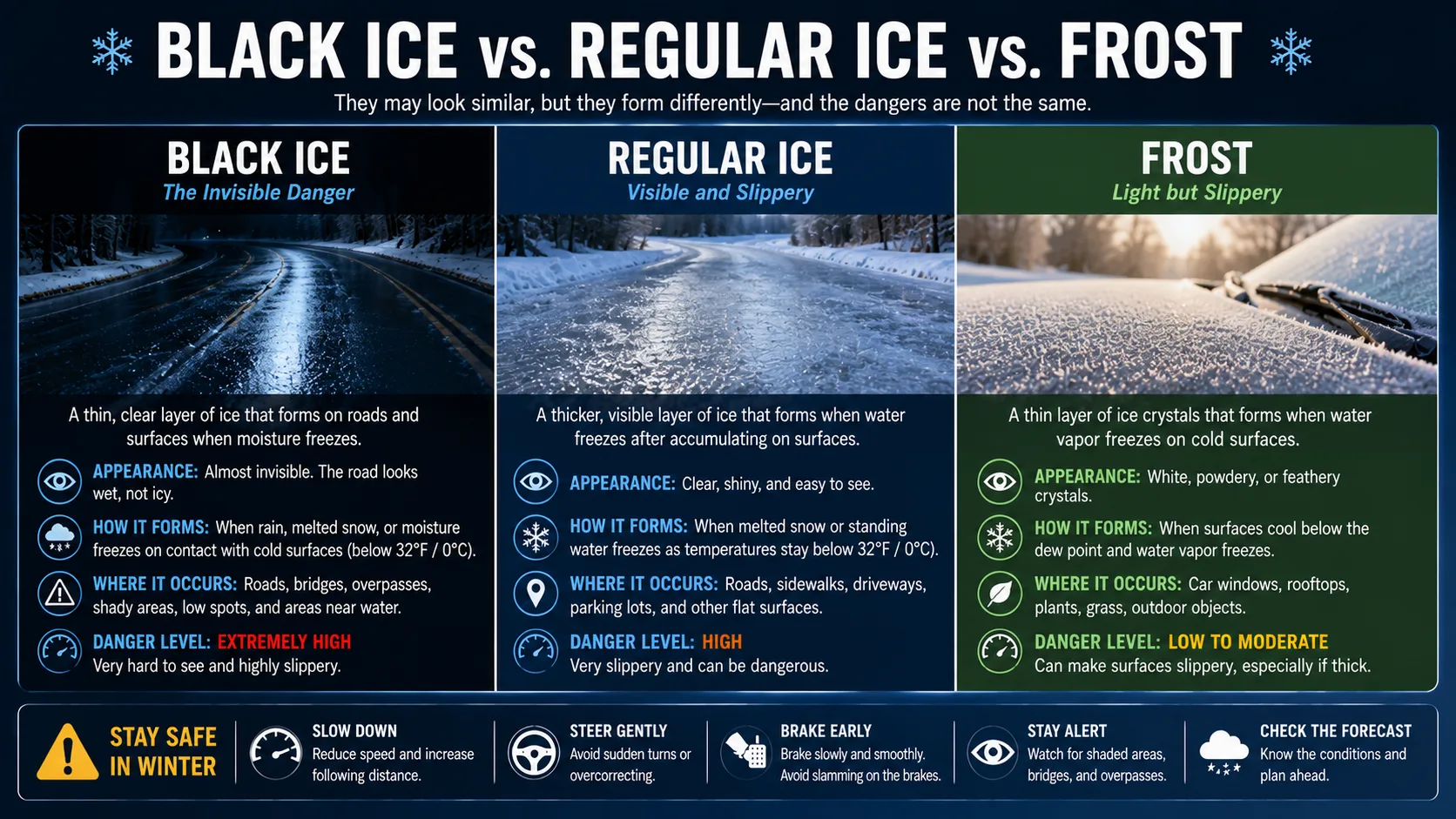
Black Ice vs. Regular Ice vs. Frost
Not all winter road hazards behave the same way. Here is how black ice compares to the other two most common types of icy conditions drivers face.
| Type | Visibility | Typical Cause | Relative Danger |
|---|---|---|---|
| Black ice | Nearly invisible, looks like wet pavement | Melt and refreeze, or moisture freezing directly on contact | Highest, because drivers rarely see it coming |
| Regular ice / ice patches | Visible as a white, frosty, or textured surface | Standing water or snowmelt that freezes with air trapped inside | High, but drivers can usually react in time |
| Frost | Visible as a thin white crystal layer | Cold, humid air condensing directly on a cold surface | Moderate, mainly affects windshields and light traction |
Real-World Examples With Numbers
The clearest way to understand black ice danger is to compare stopping distances. Controlled vehicle testing on invisible ice layers found an average braking distance of roughly 46 meters, compared with about 12 meters on dry asphalt and 11 meters on wet asphalt after rain. That means a car needing about 40 feet to stop on a dry road could need well over 150 feet on black ice at the same speed.
Speed makes the gap even larger. At around 30 mph, a vehicle on dry pavement typically stops within roughly 75 feet. On black ice, that same stop can take more than 600 feet, largely because the friction coefficient between tire and road can fall to a tenth of what it is on dry asphalt.
Put another way, stopping on black ice at a modest speed can require more distance than stopping from highway speed on a dry road. That is why safety experts consistently recommend stretching your following distance to 8 to 10 seconds, or more, in icy conditions instead of the usual 3 to 4 second rule used on dry pavement.
Read More : Freezing Rain vs Snow
Does Vehicle Type Change the Risk
Larger and heavier vehicles are not necessarily safer on black ice, and in some cases they are worse off. A loaded truck needs more distance to stop on ice than a passenger car of similar tire condition, simply because more mass has to be slowed down with the same reduced level of friction.
All-wheel drive and four-wheel drive vehicles do have an advantage when accelerating from a stop on a slick surface, since power is distributed to more wheels. That advantage disappears the moment you need to brake or turn. Braking and steering traction depend on tire grip against the road, not on how many wheels receive engine power, so an all-wheel drive SUV can slide just as easily as a two-wheel drive sedan once its tires lose contact with the pavement.
Winter tires make a measurable difference regardless of drivetrain. Their rubber compound stays flexible in freezing temperatures and grips more effectively than all-season tires, which tend to stiffen and lose traction once the mercury drops.
Common Mistakes Drivers Make
- Trusting four-wheel drive to prevent sliding. Four-wheel drive can help with acceleration, but it does nothing to shorten stopping distance on ice.
- Slamming the brakes during a skid. Hard braking on ice almost always makes the slide worse instead of stopping it.
- Assuming clear skies mean no ice. Black ice can form without any precipitation at all, especially overnight.
- Following too closely. Normal dry-road following distances leave almost no margin for error once stopping distances triple or more.
- Driving at normal speed through shaded areas or bridges just because the rest of the road looked clear a moment earlier.
Pro Tips to Stay Safe
- Reduce speed well before bridges, overpasses, and shaded curves rather than reacting once you feel the car slip.
- Make every input gradual: steering, braking, and accelerating should all be smooth and slow in freezing conditions.
- Warm up your tires' grip expectations, not just your engine. Cold rubber grips less effectively even on dry pavement.
- Keep a winter emergency kit in the car, including an ice scraper, blanket, and traction aid like sand or kitty litter.
- Check the forecast and freeze risk before you leave, not just the current temperature outside your door.
Planning Ahead With a Winter Weather Tool
Because black ice depends so heavily on overnight lows, road surface temperature, and moisture, checking conditions before you drive is one of the most effective ways to avoid getting caught off guard. The full calculator directory on thesnowdaycalculators.com includes tools built specifically for this kind of cold-weather planning.
If you are heading out on a morning where temperatures are hovering near freezing, pairing a local state-by-state winter weather prediction with a quick check of the Wind Chill Calculator can give you a much clearer picture of how cold the road surface itself is likely to be overnight, not just the air temperature reported on your phone.
For more seasonal driving guidance and updates throughout the winter, the Snow Day Calculator blog publishes regular breakdowns of upcoming cold snaps and the road conditions that tend to come with them.
Data Snapshot: Stopping Distance by Road Surface
| Road Surface | Approximate Stopping Distance at 30 mph | Multiplier vs. Dry Pavement |
|---|---|---|
| Dry pavement | ~75 feet | 1x (baseline) |
| Wet pavement | ~105 to 130 feet | ~1.4x to 1.7x |
| Packed snow | ~225 to 300 feet | ~3x to 4x |
| Black ice | 600+ feet | ~8x to 15x |
Conclusion
Black ice dangers come from a simple mismatch between what your eyes tell you and what is actually under your tires. The road can look wet, or even completely dry, while hiding a nearly frictionless layer of ice that dramatically extends your stopping distance and increases the odds of a skid. Slowing down before bridges and shaded roads, increasing your following distance, and checking cold-weather conditions before you leave are the most reliable ways to stay ahead of this hazard. Try the calculator above to check your local freeze risk before your next winter drive.