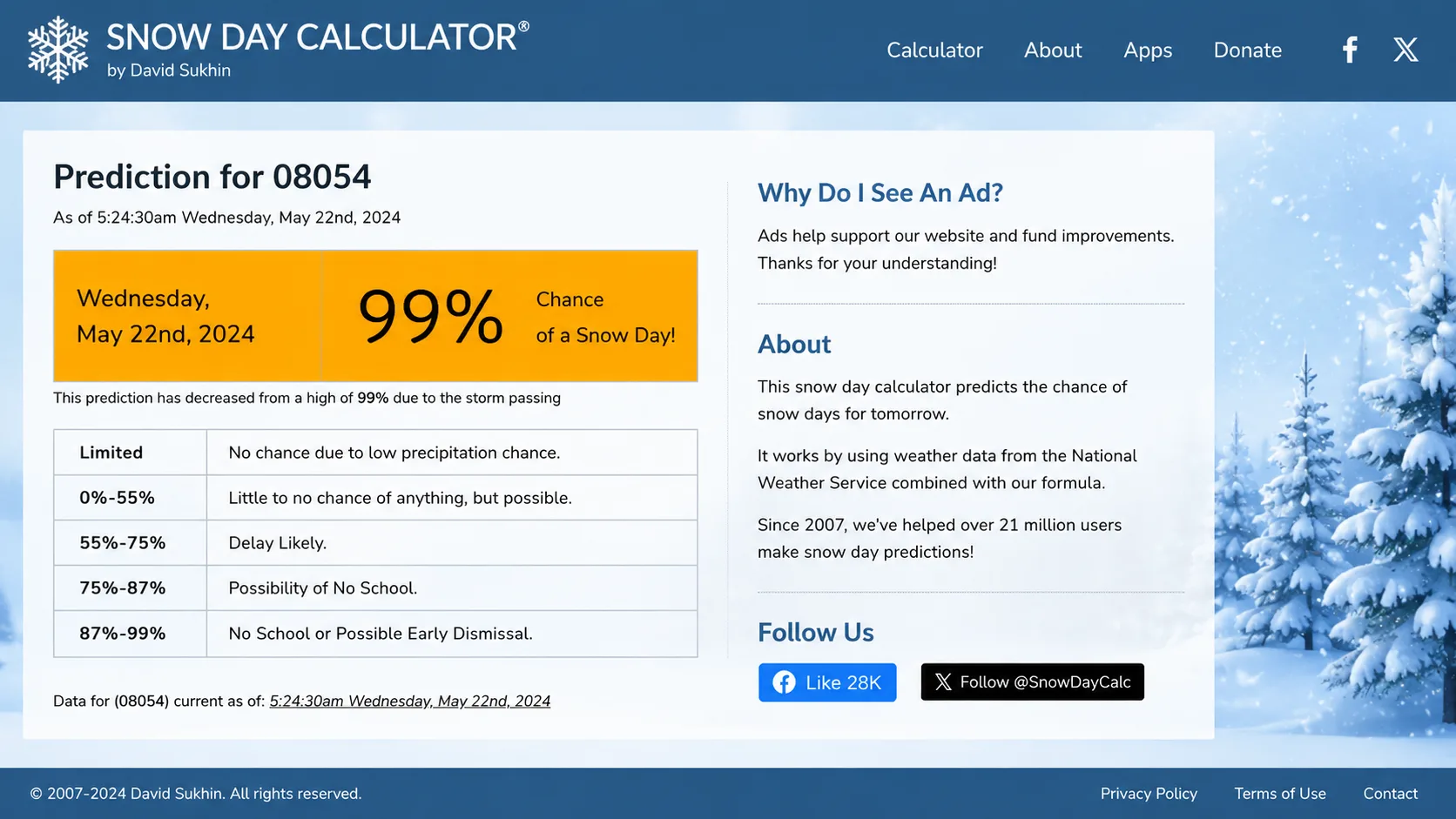
Yes, a snow day calculator works, but it is a probability tool, not a crystal ball. It combines live weather data, local snow thresholds, and historical closing patterns to estimate the odds that your school closes tomorrow. It cannot read a superintendent's mind, and it cannot guarantee an outcome. What it can do is turn a messy pile of weather variables into one simple number you can actually use.
In this guide, you will see exactly how these tools calculate that number, how accurate they tend to be, what makes a prediction go wrong, and how to get the most reliable read on your own school's chances this winter. You can also jump straight to our snow day calculator and run your own prediction while you read.
What Is a Snow Day Calculator
A snow day calculator is a web tool that estimates the chance your school will close due to snow, ice, or extreme cold. Instead of guessing, it pulls in real weather numbers and runs them through a formula built from years of past closing decisions.
Most tools ask for your zip code and a few details about your school, such as whether it is public, private, urban, or rural. Rural districts with long bus routes tend to close more easily than compact urban ones, so location and school type both shape the final number.
How Does a Snow Day Calculator Work
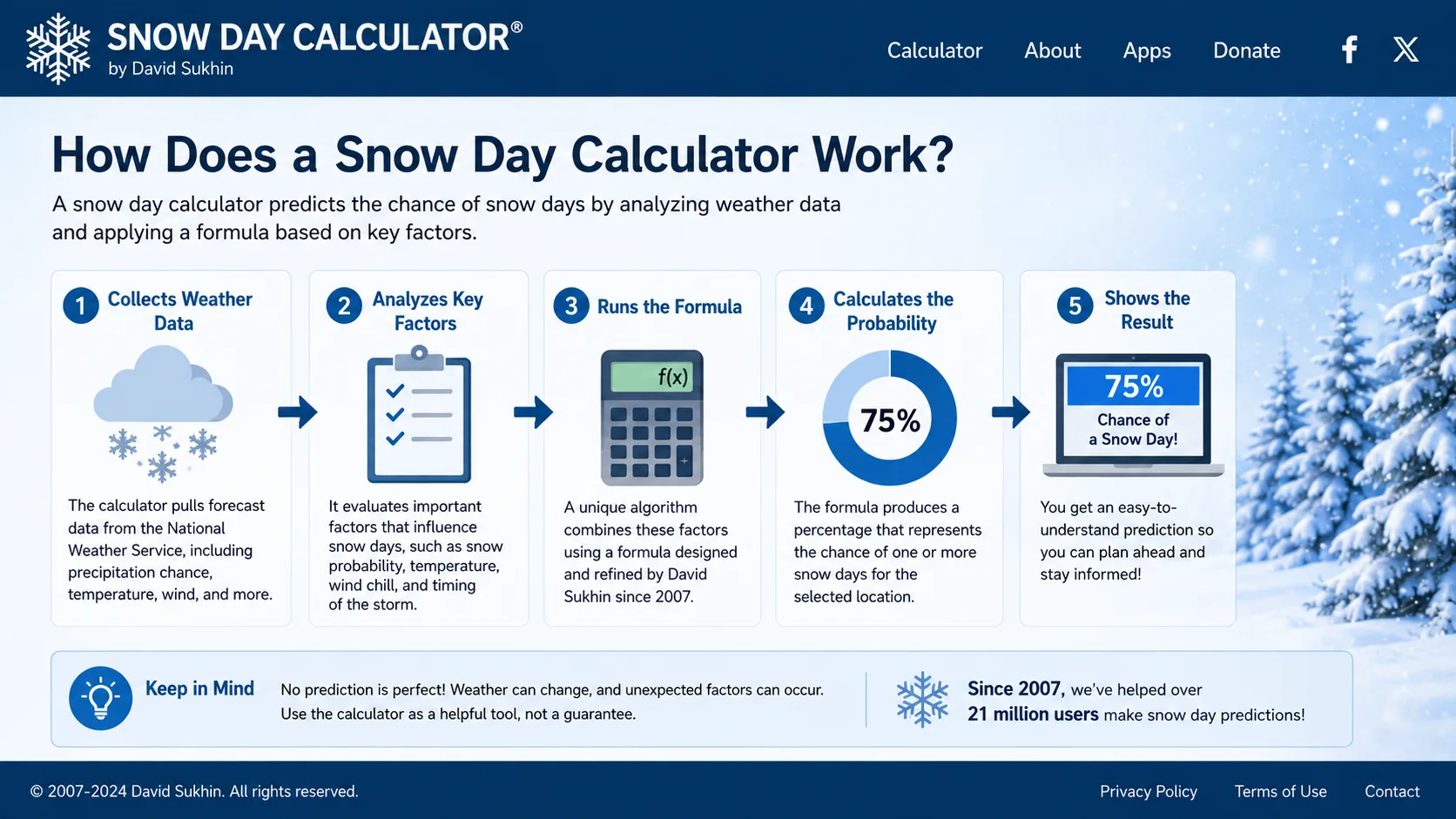
Every snow day calculator works the same basic way. It gathers forecast data, scores several weather factors, and blends those scores into one probability percentage.
According to reporting on the tool's history, one of the longest running calculators began pulling automatic data from the National Weather Service in 2010, which let it generate predictions for any United States zip code without users typing in the weather themselves.
Here is what typically goes into the calculation:
- Expected snowfall total, since more accumulation raises the odds sharply
- Storm timing, because snow falling during the morning commute matters more than snow that stops overnight
- Temperature, since colder air keeps snow from melting on roads
- Wind speed, which affects visibility and drifting snow
- Ice and freezing rain risk, which districts often treat as more dangerous than plain snow
- Historical closing patterns for that specific school or district
Each factor gets weighted differently depending on where you live. A district in Minnesota might need eight inches of snow before closing, while a district in Georgia might close for a light dusting because roads and equipment are not built for it. Good calculators, including the one on our state by state predictions page, adjust for that regional reality instead of using one national threshold.
The Formula Behind the Prediction
You do not need to do this math yourself, but understanding the logic helps you trust the output. A simplified version looks like this:
| Factor | Typical Weight in Final Score | Why It Matters |
|---|---|---|
| Snow accumulation forecast | 35 percent | Largest single driver of closures nationwide |
| Storm timing vs. school start | 20 percent | Morning storms cause more closures than overnight ones |
| Temperature and wind chill | 15 percent | Extreme cold alone can trigger a closure |
| Ice or freezing rain risk | 15 percent | Districts often treat ice as more dangerous than snow |
| Local historical pattern | 15 percent | Some districts close earlier or later than the regional norm |
Each weighted score is added together and converted into a percentage, usually shown as your chance of a snow day tomorrow, plus a lower confidence estimate for the day after. The exact weighting differs by tool and by region, which is why two calculators can show slightly different numbers for the same zip code.
Key takeaway: A snow day calculator is not predicting the weather itself. It is predicting how your specific district usually reacts to that weather. That is why local, historical data matters as much as the forecast.
How to Use a Snow Day Calculator, Step by Step
- Enter your zip code. This pulls the closest official forecast and matches your district's historical closing pattern.
- Select your school type. Public, private, rural, and urban schools each have different closing thresholds.
- Check the current prediction percentage. Anything above 60 percent generally signals a real chance of closure, though thresholds vary by region.
- Refresh the next morning. Predictions get sharper as the storm gets closer, since short range forecasts are more reliable than five day outlooks.
- Confirm with your district. Use the calculator as your early warning, then check your school's official closing announcement before making plans.
You can try all five steps right now using the full calculator directory, which includes tools built for different regions and school types.
Read More : How to Make a Snowman
How Accurate Are Snow Day Calculators
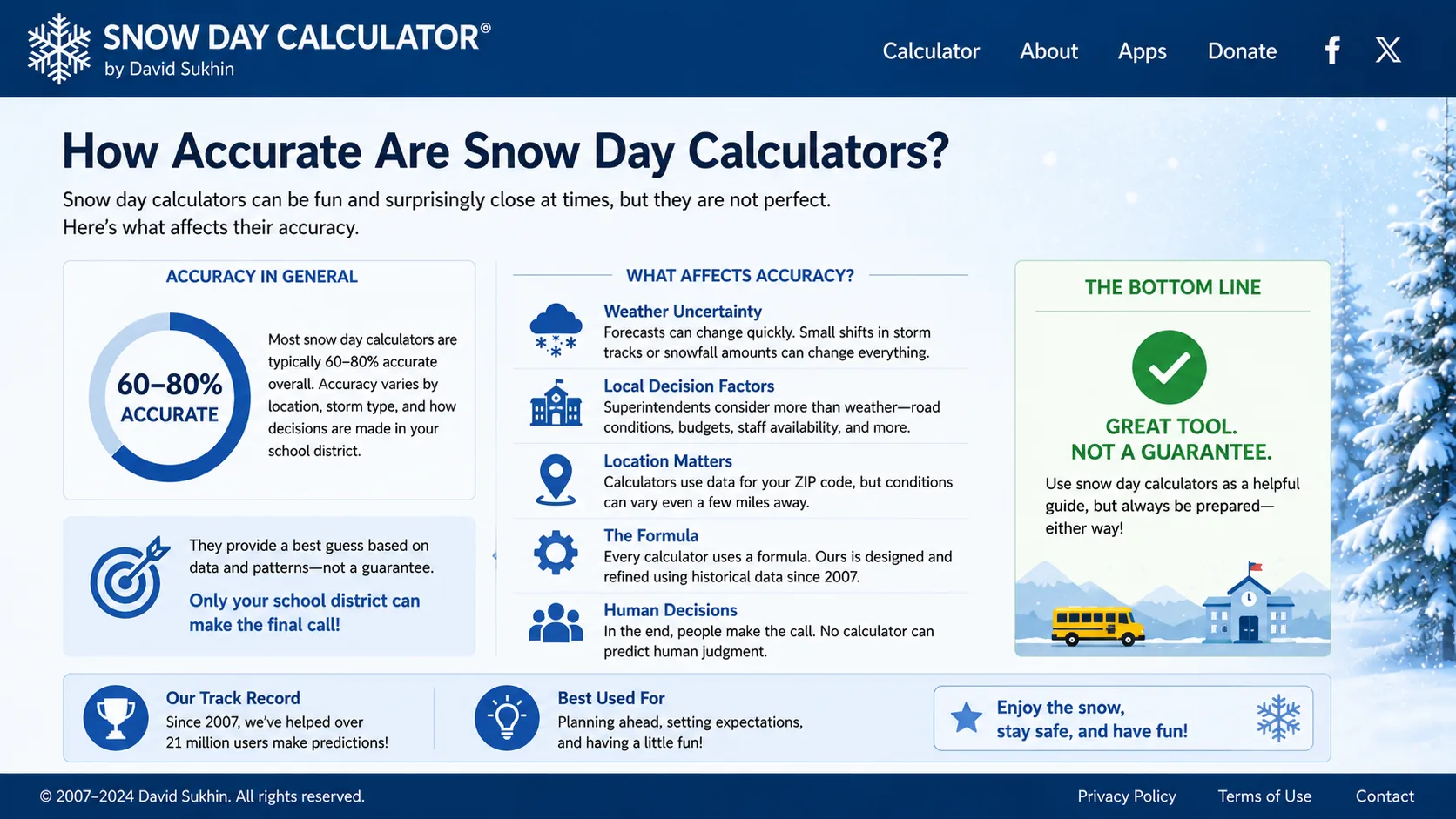
Accuracy depends heavily on location, lead time, and how much historical data the tool has collected for your specific school. Calculators tend to be most reliable within 24 to 48 hours of a storm, since short range forecasts are far more precise than predictions made a week out.
Weather forecasting professionals note that hourly, location specific snowfall and storm alert data tends to produce the strongest short range closure estimates, especially inside that 48 hour window before a storm arrives.
Some popular calculators report reaching 100 percent accuracy in certain locations during specific storms, and cite tens of millions of yearly visits from students and parents checking predictions. Those figures reflect strong performance in the districts with the most historical data behind them. Newer or smaller districts, with less closing history on file, tend to see more variation.
In short, a snow day calculator is a strong directional tool, not a guarantee. Treat a high percentage as a real signal to prepare, not as an official day off.
Real World Examples
Example 1: Suburban Midwest district. A calculator shows a 78 percent chance of closure with 6 inches of snow forecast to fall between 4 a.m. and 8 a.m. The district has closed for similar totals in 7 of the last 10 winters. The school closes.
Example 2: Southern district. A calculator shows a 55 percent chance with only 1.5 inches forecast, but freezing rain is expected first. Because this district has almost no ice removal equipment, the historical weight for ice pushes the score higher than the snow total alone would suggest. The school delays two hours, then closes.
Example 3: Mountain district with heavy snow infrastructure. A calculator shows only a 20 percent chance despite 8 inches forecast, because this district almost never closes for snow totals under a foot. School stays open.
These examples show why raw snowfall numbers alone are misleading. The calculator's real value is blending that forecast with how your specific district behaves.
Common Mistakes and Pro Tips
- Mistake: Checking the prediction five days out and treating it as final. Tip: Treat anything beyond 72 hours as a rough trend, not a forecast.
- Mistake: Ignoring storm timing. Tip: A storm that starts at 6 a.m. is far more disruptive than one that ends by midnight.
- Mistake: Comparing your district's percentage to a friend's in another state. Tip: Thresholds vary widely by region, so only compare your own district over time.
- Mistake: Skipping the official district announcement. Tip: Always confirm with your school before making final plans, even at 90 percent.
- Mistake: Only checking snow totals and ignoring wind chill. Tip: Extreme cold alone closes schools even without snow. Our wind chill calculator can help you check that risk separately.
Snow Day Calculator vs. Checking the Weather App Yourself
| Feature | Snow Day Calculator | Standard Weather App |
|---|---|---|
| Gives a school closing percentage | Yes | No |
| Factors in your specific district's history | Yes | No |
| Adjusts for school type (rural, urban, private) | Yes | No |
| Provides raw forecast data | Yes | Yes |
| Confirms the official closing decision | No | No |
A weather app tells you what the sky is going to do. A snow day calculator tells you what your school is likely to do about it. Using both together gives you the clearest picture, and you can cross check icy morning conditions with our heat index calculator during shoulder season storms when temperatures swing widely.
Conclusion
A snow day calculator works by turning live weather data and your district's closing history into one clear probability number. It will not replace your school's official announcement, but it gives you a genuine head start on planning your morning. Ready to see your own odds? Try the calculator above or explore our full blog for more winter weather guides.