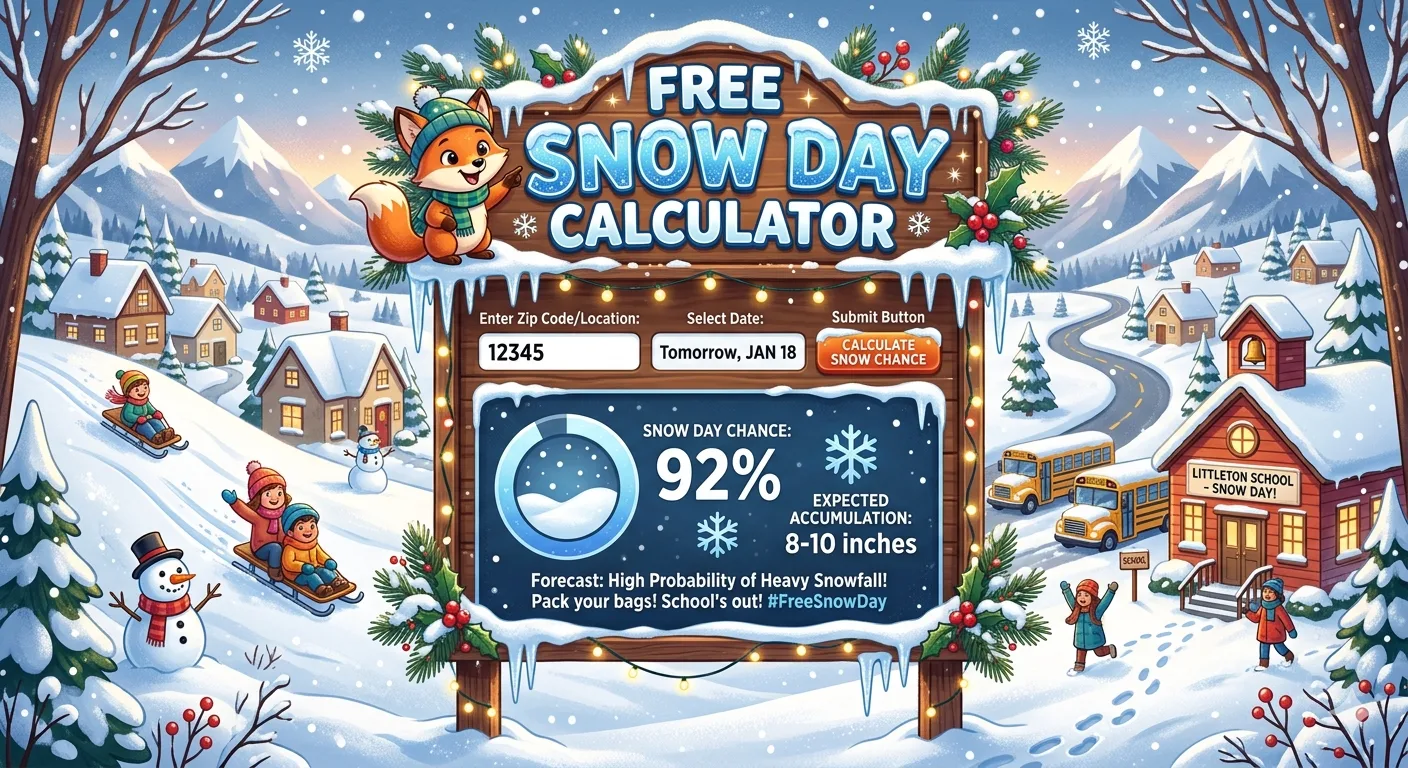
You've checked the radar three times. The local forecaster keeps saying "a wintry mix," which tells you nothing. It's almost eleven and you still don't know if tomorrow starts with a school run or a lazy morning.
That's what a free snow day calculator with no sign-up is for. Enter a ZIP code, get a percentage, stop doomscrolling. Our snow day calculator does exactly that, and it doesn't ask for your email first.
The percentage is the easy part, though. Reading it properly takes a bit more thought, and that's what most of this page covers.
The free snow day calculator landscape has grown dramatically since the original tool launched as a middle school side project back in 2007. Today's tools tap into hyperlocal government weather APIs, machine learning models, and decades of historical school closure records to give predictions that regularly hit 85 to 92 percent accuracy on short-range forecasts. This guide breaks down how all of it works and why you should never have to pay or sign up to access it.
What Is a Free Snow Day Calculator?
A snow day calculator is a kind of online tool that looks at real-time weather information and gives a percentage chance that your school or your workplace will be closed because of the snow. Unlike a weather app that just shows how many inches of snow to expect a snow day calculator turns the raw weather details into a clear answer: school is open delayed or closed.
The phrase "free no sign-up" is very important. Many tools that people use have changed to a freemium model where you have to pay or sign up to get details or longer forecasts. The best tools on the market today provide full core predictions hyperlocal percentage scores, storm factor breakdowns, and next-day outlooks completely free and anonymously.
What the Calculator Is Actually Guessing
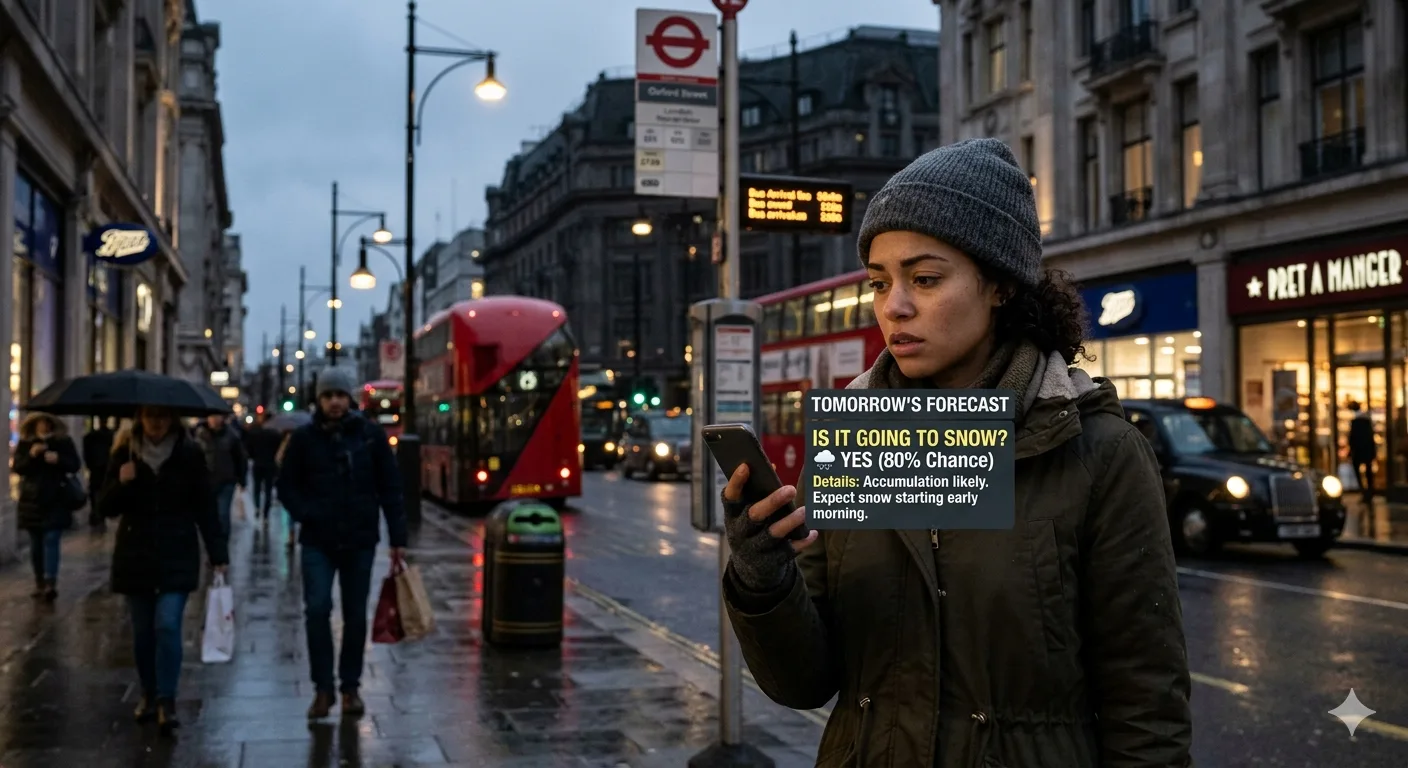
It isn't guessing the weather. The National Weather Service already does that, and the calculator borrows its data. What it's guessing is the mood of one person: a superintendent, awake before dawn, looking at road reports and deciding whether to put a bus on them.
A weather app says six inches. The calculator asks whether six inches is enough to close school in your district. Big difference, and a lot of disappointment comes from mixing the two up.
Six inches in Duluth is a Tuesday. A glaze of ice in Atlanta can empty every school in the metro. Same winter, completely different tolerance.
Timing Matters More Than Inches
Say five inches fall between 9 PM and 3 AM. Plows run all night and by sunrise the main roads are fine. Now say two inches start at 5:30 AM. Buses are rolling, nothing's been treated, and the roads turn greasy right on schedule.
The smaller storm is the bigger problem.
So before you look at anything else in your result, find the timing. Snow that peaks between 5 and 8 AM is the dangerous kind, no matter what the total says.
Ice Is the Real Villain
People love snow totals because they're easy to compare. Ice is harder to picture, so it gets ignored, and it's the thing that actually shuts schools. Even a tenth or two of freezing rain can make hills and bridges unsafe. If you see the word "freezing rain" in the forecast you should know that the percentage might be lower than it seems.
If you can't tell whether precipitation will stay liquid or glaze over, our rain delay calculator can help you see how wet weather affects timing.
Cold Closes Schools Too
Some of the most confusing snow days happen under a perfectly clear sky. It's the wind chill. When it's brutally cold, kids waiting at a bus stop can be at risk, and plenty of northern districts have a set cutoff for it. The number differs by place, so check whether your district publishes one.
To translate the forecast into what it will feel like on exposed skin, use our wind chill calculator. Temperature plus wind speed is all it needs.
And wind by itself
Gusts around 25 mph can move snow back onto roads you thought were cleared. Out in open farmland, visibility can drop to almost nothing.
Your District Has Habits
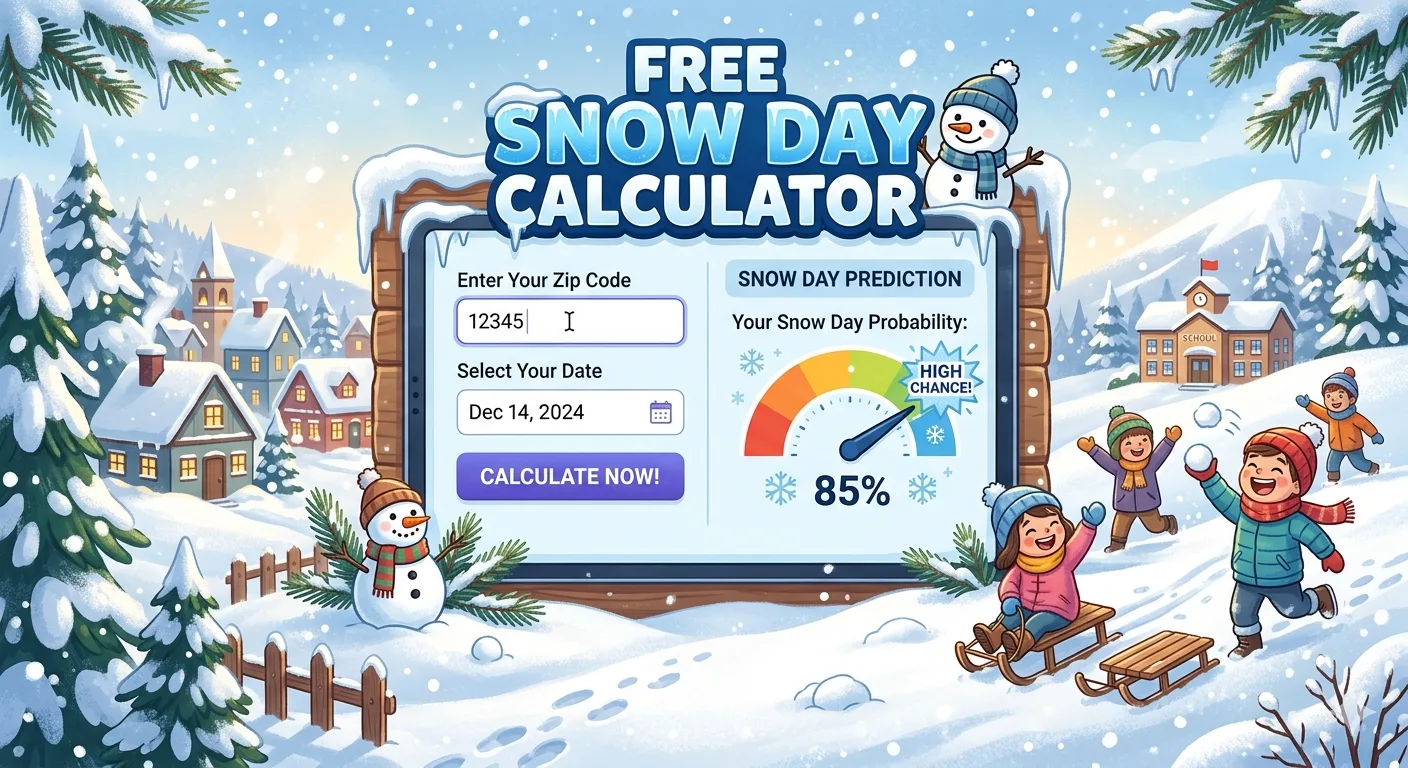
Some districts close at the first warning. Others hold on until the last possible minute, and a few will do almost anything to avoid using up a makeup day. A rural district with long gravel routes behaves nothing like a small city district where every street gets plowed by 5 AM.
If you've lived in your area a few winters, you already have a feel for this. Use it. When the calculator says 55% and you know your superintendent is the cautious type, mentally nudge it upward.
[ADD YOUR OWN STORY HERE]
How Much Should You Trust It?
Be careful of any tool that says something like 91.4% accuracy. This number is not always useful because accuracy depends on the storm, the place and how early you check. A single number is mostly for marketing.
What holds up in practice is this. The evening before is the strongest window because the forecast has settled and timing is clear. Two or three days out is a rough warning and will probably change. Past five days, it's closer to a hunch.
Misses usually come from boring causes. The storm tracks forty miles north. The snow arrives two hours early. A district low on makeup days decides to tough it out, or moves to a virtual day, which isn't the same thing as a closure.
Virtual Days Complicate Everything
A few years ago, a high closure chance meant a day off. Now it may mean "log in from the couch." Policies vary a lot between states and even neighboring districts, so look up yours before storm season. Does your district use virtual days? Do they count toward required instructional time? Does a delay come first?
Practical tip: charge the school laptop the night before a big storm. Nothing kills a snow day faster than a dead battery and an assignment due at noon.
A Simple Way to Use It
-
Enter the ZIP code of the school not your home ZIP code.
-
Check in the evening then again later at night after the forecast is updated.
-
Look at the time. The ice details, not just the number.
-
If you are between 40% and 70% set an alarm for 5 AM and check again.
-
Make sure to check the school districts website, text alerts or local news before making a decision.
A idea of what the percentage means: under 30% means you should plan to go to school. Between 30 and 60 means you should have a plan. Over 60 means you should start making arrangements for childcare or working from home. Over 85 means you can probably relax. Wait for the official message.
Parents, Students, Teachers
Parents: organize backup care. Talk to your boss before the storm not during it.
Students: finish your homework. Online days are real and a spoon under the pillow doesn’t help the roads. Sorry.
Teachers: have one lesson that works both in the classroom and online.
Different regions act differently.
In the Northeast and Upper Midwest heavy snow is common so ice, freezing cold and fast snowfall have impact than the total amount. In the Mid- Ohio Valley there is a mix of snow, sleet and ice which makes timing very important. In the South even a little ice can close schools because the roads and buses are not made for it. The Pacific Northwest has hills, and a few inches on a steep route is enough. In Canada, wind chill often decides things as much as snow does.
Treat all of that as a tendency. Your own district's history beats any regional rule.
How Accurate Are Free Snow Day Calculators?
Accuracy is the question everyone asks first. The honest answer: it depends heavily on forecast horizon. Here is a reliable breakdown of what current tools can realistically deliver:
| Forecast Window | Typical Accuracy Range | Best Practice |
|---|---|---|
| 12–24 hours out | 85% – 92% | Most reliable window check the night before |
| 24–48 hours out | 78% – 85% | Good planning window; re-check at 24 hrs |
| 3–5 days out | 70% – 80% | Useful for early awareness, not final planning |
| 5–7 days out | 50% – 65% | Highly variable; treat as general outlook only |
For the results the best time to check is between 6 PM and 10 PM the night before a weather event. At that time the weather models from NOAA have the recent data giving the calculators the latest information. Checking at midnight can give more accurate data as the NWS updates their advisories.
Beyond Winter
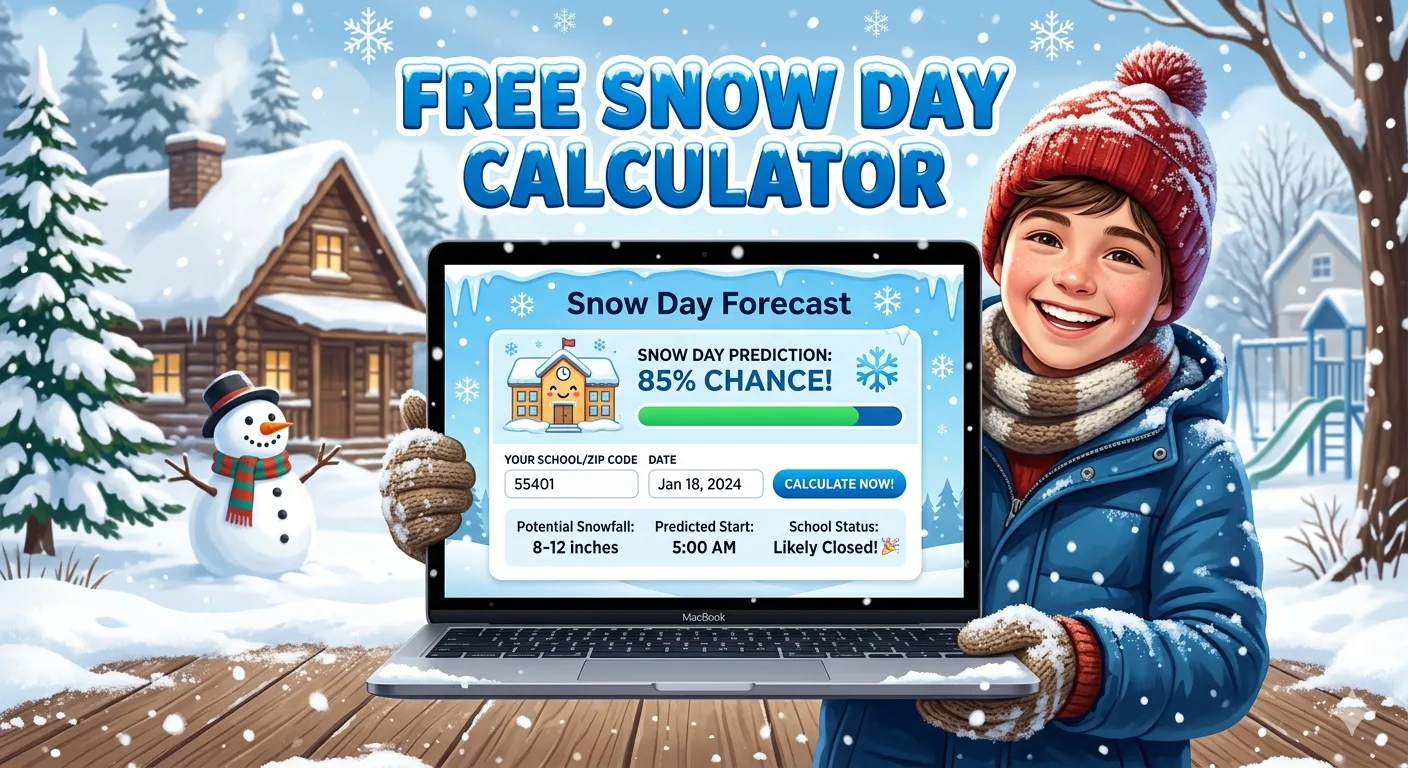
The same idea, turning raw weather data into a practical decision, works in summer. When afternoons get dangerously hot, our heat index calculator shows how safe it really is to be outside.
You can see everything we offer on our weather and planning calculators page.
Read More : Is It Going to Snow Tomorrow
Pro Tips for Getting the Most Accurate Snow Day Prediction
After reviewing the leading free calculators and the meteorological science behind them, here are the most reliable practices for getting actionable, accurate predictions:
- Use your school's ZIP code, not your home ZIP, for the most relevant hyperlocal data.
- Check multiple tools. If three independent calculators all show 80%+ probability, confidence in a closure should be high. Divergence between tools suggests genuine forecast uncertainty.
-
Pay attention to when the storm is happening than how much snow there is, especially overnight versus early morning start times.
-
Watch for NWS Winter Storm Warnings and Winter Weather Advisories in your area.
These official alerts significantly increase closure probability in most districts. - Note whether freezing rain is in the forecast even a tenth of an inch can be more disruptive than several inches of snow.
- Know your district's policy history. Has your superintendent been conservative or liberal in past decisions? This context helps you interpret a borderline 50–60% prediction.
-
Set your phone to check at midnight for the NWS data before morning announcements.
Tip: The one important thing you can do is check the calculator between 9 PM and midnight the night before a possible weather event using the schools ZIP code. The predictions at this time are usually better than the daytime forecasts, for the morning.
Conclusion: The Smartest Winter Planning Tool You Are Not Using Enough
A free snow day calculator with no sign-up required is one of the most practical, underutilized tools in any winter household or school community. It transforms a stressful morning guessing game into a data-driven decision backed by the same official NOAA weather sources that government emergency managers rely on, delivered instantly through a simple ZIP code search.
Next time a storm shows up on the forecast, run a free prediction here. It takes a few seconds, and there's nothing to sign up for. Bookmark it now, and send this page to whoever in your family refreshes the weather app at midnight.
Also Checkout :