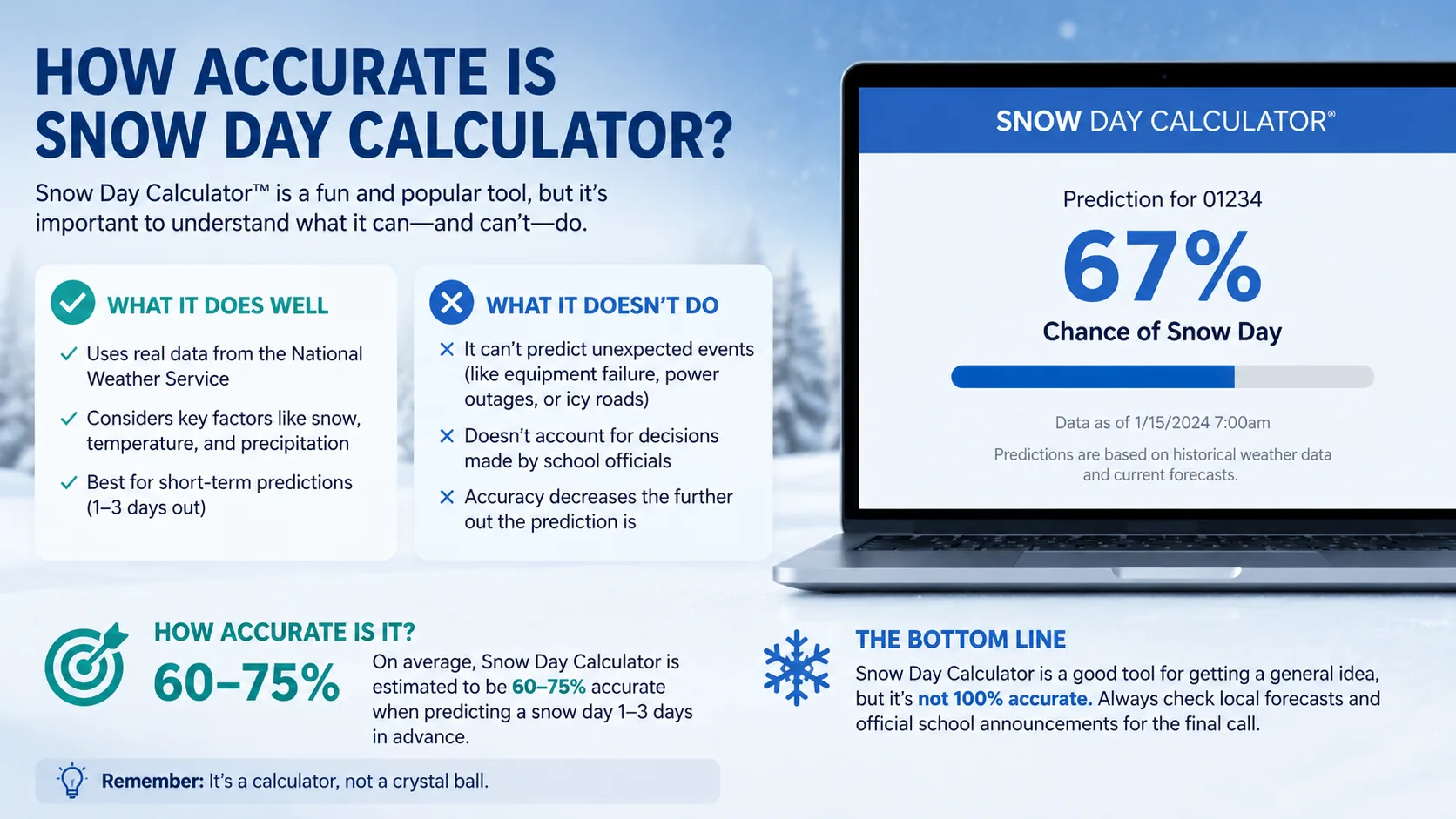
If you have ever typed how accurate is snow day calculator into Google the night before a big storm, you are not alone. Millions of students, parents, and teachers check these tools every winter to guess whether school will be cancelled. The honest answer is that a snow day calculator is usually 60 percent to 98 percent accurate, and the exact number depends heavily on how much snow is expected, how close the storm is, and your school district's specific closing habits.
In this guide, we break down exactly how these tools work, what actually drives their accuracy up or down, and how to read your personal snow day score like a meteorologist would. We will also walk through real number examples so you know exactly what to expect before the next storm rolls in.
What Is a Snow Day Calculator?
A snow day calculator is a free online tool that estimates the probability that your school will close because of winter weather. Instead of giving a simple yes or no answer, it produces a percentage score, something like "72% chance of a snow day tomorrow."
These tools first appeared in the mid 2000s and have grown into a genuine internet tradition. The original version was famously built by a high school student in 2007 and quickly turned into a viral winter ritual for students across the United States and Canada.
Today there are several popular versions, including the classic Snow Day Calculator, newer AI-driven tools like Perry Weather's Snow Day Probability Calculator, and hyperlocal apps that pull directly from the National Weather Service.
How Does a Snow Day Calculator Work?
Most snow day calculators combine live weather data with historical closure patterns. While the exact formulas are proprietary, the general logic follows a similar structure across most tools.
The Core Data Inputs
- Snowfall total forecast: How many inches are expected in your area
- Storm timing: Whether the snow falls overnight or during morning rush hour
- Temperature: Snow forms and sticks best below 32°F (0°C)
- Wind speed and wind chill: Strong wind can force closures even without heavy snow
- Ice accumulation: Freezing rain is often more dangerous than snow itself
- Historical closure data: How your specific district reacted to past storms
- Local infrastructure: Number of snowplows, road treatment habits, and terrain
The Simplified Formula
While every tool weighs its factors differently, the general concept behind most snow day probability scores can be simplified like this:
The "district sensitivity factor" is the most important and least discussed part of the equation. A district in Atlanta might close for a single inch of snow, while a district in Minneapolis may stay open through 8 inches. This is why the same storm can produce wildly different scores in two nearby states.
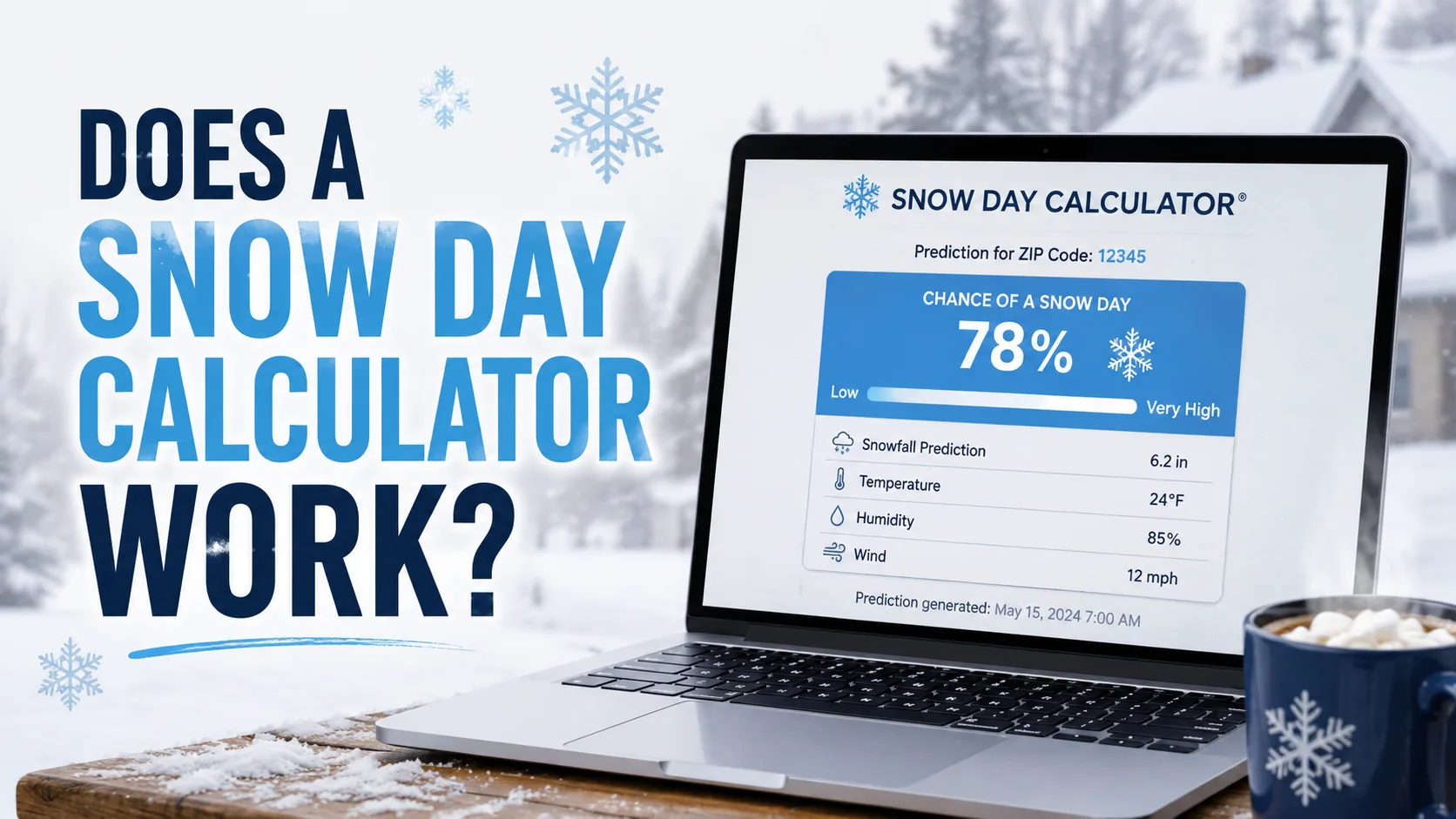
How Accurate Is a Snow Day Calculator? The Real Numbers
This is the question everyone actually wants answered. Based on how these tools describe their own methodology and independent weather forecasting standards, here is a realistic accuracy breakdown by snowfall amount.
| Expected Snowfall | Typical Accuracy Range | Why |
|---|---|---|
| Light snow (2 to 4 inches) | 60% to 70% | Borderline amounts trigger inconsistent district decisions |
| Moderate snow (5 to 8 inches) | 80% to 90% | Most districts have a clear closure threshold in this range |
| Heavy snow (10+ inches) | 95% to 98% | Almost every district closes regardless of policy differences |
| Ice storms or freezing rain | 70% to 85% | Ice is harder to forecast precisely than snowfall totals |
| Predictions 5+ days out | 40% to 60% | Long range weather models carry much higher uncertainty |
| Predictions within 24 hours | 80% to 90% | Short term forecasts are far more reliable |
According to Perry Weather, short term snowfall forecasts within a day or two are typically the most reliable, hovering in the 80 to 90 percent accuracy range, while forecasts made a full week ahead lose reliability quickly because more atmospheric variables can shift.
One popular tool, the original Snow Day Calculator, claims it becomes more precise over time because it learns from user feedback. When users report whether school actually closed, the system uses that data to refine future predictions for that exact school and region.
Meanwhile, newer AI powered tools such as Will It Snow connect directly to the National Weather Service API and generate predictions at the ZIP code level using a grid system of roughly 2.5 kilometer squares, which helps capture neighborhood level differences that broader weather apps often miss.
Factors That Affect Snow Day Calculator Accuracy
Even the best calculator cannot control every variable. Here are the biggest factors that push accuracy up or down.
1. How Far Out You Check
Checking five days before a storm gives you a rough guess at best. Checking the morning of, ideally between 5 AM and 6 AM when most districts announce closures, gives you the sharpest possible number.
2. Your District's Closure Threshold
Some districts close schools for 2 inches, others push through 10 inches without blinking. A calculator that does not know your district's specific history will always be less precise than one that does.
3. Urban vs Rural Location
Urban areas typically clear roads faster thanks to more plows and treatment trucks, while rural roads take longer to clear, which can shift the real world outcome even when the raw weather data looks identical.
4. Human Decision Making
No calculator can predict a last minute judgment call from a superintendent. Administrators sometimes close schools out of caution even with mild forecasts, or stay open despite a rough looking storm, especially if it is expected to hit after school hours.
5. The Type of Winter Event
Straightforward snow accumulation is easier to model than mixed precipitation. Freezing rain and ice are notoriously harder to predict precisely, which lowers accuracy compared to a clean snowfall event.
Read More : School Delay Calculator
Snow Day Calculator vs Snow Day Predictor: What Is the Difference?
You have probably noticed two similar sounding tools online: the Snow Day Calculator and the Snow Day Predictor. While they aim to do the same job, users often report different experiences with each.
| Feature | Snow Day Calculator | Snow Day Predictor |
|---|---|---|
| Data source | Weather data plus user submitted feedback | Live weather forecast models |
| Personalization | Learns your specific school over time | General regional forecast based |
| Best for | Repeat users in the same district | Quick one time checks |
| Published methodology | Publicly described on its site | Not always publicly detailed |
Neither tool is objectively "better" in every case. Some longtime users report that the Predictor felt closer to reality in their experience, while others found the Calculator's learning system more consistent for their specific school over multiple seasons. Your best move is to try both once or twice and see which one tracks more closely with your own district's actual behavior.
Real Life Examples: Calculating Your Snow Day Chances
Numbers make more sense with real scenarios. Here are three sample situations and how a typical calculator would likely score them.
Example 1: The Light Dusting
Forecast: 3 inches of snow, temperature 30°F, light wind, storm arrives overnight.
Estimated score: Around 55% to 65%. This falls in the gray zone where district policy matters more than the weather itself. A district near Atlanta might score this much higher than a district in Buffalo.
Example 2: The Classic Snow Day Setup
Forecast: 7 inches of snow, temperature 22°F, moderate wind, storm peaks during the morning commute.
Estimated score: Around 85% to 92%. Morning timing plus a moderate to heavy total pushes most calculators, and most real districts, toward closure.
Example 3: The Sure Thing
Forecast: 12 inches of snow, temperature 18°F, high wind creating blizzard conditions.
Estimated score: 96% to 99%. At this level, almost every calculator and every real school district agrees, this is a snow day.
How to Use a Snow Day Calculator the Right Way
- Enter your ZIP code or school name. Precision matters, a nearby town can have a completely different closure policy.
- Check the forecast details, not just the percentage. Look at expected snowfall, timing, and temperature so you understand why the score landed where it did.
- Check again the night before. Forecasts tighten up significantly as the storm approaches.
- Check one final time early morning. Most tools recommend checking between 5 AM and 6 AM, which lines up with when most districts actually announce closures.
- Compare with your district's official communication channels. Use the calculator as a heads up, not a replacement for the real announcement.
- Report the outcome if the tool allows it. This is what helps calculators that use learning systems get sharper over your next storm.
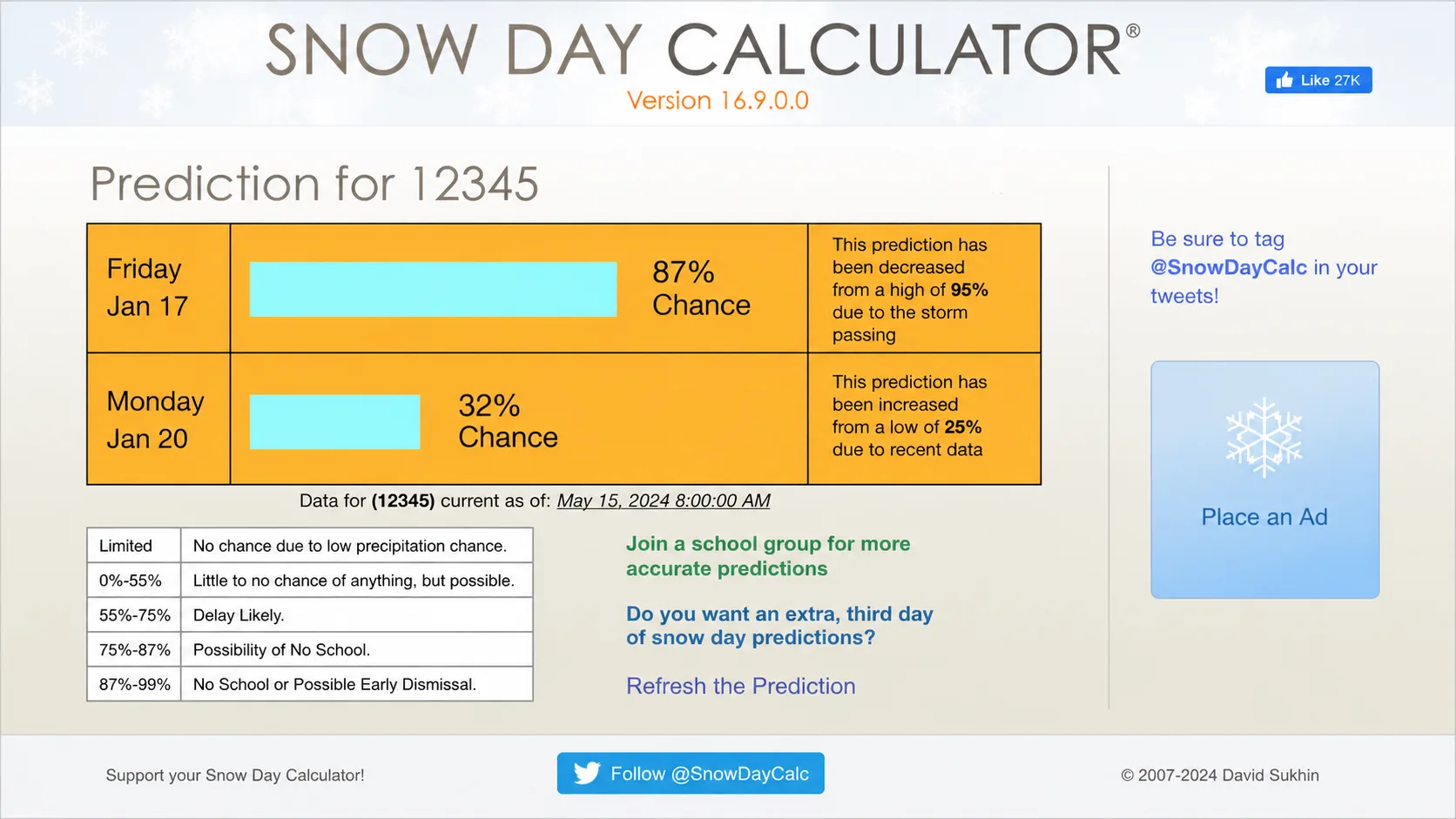
Common Mistakes People Make With Snow Day Calculators
- Checking too early: A score from five days out is closer to a guess than a forecast.
- Ignoring your specific district's history: A generic regional score will not reflect your district's unique closure threshold.
- Treating the percentage as a guarantee: An 85% score still means there is roughly a 1 in 7 chance school stays open.
- Not checking official school channels: The calculator is a helpful estimate, the final call always belongs to your district.
- Forgetting about remote learning policies: Some districts now use virtual learning days instead of a true day off, which a calculator cannot predict.
Why Snow Day Calculators Sometimes Get It Wrong
Even accurate looking scores can miss the mark, and that is not necessarily a flaw in the tool itself. Weather forecasting has natural limits, and human decision makers add another layer of unpredictability on top of that.
Local news outlets have noted that even a strong looking prediction can be undercut by a single administrative judgment call, since a superintendent might weigh factors a calculator simply cannot see, like a specific bus route condition or a local event schedule.
In short, think of a snow day calculator the same way you think of a weather app's rain percentage. It is a well informed estimate built on real data, not a promise.
Benefits of Using a Snow Day Calculator
- Plan child care in advance instead of scrambling at 6 AM
- Reduce morning stress for parents juggling work schedules
- Help teachers prep lesson plans with a backup option in mind
- Build excitement for students checking their odds the night before
- Track historical patterns for your specific school over multiple winters
Snow Day Calculator Accuracy at a Glance
Here is a simple visual breakdown of how prediction accuracy trends as a storm gets closer, based on the general forecasting principle that shorter range predictions are more reliable than long range ones.
| Days Before the Storm | Typical Prediction Accuracy |
|---|---|
| 7 days out | ■■■□□□□□□□ 30% to 40% |
| 5 days out | ■■■■■□□□□□ 45% to 55% |
| 3 days out | ■■■■■■□□□□ 60% to 70% |
| 1 day out | ■■■■■■■■□□ 80% to 90% |
| Morning of (5 to 6 AM) | ■■■■■■■■■□ 90% to 98% |
Conclusion
So, how accurate is a snow day calculator really? The honest, data backed answer is that it depends on your storm size, your timing, and your district's individual habits. Light snowfall predictions hover around 60 to 70 percent accuracy, moderate storms climb to 80 to 90 percent, and major storms push toward 95 to 98 percent reliability.
The smartest way to use these tools is simple. Check early for a rough idea, check again the night before for a sharper read, and check one final time early in the morning for your most accurate score. Treat the percentage as a well informed estimate built on real weather science, not a guaranteed outcome, and you will get the most value out of every snow day calculator you use this winter.
Also Checkout :