
It's 9 p.m., there's snow in the forecast, and you're refreshing a snow day calculator for the fourth time in an hour, willing that percentage to climb. Every kid. And honestly every parent scrambling for childcare. Has felt this way.. The one question that no one really answers is: does that number really matter or is it just a fancy guess?
The honest answer sits somewhere between extremes. It changes a lot based on the time you look the place you live and how much snow's truly on the way. In this guide we will explain what accuracy numbers look like for the 2026 winter show how these predictions are made and give you a playbook to read a snow day percentage like a weather expert not like a hopeful ten‑year‑old.
What a Snow Day Calculator Actually Does
A snow day calculator isn't just a weather app with a different coat of paint. A standard forecast tells you how much snow is expected. A snow day calculator does more than show a number. A snow day calculator turns weather into a decision estimating the odds that a particular school district will cancel classes.
This challenge is tougher than it looks. Two school districts located fifteen miles apart facing the storm can make very different choices. The decision depends on their bus fleet, their road‑treatment budget and how careful their superintendent is.
The idea began in the 2000s and tools have become far more advanced. In 2026 good snow day calculators pull live data every fifteen to sixty minutes compare several weather feeds and add years of district‑specific closure history instead of treating every ZIP code the same.
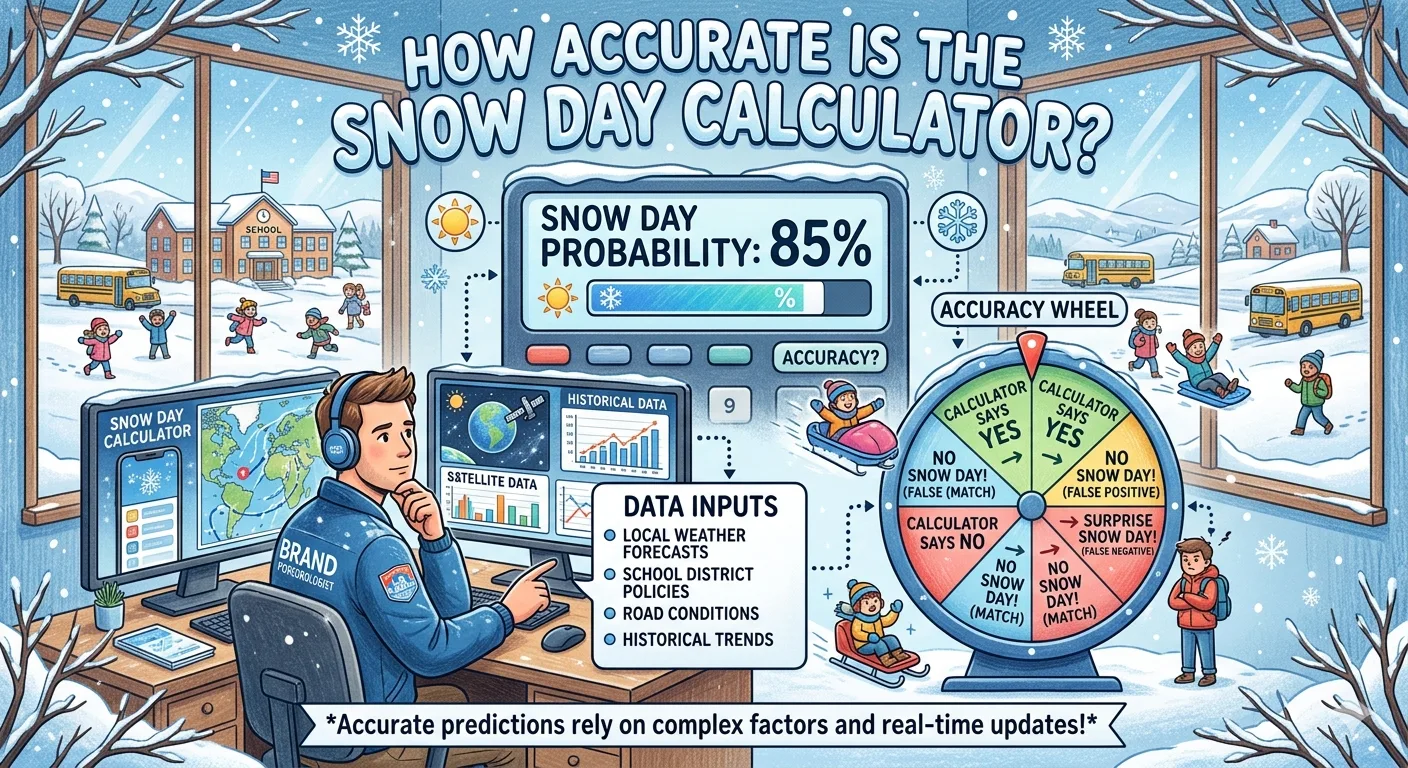
So how accurate is the snow day calculator really?
Many articles. Hype the snow day calculator with claims like "98% accurate!" or ignore the snow day calculator altogether. Neither is fair. Accuracy swings hard depending on your timeframe and how much snow is actually in play. Here's a realistic breakdown based on how these predictions tend to perform across recent winters:
- Next-day predictions (12–24 hours out): roughly 85–92% accurate
- Short-term predictions (24–48 hours out): roughly 78–88% accurate
- Medium-range predictions (3–4 days out): roughly 60–75% accurate
- Long-range predictions (5–7 days out): roughly 45–60% accurate treat these as a vibe check, not a plan
- Borderline snow events (2–4 inches): the least reliable, often 55–70%
- Major storms (6+ inches): the most reliable, often 90%+
Notice the pattern: as you get nearer to the storm and as the storm grows bigger the snow day calculator’s number becomes more trustworthy. A calculator predicting a near-certain closure two days before a foot of snow is on much firmer ground than one guessing about a borderline two-inch dusting a week out.
How the Prediction Is Actually Built
Here's the part most people never see what happens between typing in your ZIP code and getting a percentage back.
1. Pulling Live Weather Data
The calculator starts by pulling current forecasts precipitation type, expected accumulation, temperature trends, and wind conditions from meteorological sources. The fresher and more frequently updated this data is, the more reliable everything downstream becomes.
2. Weighing the Timing, Not Just the Amount
How much snow falls matters, but when it falls matters just as much. Snow that piles up between roughly 3 a.m. and 7 a.m. right in the middle of bus routes and morning prep — is far more likely to trigger a closure than the same accumulation falling on a Tuesday afternoon after dismissal.
3. Adjusting for Local Infrastructure
A half‑inch of snow barely shows up on the snow day calculator in a place, like Syracuse, New York where crews have already cleared roads before most people wake up. A good snow day calculator adjusts its threshold to match how well equipped a region really is, of using a single national standard.
4. Learning From District History
The best tools track how a specific superintendent or district has responded to storms in the past. A district that's closed early and often builds a "cautious" profile; one that's pushed through blizzards builds a "reluctant to close" profile. That history shifts the prediction even when the weather looks identical on paper.
5. Turning It Into a Number
All of that gets weighted and combined into a final percentage usually capped below 100%, because no algorithm should ever claim certainty about a human decision made at 5 a.m.
The Factors That Move the Needle Most
Not every input carries the same weight. Here's what tends to matter most, in roughly the order it influences a closure call:
- Snowfall timing over total amount a storm that lands during the overnight bus-prep window causes more closures than one that arrives mid-afternoon, even with less total snow.
- Ice and freezing rain often more disruptive than snow itself, since icy roads are simply more dangerous than packed snow, and it takes far less of it to cause problems.
- Temperature and wind chill extreme cold can close schools with zero snow on the ground, purely over concerns about bus reliability and kids waiting at stops. If you're ever unsure how dangerous a cold snap really is, our wind chill calculator is a fast way to see how the temperature actually feels once wind is factored in.
- District policy and geography rural districts with long bus routes and fewer treated roads tend to close earlier and more often than compact urban districts.
- Local infrastructure plow fleet size and road-treatment budgets vary wildly by town, which is why the same storm produces different outcomes a few miles apart.
Why Your Location Changes Everything
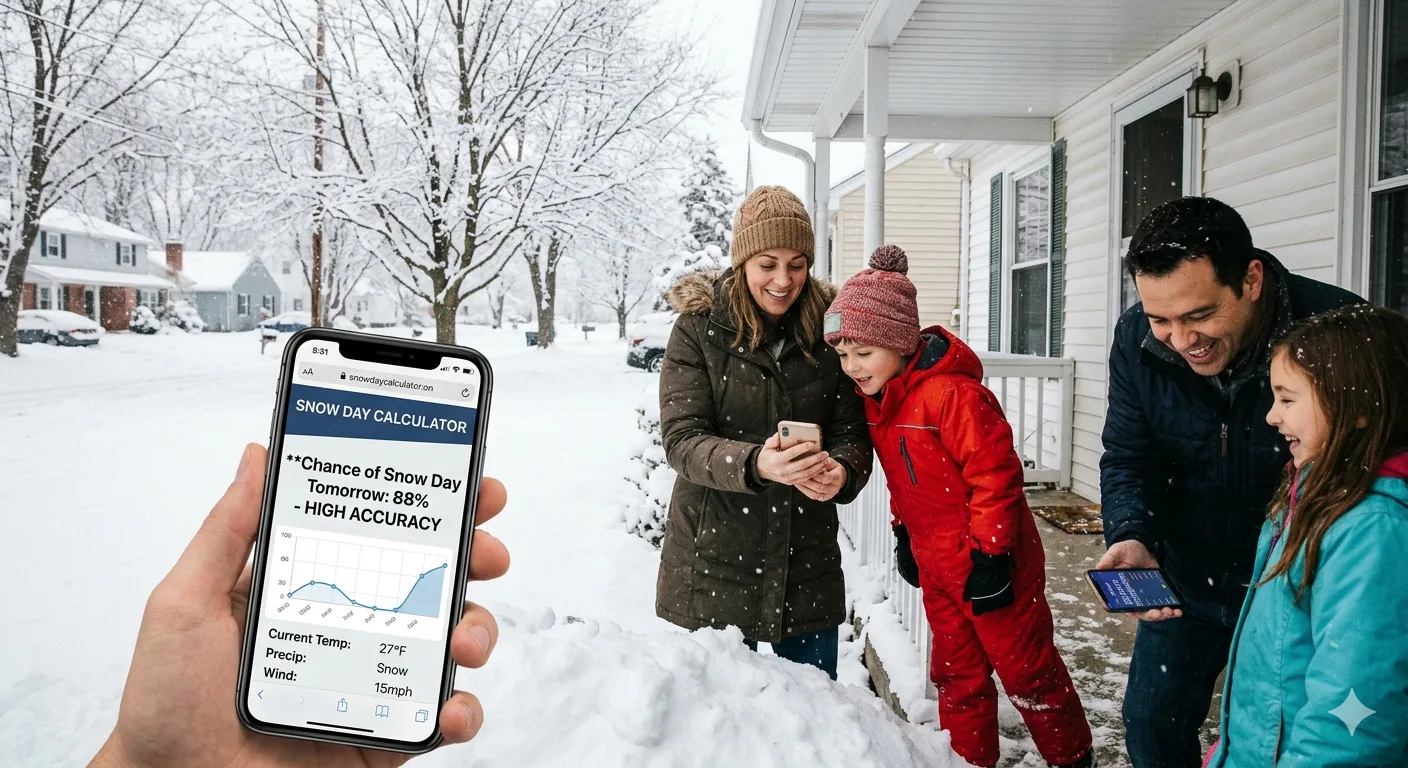
Geography is probably the single biggest factor in how much you should trust a prediction. A calculator that nails it 9 times out of 10 in Buffalo might be far less reliable in Atlanta not because the tool got worse, but because the underlying conditions are completely different.
Snow-heavy regions like the Northeast and Upper Midwest have decades of closure data to learn from, and administrators there tend to be fairly consistent and predictable. Warmer regions that rarely see snow have thinner historical data, less consistent infrastructure, and administrators who are, understandably, making more judgment calls on the fly. That's not a flaw in the tool it's just a harder problem to model.
Regional Accuracy: Why Your Location Changes Everything
The single biggest variable in snow day calculator accuracy is geography. A calculator that achieves 92% accuracy in Buffalo, New York may only hit 65% in Atlanta, Georgia — not because the tool is worse, but because the underlying conditions are fundamentally different.
| Region | Typical Closure Threshold | Avg. Accuracy (24-hr) | Key Challenge |
|---|---|---|---|
| Northeast US (Boston, NYC, Buffalo) | 4–8 inches | 85–92% | Nor'easters shift rapidly |
| Midwest (Minneapolis, Chicago) | 6–12 inches | 80–88% | High infrastructure keeps schools open |
| Southeast US (Atlanta, Charlotte) | 1–3 inches (or ice) | 70–82% | Unpredictable admin decisions |
| Pacific Northwest (Seattle, Portland) | 2–4 inches | 68–78% | Rain-to-snow transitions are hard to model |
| Southern US (Texas, Florida) | Any ice / 0.5+ inches | 60–72% | Rare events with no historical data baseline |
| Canada (Toronto, Montreal, Ottawa) | 15–25+ cm | 82–90% | Lake-effect snow creates localized surprises |
Snow-experienced regions like the Northeast and Midwest have richer historical datasets, more predictable administrator behavior, and better-calibrated infrastructure coefficients. In contrast, regions where snow is rare such as the Deep South have fewer historical closures for the algorithm to learn from, making predictions inherently less reliable.
How Snowfall Amount Affects Prediction Reliability
The relationship between snowfall totals and prediction accuracy is not linear it follows a clear tiered pattern that every user should understand before trusting a percentage.
- Light snow (1–3 inches): Accuracy drops to 55–70%. The margin of error in weather forecasts at this level is itself 1–2 inches, meaning the calculator is working with uncertain inputs. Human discretion plays a large role.
- Moderate snow (4–8 inches): Accuracy improves to 75–85%. Most districts have consistent historical behavior at these levels, giving the algorithm stronger training data.
- Heavy snow (9–12 inches): Accuracy climbs to 88–93%. School closures become near-certain, and the remaining uncertainty comes from road-clearing speed and bus availability.
- Blizzard conditions (12+ inches or whiteout): Accuracy peaks at 93–98%. Near-certain closure territory; the calculator's prediction becomes more of a formality than a forecast.
- Freezing rain / ice storm: High accuracy (85–92%) even with minimal accumulation, because icy roads represent a categorically different safety risk that administrators respond to consistently.
Where the Predictions Still Fall Short
Even the best-built calculator has real limits worth knowing about before you plan your morning around a percentage.
The weather forecast itself can be wrong. A calculator is only as good as the data feeding it, and snow forecasting is notoriously tricky a storm track can shift just enough to turn an expected eight inches into two.
Human decisions don't follow formulas. Superintendents weigh things no algorithm can see: bus driver call-outs, a scheduled standardized test, or simply how much pressure they got from parents after skipping the last closure. Sometimes a district over-corrects after a controversial decision, and that's nearly impossible to predict.
Remote-learning days have muddied the picture. Since many districts now default to a virtual day instead of a full closure, older data trained on pre-remote-learning closure patterns can overestimate the odds of an actual day off from school.
Microclimates get missed. A single district can stretch across a hilltop that gets six inches and a valley three miles away that gets half that. Predictions built on ZIP-code averages can't always catch that kind of local variation.
How to Actually Use the Number Wisely
You can't make the tool more precise than its design allows but you can absolutely use it smarter. Here's how:
- Check late, not early. Predictions made between 9 p.m. and 6 a.m. reflect the freshest weather data and are far more reliable than a check done at lunchtime the day before.
- Use your school's ZIP code, not your home address if they differ, the school's local conditions are what actually matter.
- Treat the middle ground with suspicion. Anything under 50% is genuinely unlikely; anything over 80% is genuinely probable. The 50–80% range is where the real uncertainty lives.
- Refresh as the storm gets closer. A 60% reading at dinner time can easily become a confident 90% or drop to 20% by midnight once the storm track firms up.
- Know your district's personality. If your school has never closed for under six inches in the past five winters, be skeptical of a high prediction for a four-inch storm.
- Always confirm with your district directly. Use the calculator for early planning, then let your school's official app, email alert, or local news be the final word.
It's also worth remembering that snow isn't the only weather condition that disrupts a school or work schedule. Spring storms bring their own version of this problem if you're trying to plan around a wet forecast, our rain delay calculator works through the same logic for rain-driven schedule changes. And once winter turns to summer, extreme heat can trigger early dismissals and delays just as easily as snow does, which is exactly what our heat index calculator is built to estimate.
The Bottom Line
A snow day calculator isn't magic, and it was never going to be. No algorithm can fully replicate the judgment call a superintendent makes at 5 a.m. while staring at icy roads and a bus driver group chat. What it is, though, is a genuinely useful probability tool — one that processes far more variables, far faster, than any of us could manage on our own with a cup of coffee and a weather app. Use it the way it's meant to be used: as an early signal, not a guarantee. Trust the high numbers, be skeptical of the middle ground, and always keep your phone on for the official call. That remaining uncertainty is exactly why the alarm still goes off even on a night that felt like a sure thing.
Also Checkout :