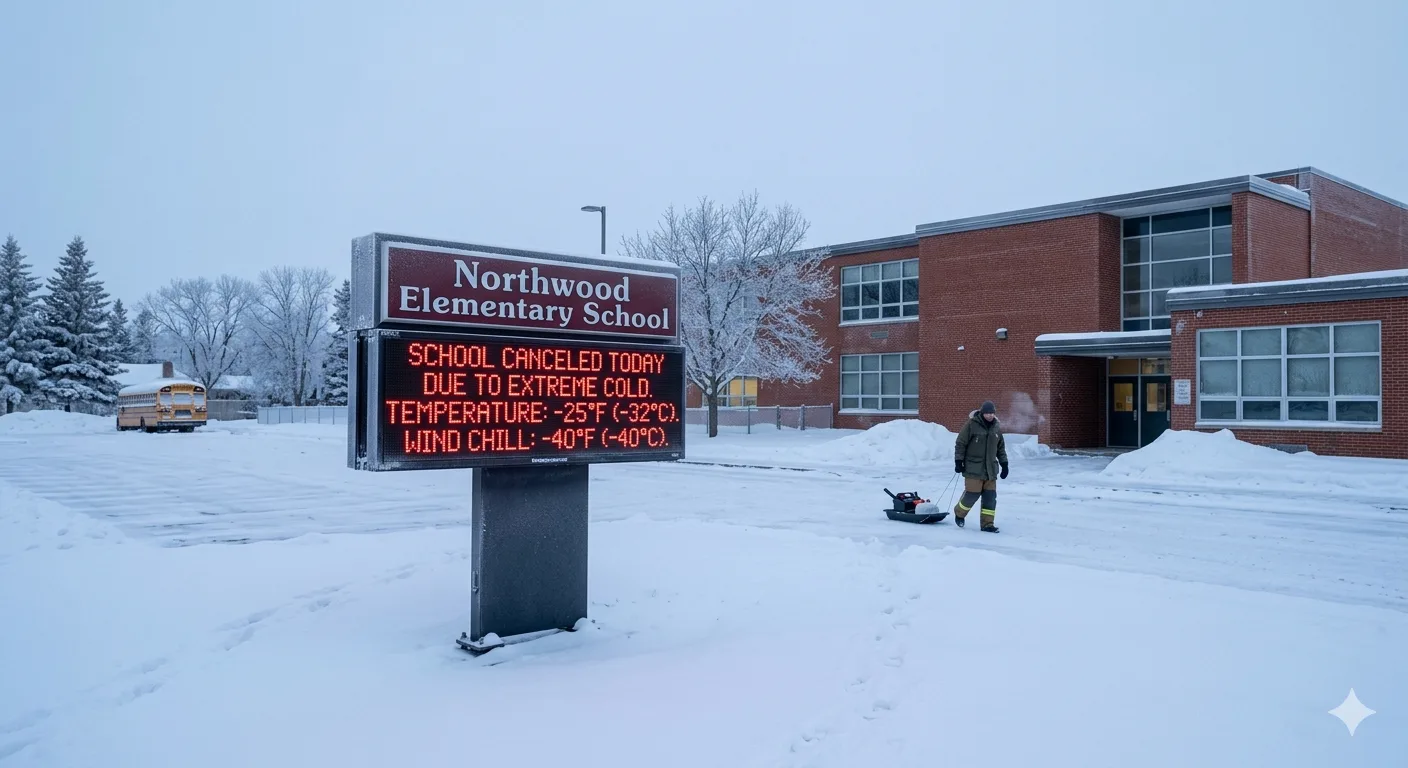
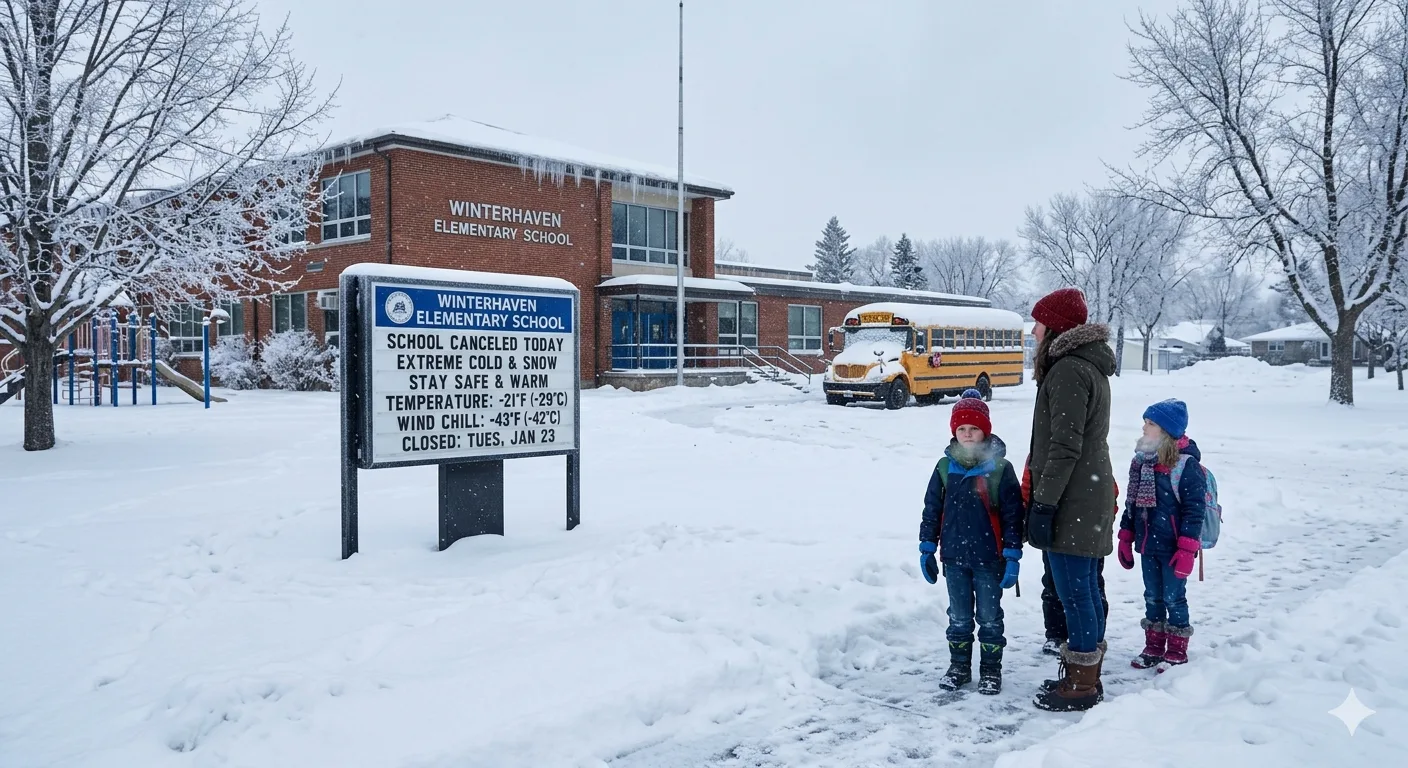
It is 4:30 a.m. The porch thermometer says 2°F, the wind is rattling the fence, and you are refreshing your phone for one message: is school on or off?
Somewhere across town, a superintendent is doing the same thing with a lot more riding on it. They are checking forecasts, calling the transportation director, and sometimes literally starting a bus in a dark parking lot to see if it will turn over.
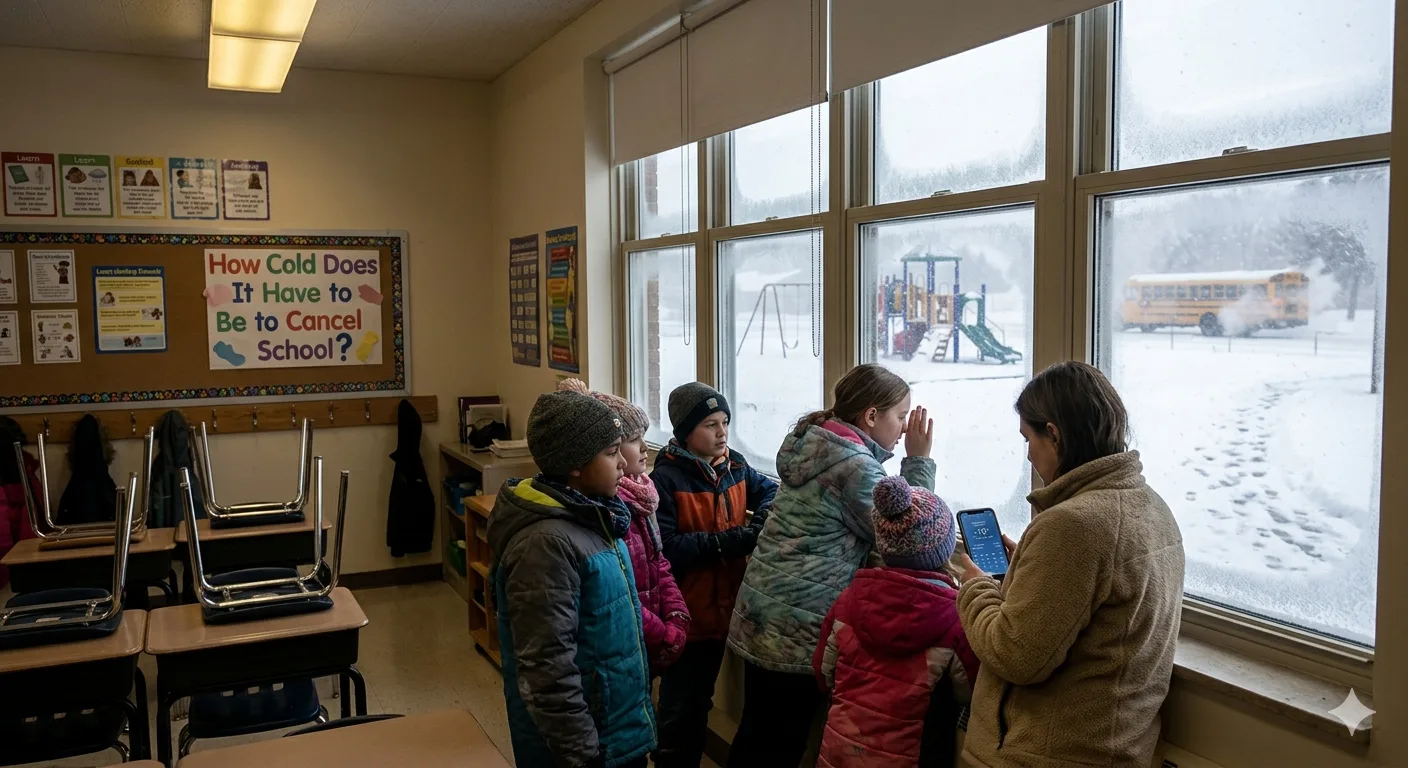
Every winter morning, thousands of superintendents across the country wake up before 4 a.m. and ask themselves the same urgent question: How cold does it have to be to cancel school? The answer is rarely simple. It is a thought decision that looks at wind chill limits, bus reliability whether students have proper clothing how roads are and the real medical risks of frostbite and hypothermia.
In 2026, cold weather accounts for roughly 15% of all U.S. school closures, and that figure continues to climb as extreme weather events become more frequent. If you are a parent waiting for a two‑hour delay, a teacher planning a week or an administrator drafting a policy this guide gives you all the information you need about school cancellation temperatures, wind chill danger zones and the science behind these important decisions.
The Short Answer
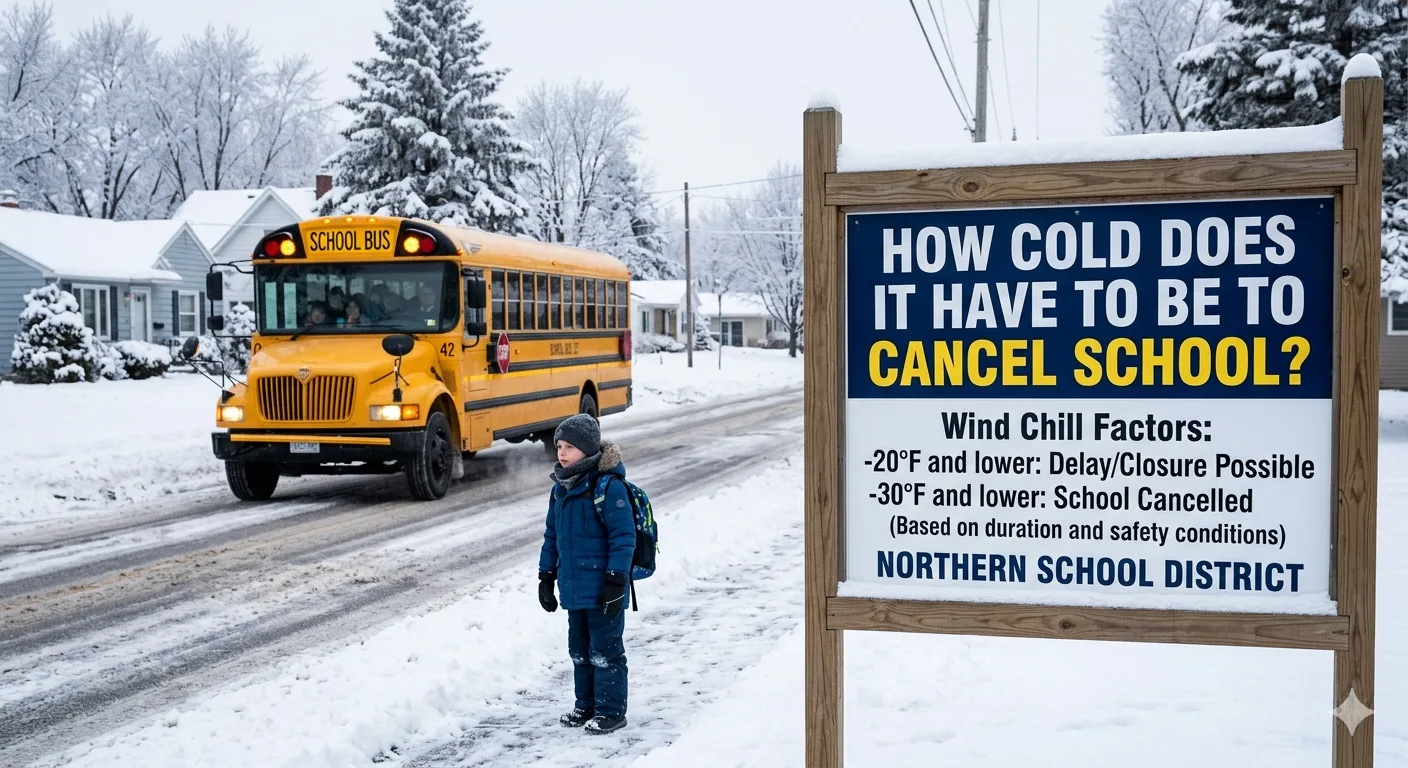
- Most northern US districts start canceling when the sustained wind chill reaches roughly -20°F to -35°F.
- Mid-latitude and southern districts often close at much milder readings, because buses, roads and buildings are not built for deep cold.
- Canadian school buses commonly stop running at about -40 to -45 wind chill (in °C), and the cutoff is often tied to the Environment Canada warning.
- UK schools rarely close for cold alone. Snow, ice, and heating failures are the usual reasons.
- No federal or state law sets a temperature. The call belongs to the district.
The rest of this guide explains why those numbers look the way they do, how to read your own district's pattern, and what to do whether school is open or closed.
Why Wind Chill Matters More Than the Thermometer
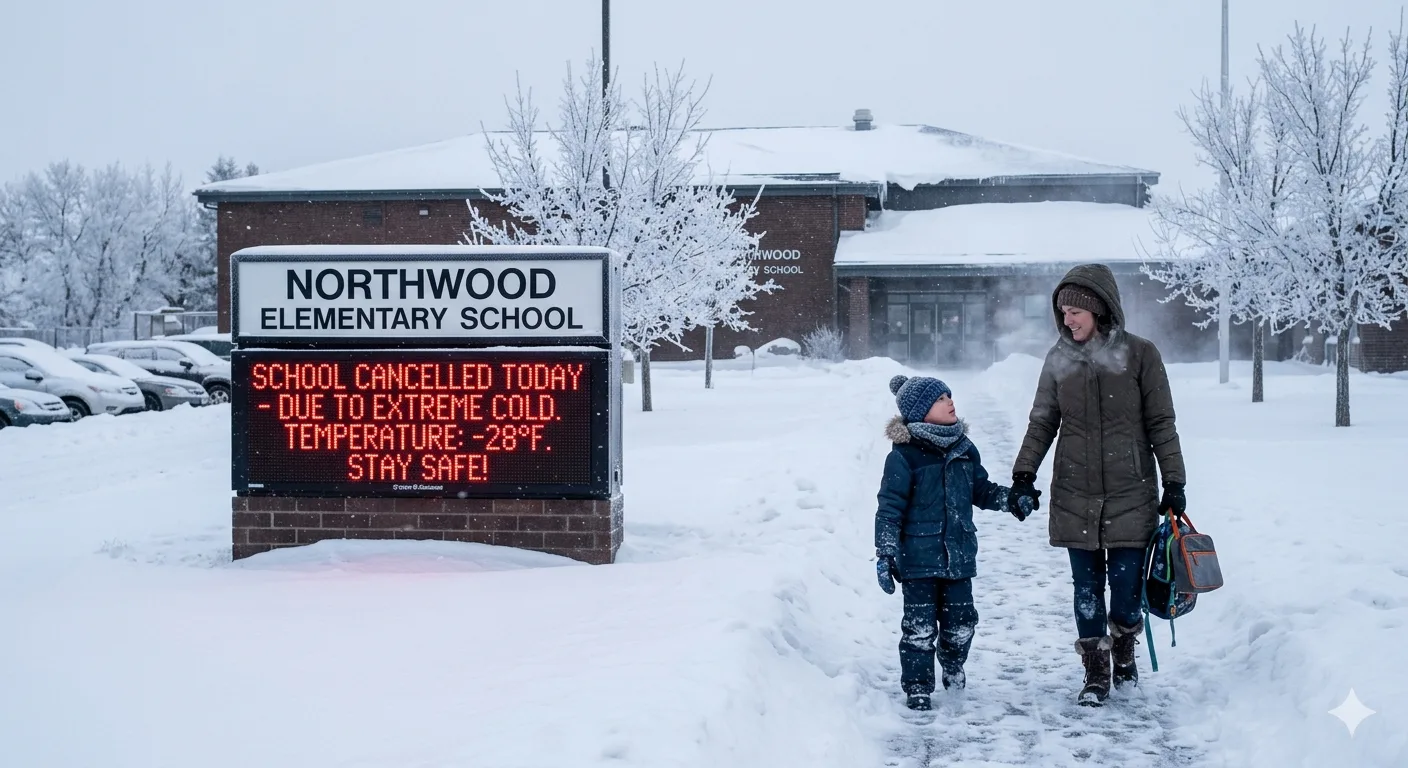
Parents often assume schools close at a certain air temperature. In practice, most districts watch the wind chill, the "feels like" number that shows how fast exposed skin loses heat.
Here is a good example. At 0°F with a 15 mph wind, the wind chill works out to about -19°F. That is the difference between a cold walk to the bus stop and a real frostbite risk for a kid who is waiting around.
The National Weather Service formula behind that number looks like this:
Wind Chill (°F) = 35.74 + 0.6215T - 35.75(V0.16) + 0.4275T(V0.16)
T is the air temperature in °F and V is the wind speed in mph. It only works at or below 50°F, with winds above 3 mph. Plug in 0°F and 15 mph and you get roughly -19°F.
You do not need to do the math by hand. Our wind chill calculator does it in seconds, and it is handy when the forecast gives you a temperature and wind speed but no "feels like" figure.
One Important Detail About Frostbite
Frostbite can only happen when the real air temperature falls below 32°F. Wind speeds up heat loss. It cannot make the air colder than it already is. Hypothermia is a different story. It can develop in much milder weather if someone is wet, underdressed, or stuck outside for a long time.
How Fast Can Frostbite Set In?
This is the science that sits underneath most closure decisions. The estimates below are based on National Weather Service wind chill guidance for exposed adult skin.
| Wind Chill | Rough Time to Frostbite | What Schools Often Do |
|---|---|---|
| -10°F to -19°F | 30 minutes or more | Stay open, move recess indoors, watch the forecast. Some districts delay. |
| -20°F to -29°F | About 15 to 30 minutes | Closures become common, especially in Michigan and Ohio. |
| -30°F to -39°F | About 10 to 15 minutes | Standard cancellation range across the Upper Midwest. |
| -40°F to -49°F | About 5 to 10 minutes | Bus service cut in Canada. Closures nearly everywhere. |
| -50°F and below | 5 minutes or less | Emergency conditions. Expect full shutdowns. |
Treat these as best-case numbers. The wind chill index was built around adult faces. Children have less body mass and lose heat faster, so they can get into trouble sooner than the chart suggests.
Real District Policies: How Cold Is Too Cold?
The examples below come from published or publicly stated district guidance. Policies change from year to year, so use these as patterns rather than promises.
| Area | Typical Trigger |
|---|---|
| Cleveland, OH | Usually open when the air temperature is below zero. Calls come the night before or by about 5 a.m. |
| Parma, OH | Used to be an automatic closure at a sustained -15°F wind chill. The superintendent says they are now more cautious once it reaches double digits below zero. |
| Michigan districts | Around -20°F wind chill is a common line. |
| Southeast Wisconsin | Sustained -35°F wind chill, with the National Weather Service involved in the call. |
| Minneapolis, MN | Likely closure if the 6:30 a.m. forecast shows -35°F wind chill or colder. |
| St. Paul, MN | Closure if the 6 a.m. forecast shows air below -25°F or wind chill below -35°F. |
| Greater Cincinnati, OH | A National Weather Service warning for the start of the school day often starts the closure conversation. |
| Glenview, IL | Closes under an extreme cold warning, stays open under a cold weather advisory. |
| New York City | Does not close for cold alone. Decisions are case by case. |
| Bangor, ME | Cold changes school practices, such as busing walkers, rather than closing buildings. |
| Saskatchewan Rivers, SK | Buses stop at -40, or at -35 with a wind chill of -45. |
| Winnipeg, MB | School bus service is canceled when the wind chill falls below -45. |
| Thunder Bay, ON | Buses are canceled at -40 or colder, wind chill included, at 6 a.m. |
Notice how much the same weather can mean different things. A reading that closes schools in Ohio barely changes the routine in Minnesota. That is not inconsistency. It is each community measuring risk against what its roads, buses and families can handle.
The 7 Things Superintendents Weigh Before Closing
Wind chill is the headline, but it is rarely the only factor. Here is what actually goes into the decision.
1. How Long the Cold Lasts
A brief gust that pushes the wind chill down for ten minutes is not the same as a forecast showing -25°F from 6 a.m. to 9 a.m., exactly when kids are walking and waiting for buses. Sustained readings matter most.
2. Whether the Buses Will Run
Cold is hard on diesel engines. Fuel can thicken, batteries weaken, and systems like wheelchair lifts become less dependable. One Saskatchewan transportation manager put the worry plainly: if a bus with 30 students breaks down on a rural road, you have a serious problem. That is why many bus cutoffs sit lower than the school cutoff.
3. Road Conditions
Road salt becomes less useful as temperatures drop, which is why a superintendent in Michigan said that salting stops helping in cold. Roads that looked fine last night can be slick by morning.
4. How Kids Get to School
Districts with lots of walkers or exposed bus stops tend to close sooner. Not every child has a proper coat, hat and gloves either, so the same wind chill carries more risk for some families than others.
5. Building Heat
Older schools with aging boilers can struggle in a deep freeze. If a building cannot hold a safe temperature, it does not matter how nice the roads are.
6. Local Habits and Equipment
A -10°F wind chill is an emergency in Atlanta and a normal Tuesday in Duluth. Northern districts have the plows, the winter gear and the experience. Southern districts do not, so they close earlier. Neither is wrong.
7. What Closing Costs Families
This one gets overlooked. For many students, school is where they get a warm room and a meal. Closing is a big disruption for working parents, too. That is why most superintendents treat a cold closure as a last resort, not a first move.
How the Decision Gets Made, Hour by Hour
- The evening before: Staff watch the forecast. If the numbers are clearly past the line, some districts call it the night before.
- Around 3 to 4:30 a.m.: Transportation teams check roads and bus starts. Superintendents review hourly wind chill forecasts.
- Around 4:30 to 5:30 a.m.: Neighboring districts often compare notes so families do not end up with a confusing patchwork of open and closed schools.
- By about 5:30 to 6 a.m.: The announcement goes out by text, email, website, social media and local news.
When "Closed" Does Not Mean a Day Off
Since 2020, many districts have moved to e-learning days. Some Greater Cincinnati schools, for example, keep students on remote learning when buildings are closed for cold. Other districts count a closure as a make-up day later.
If you hear "closed," check the message for the words "remote," "virtual," or "e-learning." It could save you a surprise at 8:30 a.m.
How the US, Canada and the UK Compare
United States
The range is wide: from "we almost never close for cold" in places like New York City to a firm -35°F in parts of Wisconsin and Minnesota. Most of the northern tier clusters between -20°F and -35°F.
Canada
Bus cutoffs in the Prairies and northern Ontario are usually tied to -40 or -45 wind chill (in °C). That is far colder than most US triggers. In Saskatchewan Environment Canada says that an extreme cold warning starts at -40°F or colder for at least two hours and the north has a -45°F threshold. Many divisions simply cancel buses first and let families decide whether to bring kids in.
United Kingdom
You will almost never see a UK school close because the thermometer hit a certain low. Headteachers decide based on whether staff and pupils can get in safely, whether the site is clear of ice, and whether the heating works. Met Office snow and ice warnings, especially amber or red, are the signal to watch. A burst pipe or boiler failure can close a school on a mild day.
The same "feels like" thinking applies at the other end of the year, too. In heat waves, our heat index calculator helps you see when summer conditions get risky for kids outdoors.
Read More : How Do Schools Decide Snow Days
How to Predict a Snow Day or Cold Day Before the Alert Arrives
I built the snow day calculator after seeing parents in my area confused about school closures. People were guessing, screenshotting forecasts, and asking each other in group chats. A little structure helps.
Here is a simple way to make your own prediction.
- Find your district's pattern. Search your district's website for "inclement weather" or "cold weather." If there is no number, look at past closures and write down the wind chill on those days.
- Check the hourly forecast, not the daily low. You want the wind chill between about 6 a.m. and 9 a.m., when kids travel.
- Run the numbers. Enter the temperature and wind speed into the wind chill calculator to see the real feel.
- Look for official warnings. An extreme cold warning (or the older "wind chill warning" some policies still use) is a strong sign that the district will at least discuss closing.
- Ask about buses. If your area has routes or an older bus fleet bus problems can close school even when the wind chill looks borderline.
- Check for ice or freezing rain. Cold plus moisture is its own problem. Our rain delay calculator is useful on mornings when the issue is wet, slippery conditions rather than raw cold.
- Wait for the official word. This is the most important step.
In my opinion no calculator can replace the school district announcement. A tool like mine can help you plan ahead and prepare, but your district has information I do not, like bus mechanics' reports, road crew updates and building conditions. Use any prediction as a head start, never as the final answer.
What to Do If School Stays Open on a Dangerously Cold Day
Many districts stay open in tough weather so having a plan helps.
Dress for the Wait, Not the Walk
- Layer: A thermal base layer, an insulating middle layer, and a wind-resistant outer layer.
- Choose mittens over gloves. Fingers stay warmer when they share heat.
- Cover every inch: Hat, neck gaiter or scarf, and a face covering for ears, nose and cheeks.
- Keep it dry. Wet socks and gloves lose insulation fast, so pack a spare pair in the backpack.
Shorten the Time Outside
- Wait indoors until the bus is visible, if you can.
- Drive kids to the stop or school on the coldest mornings.
- Pick a warm backup spot along the route (a neighbor, a shop, a library) and make sure your child knows where it is.
Know the Warning Signs
- Frostnip and early frostbite: Skin turns red, then pale or white, and feels numb or tingly.
- Hypothermia: Shivering, slurred speech, clumsiness, unusual sleepiness.
- What to do: Get indoors, remove wet clothing, warm the body gradually with dry layers, and do not rub frostbitten skin. If a child looks hard waxy or blistered or seems confused seek help.
You Can Usually Keep Your Child Home
Most districts let parents keep children home in weather as long as they notify the school. If your child’s route is long or exposed trust your judgment. And if you are short on winter gear, call the school office. Many schools keep spare coats, hats and gloves or can connect you with local programs.
-
The Night-Before and Morning-Of Checklist
The night before:
- Sign up for your district's text and email alerts.
- Lay out layers, mittens and a spare pair of socks.
- Check the hourly forecast for 6 a.m. to 9 a.m.
- Plan childcare in case of a delay or closure.
The morning of:
-
Check the district website, not just social media posts.
-
Read the message for e‑learning or delayed‑start details.
-
Confirm bus changes, such as stops or earlier pickups.
- Check on indoor recess and after-school plans.
What's Different Heading Into Winter 2026-27
A few shifts are worth knowing about as the new season starts.
- New warning names. The National Weather Service now uses "extreme cold warning" and "cold weather advisory" instead of the old wind chill alerts. Some district policies still use the wording so check which one applies.
-
More e‑learning days. Remote days are now a backup, in many districts, which changes how many leaders think about closing.
- More conservative calls. Some superintendents say they are more cautious than they used to be, closing earlier than older policies would have suggested.
- Faster alerts. Many districts send text and app notifications as soon as a decision is made, so turn those on.
Conclusion
So, how cold does it have to be to cancel school? In much of the northern US, sustained wind chills between -20°F and -35°F do the trick. In Canada, expect -40 or colder for bus cancellations. In the UK, cold alone is rarely the cause, and snow, ice or heating problems matter more.
What stays the same everywhere is the logic: frostbite timelines, bus reliability, road conditions, building heat, and how many families can cope with a closure. Learn your district’s pattern watch the 6 a.m. To 9 a.m. Wind chill. Keep warm gear ready.
When the next cold snap hits, give our snow day calculator a try for a quick read on your odds, and check the wind chill calculator for the real feel. You can also explore everything else we offer on our full list of weather calculators. Then wait for your district's official announcement, because that is the one that counts.