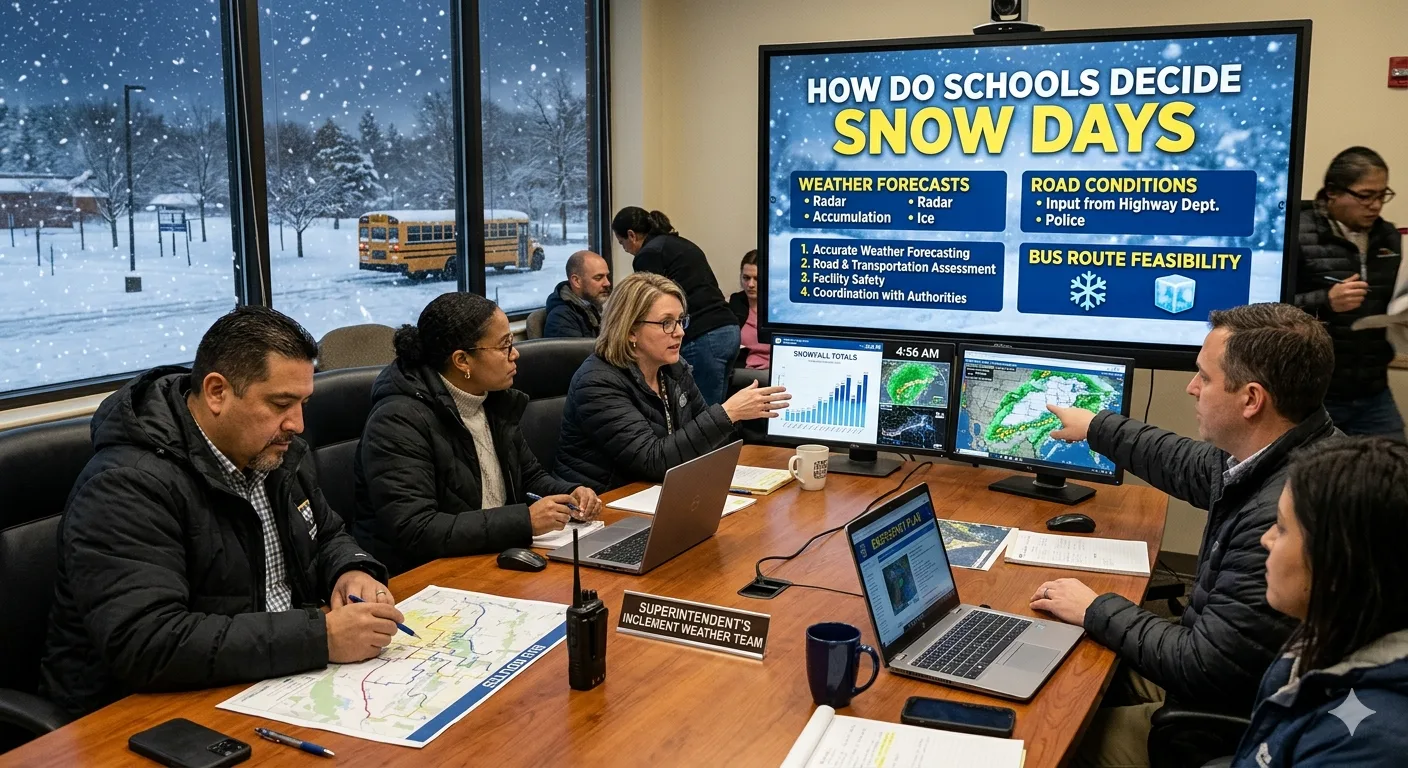
It's 5:40 AM. Your phone buzzes. Or it doesn't, and you spend the next twenty minutes refreshing a website, wondering whether to pack lunches or pour a second coffee.
If you have ever asked how do schools decide snow days, you are not alone. I built my own snow day calculator after watching parents in my area get completely tangled up over school closures. Everyone was guessing, and nobody could see why one district shut down while the next town over carried on as normal.
Here is the short version: the decision is rarely about how much snow is on the ground. The outcome depends on timing, ice, bus routes and a few quiet factors that most families never hear about. This guide walks through all of it, for the US, Canada, and the UK, so you can read the signs before the official message lands.
Who Actually Makes the Snow Day Decision?
It depends on where you live, and that single detail explains a lot of confusion.
- United States: The district superintendent makes the final call, usually after talking with the transportation director, the facilities manager, and local road crews.
- Canada: A regional school board or centre for education decides, often alongside a busing consortium. Officials normally begin collecting information before dawn calling a weather forecaster and speaking with contacts at the municipal and provincial road departments.
- United Kingdom: The headteacher decides, school by school, often with the chair of governors. The local council then lists the closure on its emergency closures page.
That last difference matters. In the UK, two schools a mile apart can make different choices because each head is judging their own car park, their own staff, and their own front gate. In the US and Canada, one decision usually covers a whole district.
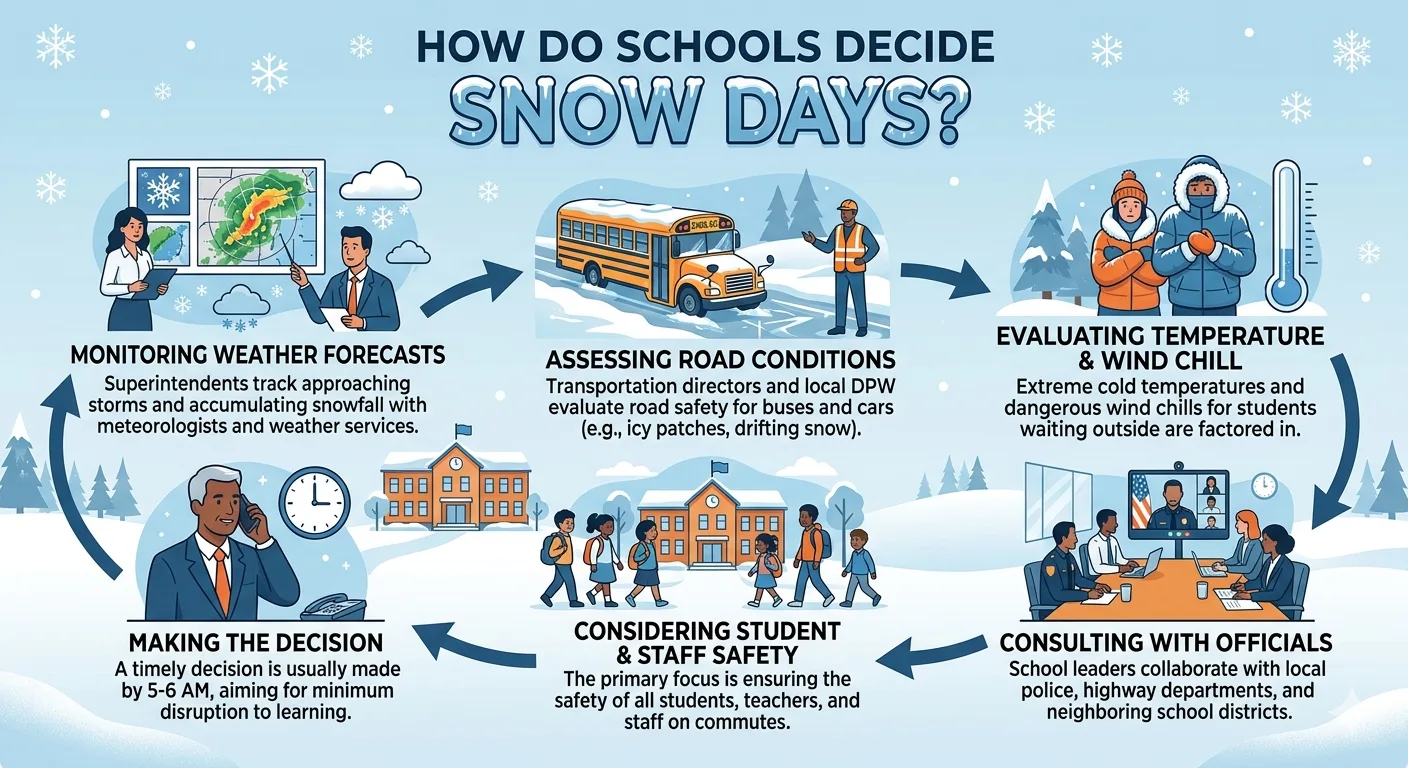
The people in the background
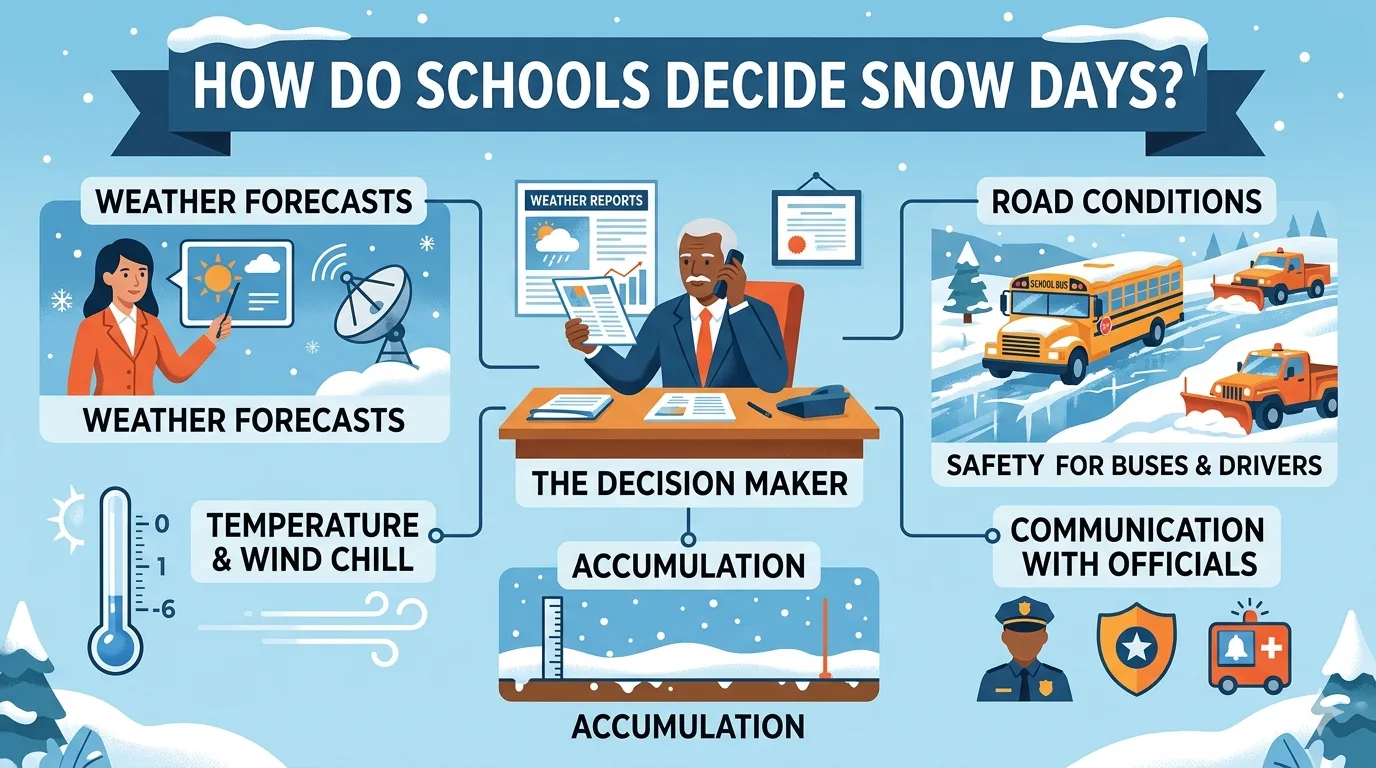
Whoever signs off, they rarely work alone. A typical decision team includes:
- Transportation staff, who know which bus routes turn icy first
- Facilities or site managers, who check heating, parking lots, and walkways
- Local police or road authorities, who report on main roads
- Neighboring districts or schools, so families are not hit with contradictory messages
- A private or public meteorologist, in many larger districts
The Snow Day Decision Timeline, Step by Step
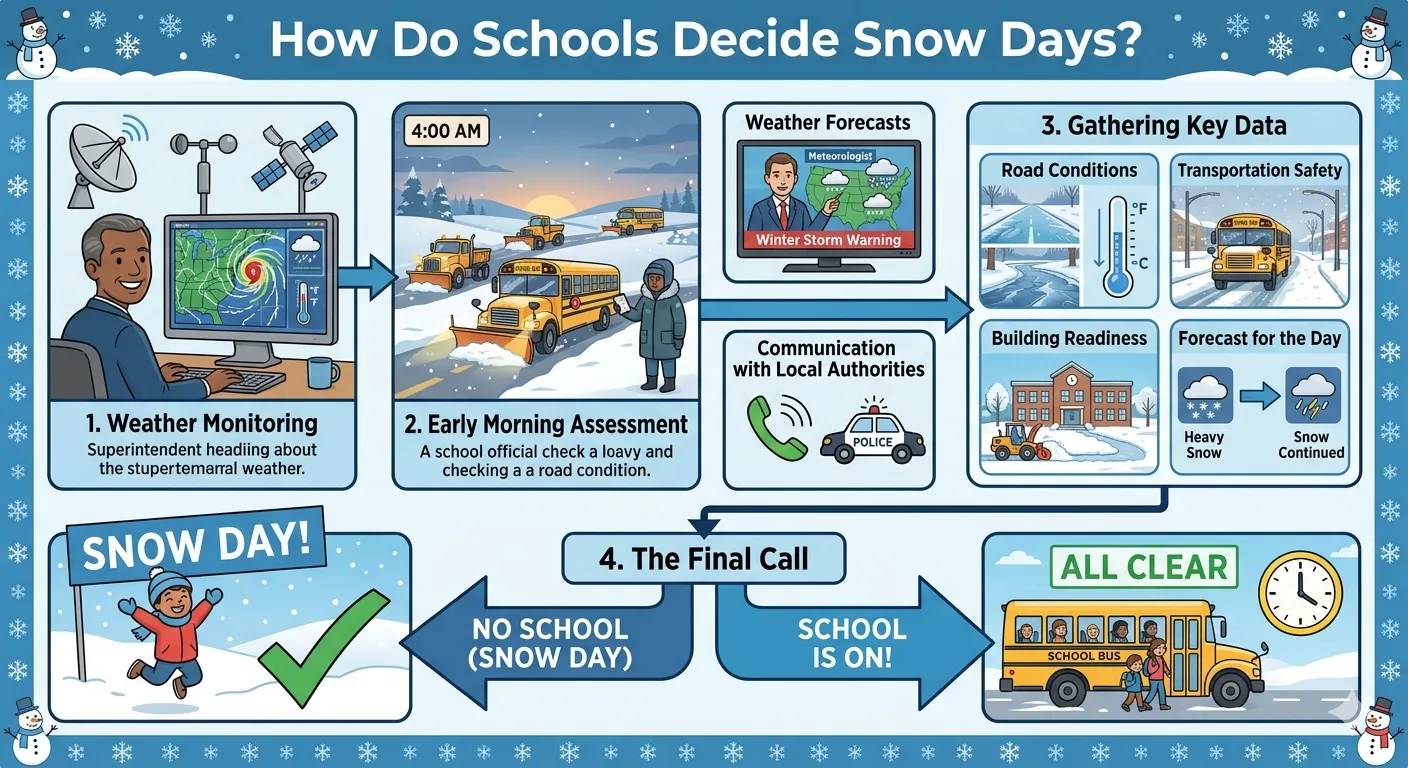
The call you receive at 5:45 AM is the end of a process that often starts days earlier. Here is how a well-run district typically moves.
- Several days out: Administrators watch the extended forecast. No decision is made yet. Backup plans quietly begin to form.
- The day before: If a storm looks real, transportation and facilities teams are put on alert. Backup drivers are lined up and boilers are checked.
- Around 3:00 to 4:30 AM: Road spotters and transportation staff physically drive the toughest routes in the dark. Officials search for ice drifting snow, poor visibility and untreated hills.
- Around 4:30 to 5:00 AM: Phone calls with forecasters and neighboring districts. This is when conflicting reports get compared.
- The bus window: The question everyone is really answering is whether the roads will be safe when the first buses leave.
- Around 5:30 to 6:00 AM (US and Canada): The decision goes out by automated call, text, email, website, app, and social media. UK schools often confirm a little later, commonly by about 7:30 AM, once staff have reported in.
Notice how late the real information arrives. A forecast made at 9 PM can be wrong by 4 AM, which is exactly why most districts wait until the morning instead of deciding the night before.
The Six Factors That Matter Most
No two districts use the same formula, and most have no fixed snowfall number that triggers a closure. Some places close for a few inches at the wrong moment. Others stay open through a foot of snow that plow crews can keep up with. Still, the same six factors show up again and again.
1. Storm timing
This is the big one. Ten centimetres falling on a Saturday barely registers. Two or three centimetres arriving between 4 and 7 AM on a Monday can shut a whole region.
2. Bus route safety
Main roads are rarely the problem. Hilly back roads, gravel lanes, and narrow cul-de-sacs are. A single route that buses cannot safely travel can affect hundreds of students.
3. Ice and freezing rain
A thin glaze of ice is far more dangerous than a deep layer of dry snow. Buses can plow through snow. They cannot grip glare ice.
4. Snowfall rate
When snow falls faster than an inch (2.5 cm) every hour the snow plows have a hard time keeping up. Conditions can get worse between each time the plows go through.
5. Wind chill and extreme cold
Children waiting at exposed bus stops are the concern here. Cold thresholds vary a lot by region. Many Canadian boards, for example, set their own limits that are much lower than you would see in the southern US, so always check your own district's policy. If you want to see how cold the air actually feels, try this wind chill calculator.
6. Building and staff readiness
A school that cannot heat its classrooms, clear its entrance, or field enough staff cannot open safely, even if the roads look fine. A failed boiler in an old building can close a school on its own.
Snow Type and Ground Temperature: The Details Most People Miss
Not all snow behaves the same way, and experienced administrators and forecasters know it.
- Wet, heavy snow (low snow-to-liquid ratio, roughly 5:1 to 10:1) weighs a lot. Snow snaps branches brings down power lines and can cut electricity to a school.
- Dry, fluffy snow (high ratio, 15:1 to 20:1 or more) is easier to plow but blows around easily. Drifting snow and whiteouts can keep roads dangerous after the snow stops.
Surface temperature is the other hidden factor. If roads and pavement have been well below freezing for a day or two, even light snow bonds to the surface and turns into slick, packed ice. If the ground is above freezing, the same snow may melt on contact and cause little trouble.
This is why a "small" storm after a deep freeze can cause more closures than a bigger storm after a mild week.
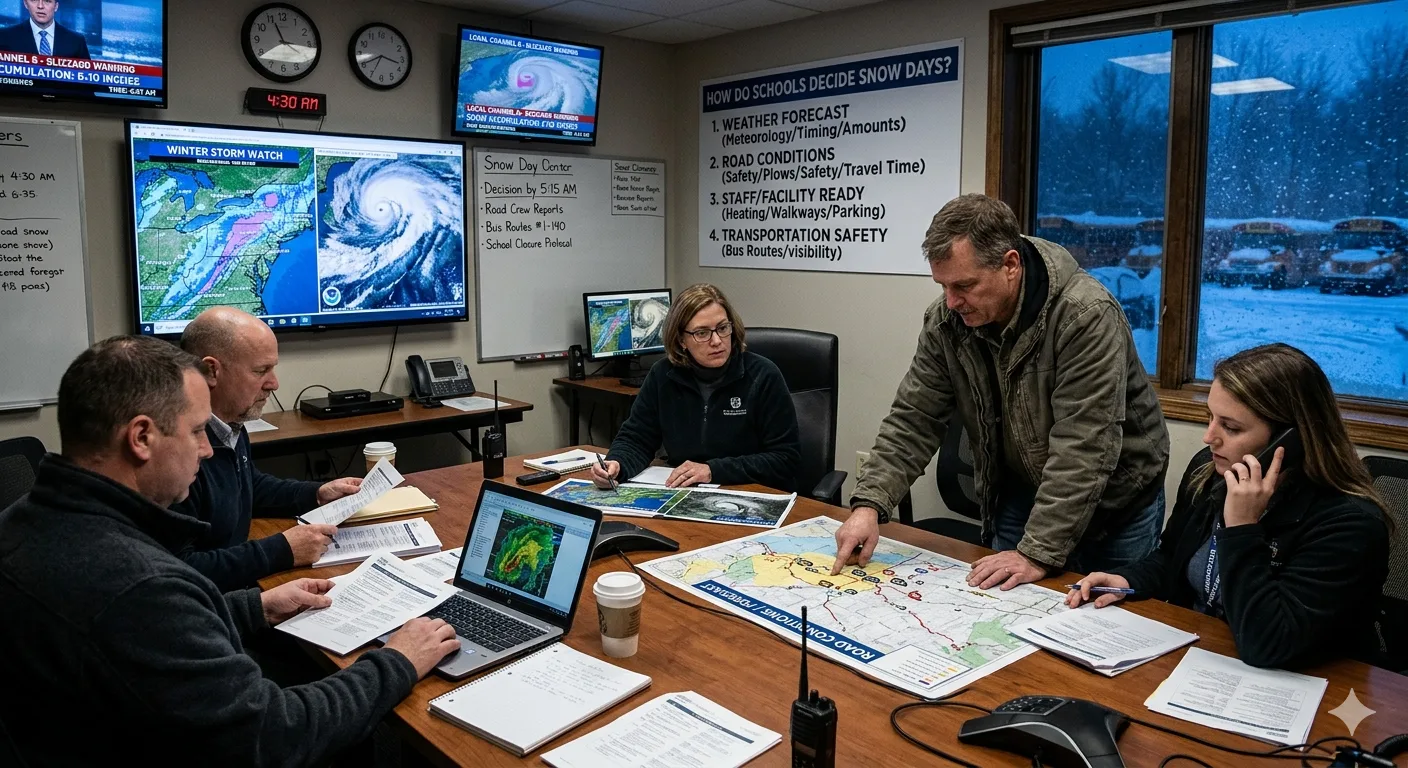
Why Your Neighbors School Is Open When Yours Is Closed
It feels unfair. There are real reasons for this.
- Urban versus rural: City districts get faster plowing and salting. Rural districts may have many kilometres of lightly traveled roads that wait hours for a plow.
- Lake-effect zones: Near the Great Lakes, snow bands can drop several inches per hour on one town and almost nothing on the next one just a few miles away.
- Hills and elevation: A road that looks fine at the bottom of a hill can be a sheet of ice at the top, where it is colder.
-
Local rules: Different school boards, different bus contractors and different policies cause outcomes even in the same storm.
Rough closure thresholds by region
These are general patterns, not rules. Your own district's habits matter more.
| Region | Typical snow that starts to cause closures | Ice sensitivity |
|---|---|---|
| Deep South (GA, AL, SC) | 1 to 2 inches | Very high |
| Mid-Atlantic (VA, MD, DC) | 2 to 4 inches | High |
| Midwest (OH, MI, IN) | 4 to 6 inches | Medium |
| Great Lakes and Upstate NY | 6 to 12+ inches | Medium |
| New England | 8 to 15+ inches | Lower |
| Pacific Northwest | 1 to 3 inches | High |
| UK (most of England) | A few centimetres can be enough, especially with ice | High |
The pattern is simple. The less often a region sees snow, the lower its tolerance. Places with little snow have fewer plows, fewer salt supplies, and drivers with less winter experience.
The Hidden Factors Parents Rarely Hear About
Food and care for students
For many families, school is where breakfast and lunch come from. School also provides supervised care while parents work. Administrators know that a closure can create hardship, which is part of why some of them agonize over borderline mornings.
The calendar cushion (the "calamity day bank")
In many US states, districts build a few spare days into the calendar. Once closures are used up extra closures may mean a school year or lost vacation days. That is why December closures can come more easily than February or March ones. Canada and the UK handle this differently so check how your board or school treats lost days.
Staff availability
If too many teachers or bus drivers cannot get in, the school may close or open late, even with passable main roads. This is a major factor for UK headteachers, who often ask staff to report their travel situation before 7:30 AM.
Power outages and building damage
Wet snow, ice, and wind can knock out power or damage a roof. Weather does not have to be on the roads to close a school.
Delay, Closure, or Remote Day? How Districts Choose
When a delay makes sense
- The snow has stopped, but crews still need a couple of hours to finish plowing
- Temperatures are climbing and will soon melt overnight ice
- Side streets and bus routes are the only trouble spots
When a full closure is more likely
- Snow or freezing rain is still falling and is expected to continue
- Ice is widespread with no warming in sight
- Dangerous cold will last the whole day
- A heating failure or power outage affects the buildings
The remote learning option in 2026
Since the pandemic, many districts have asked whether a snow day can become a remote learning day. The answer varies widely by state, province and district. Some places allow it freely, some cap the number of days, and some still require make-up days.
The results have been mixed. Attendance can drop younger students struggle without a parent at home and short notice makes it hard for teachers to plan. Because of that, plenty of districts still prefer a traditional snow day for sudden storms and save remote days for storms they can see coming. Check your district's current policy, because it may change from year to year.
How to Predict a Snow Day Before the Official Call
I'll be upfront about something. I built a calculator because families wanted answers. I also believe no calculator can replace the official school district announcement. A prediction tool is a planning aid. The district's message is the final word.
With that in mind here is a routine that actually helps.
The night before
- Check the hourly forecast, not just the daily total. Look for when snow or ice starts and stops. Anything active between 4 and 8 AM is the danger zone.
- Look for ice. If the forecast mentions freezing rain treat it seriously than the snowfall number.
-
Check temperatures. A hard freeze means any snow will stick and ice up faster.
- Sign up for alerts. Make sure your phone number and email are current with the school or district, and turn on app notifications.
- Run a probability estimate. Use the snow day calculator for a quick read on the odds, and treat it as a guide, not a promise.
The morning of
- Check your district website or app first, since it is usually updated before anywhere else.
- Look at local radio, TV, or your council or board closures page for the official list.
- Watch what neighboring districts do. If several schools close yours may follow.
- Do not drive on a hunch. If the message has not arrived, wait for it.
Build a backup plan now
The families who handle snow days best are the ones who prepared in October, not at 5:50 AM. Talk to a neighbor or relative about swapping care. Ask your employer about flexible hours. Keep a non-perishable lunch items and some indoor activities ready.
Read More : Snow Day Calculator Canada
Beyond Snow: Other Weather That Closes Schools
Snow gets the attention, but schools make similar calls for other conditions. looding and heavy downpours can block roads and buildings. A rain delay calculator helps you judge how a storm might disrupt your day. Summer and early-fall heat can also push schools to adjust schedules and a heat index calculator shows how hot it truly feels. If you want to explore more weather tools in one place, you will find them all on the full calculators page.
What to Expect From Snow Days in 2026 and Beyond
- Faster, smarter alerts. More districts now rely on text and app notifications of waiting for local broadcasts.
-
Better data. Some districts use road sensors and detailed forecast tools to support the decision.
- Flexible learning plans. Remote days are likely to remain part of the picture, but with more attention to when they actually work.
- More extreme storms. Climate researchers point to more intense precipitation events, in a warming climate. That can mean small dustings and more serious storms.
Tips for Parents: How to Predict a Snow Day Before the Official Call
Even though no parent can know for sure when there will be a snow day knowing how the process works helps you get ready better.
- Monitor the 5-day forecast actively. If a major storm is in the outlook, begin making contingency plans early. Do not wait for the official call.
- Check the storm timing. Snow that arrives between midnight and 4 AM and continues through morning is the highest-risk window for a closure. Snow that stops by 2 AM makes it less likely that there will be a closure.
-
Look closely at ice forecasts. Even a small amount of freezing rain like half an inch can cause a school closure, than a lot of light snow.
- Follow your superintendent on social media. Many superintendents now post real-time updates directly to their personal or district social media accounts in the early morning hours.
- Know your district's calamity day status. Districts running low on banked days in February or March are statistically less likely to call a closure than they would be in December.
- Use online snow day calculators as a rough guide. Tools like Snow Day Calculator analyze the same meteorological data superintendents use. They offer a probability estimate, not a guarantee, but can inform planning decisions.
Conclusion
So, how do schools decide snow days? They weigh timing, ice, bus routes, cold, building readiness, staffing, and the school calendar, usually in the dark hours before dawn. It is a judgment call, and a hard one.
Once you understand what decision-makers are looking at the mystery fades. You can watch the same signs they do, plan your morning, and avoid the last-minute scramble. Just remember that predictions are only predictions, and the official district announcement is the one that counts.
Also Checkout :