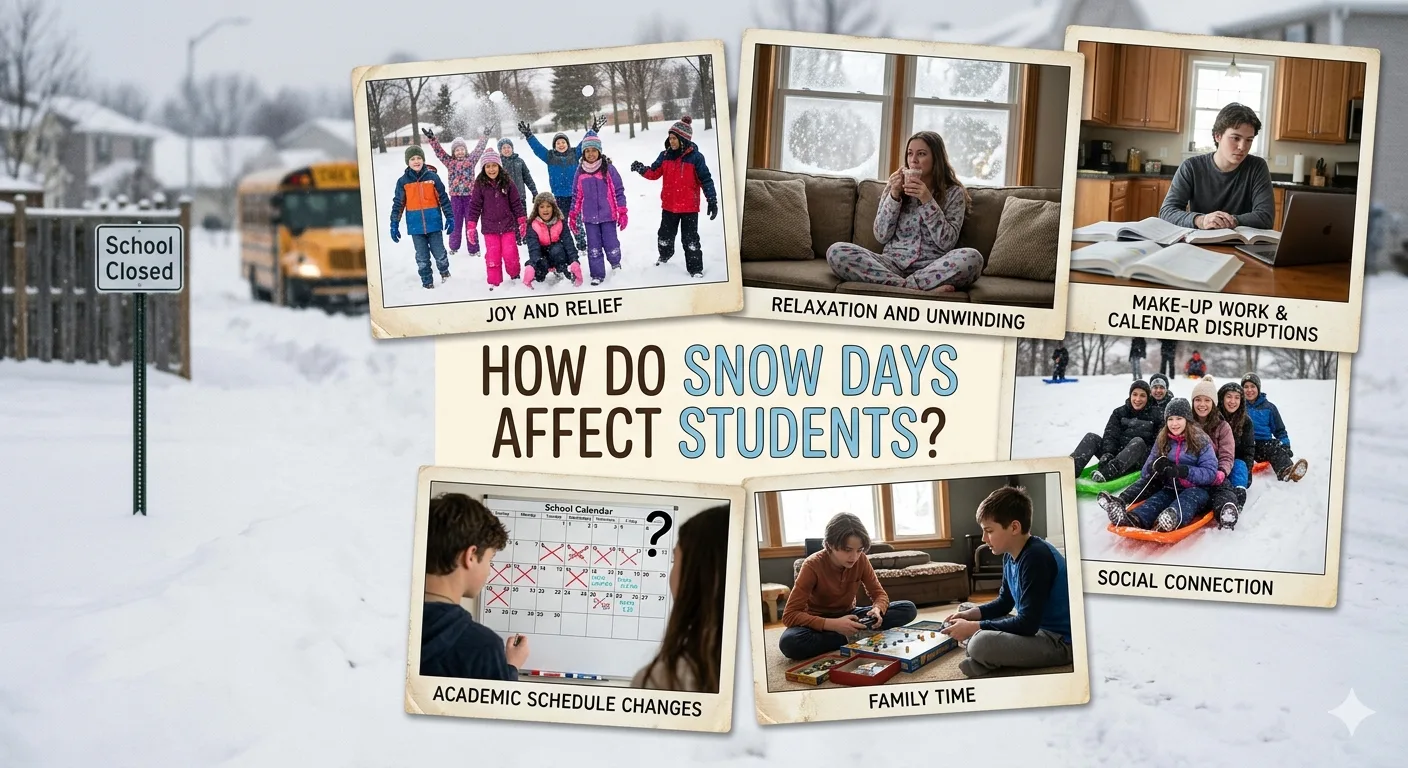
Snow days feel magical from a child's perspective, but for educators, parents, and school administrators, the picture is far more complicated. Research now reveals that these unplanned closures ripple through academics, mental health, nutrition, family economics, and more.
Every winter, millions of students across the United States wake up to the thrilling news of a school closure. Snowflakes mean sledding, hot chocolate, and freedom from homework. But underneath that joy lies a web of consequences that administrators, teachers, parents, and policymakers must carefully navigate. How do snow days affect students? The answer spans learning loss, mental health benefits, food insecurity risks, social disruption, and long-term academic consequences.
It's 6 a.m., the phone buzzes, and the whole house changes mood. The kids are cheering. One parent is already doing the math on who can work from home. A teacher somewhere is quietly rearranging a unit plan for the third time this month.
Same snowstorm, very different reactions. So how do snow days affect students really? Is a day off a treat a small setback or something in between?
The honest answer is more interesting than either side of the argument. The learning cost is smaller than most people assume. The hidden costs land on meals, childcare, and kids who are already stretched. And since the massive January 2026 storm, which forced thousands of schools to change plans across more than 40 states, the classic snow day has a new rival: the remote learning day.
This guide walks through what studies found where the popular numbers are misleading and what parents, teachers and school leaders can do about it. If you're reading this the night before a forecast storm our snow day calculator can give you a quick estimate of tomorrow's odds.
What Snow Days Do to Learning
This is the question everyone asks first, and the research is genuinely mixed.
Economists Dave Marcotte and Benjamin Hansen studied data from several states and found that the share of students passing math tests dropped by about a third to a half of a percentage point for each day school was closed. That's a real effect, though a small one. Earlier work in Maryland also found somewhat lower scores in years with more snow days.
Then came Harvard economist Joshua Goodman, who looked at Massachusetts data from 2003 to 2010 and found something surprising. Winters with lots of heavy snow, the kind that closes schools outright, showed no drop in test scores. But years with more moderate snow days, roughly 4 to 10 inches, were linked to lower math scores.
Why? Because moderate snow often doesn't close schools. Classes go on, attendance drops sharply (especially among lower-income students), and teachers end up splitting their attention between kids who are there and kids who aren't. Goodman did find small negative effects for high-poverty schools even from closures, so the picture isn't perfectly rosy.
The "1% per snow day" claim
You'll see this number in a lot of articles, so let's be clear about it. One day out of a 180-day year is a little over half a percent. That's arithmetic, not a research finding. It assumes every hour of school produces the same learning and that none of it can be recovered, and studies suggest schools are pretty good at recovering it when the whole district closes at once.
In Goodman's own words, snow days are "less disruptive than other forms of lost instructional time," because a coordinated closure is easier to plan around than scattered absences.
2. The Problem With Staying Open
This is the part that gets overlooked. When a district decides to hold school during a storm, families make their own call. Some send their kids, some don't, and the result is a half-empty classroom.
Teachers then face a no-win choice. Teach new material and the absent kids fall behind. Repeat old material and the present kids get bored. There's also research suggesting students learn less when their classmates are frequently absent, which makes whole-class teaching harder.
My take: this is the strongest argument for closing decisively when conditions are truly bad. A clear closure protects safety and often protects learning too.
3. Curriculum Pressure and Teacher Stress
Behind every closure is a teacher rethinking a schedule. The pain is sharpest in courses tied to fixed external dates. AP exams, for example, are held on set days each May, and a storm in February doesn't move them. A couple of lost days can mean skipped review time or a squeezed unit.
Teachers cope in a few ways: shifting to independent work compressing review or trading lessons with colleagues to keep pacing aligned. None of it is dramatic. It adds up especially when several storms hit in a row.
4. Mental Health, Play, and the Case for a Day Off
Not every effect is a cost. A 2024 study in the Alberta Journal of Educational Research interviewed teachers and administrators in Canadian elementary schools about weather closures. They took a positive view, pointing to benefits for student mental health and useful planning time for staff, though they worried if closures became too frequent.
Worth noting: that study captures educators' perceptions rather than measuring student outcomes directly. Even so, it matches what many parents see. A surprise day of rest, outdoor play, and unhurried time with family can lower the temperature for a stressed kid.
Goodman put it well in an interview: snow days create memories with friends and family that may matter as much as one day of school. I'd go a step further. For students running on fumes in February, an unplanned break might be the one time all winter nobody is asking them to perform.
5. Food Insecurity: The Hidden Cost
For many kids, school is where the reliable meals are. In a 2025 survey of 1,000 K-12 teachers three in four said they see students come to school hungry at least monthly and roughly six in ten knew firsthand that their students were experiencing hunger.
When school closes suddenly that safety net disappears overnight. A snow day can mean skipped breakfast and a thin lunch for children who already have margin. Hunger also affects concentration and mood which makes the return to school harder.
What families can do
-
Keep a shelf-stable meals on hand before winter starts, like pasta, canned soup, peanut butter and oatmeal.
-
Check your districts website or social media for grab-and-go meal announcements on closure days.
-
Ask a neighbor or relative if you're short. Most people are glad to help during a storm.
-
In the U.S. you can dial 211 to find food pantries and community assistance.
What schools can do
Some districts partner with food banks or send meal bags home when heavy snow is in the forecast. It's a low-cost habit that pays off. Its worth setting up before the first storm rather than during it.

6. Routine, Behavior and the Day After
Kids run on routine and a surprise day off scrambles it. Teachers often notice restlessness and off-task behavior on the first day back especially with younger children and students who struggle with transitions.
Students with ADHD, autism or anxiety can find the disruption harder since predictability is a part of how they stay regulated. A single day off can take a days to settle for some of them.
A simple fix for parents: keep bedtime and wake-up time the same during a snow day and build a light structure into the day. A walk, a meal at the time and a little reading go a long way toward making Monday less rough.
7. Working Families and the Childcare Scramble
Snow days are a joy for kids and a headache for parents who can't work from home. Nurses, retail staff, factory workers and restaurant employees often can't simply stay in. That leaves them choosing between lost pay and last-minute childcare.
The burden falls hardest on parents and hourly workers without paid leave. When Charlotte-Mecklenburg Schools in North Carolina moved to learning after the January 2026 storm families were reminded that remote days create real logistical and financial strain for households without backup childcare.
If you're a parent, a backup plan made in advance helps enormously. Line up one or two adults who can cover ask your employer about arrangements before winter and keep a list of activities the kids can do without constant supervision.
8. Remote Snow Days: A Fix or a New Problem?
This is where 2026 changed the conversation. During the January storm, New York City, the country's largest school system, moved about half a million students to remote learning instead of calling a traditional snow day. Other districts did the same, while some simply closed.
The results were mixed. In New York, reporting found that about one in five students never logged on, and one fifth-grade teacher said around 70 percent of her class showed up. Many of those who did kept cameras off. She wisely spent the day on independent reading and review rather than new material, which is exactly what the research on low-attendance days suggests.
The rules also vary a lot by state. Some states, including Massachusetts and Arkansas, don't let remote days count toward required instructional time at all. North Carolina, by contrast, allows districts five remote days per year for emergencies. In Charlotte, students did independent work with no live sessions.
The digital divide problem
Remote days quietly assume every child has a working device, internet, a quiet spot and an adult who can help. Many households don't. For families families sharing one laptop among several kids and students whose disability accommodations don't translate online a virtual day can be a day of falling behind.
If your district uses days it helps to ask what the plan is for students without reliable internet. Good answers include packets, loaner devices and mobile hotspots.
9. Make-Up Days and a Crowded Calendar
Most districts build a few weather days into the calendar. When those run out, the school year stretches or breaks shrink. After the January 2026 storm, Memphis-Shelby County Schools missed ten days to an ice storm and received a state waiver for five of them, so not every missed day had to be made up. Some states, like Michigan, automatically excuse a set number of weather days.
For families, late calendar changes cause real headaches, from shortened spring breaks to cancelled travel plans. For seniors, a compressed spring semester can crowd exams, graduation events, and college deadlines into fewer weeks.
Read More : Snow Day Calculator New York
10. Safety, Social Life, and Other Trade-offs
Then there's the reason snow days exist in the first place: safety. Icy roads, unplowed side streets, and tricky bus routes are the obvious concerns. Extreme cold is the quieter one. Kids waiting at bus stops or walking to school can face dangerous conditions even when there's little snow, so it's worth checking the wind chill calculator before deciding whether a morning walk is safe.
Not every decision has to be all or nothing. Some districts use two-hour delays to give crews time to roads, which lets kids get a full day of school and helps working parents too. Others plan around the weather more broadly. If you coordinate outdoor practices or field trips, a rain delay calculator is a useful tool when the storm is freezing rain rather than snow.
Weather closures aren't only a winter story, either. Extreme heat now closes or shortens school days in some places, and the heat index calculator can help families judge how dangerous a hot afternoon really is.
Finally there's the side. School is where kids see their friends work on group projects and get support from trusted adults. A day off barely matters but for isolated students repeated closures can hurt.
Snow Day Effects at a Glance
| Area | Who feels it most | What helps |
|---|---|---|
| Learning | Students in high-poverty schools, math learners | Clear closures, review lessons, built-in weather days |
| Staying open on stormy days | Low-income students with transportation barriers | Close decisively when conditions are bad |
| Meals and nutrition | Students who rely on school breakfast and lunch | Grab-and-go meals, food bank partnerships |
| Childcare and income | Single parents, hourly workers | Backup plans, employer flexibility |
| Remote learning | Rural and low-income households | Loaner devices, offline packets, review-focused lessons |
| Routine and behavior | Young children, students with ADHD or autism | Consistent sleep schedule, light daily structure |
| Mental health | Stressed or burned-out students | Unstructured play and rest |
A Practical Snow Day Plan
For parents
-
Check the forecast the night before. Set an alert, for your districts announcement.
-
Decide in advance whos staying home if school closes and keep a name ready.
-
Stock a few meals and snacks so a closure never leaves kids hungry.
-
Keep the wake-up time to normal and plan one screen-free activity.
-
If its a day set up the device and a quiet spot early so nobody scrambles at 8 a.m.
For teachers
- Keep a bank of review activities ready to go for low-attendance or remote days.
- Avoid introducing big new concepts when many students are missing.
- Build a little slack into pacing during winter months, especially before fixed exam dates.
For school leaders
- Decide early and communicate clearly. A late, muddled announcement is worse than either choice.
- Plan for meals, connectivity, and childcare needs before the first storm.
- Review your remote day policy so families know what's expected, and don't assume every student can log on.
The Bottom Line
Snow days aren't the catastrophe that scary headlines suggest, and they aren't just a free gift either. For most kids, a few days barely dent their learning. For kids who depend on school meals, or families who live paycheck to paycheck, the same day can hurt.
The research points to a few simple habits. Close clearly when it's dangerous. Plan for meals and childcare. Use remote days for review, not for pushing ahead. And make sure the kids with the fewest resources aren't the ones who pay for a storm.
Planning for the winter ahead? Bookmark our full set of weather calculators so you're ready before the next forecast hits, and check back before every storm.
Also Checkout :