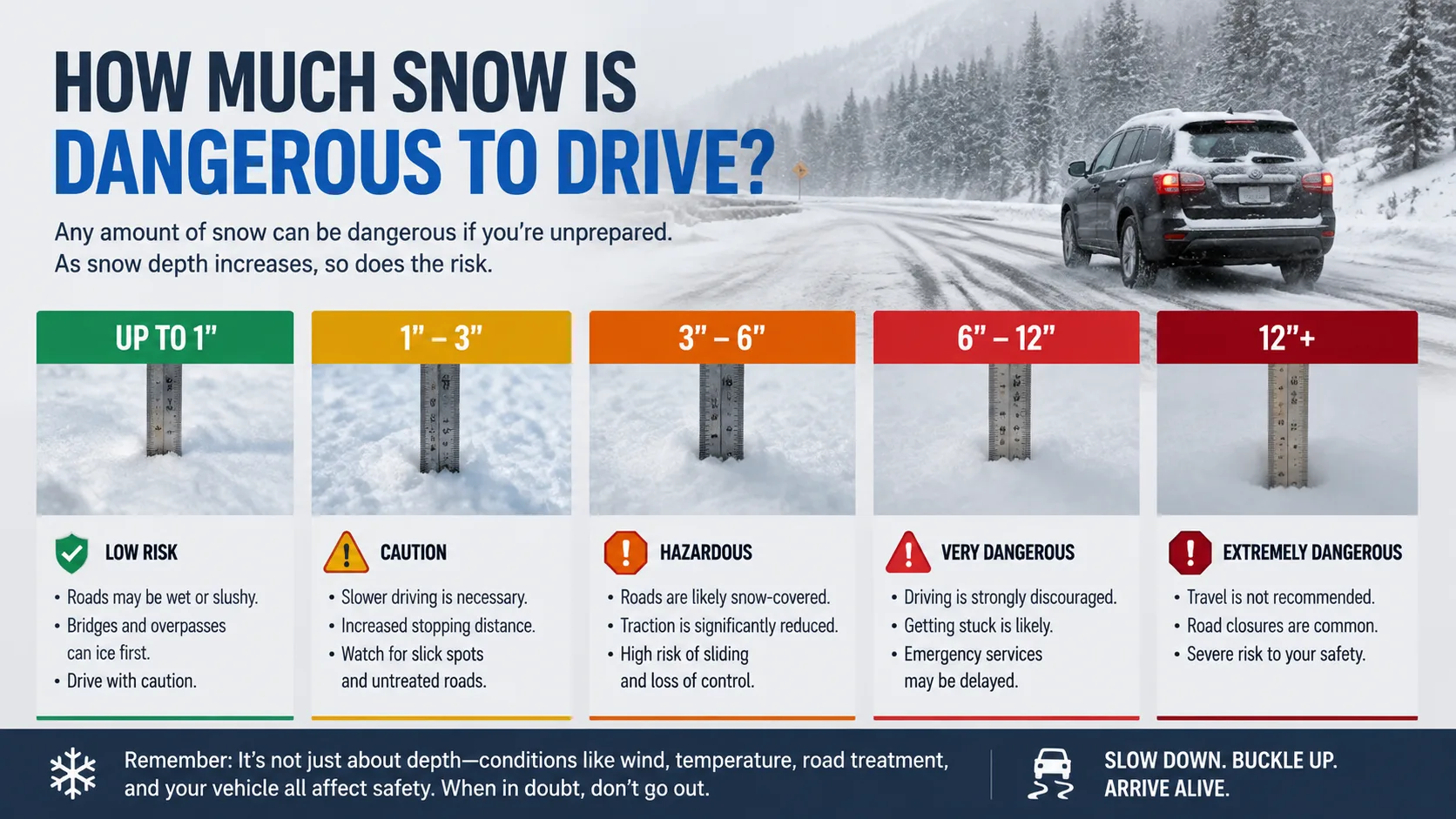
If you only remember one sentence from this guide, remember this: the first inch of snow is often more dangerous than the sixth, because that's when black ice forms and drivers haven't slowed down yet.
Before you head out, it takes less than a minute to check your own snow day and road risk calculator for your zip code. It's built to translate raw snowfall numbers into a real answer for your specific area, which is exactly what this article walks through in detail below.
Why "How Much Snow Is Too Much" Doesn't Have One Answer
People search for a single magic number. In reality, snow depth is only one input in a much bigger equation. Two drivers can face the exact same 3 inches of snowfall and have completely different levels of danger.
Here is what actually decides whether snow is dangerous to drive in:
- Snow depth on the road surface right now, not the total forecast for the day
- Pavement temperature, which determines whether snow melts, refreezes, or stays powdery
- Traffic volume, because packed snow behaves very differently from fresh powder
- Tire type and tread depth, since worn all-season tires perform far worse than winter tires
- Vehicle ground clearance, which decides when a car starts "plowing" snow with its bumper
- Wind and visibility, since a whiteout can be dangerous even with only an inch on the ground
Understanding these six factors is more useful than memorizing a single inch count, and we'll walk through each one with real numbers.
Suggested image placement: a wide photo of a residential street with light snow cover and visible tire tracks, showing the difference between fresh powder and packed snow. Alt text: "packed snow versus fresh powder on a residential road showing driving traction differences."
It also helps to separate two questions people often blur together: "How much snow makes driving uncomfortable?" and "How much snow makes driving dangerous?" Uncomfortable driving means slower speeds, more effort at the wheel, and some fishtailing on turns. Dangerous driving means a real chance of losing control entirely, whether from sliding through an intersection, jackknifing on a hill, or failing to stop before a collision. This guide focuses on the second, more serious threshold, since that's the one that actually determines whether a trip is worth the risk.
How Many Inches of Snow Is Dangerous to Drive In? (Chart)
The table below gives a realistic breakdown for a typical passenger car with all-season tires. If you drive a truck or SUV with winter tires, you can generally move one tier to the right.
| Snow Depth | Risk Level | What Typically Happens | Recommended Action |
|---|---|---|---|
| Under 1 inch | Low, but deceptive | Roads look wet, not white. Black ice risk is highest here. | Drive slowly, increase following distance |
| 1 to 2 inches | Moderate | Traction drops noticeably. Compact and hard-packed patches begin forming. | Reduce speed by 30 to 40 percent, avoid sudden braking |
| 3 to 4 inches | High | Standard sedans start losing traction and clearance. Handling becomes unpredictable. | Delay non-essential trips, use winter tires if driving |
| 5 to 6 inches | Very High | Low-clearance cars begin "plowing" snow with the bumper. Steering and braking are both compromised. | Avoid driving unless the vehicle has real ground clearance and 4WD or AWD |
| Over 6 inches | Severe | Even trucks and SUVs face reduced control. Visibility often drops with accumulation rate. | Stay off the road; check local advisories before any trip |
Key Takeaway: Depth alone is not the danger. A single inch of snow on a freezing road can be more hazardous than four inches of snow on a road that's been salted and plowed. Always check current conditions, not just the forecast total, using a tool like the full calculator directory before deciding whether to drive.
Why the First Inch of Snow Is Often the Most Dangerous
This surprises most drivers, but it's backed by research. Highway safety researchers who studied fatal snow-related crashes found that a large share of deadly accidents occurred during light snowfall, not during the biggest storms of the year. Roads under an official winter storm warning actually accounted for well under half of these fatal crashes.
Here's the mechanism behind that. When the first flakes fall, the pavement is often still holding heat from the previous day. That warmth melts the snow on contact, creating a thin film of water. As temperatures drop after sunset, that water freezes into black ice, a nearly invisible, glass-smooth layer that looks like a harmless wet patch.
Drivers who see "just a dusting" and keep their normal speed are the ones most likely to hit a patch of black ice unprepared. A tire that loses grip on black ice can lose essentially all traction in an instant, with no warning.
This is also why the day after the season's first snowfall tends to be statistically dangerous. Drivers haven't re-adjusted their habits yet, and many haven't swapped to winter tires or checked their tread depth.
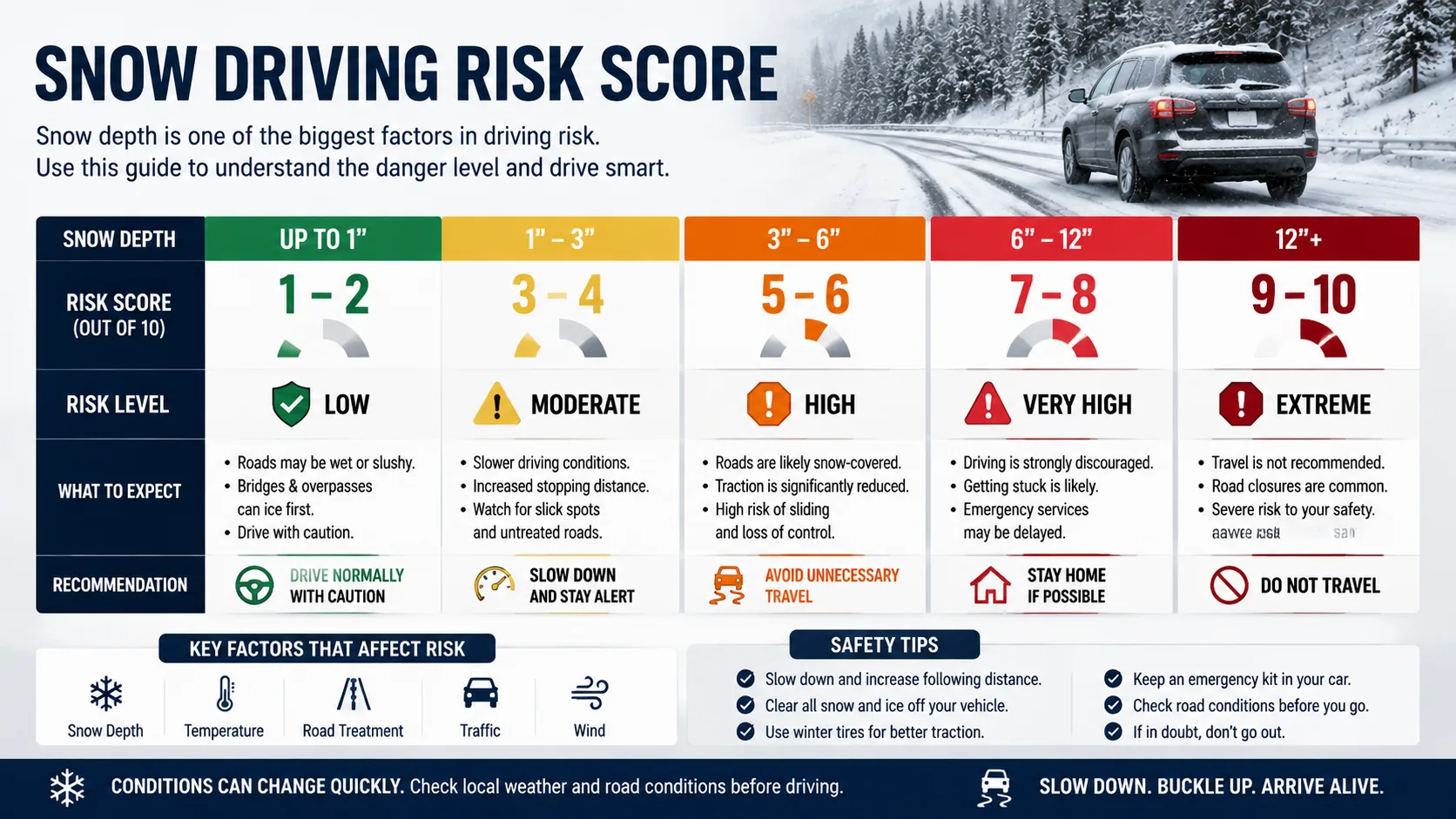
How a Snow Driving Risk Score Is Calculated
Behind any good snow day or road risk calculator is a fairly simple weighting model. You don't need to run the math yourself, but understanding the logic helps you judge conditions even without a tool in front of you.
A basic risk score generally combines four weighted inputs:
- Accumulation rate (how many inches per hour are falling), weighted heavily because plows and salt trucks can't keep pace above roughly 1 inch per hour
- Pavement temperature, weighted heavily because anything within a few degrees of 32°F (0°C) sharply raises refreeze and black ice risk
- Total ground accumulation, weighted moderately using the depth tiers from the chart above
- Wind speed, weighted moderately because wind above 20 to 25 mph can cause blowing snow and near-zero visibility even with low accumulation
In plain terms, the logic looks something like this:
A low score points to routine winter driving conditions. A high score points toward delaying the trip or working from home if possible. This is exactly the calculation our calculator directory automates for your specific zip code, pulling in live forecast data instead of asking you to estimate each factor by hand.
The value of a tool like this over a gut feeling is consistency. Two people can look at the same snowy window and reach opposite conclusions about whether it's safe to drive. A weighted score removes some of that guesswork by treating every commute the same way, every time.
Stopping Distance: The Number That Actually Matters
Depth tells you how much snow fell. Stopping distance tells you how much control you actually have. This is the number that should change your driving behavior.
Industry braking tests consistently show the same pattern: friction between your tires and the road drops sharply once any snow or ice is present, and that directly extends the distance it takes to stop.
| Road Surface | Stopping Distance vs. Dry Pavement |
|---|---|
| Dry pavement | Baseline (1x) |
| Wet pavement | Roughly 1.5x to 2x longer |
| Packed snow | Roughly 3x to 4x longer |
| Ice or black ice | Roughly 5x to 10x longer |
To put that in plain terms: a car that normally stops in 100 feet on dry pavement could need 300 to 400 feet on packed snow, and potentially 500 to 1,000 feet on ice. At highway speeds, that is the difference between stopping in time and not stopping at all.
"Winter driving isn't about the number on the ruler," says Marcus Reyes, a certified winter driving instructor who trains commercial fleet drivers. "It's about how much room your car actually needs to stop, and most people dramatically underestimate that number until they've experienced it firsthand."
Federal Highway Administration data backs this up at a national scale. Every year, snowy, slushy, or icy pavement contributes to more than 1,300 deaths and over 116,000 injuries across the United States. Roughly a quarter of all weather-related crashes happen specifically on snowy, slushy, or icy roads.
Dana Whitfield, reviewer of this guide, adds a field perspective: "In my years coordinating winter road response, the calls we dreaded most weren't from the big storms. Everyone respects eight inches of snow. It was the quiet, half-inch mornings that caught commuters off guard, because nobody thought to slow down."
This is also why speed reduction matters more than most drivers assume. Research on freeway speeds shows that light snow alone can cut typical freeway speeds by roughly 3 to 13 percent, while heavier snow can cut speeds by 5 to 40 percent. Arterial roads see even sharper drops, often 30 to 40 percent below normal, as drivers instinctively slow down once traction starts to disappear. If everyone around you is going slower, that's a signal worth listening to, not an inconvenience to drive around.
Step-by-Step: How to Decide If It's Safe to Drive
Use this checklist before any trip once snow is falling or has recently fallen.
- Check current accumulation, not just the forecast. A forecast of "6 inches by evening" doesn't tell you what's on the ground right now.
- Look up your local road advisory. State transportation departments issue real-time updates, and our state-by-state prediction pages pull together local snow trends so you can see what your area typically does with a given accumulation.
- Check the pavement temperature, not just the air temperature. Snow sitting on pavement near 32°F (0°C) is far more dangerous than the same snow on pavement well below freezing, because it's more likely to melt and refreeze into ice.
- Inspect your tires. Tread depth below 4/32 inch dramatically reduces snow traction, regardless of your vehicle type.
- Match your vehicle to the conditions. Use the chart above as your baseline, then adjust up a tier if you have winter tires and AWD, or down a tier if you're on worn all-seasons.
- Plan your route for the lowest-risk roads. Highways are usually treated first; side streets and hills are treated last and stay dangerous longest.
- Decide, then commit. If two or more of the above checks point to "risky," delay the trip rather than testing it.
Real-World Examples With Numbers
Example 1: The commuter sedan. A driver with a front-wheel-drive sedan and all-season tires faces 3 inches of fresh, unplowed snow at 28°F. Expected stopping distance is roughly 3 to 4 times longer than normal. At 40 mph, a stop that would normally take about 80 feet could take 240 to 320 feet. This falls in the "high risk" tier from the chart above.
Example 2: The mountain SUV. A driver with an AWD SUV, winter tires, and 8 inches of ground clearance faces the same 3 inches of snow. Traction is far better, and the vehicle sits in the "moderate" tier instead. The tires and clearance meaningfully change the outcome, even though the snowfall is identical.
Example 3: The refreeze trap. A driver checks the forecast at 6 a.m. and sees only half an inch of snow overnight. It looks minor, so they don't adjust their driving. What they don't see is that overnight temperatures dropped to 25°F after a partial daytime melt, turning that half inch into a sheet of black ice on bridges and overpasses. This is the scenario researchers point to when they say light snow can be just as dangerous as a major storm.
Read More : Does a Snow Day Calculator Actually Work?
Common Mistakes and Pro Tips
Common Mistakes
- Trusting all-wheel drive too much. AWD helps you accelerate. It does almost nothing to help you stop or turn on snow and ice.
- Driving your normal following distance. Winter driving experts recommend 8 to 10 seconds of following distance on snow or ice, not the usual 3 to 4 second rule.
- Braking hard when you start to slide. This locks up the wheels and removes what little steering control you had left.
- Ignoring bridges and overpasses. These freeze first and thaw last because cold air moves under them, not just over them.
- Assuming yesterday's plowed road is still clear. Wind can drift snow back onto a cleared road within hours.
Pro Tips
- Ease off the gas instead of braking if your car starts to slide, and steer gently in the direction you want to go.
- Keep your gas tank at least half full in winter to prevent fuel line freeze and to have a buffer if you get stuck in traffic.
- Pack a basic winter kit: blanket, flashlight, small shovel, and traction mats or sand.
- Check tire pressure weekly. Cold air reduces tire pressure, which reduces the contact patch and hurts traction.
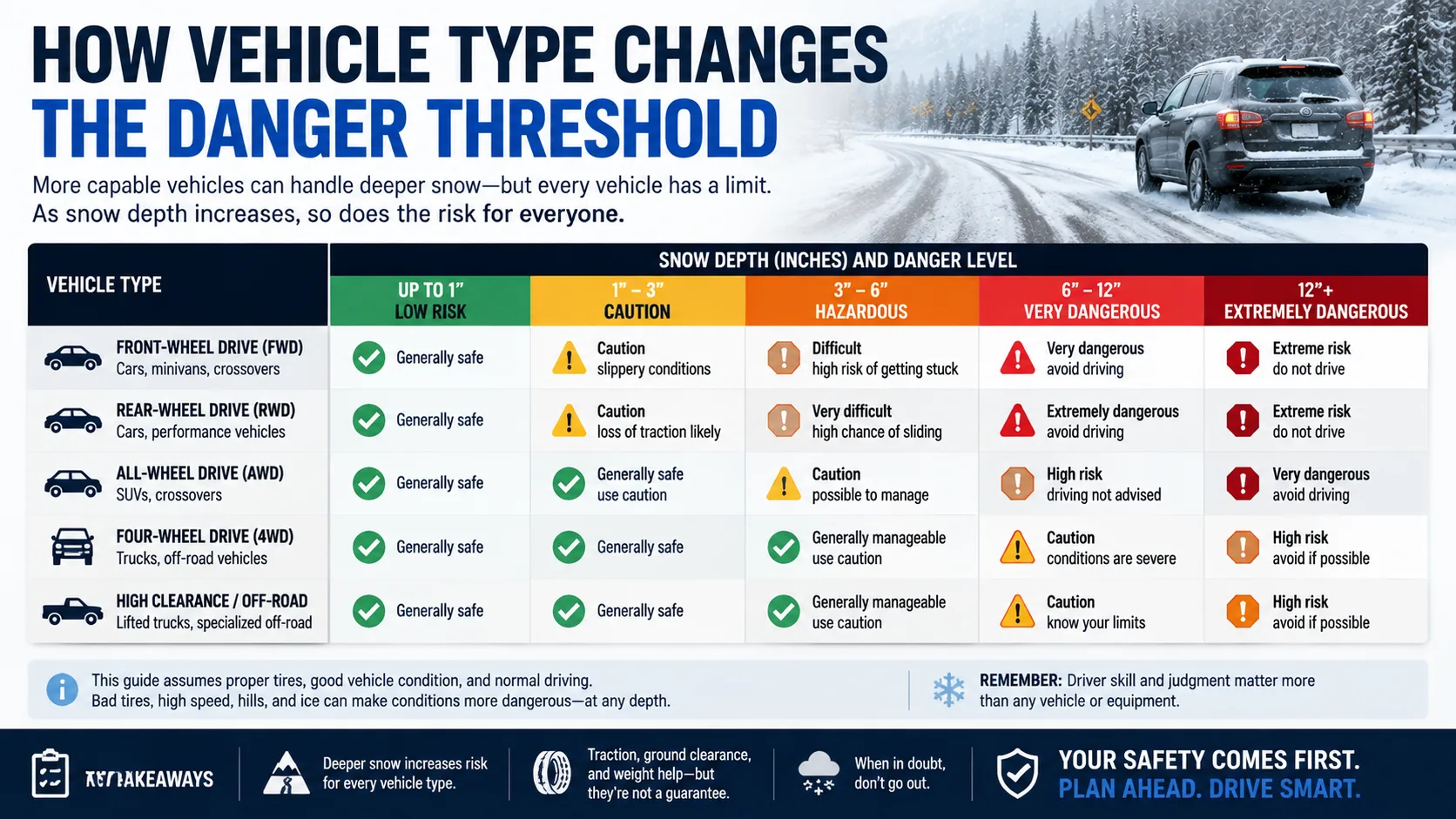
How Vehicle Type Changes the Danger Threshold
| Vehicle Type | Approximate Ground Clearance | General Comfort Threshold |
|---|---|---|
| Low sedan / sports car | 4 to 5 inches | Under 2 inches |
| Standard sedan | 5 to 6 inches | Up to 3 to 4 inches |
| Crossover / small SUV | 6 to 7 inches | 4 to 6 inches |
| Full-size SUV / truck | 8 to 10 inches | 6 to 8 inches, with proper tires |
These are general comfort thresholds for capable drivers with properly maintained tires, not hard limits. A skilled driver in a well-prepared truck can still get into serious trouble in a whiteout, and a cautious driver in a sedan can safely manage 2 inches of light, dry powder on a treated road.
If you're weighing whether tomorrow's storm will actually shut things down in your area, it helps to check both the snowfall total and the wind chill together, since strong wind dramatically worsens visibility and road refreeze. Our wind chill calculator is useful for exactly that kind of combined check before a winter trip.
When to Simply Stay Home
Sometimes the smartest driving decision is not driving at all. Consider staying off the road when any of the following are true:
- Local officials have issued a travel advisory, watch, or warning
- Snowfall rate exceeds 1 inch per hour, since plows can't keep up
- Visibility drops below a quarter mile due to blowing or falling snow
- Temperatures are hovering within a few degrees of freezing, creating refreeze risk
- You have any doubt about your tires, brakes, or battery in cold weather
If your trip can wait, let it wait. Most weather-related crashes happen to drivers who felt they had no choice but to go, when in reality the trip could have been delayed by a few hours.
Conclusion
There is no single inch count that makes snow "dangerous" for every driver in every location. What actually determines your risk is the combination of snow depth, pavement temperature, tire condition, and vehicle clearance. As a general rule, treat anything over 3 to 4 inches as high risk for a standard car, and never underestimate that first inch, since it's the one most likely to hide black ice.