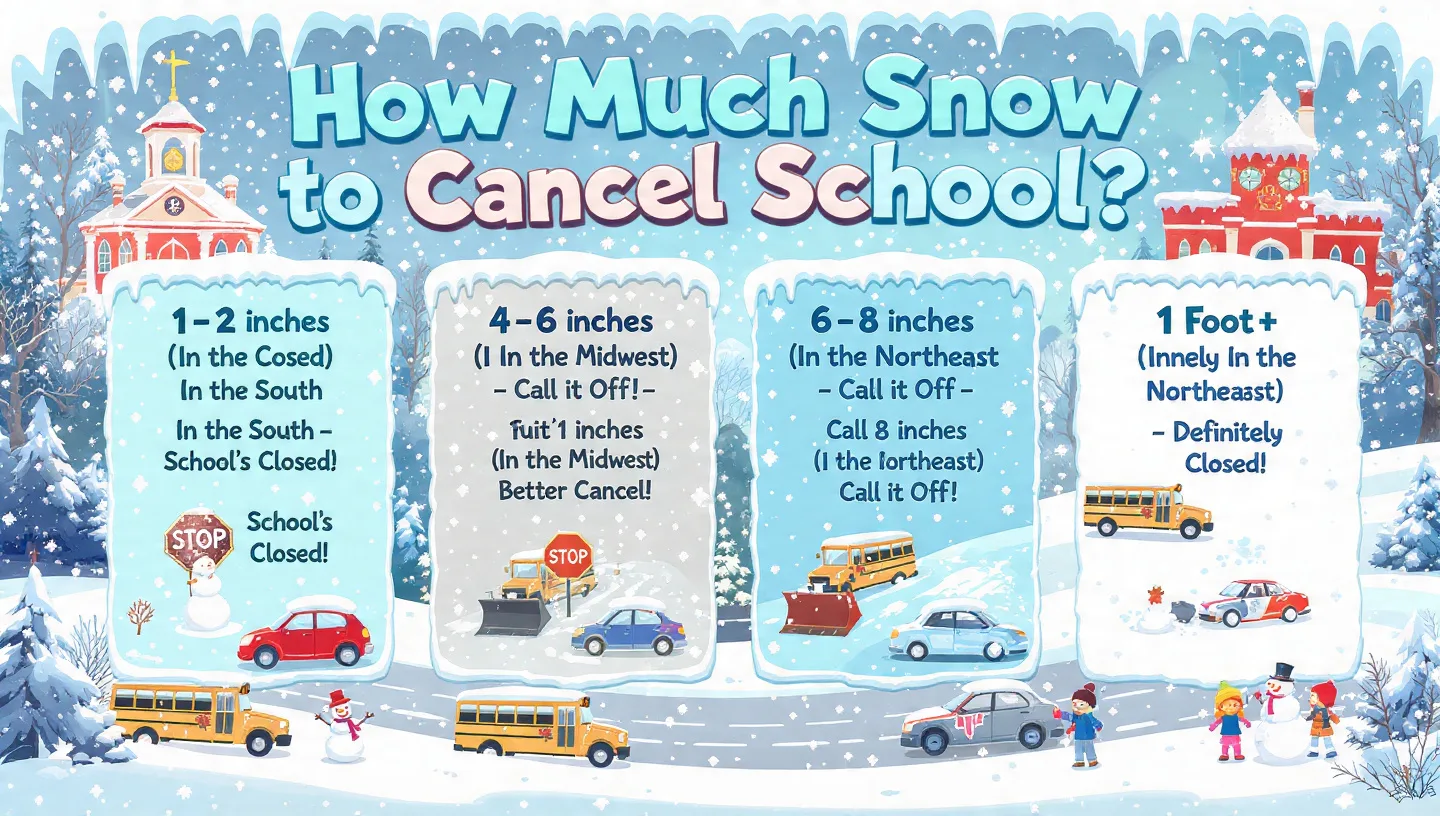
How much snow to cancel school varies wildly across the United States. In Louisiana, a light dusting can shut down an entire district. In Buffalo, New York, schools routinely open after 8 or 9 inches of overnight snow. Understanding these regional differences helps parents plan childcare, allows students to manage expectations, and gives educators a clearer picture of when a closure call is likely.
It's 9 PM. The forecast just changed. Your phone is buzzing with group chats, and everyone in the house is asking the same thing: how much snow does it take to cancel school?
Here's the annoying truth. The answer in Atlanta is a light coating on the grass. In Buffalo, it's a foot and a shrug. And in some places, the decision has nothing to do with snow at all.
This guide gives you numbers for every state. It explains what school leaders look at before making the school call. It shows you how to read the signs before the snow announcement lands. Bookmark it before the snow storm of the season.
The Short Answer: How Snow Cancels School?
Across the country the middle of the road is roughly 5 to 6 inches of snow in 24 hours. But an average like that hides gaps:
-
Deep South: a trace of snow or even the forecast of it can close schools.
-
Southeast and Mid-South: about 1 to 4 inches faster if ice is involved.
-
Northeast: roughly 4 to 10 inches depending on the district.
-
Northern Plains, Rockies and northern New England: 10 to 18 inches or a brutal wind chill instead.
Treat those figures as a starting point, not a promise. Two districts in the same county can make opposite calls on the same morning.
Why There Is No National Snow Day Rule
No federal law says when a school must close for weather. Every decision is local. It sits with a superintendent usually backed by a transportation director and a few phone calls to neighboring districts.
That is why "how much snow cancels school" gets an answer from every person you ask. Local roads, budgets, bus routes and a leaders comfort with risk all shape the school call.
Why the South Closes Over Tiny Amounts
It is tempting to joke about it. The logic is solid. Many southern districts own no plows keep small salt supplies and serve drivers who may see real snow once every few years. Most cars there run on all-season or summer tires.
Half an inch of snow that freezes on a bridge is a real hazard.
Why the North Stays Open
Now flip it. Districts in Minnesota, Maine or upstate New York plan for winter all year. Fleets of plows and salt trucks hit main roads before dawn, buses are maintained for cold starts, and everyone on the road has driven in snow for years.
Ten inches in those places is inconvenient. Ten inches in Nashville is a shutdown.
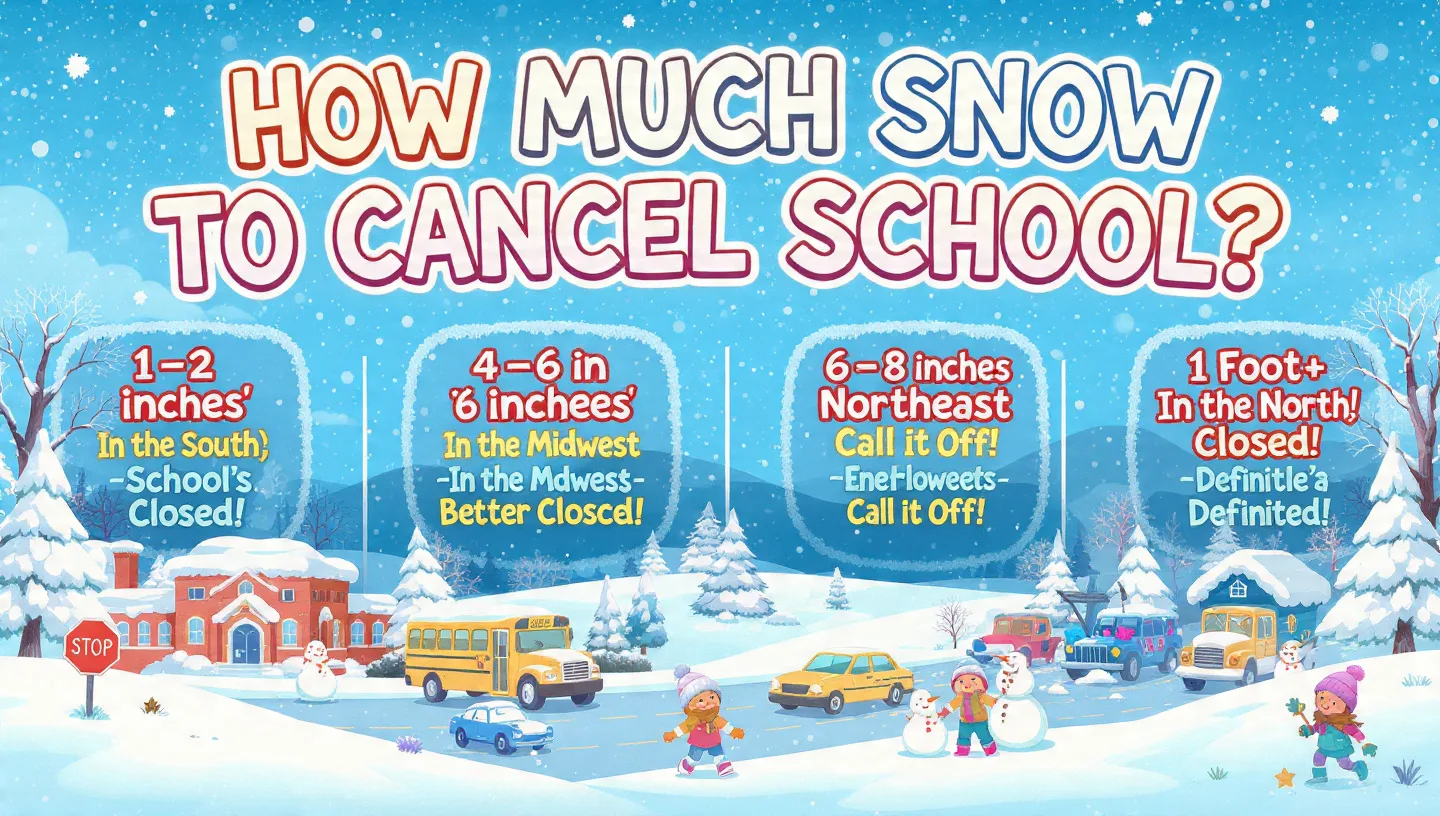
Snow Cancellation Thresholds by Region
Before the state details, here is the big picture.
-
Deep South (AL, MS, LA, TX, FL): 0 to 1 inch. Any snow or the forecast alone can close schools.
-
Southeast (GA, NC, SC, TN, VA): 1 to 3 inches. Ice on hills and overpasses is the worry.
-
Mid-Atlantic (MD, DE, WV, KY): 3 to 5 inches. Hilly roads and freezing rain keep these numbers low.
- Northeast (NY, MA, CT, PA, NJ, RI): 4 to 10 inches. Strong coastal storms lead to quicker closures because of wind.
-
Midwest (OH, MI, WI, MN, IL IN IA): 4 to 10 inches. Lake-effect zones and rural districts close sooner.
-
Mountain. Northern Plains (CO, MT, WY, ND, SD): 10 to 18 inches. Temperature and wind often matter more than depth.
- Pacific West (WA, OR, CA): 4 to 6 inches in lower areas, with mountain districts closing at higher totals depending on elevation.
Snow Day Thresholds for All 50 States
These are typical figures based on general patterns. Your own district may sit well above or below its state's range, so use this as a guide to what's normal, not a guarantee.
Deep South and Southeast
| State | Typical Threshold | What Usually Drives the Call | |
|---|---|---|---|
| Alabama | Trace to 1 inch | Icy bridges, almost no snow equipment | |
| Florida | Any flurries | Snow is extremely rare, so any is a closure | |
| Georgia | 1 to 2 inches | Icy overpasses, limited salt trucks | |
| Louisiana | Trace | No plows, unfamiliar drivers | |
| Mississippi | Trace | Rare event, little infrastructure | |
| North Carolina | 1 to 3 inches | Ice-first storms, huge district areas | |
| South Carolina | 1 inch or less | No removal equipment for rare storms | |
| Tennessee | 1 to 3 inches | Hilly roads, ice, few plows | |
| Texas | Trace in most areas | Ice on roads, limited winter equipment | |
| Virginia | 2 to 5 inches | Hills, ice, wide district geography | |
| Arkansas | 1 to 2 inches | Ice storms are more common than snow | |
| Oklahoma | 2 to 4 inches | Freezing rain is the main trigger |
Mid-Atlantic and Northeast
| State | Typical Threshold | What Usually Drives the Call |
|---|---|---|
| Delaware | 3 to 5 inches | Ice risk, coastal storms |
| Maryland | 3 to 5 inches | Hills, icy bridges, heavy commuter traffic |
| West Virginia | 3 to 6 inches | Steep, winding rural roads |
| Kentucky | 2 to 4 inches | Hilly terrain, frequent freezing rain |
| New Jersey | 4 to 7 inches | Dense traffic, coastal storms |
| Pennsylvania | 4 to 7 inches | Mountain roads, long rural bus routes |
| Rhode Island | 5 to 7 inches | Coastal storms in a compact state |
| Connecticut | 6 to 8 inches | Coastal storms, road ice, wind chill |
| Massachusetts | 6 to 10 inches | Strong coastal storms, wind |
| New York | 8 to 12 inches (lower in Buffalo-area counties, near 9) | Lake-effect bands, city plowing capacity |
| New Hampshire | 8 to 12 inches | Winding rural roads, cold temperatures |
| Maine | 8 to 12 inches | Very well prepared, long rural distances |
| Vermont | 12 to 18 inches | Highly experienced plow crews |
Midwest and Plains
| State | Typical Threshold | What Usually Drives the Call |
|---|---|---|
| Missouri | 2 to 4 inches (south), 4 to 6 (north) | Freezing rain often arrives before snow |
| Ohio | 2 to 4 inches (south), 4 to 7 (north) | Ice under snow, lake-effect in the northeast |
| Indiana | 4 to 7 inches | Ice layers, rural roads |
| Kansas | 5 to 8 inches | Wind and blowing snow on flat, open land |
| Illinois | 6 to 8 inches (Chicago), 4 to 6 (rural) | Lake-effect, wind chill |
| Michigan | 6 to 10 inches | Wind chill often triggers a closure first |
| Wisconsin | 6 to 10 inches | Lake-effect near Lake Michigan, wind chill |
| Iowa | 6 to 10 inches | Blowing snow, low visibility, wind chill |
| Nebraska | 6 to 10 inches | Blowing snow, wind advisories |
| Minnesota | 8 to 12 inches | Wind chill near -20°F is a common cutoff |
| South Dakota | 10 to 14 inches | Blizzard winds, temperature |
| North Dakota | 12 to 18 inches | Cold and wind chill outweigh snow depth |
Mountain West, Southwest and Pacific
| State | Typical Threshold | What Usually Drives the Call |
|---|---|---|
| Arizona | 1 to 3 inches (northern areas) | Elevation; Flagstaff and Phoenix are worlds apart |
| New Mexico | 4 to 8 inches (north), 1 to 2 (south) | Elevation, wet versus dry snow |
| Oregon | 4 to 6 inches | Wet snow refreezing, steep roads |
| Washington | 4 to 6 inches | Freeze-thaw cycles, steep Seattle-area hills |
| Nevada | 6 to 10 inches (Reno and Tahoe area) | Elevation and mountain roads |
| California | Depends on elevation | Mountain districts close around 6 to 12 inches, coastal areas rarely close |
| Idaho | 8 to 12 inches | Mountain terrain, rural bus routes |
| Utah | 8 to 12 inches | Mountain passes, bus safety |
| Colorado | 10 to 12 inches (Front Range) | Wet versus dry snow, wind |
| Montana | 12 to 18 inches | Blizzard conditions, wind chill |
| Wyoming | 12 to 18 inches | Blizzard winds, highway closures |
| Alaska | 12 to 24 inches or more | Extreme cold matters more than depth |
Beyond Snow Depth: 7 Things That Really Decide a Snow Day
If you only watch the snowfall total, you will get it wrong a lot. School leaders weigh several things at once, and any one of them can flip the decision.
1. Wind Chill and Extreme Cold
In the Midwest and Great Plains dangerous cold can shut down schools even when there is almost no snow. Many school districts set a wind chill threshold around -15°F to -20°F. That’s because children waiting at bus stops can get frostbite quickly in those conditions.
If your forecast shows a deep freeze, check the actual "feels like" number with a wind chill calculator instead of trusting the air temperature alone. A 5°F morning with a 25 mph wind is a very different day from a calm one.
2. Ice Beats Snow Almost Every Time
A thin layer of ice can be worse than a foot of snow. Just a tenth of an inch on hills, bridges and overpasses can make driving and bus travel extremely risky.
That’s why places like Louisville and Cincinnati might close when it reaches 2 or 3 inches of snow while Chicago often stays open with double that amount. In the Mid-South many winter storms begin with freezing rain, which creates a surface under the snow. When you see "wintry mix" in a forecast, your odds of a closure or delay jump.
Freezing rain also brings disruptions similar to a rainy day. If you're curious how much a stormy morning can shift a schedule, a rain delay calculator can help you think through how precipitation affects timing.
3. Timing Matters More Than Totals
A storm that wraps up at 2 AM gives crews hours to plow and salt. A storm that starts at 5 AM lands right as buses are about to roll. The window between roughly 6 and 8 AM is the pressure point.
Four inches at 4 AM can cause a closure. Eight inches that ended the previous evening might only cause a delay.
4. The Early Morning Drive-Through
On borderline days, transportation directors often drive the worst bus routes themselves, sometimes as early as 3 AM. They aren't checking a forecast. They're checking whether a real bus can climb a real hill.
One unplowed rural road with a steep grade can close an entire district, even if most streets look fine.
5. Rural Versus Urban Districts
Compact city districts with plowed main roads can often stay open. Rural districts run longer routes on secondary roads that get cleared later, so they usually close at lower totals.
If your child attends a rural district and your office is in the city, expect your commute to be normal while their school is not.
6. The Type of Storm
-
Coastal storms (like nor'easters): lasting, windy and disruptive even when snow totals are moderate.
-
Lake-effect snow: narrow bands that can drop several inches, per hour in one town while the next street stays dry.
- Short heavy bursts: two or three inches during the morning commute can create whiteout conditions.
- Wet, heavy snow: easier to plow than powder, but it brings down branches and power lines.
7. How Sure the Forecast Is
When weather models disagree, some superintendents call it early to give families time to plan. Others wait until around 5 AM to see real conditions. Neither approach is wrong. It's a judgment call under uncertainty, and that's why announcements sometimes arrive while you're still half asleep.
Read More : Snow Day Survival Guide for Parents
How a Snow Day Decision Actually Unfolds
The process is more organized than most families realize. Here is a typical timeline:
- 2 to 3 days out: staff start watching National Weather Service updates and local forecasts.
- The day before: the superintendent talks with transportation, road crews and neighboring districts.
- Evening before: if the storm looks certain, some districts announce a closure right away.
- 3 to 5 AM: drivers check roads, and maintenance staff check heating and parking lots.
- 5 to 6:30 AM: the final call is made and sent out through phone alerts, email, websites and local media.
Knowing this timeline helps you stay calm. If the night-before message hasn't come, the decision may simply be waiting on morning road checks.
What's Different About Snow Days in 2026
Virtual Snow Days Are Now Normal in Many Places
Remote learning tools built during the pandemic era changed the game. Plenty of districts now shift to online instruction when buildings close, which means a "closure" no longer always means a day off.
Policies vary widely. Some districts still hand out classic snow days, some go fully virtual, and some use a mix depending on the storm. Check your district's handbook so your kids don't assume a day off that isn't coming.
Winter Weather Is Less Predictable
Many regions are seeing sharper swings between mild spells and hard freezes. That pattern creates more freeze-thaw ice and more surprise storms, which makes closure decisions harder and forecasts less reliable than a simple snow total suggests.
Districts Watch More Than Snow
Extreme weather isn't just a winter issue anymore. Some districts also adjust schedules for dangerous heat in early fall and late spring. If you like tracking conditions year-round, our heat index calculator uses the same kind of thinking, just for the other end of the thermometer.
Public vs. Private Schools, and Why Snow Days Run Out
Most states require somewhere around 175 to 180 instructional days. Public districts usually build a few spare days into the calendar, commonly three to five, and they're often reluctant to use them early in winter.
Private schools generally have more flexibility. That's why a private school down the street may close on a marginal morning while the public school stays open.
When a district burns through its spare days, makeup days can stretch into June. Some states grant waivers after major storms, and some allow a limited number of weather days without makeup. Your state education department's website will spell out the specifics.
How to Predict Tomorrow's Snow Day (Step by Step)
You can't be certain, but you can be much better informed. Try this routine:
- Check the ice risk first. Freezing rain in the forecast matters more than the snow number.
- Look at the timing. Snow arriving between midnight and 6 AM sharply raises the odds.
- Watch neighboring districts. If two or three nearby districts close the night before, yours is likely next.
- Check the wind chill. Advisories in cold states often lead to closures on their own.
- Run an estimate. Our snow day calculator looks at your location and conditions to give you a probability. Try it the night before, then again early in the morning as forecasts update.
- Turn on district alerts. Text and app notifications reach you faster than a website refresh.
Practical Tips for Parents, Students and Teachers
For Parents
- Line up a backup childcare option whenever the forecast shows 2 to 6 inches, since calls can come as late as 6 AM.
- Keep a "snow day box" with puzzles, art supplies and a few snacks so the day doesn't turn into screen time by 9 AM.
- Update your contact info with the district at the start of the school year.
For Students
- Charge your laptop the night before in case the day goes virtual.
- Don't skip homework on the assumption of a closure. A delay is just as likely.
- Keep boots, gloves and a warm hat by the door for when school stays open.
For Teachers
- Keep a simple, flexible lesson plan ready for a sudden virtual switch.
- Post materials online ahead of time when a storm is on the way.
- Plan your own commute early, since staff may still need to travel on delay days.
The Most and Least Snow-Tolerant Places
At the tough end, Alaska, Vermont, North Dakota and Montana rarely close over snow alone. In these states, cold and wind are usually the real triggers. In Fairbanks, schools have operated in temperatures far below zero, closing only when conditions become a true operational problem.
At the other end, Florida, Louisiana, Mississippi and South Carolina will close for almost any snow, and sometimes just for a forecast. It's not a lack of toughness. It's a lack of equipment, salt and practice.
Conclusion: Your Location Decides Your Snow Day
So, how much snow does it take to cancel school? The honest answer is that it depends on where you live, how prepared your roads are, whether ice is involved, how cold it gets and when the storm hits. A national average of 5 to 6 inches is a fun number, but your local pattern matters far more.
Learn what your district tends to do, pay attention to ice and wind chill, and keep a plan ready for those uncertain mornings. That mix of knowledge and preparation makes snow days far less stressful.