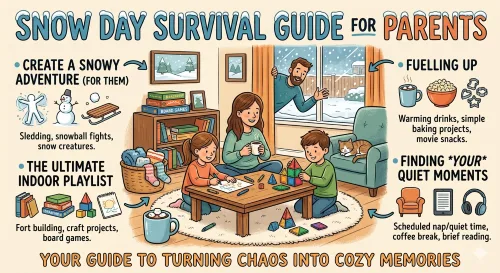
The school-closing alert hits your phone at 6:02 AM. Your inbox is already filling up. The kids are vibrating with excitement. And you? You're standing in the kitchen wondering how to survive the next 10 hours. This snow day survival guide for parents was built from the ground up to be more practical and complete than anything else online covering preparation, age-by-age activities, remote-work strategies, safety checklists, and a realistic hour-by-hour schedule to keep everyone, including you, sane.
Your phone buzzes at 6:02 AM. It's the school district's robocall, and you already know what it says before you unlock the screen. Snow day. Somewhere in the house, a kid is doing a victory lap in pajamas. Somewhere in your inbox, three meetings just became your problem to solve. And you're standing in the kitchen in yesterday's socks, trying to figure out how you're going to get through the next ten hours without losing your mind or your job.
If that's you right now, take a breath. This guide is built to actually get you through it prep steps, age-specific activities that don't fall apart by 9 AM, real strategies for working from home with kids underfoot, the safety stuff nobody tells you until it's too late, and an hour-by-hour schedule you can steal wholesale. No fluff, no filler, just what works.
Why Snow Days Hit Parents So Much Harder Than Kids
For your kids, a snow day is pure gift. No homework, no bus, no bell schedule. For you, it's a logistical scramble dressed up in a pretty white blanket. In the span of one morning you become the cruise director, the short-order cook, the referee, the emergency childcare provider, and if you're lucky enough to work remotely a functioning employee, all before lunch.
The numbers back this up. According to KPMG's Parental Work Disruption Index, roughly 1.5 million American workers either missed work entirely or cut their hours in a single recent month because of childcare disruptions, and 86% of them were women. That's 21% higher than the pre-pandemic baseline. Snow days aren't a footnote in that statistic they're one of the most common triggers, precisely because you rarely get more than a night's notice.
Knowing the scale of the problem doesn't fix it, obviously. But it does mean you're not overreacting when a "fun snow day" leaves you wrung out by 3 PM. This is genuinely hard. The rest of this guide is your plan for making it easier.
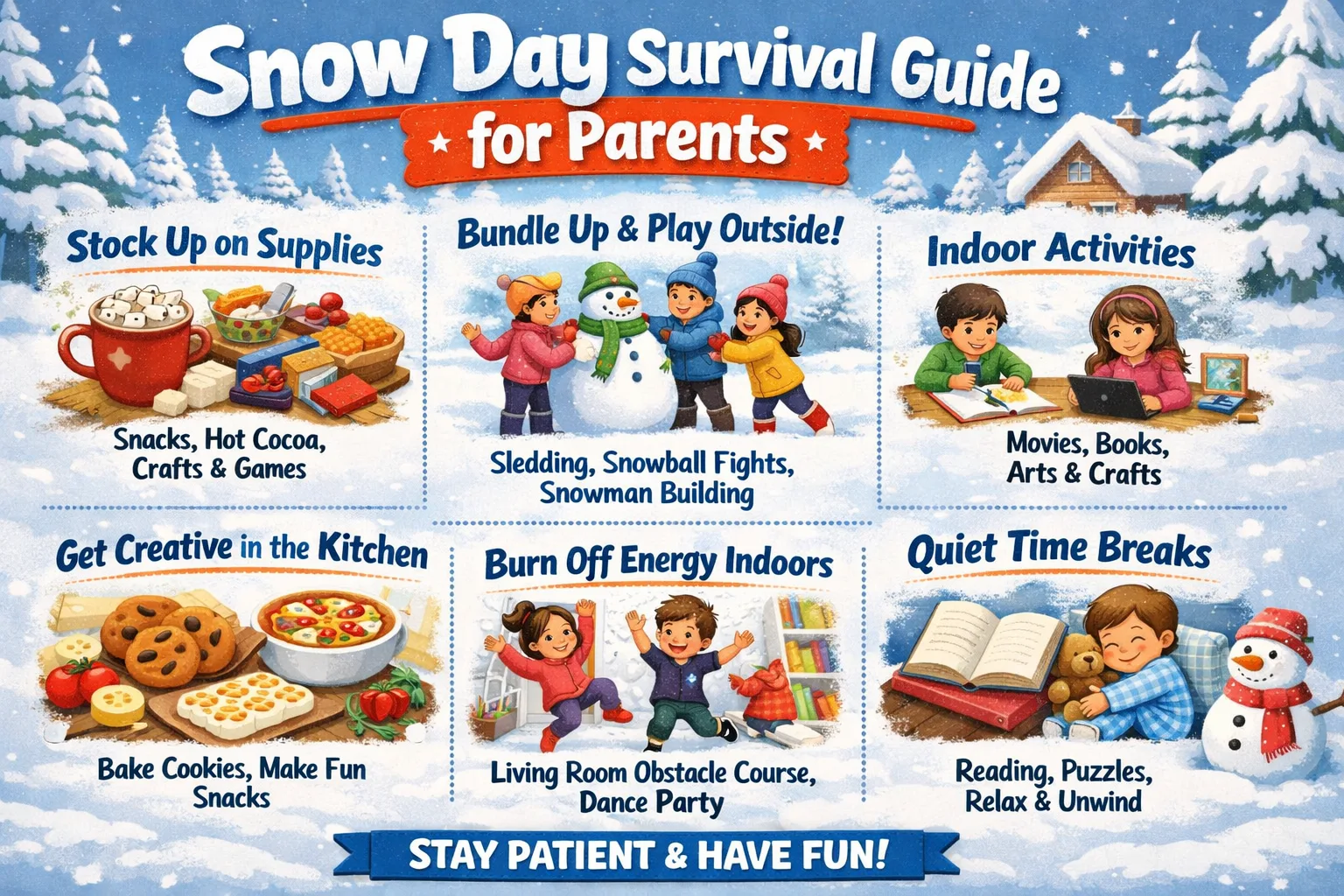
Step One: What to Do the Night Before a Snow Day
Parents who handle snow days well rarely treat them as a surprise. If there's snow in the forecast, spend twenty minutes the night before getting ahead of it. It's the single highest-leverage thing you can do.
- Charge everything. Phones, tablets, laptops, the portable charger you keep forgetting about. A dead device mid-Zoom-call or mid-meltdown is a genuinely bad time to discover your charger is missing.
- Find the snow gear now. Mittens, boots, snow pants, hats locate them the night before. Hunting for one missing boot at 8 AM adds thirty minutes of pure, avoidable chaos to your morning.
- Stock the kitchen. Hot cocoa mix, easy snacks, breakfast staples. Having designated "snow day food" makes the day feel special to your kids without any extra effort from you.
- Set up activity stations. Pull out the art supplies, board games, and building blocks and leave them visible. Kids reach for what they can see. Fewer visible options means more "I'm bored" by 9 AM.
- Prep your workspace. If you are working from home arrange your desk before you go to sleep. A prepared work area lets your brain and your children know that work is really happening, not something you choose to do.
- Sketch a loose plan. Just a rough list of possible activities for the day. Kids handle unstructured time far better when they've got a mental map of what might happen, even a fuzzy one.
If you only do one thing from this list, talk to your kids about what the day will look like before they wake up excited and unregulated. Let them know when you need to have time for work when they can go outside and when there is a movie scheduled. Children manage themselves better when they have an idea of what is coming even if the plan is not strict.
Indoor Activities That Actually Work, By Age
This is where most snow day lists fall apart they hand you fifty activities with zero regard for whether your kid is three or thirteen. A toddler and a teenager need completely different approaches, so here's what actually holds up by age group.
Ages 2–5: Toddlers and Preschoolers
Little kids have attention spans measured in minutes. Don't aim for one big activity aim for novelty and frequent transitions.
- Indoor snow tub. Scoop real snow into a plastic bin, set it on a towel, and hand over some sand toys. This buys you a surprising amount of quiet time for very little setup.
- Shaving cream "snow." Spread it on a tray for sensory play that mimics the texture of real snow without the mess of melting.
- Cotton ball snowstorm. Toss cotton balls in the air, "shovel" them with spoons, sort them into bowls by size.
- Frozen toy excavation. Freeze a few small toys in a block of ice overnight. Kids chip them free the next morning with a spoon and warm water this one has serious staying power.
- Basic baking. Even a child who is three years old can pour, mix and decorate. Sugar cookies made with snowflake cutters are a success.
Ages 6–9: Elementary School
This age group wants to feel capable. Give them a clear goal, a process, and a visible finished product.
- Snow volcano. Build a snow mound outside, pack baking soda into the top, pour in vinegar. Real chemistry, real fizzing eruption, real excitement.
- Paper snowflake geometry. Fold and cut, then challenge them to make the most intricate design possible. Tape the winners in the windows.
- Painter's tape obstacle course. A few strips of tape on the floor turns any room into a hopping, crawling, balancing course.
- Blanket fort architecture. Chairs, cushions, sheets, flashlights. Frame it as a "biggest and best fort" challenge and it'll swallow an entire morning.
- Board game marathon. Clue, Ticket to Ride Junior, Uno, Sorry! screen-free entertainment with rules kids this age genuinely enjoy following.
Ages 10–13: Tweens
Tweens want independence more than instruction. The best activities here are self-directed and give them ownership of the outcome.
- Stop-motion animation. A free app like Stop Motion Studio and any smartphone turns Legos or stuffed animals into a mini film.
- Pantry cooking challenge. Give them a theme "make something using only what's already in the kitchen" and let them run with minimal supervision.
- Creative writing prompt. Try: "You wake up and the entire world is permanently covered in snow. What's the first thing you do?" No word count, no grading.
- Trivia tournament. Let them build the quiz on whatever they're into sports, music, history. Being the host makes it their project, not yours.
- DIY crafts. Tie-dye, making resin jewelry and creating things from old clothes require little help from parents but create a lot of fun.
Ages 14+: Teens
Trying to set a schedule for a teenagers snow day will probably cause problems every time. Suggest, don't. Let them come to you.
- Invitations over mandates. "I'm making waffles, want some?" lands infinitely better than "Come to family breakfast."
- Shared screen time. Let them pick the show. The point is being in the same room, not the content itself.
- Game night. Trying to set a schedule for a teenagers snow day will probably cause problems every time. Suggest, don't. Let them come to you.
- Outdoor nudges. Plenty of teens genuinely want to sled, throw snowballs, or shovel a neighbor's driveway for cash they just need the idea planted, not pushed.
Outdoor Activities Worth Bundling Up For
Make sure to have least one time outside on every snow day. Being outside in the cold helps feel better burns off extra energy and reduces arguments between siblings for the rest of the day. Try for 45 to 60 minutes if the weather allows.
- Snowman engineering challenge. Skip "build a snowman" and challenge kids to build the tallest freestanding structure they can it turns into a real lesson in balance and structure.
- Snow painting. Fill spray bottles with water and food coloring. The results against white snow are genuinely striking, and kids love being "yard artists" for an hour.
- Snow scavenger hunt. A checklist of animal tracks, a pinecone, the biggest icicle, the softest patch of snow. Gets kids exploring on their own and burns real energy.
- Frozen bubbles. Below about 25°F, soap bubbles crystallize into delicate ice spheres mid-air. It works reliably and it amazes every age group.
- Scored sledding. Add categories fastest run, most rotations, funniest wipeout and a casual hill turns into a competition with real laughs attached.
Before you send anyone outside, it's worth checking conditions rather than guessing. Wind can make a mild-looking day feel dangerous fast running the numbers through a wind chill calculator takes thirty seconds and tells you exactly how long outdoor time is actually safe.
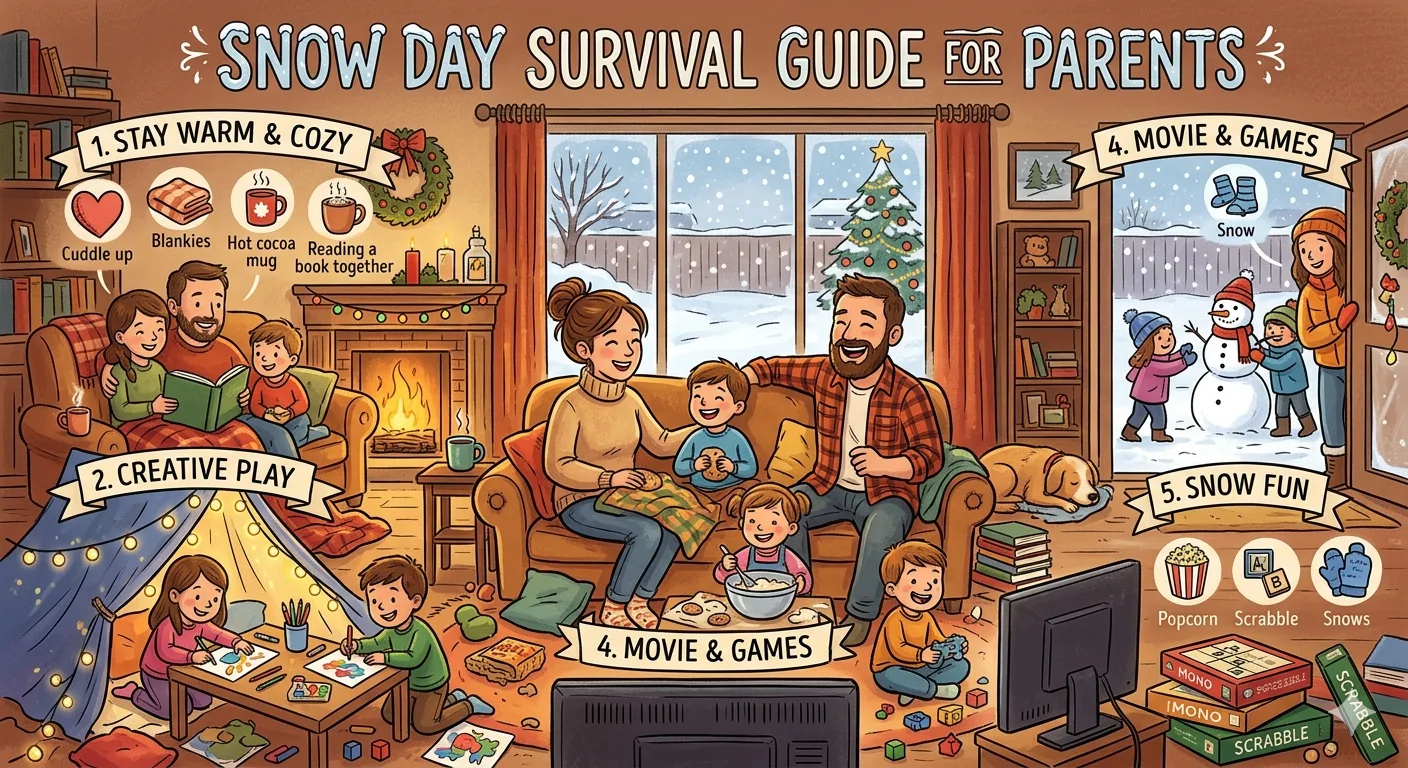
The Working Parent's Snow Day Strategy
If you're managing a job and a house full of kids on the same day, the strategy has to start before the storm hits, not the morning of.
Before the Snow Day
- Front-load your week. Once significant snow shows up in the forecast, move your highest-priority tasks earlier. Never leave a critical deliverable sitting on a day that might disappear.
- Give your manager a heads-up. Most managers appreciate an early warning about a possible closure far more than a panicked message at 6:15 AM. It protects your reputation more than staying silent ever does.
- Split coverage with your co-parent. Divide the day into blocks before it starts — one of you takes mornings, the other afternoons. Sorting this out in advance heads off the resentment that builds when the split feels lopsided.
- Build a neighborhood backup network. A small "snow day co-op" with two or three other families means each household only has to cover roughly a third of unexpected closures, and the kids end up entertaining each other for free.
On the Day Itself
- Set concrete work hours. Tell your kids exactly when you need quiet and what comes after: "From 9 to 11 I'm working, then we go sledding." Make it specific, and keep the promise every time.
- Save screens for when you need them most. Don't burn through screen time before 9 AM. Hold it in reserve for your tightest work windows a scheduled call, a hard deadline, a client email that can't wait.
- Set up independent stations before you sit down to work. A craft table, an audiobook corner, a puzzle in progress. The less kids need you to entertain them, the more your work blocks actually work.
- Don't try to do both at once. When you're with your kids, be with them. When you're working, actually work. Splitting attention between the two makes you worse at both and exhausted by either.
- Keep a clean virtual background handy. When a surprise Zoom call lands, your colleagues don't need to see the wet snowsuits drying over every chair in the house.
A Snow Day Schedule That Actually Holds Up (Ages 5–12)
You don't need a military timetable. You should have a routine that switches between active and calm outdoor and indoor and child-led and parent-guided. Here is a plan that works well for families with children who're in school.
- 7:00–8:30 Slow breakfast. No rushing. Pancakes, cereal, hot cocoa, pajamas still on. Thirty minutes of TV is fine here. You check email and mentally sketch the day.
- 8:30–10:00 Independent activity time. Art station, Legos, puzzles. This is your first work block set a visible timer so kids know exactly when you'll be free.
- 10:00–11:30 Outdoor adventure. Sledding, snowman building, snow painting, or the scavenger hunt. Everyone comes back inside in a noticeably better mood.
- 11:30–12:30 Lunch and warm-up. Soup, grilled cheese, something the kids help make. A natural lull that's good for a short second work sprint.
- 12:30–2:00 Structured indoor project. Baking together, a board game tournament, a STEM challenge, or a movie saved specifically for the afternoon.
- 2:00–3:30 Quiet time. Nap for younger kids, audiobooks or independent play for older ones. Usually your most productive work window of the day.
- 3:30–5:00 Free play and wind-down. Kids decompress on their own terms while you close out work and start dinner consider doing that part together.
- 5:00–Bedtime Family wind-down. Dinner, a story or show, and an earlier bedtime if the day ran everyone ragged. Dimming the lights by 7 PM genuinely calms a household down, whether or not anyone's actually tired yet.
Snow Day Safety: The Section Most Guides Skip
Plenty of snow day articles stop at activities and never get to the risks and multi-day storms, power outages, and extreme cold snaps carry real ones. Don't skip this part.
- Never use a gas oven for heating. Gas ovens are not made for being left open for a time and can create carbon monoxide, which has no smell, no color and can kill you.
- Never use a generator. Not in the garage not in the basement not with the windows a little open. Keep generators away from all building entrances.
- Never use any fuel-burning devices inside. Camp stoves, kerosene heaters, charcoal grills all release fumes inside without question.
- Do not run a car in a garage. Even if the garage door is open carbon monoxide can get to levels faster than people think.
- Children lose body heat faster than ups. Use a glove under a waterproof mitten and limit time outside when temperatures drop below around 10 degrees Fahrenheit.
- Know the signs of frostbite. Feeling nothing skin that's pale or light yellow a waxy feel. Bring the child inside immediately. Warm the area gently with body heat, not hot water.
- Stay clear of eaves and overhangs. Accumulated snow and ice dams can let go without warning.
- Teach proper shoveling technique for older kids and teens. Wet, heavy snow is a well-documented trigger for cardiac events even in otherwise healthy people. Lift with the legs, take breaks, and never tackle packed or icy snow without warming up first.
he Three-Layer System, Explained Correctly
The National Weather Service says that proper layering is the thing you can do to keep children safe and comfortable when it is cold outside. It is about three layers:
- Base layer moisture management. Synthetic fabric or merino wool. Skip cotton; it holds moisture against skin and accelerates heat loss, which is the most commonly overlooked mistake.
- Mid layer insulation. A fleece jacket or down vest to trap body heat close to the core.
- Outer layer weather protection. Fully waterproof, windproof snow pants and a jacket. Regular jeans in wet snow buy you about thirty minutes before misery sets in and everyone's heading back inside early.
The old rule of thumb still holds: if you feel comfortable the moment you step outside you are probably underdressed. Kids should feel a little warm when they walk out the door; they will settle into a temperature within a few minutes of moving around.
Looking After Your Own Mental Health, Too
Here is the part that every snow day guide leaves out entirely: you matter in this equation too. Snow days are genuinely stressful for parents and admitting that is not weakness; it is what actually lets you make decisions through the day.
Lower the Bar on Purpose
Snow days aren't built for thriving. They're built for getting through. Screen time rules can flex. Meals can be snack-based. The house doesn't need to be clean. If everyone's alive and emotionally intact by bedtime, you won. Letting go of the perfect version of the day isn't giving up it's smart triage.
Actually Take Your Breaks
Twenty uninterrupted minutes with a coffee, a chapter or a short solo walk can reset your patience for the rest of the afternoon more than people expect. If you are parenting solo that day use play or an age‑appropriate show to carve out that window without guilt. You are not obligated to entertain your kids every waking minute.
Let Boredom Do Its Job
When a kid announces they're bored, the instinct is to fix it immediately. Resist that. Boredom is where creative thinking actually starts. Give it ten or fifteen minutes before you step in most kids land on something more inventive than anything you would have handed them.
Know Your Own Warning Signs
If you feel yourself getting snappy, step away for sixty seconds. Breathe. Refill your water. Name what's actually happening "I'm frustrated, not broken" and go back in. A good-enough snow day beats a perfect one every time, and good enough is genuinely all anyone needs from you.
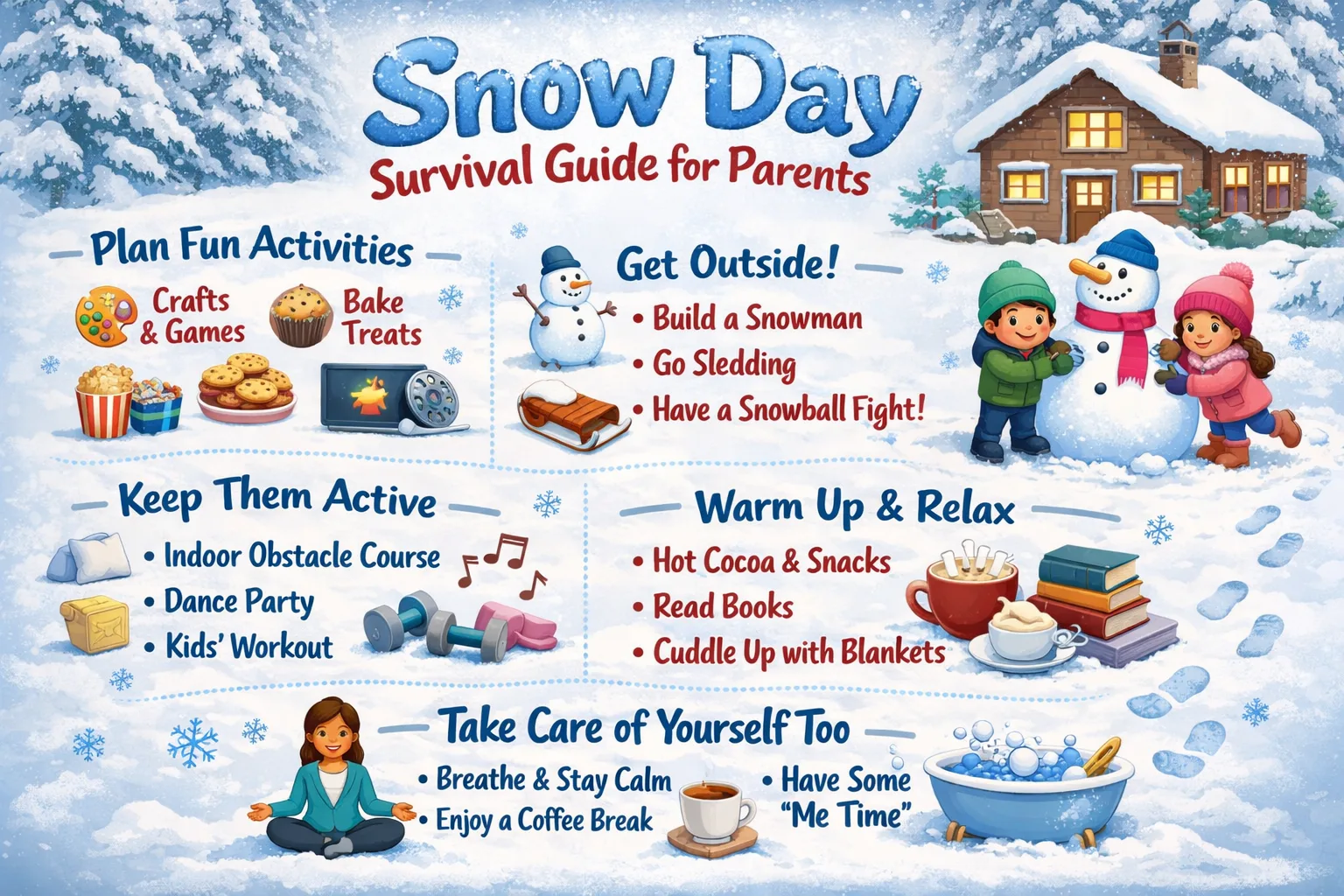
Snow Day Food: Your Most Underused Tool
Food does more heavy lifting on a snow day than people give it credit for. Cooking together, eating together, and having a few "snow day only" foods turns a chaotic day into a memorable one and it doubles as a structured, screen-free activity.
Build a Hot Cocoa Bar
Set out marshmallows, whipped cream, crushed cookies, chocolate chips, cinnamon and peppermint sticks and let kids build their own. Five minutes of setup buys a surprising amount of quiet, happy time. Make it a ritual specific to snow days at your house and it becomes something they look forward to.
Real Snow Ice Cream
This works with freshly fallen snow. Mix eight cups of snow with one cup of milk half a cup of sugar and one and a half teaspoons of vanilla. Stir fast. Serve immediately before it melts. Kids are always shocked that it actually works and it genuinely tastes good. Use clean, bright‑white snow well away from roads or driveways.
Let the Slow Cooker Do the Work
Load ingredients in the morning, set it to low, and by lunch or dinner the house smells incredible and you haven't thought about food prep all day. Chicken noodle soup, white bean chili, and beef stew are all reliable, low-effort options for a day like this.
When a Snow Day Turns Into a Snow Week
Major winter storms can mean days of closures possible power outages and genuinely not being able to leave the house. If you live somewhere prone to weather it is worth prepping beyond just tomorrow.
- Non-perishable food for 5–7 days. Canned soups, pasta, peanut butter, crackers, oatmeal, dried fruit, protein bars nothing that needs refrigeration or complicated prep.
- Water reserves. One gallon per person per day, for at least three days, in case a pipe freezes or local infrastructure gets disrupted.
- Refilled medications. Pharmacies and roads can both be inaccessible for days during a major storm. Refill prescriptions the moment serious weather shows up on the forecast.
- Flashlights and fresh batteries. One in every bedroom, kept somewhere you can find it in the dark without searching.
- Entertainment that does not need electricity. Board games, cards, novels, coloring books puzzles all of it pays off if the power actually goes out.
- A printed emergency contact list. Phones die. Have your neighbors' numbers, your utility company's outage line, and non-emergency police written down somewhere visible on paper.
- A prepared vehicle. Full tank, snow brush, ice scraper, a blanket and a bag of sand or kitty litter for traction all sorted before the storm actually arrives.
If the storm looks like it's shifting toward freezing rain or a straight washout instead of snow, it's worth a quick check with a rain delay calculator before you finalize any outdoor plans for the week ice adds a layer of risk that snow alone doesn't.
Screen Time on Snow Days: A Middle Ground That Works
Every snow day article seems to land on a different extreme ban all devices, or let kids watch whatever they want all day. Most pediatricians land somewhere in between, and so should you.
- Morning: hold off. Starting the day with a tablet or the TV locks kids into passive mode early and makes every transition after that harder. Use the morning for something physical or hands-on instead.
- Midday: deploy it strategically. Use a 45–60 minute screen window to protect a focused work block for yourself. This is where screens genuinely earn their place in the day.
- Afternoon: watch together. A shared movie later in the day is bonding time, not a failure of parenting. Popcorn on the couch, watching the same thing, counts as connection.
A kid who has had an hour of connected screen time has a completely different day than one who has been parked in front of a device since seven a.m. even if the total minutes look similar on paper.
Read More : What Time Do Schools Announce Snow Days?
Snow Day Food: Recipes and Meal Strategies
Food is one of the powerful and underused tools in the snow day toolkit. Eating together cooking together. Having special snow day foods transforms the day from chaotic to memorable and provides structured, screen‑free activity in the process.
The Hot Cocoa Bar
Set up a cocoa station, with toppings kids can customize themselves: mini marshmallows, whipped cream, crushed cookies, chocolate chips, cinnamon and peppermint sticks. Takes five minutes to set up and occupies children for far longer. Make it a ritual they associate specifically with snow days at your house.
Snow Ice Cream A Classic Snow Day Recipe
This works with freshly fallen snow. Combine eight cups of snow one cup of milk half a cup of sugar and one and a half teaspoons of vanilla extract. Mix quickly. Serve immediately before it melts. Kids are always amazed that it actually works and the taste is genuinely good. Always use fresh, bright‑white snow away from roads or driveways.
Slow Cooker Soups and Chilis
The snow day slow cooker is a parent's best friend. Load it with ingredients in the morning turn it on low and by lunchtime or dinnertime the house smells incredible. You have not thought about food preparation for hours. Chicken noodle soup, white bean chili and beef stew are all crowd‑pleasers requiring minimal active cooking time.
Involve Kids in Cooking as an Activity
Cooking is one of the highest‑value snow day activities hiding in sight. Even young kids can pour, stir, count ingredients and decorate. Cooking teaches math, basic chemistry and the ability to follow sequential instructions while producing something real that a kid feels genuine pride in having made.
Screen Time on Snow Days: A Balanced and Evidence-Based Approach
When parents read an article about a snow day they see the author taking a stance on screens. Some writers say to ban all screens while others say screens should be free. The advice, from pediatricians and child psychologists is neither extreme.
Final Thoughts: Survive, Then Thrive
The best snow day survival guide, for parents is not one that promises transformation. It is one that helps a parent reach bedtime with kids loved, household functional and sanity mostly intact.
Prepare the night before. Give your kids structure without rigidity. Protect your work windows. Get everyone outside. Feed people something warm. Lower your standards just enough to actually enjoy the unexpected gift of time.
Also Checkout :