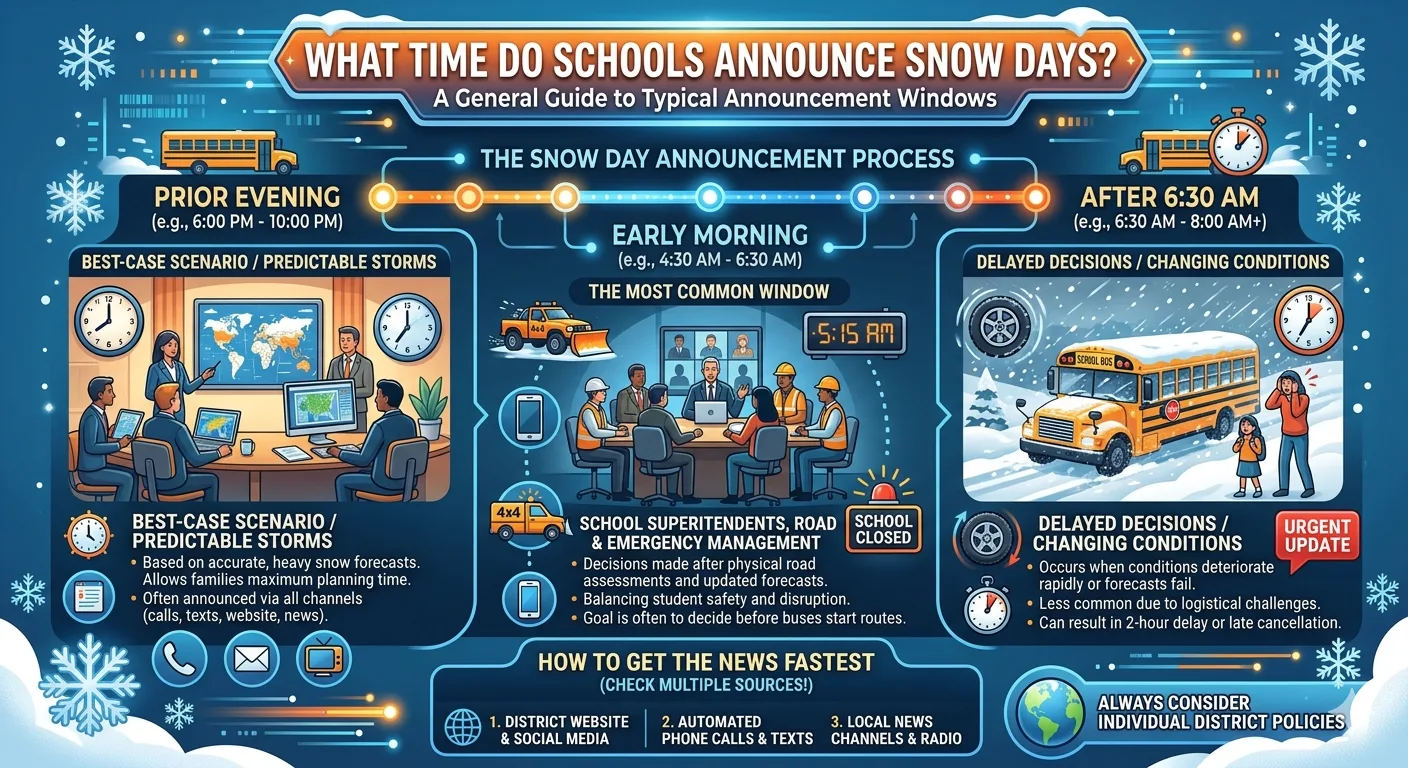
Every winter morning when storm clouds gather, millions of parents, students, and teachers ask the same urgent question: what time do schools announce snow days? Whether you need to arrange emergency childcare, reschedule a commute, or simply set your alarm with confidence, knowing the exact window when school closure decisions are made can save you hours of uncertainty.
It is 9:47 PM. The forecast says eight inches of snow will fall overnight. You look at your phone. Wonder whether to set an alarm for 5 AM or to go to bed and hope for the best. Does that sound familiar?
Every parent, teacher, and student who has ever lived through a real winter knows this exact feeling.
You want an answer. You want it now not "sometime before school starts.”
Here is an honest short version: Most U.S. School districts announce snow days between 4:30 AM and 6:00 AM. The sweet spot for the majority of districts is between 5:00 AM and 5:30 AM. That single window barely scratches the surface of what's actually going on.
There's a whole overnight operation happening while you sleep, and once you understand it, you'll never look at a snow day text the same way again.
The Quick Answer: When Snow Day Alerts Usually Land
Based on published weather policies from hundreds of districts across the country, here's roughly how the timing breaks down:
- Before 4:30 AM a smaller group of early-deciding districts, usually ones with long rural bus routes that need extra prep time
- 4:30–5:00 AM common in rural and larger districts that need to start checking roads well before sunrise
- 5:00–5:30 AM the most common window nationwide, and the one most districts explicitly target
- 5:30–6:00 AM typical for suburban districts with shorter routes and more predictable conditions
- After 6:00 AM rare, and usually means the storm is a genuine toss-up right up to the wire
That's the pattern. But two things can shift it entirely: how severe the storm looks the night before, and which part of the country you're in. Let's get into both.
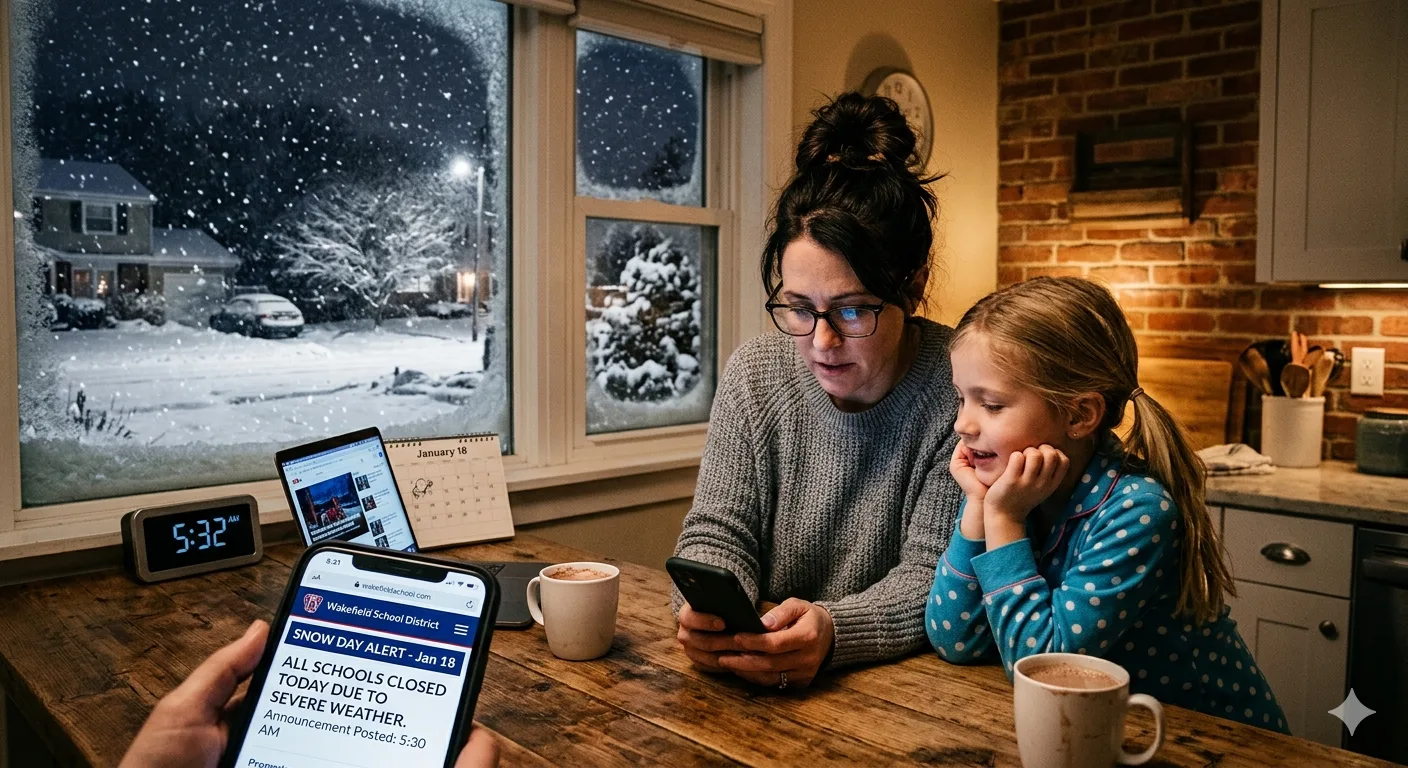
Sometimes the Decision Comes the Night Before
Not every closure waits for a 5 AM phone call. When a storm system is obviously bad, think a winter storm warning already in effect, heavy ice accumulation forecast, or a blizzard expected to peak right during the morning commute, districts often just make the call the evening before.
This isn't laziness. It's actually the more responsible move in those cases. If the forecast is already unambiguous, there's no reason to make thousands of families wait until 5 AM to hear what everyone already suspects. Districts that do this well tend to say so explicitly in their weather policy: something along the lines of "an announcement may occur the evening before when conditions are clearly severe." The tradeoff is real, though. A night-before call locks in a decision before the storm has fully arrived, and every so often a district ends up either closing for a storm that fizzles or, worse, staying open for one that gets suddenly worse overnight. That's exactly why most districts still prefer to wait until the early morning hours whenever the forecast allows it.
Why Schools Don't Just Decide at Midnight
If you have wondered why districts torture parents by waiting until the crack of dawn of deciding at 11 PM and letting everyone sleep in peace the answer is simple: conditions change fast overnight.
A road that is clear at midnight can become a sheet of ice by 4 AM. Snowfall rates shift. Temperatures drop right at the point where slush turns to ice. Waiting those extra few hours isn't bureaucratic foot-dragging, it's the difference between a guess and an actual assessment. Most districts that publish detailed weather policies are upfront about this: they won't place automated calls before a certain hour, often 5 AM, specifically because earlier data just isn't reliable enough yet.
Who Actually Makes the Call?
In almost every U.S. school district, one person carries the final responsibility: the superintendent. Not a committee. Not a vote. One person, at an ungodly hour, deciding whether thousands of kids go to school. That pressure doesn't fade with experience, either. Superintendents who've done this for over a decade still describe the stress of getting it wrong in either direction, closing schools for a storm that never really arrives, or keeping them open when a bus slides off an icy road. But the superintendent isn't working alone. By 3:30 or 4 AM on a storm morning, a whole team is already out in it.
Who's Involved in the Decision
- Transportation directors physically drive the district's trickiest bus routes, hills, curves, and back roads, sometimes starting before 3 AM
- Facilities and maintenance crews check boilers and building systems as early as 2 AM, because a failed heating system can shut down a building regardless of the weather
- Public works and DOT crews report on plowing and salting progress in real time
- Local law enforcement weighs in on major road safety
- Private meteorologists a growing number of districts now pay for hyper-local, street-level forecasting rather than relying only on general regional forecasts
- Neighboring superintendents often coordinate, especially where districts share bus routes or sit in the weather system.
One superintendent from a district in the Hudson Valley described her transportation director being out driving the routes by 2:45 AM staying in contact with town and highway crews. That is the part most people never see. By the time your phone buzzes with a hours of physical on-the-ground work have already gone into that single decision.
The Overnight Timeline, Hour by Hour
So what does the whole night actually look like from the inside? Based on published protocols from multiple districts across the country, here's a realistic picture.
2:00 AM Building Checks Begin
Maintenance teams inspect heating systems and boilers first. It sounds unglamorous, but a single failed boiler can force a closure on its own, snow or no snow.
3:00–3:30 AM Road Spotters Head Out
Transportation staff hit the actual bus routes, not the highways. The steep neighborhood streets and unplowed back roads are what determine whether buses can run safely, not how clear the interstate looks.
4:00–4:45 AM Everything Gets Compiled
Road reports, radar updates, meteorologist briefings, and public works updates all funnel back to one place. The superintendent starts consulting with the transportation director and, often, neighboring districts.
4:45–5:15 AM The Call Gets Made
This is typically where the final decision lands. In several large districts, a deputy superintendent calls the superintendent with a formal recommendation right around 5 AM, and the notification system gets triggered almost immediately after.
5:00–6:00 AM Notifications Fire
Automated calls, texts, emails, website banners, social posts, and local news alerts all go out at roughly the same time. This is the window where your phone actually buzzes.
6:00 AM and Beyond Conditions Keep Getting Watched
If a district calls a delay of a full closure that is not necessarily the final word. Conditions can still. A delay can be upgraded to a full closure later in the morning. Do not stop checking your notifications just because you received the one.
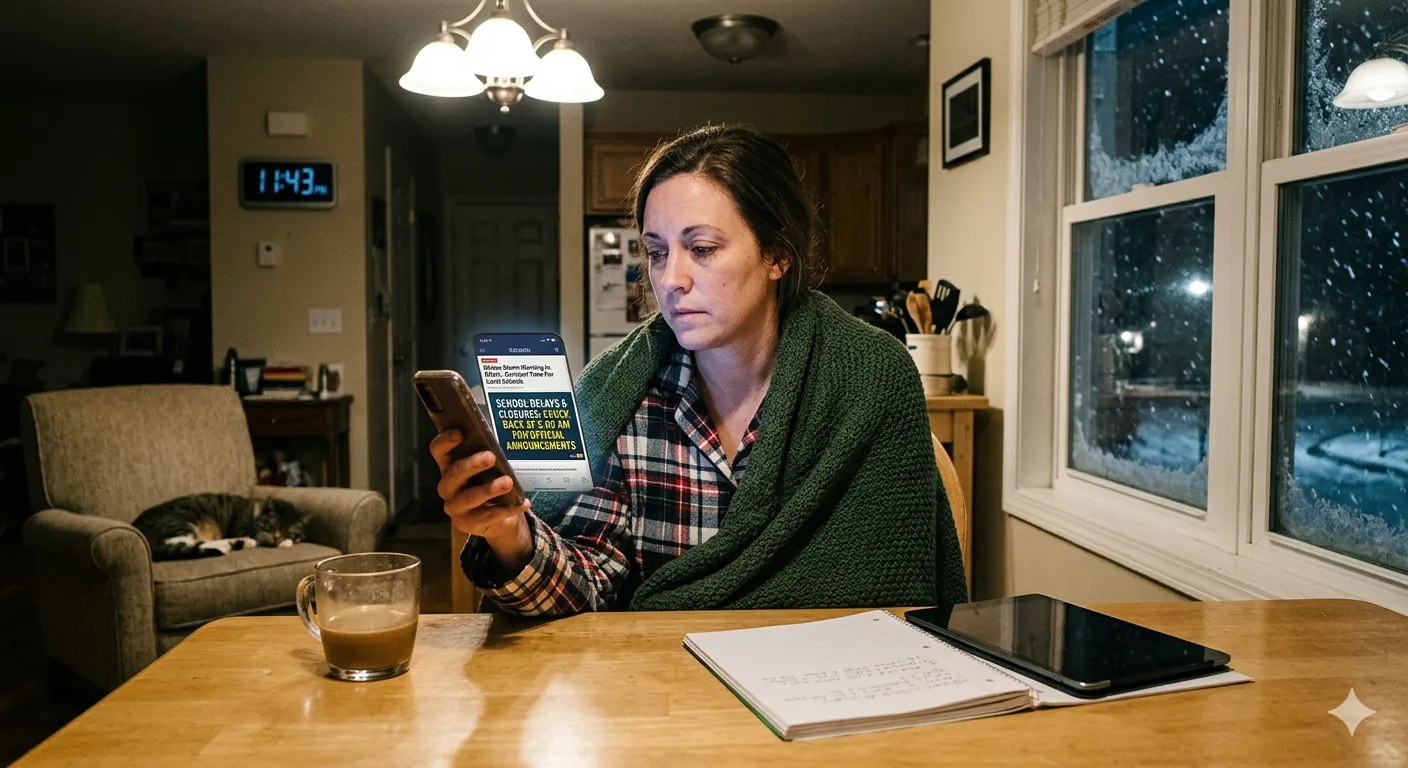
What Actually Triggers a Snow Day (Hint: It's Rarely Just Snow Depth)
People assume it's all about inches on the ground. In reality, snowfall totals are only one input among several, and sometimes not even the most important one.
Ice Is the Real Villain
Ask any superintendent what scares them more six inches of snow or a thin glaze of ice and ice wins every time. A 30,000-pound school bus can handle snow reasonably well. A patch of ice on a curve is a completely different kind of danger and it is often invisible until it is too late.
Timing of the Snowfall Matters More Than the Amount
Snow that falls between midnight and 5 AM is the worst-case scenario, roads get buried before plows can catch up, right as buses need to move. The same total snowfall arriving after 9 AM, once kids are already at school, is far less likely to trigger a closure.
Wind Chill Can Close School Even With Barely Any Snow
This one surprises a lot of people. Most districts have a hard cutoff for wind chill, often somewhere around -15°F to -22°F, because standing at a bus stop in that kind of cold is genuinely dangerous, independent of how much snow is actually falling. If you're trying to get ahead of a potential cold-weather closure, a wind chill calculator can give you a much clearer read on how dangerous the "feels like" temperature actually is than the raw air temperature alone.
Bus Geography Makes Every District Different
A flat suburban district with sidewalks and heavy plow coverage can absorb a lot more snow than a rural district full of steep, narrow, unpaved roads. This is exactly why two neighboring districts can look at the same storm and make completely opposite calls. It's not inconsistency, it's geography.
The "Calamity Day Bank" Changes the Math
Every school calendar is built with a certain number of forgiven weather days baked in, usually somewhere between five and ten, depending on the state. Early in the season, when that bank is still full, superintendents can afford to close more readily. By late February or March, with most of those days already used up, the exact same storm might only get you a delay instead of a full closure. It's not that the roads are different, it's that the calendar math is different.
Bus Drivers and Diesel Engines Play a Role Too
If enough bus drivers can't safely get to work themselves, routes simply can't run, regardless of road conditions near the schools. And in districts with older diesel fleets, extreme cold can make buses difficult to start at all, forcing mechanics in hours early just to get the fleet running.
Why Your State Might Handle the Same Storm Completely Differently
If you've ever complained to a friend in another state that your district "overreacts" to snow, or under-reacts, you're both probably right, just for different reasons.
- Northern Midwest (Michigan, Minnesota, Wisconsin): Typically announces between 4:30–5:15 AM and doesn't blink until 6–10+ inches, because the infrastructure is genuinely built for heavy winters.
- Northeast (New York, Massachusetts, Connecticut): Usually 5:00–5:30 AM, moderate thresholds around 4–8 inches.
- Mid-Atlantic (New Jersey, Pennsylvania, Maryland): Often 5:00–6:00 AM, with more variability district to district.
- Southeast (Georgia, North Carolina, Tennessee): Frequently decides the evening before, and it doesn't take much, sometimes as little as 1–3 inches, since roads and equipment just aren't built for snow at all.
- Mountain West (Colorado, Utah): Highly dependent on altitude and terrain, with road conditions mattering more than raw snowfall totals.
- Rural districts everywhere: Tend to announce earlier and act more cautiously than urban districts in the same state, purely because of longer, less-plowed bus routes.
A NOAA-affiliated risk communication researcher put it well in a past interview: for a lot of southern districts, even a flake in the forecast is enough to shut things down. It's not overreaction, it's a rational response to infrastructure that simply wasn't built for ice and snow.
Delay, Closure, E-Learning, or Early Dismissal? Know the Difference
Not every rough weather morning ends in a full day off. There are actually four distinct outcomes, and knowing which one you're dealing with changes how you plan your morning.
Two-Hour Delay
The most common middle-ground call. Everything, bus pickup, building access, class start, shifts back two hours, buying time for plows and de-icing crews to catch up while temperatures hopefully climb a few degrees. In states a two-hour delay still counts as a full instructional day so it does not eat into the calendar’s forgiveness bank. If you are trying to figure out how likely a delay is based on rain-to-snow transitions or freezing rain a tool, like a rain delay calculator can help you think through the timing before the official call even comes in.
Full Closure
Reserved for conditions too dangerous even for a delayed start. Everything shuts down, classes, sports, after-school programs, evening events.
E-Learning or Asynchronous Day
An increasingly normal third option. Students complete assignments remotely, and in many states this now counts toward required instructional hours, which cuts down on make-up days later in the year. The one real downside is equity, kids without reliable internet or a working device at home can genuinely be left behind on these days, and that's still an unresolved issue in a lot of districts heading into 2026.
Early Dismissal
Called when a storm rolls in mid-day that wasn't fully expected that morning. Districts generally try to avoid this if possible, since it can be logistically messier than a planned closure, but sometimes the weather simply doesn't cooperate with the forecast.
Read More : How Accurate Is the Snow Day Calculator?
How to Make Sure You Never Miss a Snow Day Announcement
Even the most timely district announcement is useless if it doesn't reach you. Here is a practical system for ensuring you're always the first to know:
- Update your contact info in the district parent portal : Do this every August before the school year begins. Check that your primary phone, backup phone, and email are all current and opted into emergency alerts.
- Follow the district's official social media accounts : Twitter/X and Facebook pages for your school and district often post at the same time as automated alerts.
- Bookmark the district website : Most homepage closures appear as pop-up banners or top-of-page alerts immediately after the decision is made.
- Enable push notifications on the district's app : If your district has a parent-facing app (many use Remind, ParentSquare, or Schoology), turn on push notifications specifically for emergency alerts.
- Tune local TV or radio at 5:00 AM during storms : Morning news programs actively broadcast running closure lists during severe weather events.
- Check a regional school closure aggregator : Sites like your local TV station's closure page often update the moment a district submits its data.
- Know your district's specific policy ; Some districts explicitly state they will never call before 5:00 AM; others may call as early as 4:30 AM. Reading your district's official weather policy page takes five minutes and saves confusion all winter.
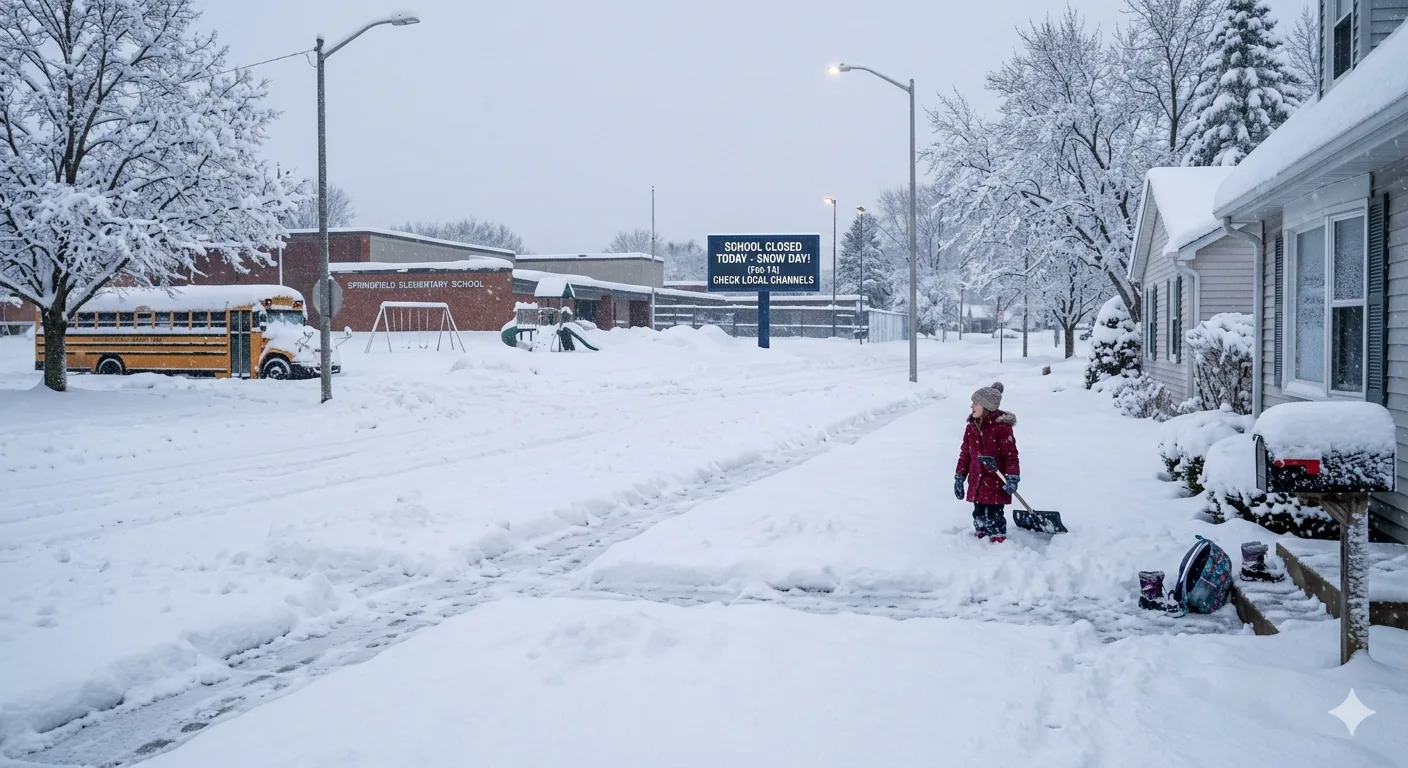
How Schools Actually Notify Families
The moment the decision is made, notifications don't trickle out, they fire almost simultaneously across several channels.
- Automated calls, texts, and emails through platforms like ParentSquare, SchoolMessenger, or Blackboard Connect, these are usually the fastest and most direct. This only works if your contact info in the parent portal is actually current.
- District website and app — most homepages get a prominent banner within minutes of the decision.
- Local TV and radio — many districts still maintain formal relationships with local stations that run scrolling closure lists during storm mornings.
- Social media — increasingly, districts post to social channels at the same time as, or even slightly before, the automated calls go out.
- Third-party closure aggregators — regional news sites often pull closure data from dozens of districts at once, handy if you're tracking more than one district.
Practical Steps to Never Miss an Alert
None of this timing matters if the alert doesn't actually reach you. Here's a short checklist worth doing once, ideally before the season even starts:
- Update your contact info in the district's parent portal every August, and double-check it's opted into emergency alerts specifically.
- Follow your district's official social accounts, they often post before or at the same moment as the automated call.
- Bookmark the district website so you can check the homepage banner directly during a storm.
- Turn on push notifications in whatever app your district uses, Remind, ParentSquare, or Schoology, specifically for emergency alerts.
- Read your district's actual weather policy page, most districts publish one, and it tells you exactly what time window to expect and whether night-before calls are ever used.
It's also worth building a habit of checking conditions yourself the night before, rather than relying entirely on the district. If you head to thesnowdaycalculators.com, you can get a sense of your own odds based on your local forecast before the official call even comes through, useful for deciding whether it's worth setting that 5 AM alarm at all.
What Happens to Make-Up Days?
Most states require somewhere around 180 instructional days, or a set number of instructional hours, each year. Calendars are usually built with a small buffer of snow days already factored in, typically three to seven. As long as closures stay inside that buffer, nothing changes. Once a district exceeds it, options usually include using up previously scheduled vacation days, extending the school year into June, or applying for a state waiver. Some states, including Minnesota under its e-learning statute, now allow remote learning days to count directly toward instructional requirements, which is steadily reducing how often districts need to tack days onto June.
What's Changed Heading Into 2026
A few things are shifting the snow day landscape this year worth knowing about:
- Faster, hyper-local forecasting is letting more districts push decisions slightly earlier without sacrificing accuracy, since street-level weather data has gotten noticeably better than the regional forecasts districts relied on even five years ago.
- E-learning days are becoming the default third option in more states, meaning fewer true "day off, no work" snow days and more asynchronous assignment days, especially for districts trying to protect their June calendar.
- Notification systems are converging around app-based push alerts rather than pure robocalls, which means keeping your district's app installed and notifications turned on matters more than it used to.
- Extreme cold closures are becoming more common as districts formalize wind chill thresholds rather than deciding case by case, which is why checking the "feels like" temperature specifically, not just the air temperature, has become a genuinely useful habit for parents.
Wrapping It Up
So, what time do schools announce snow days? Realistically, plan on somewhere between 5:00 and 6:00 AM for most districts, with a real chance of an evening-before call if the forecast is already ugly the night before. Behind that single text alert is a genuine overnight operation: road spotters driving icy back streets before dawn, boilers getting checked at 2 AM, and one person ultimately making a judgment call that affects thousands of families. Knowing the pattern won't make the decision come any faster, but it'll stop you from refreshing your phone at 3 AM for no reason. Set your alarm around 5, keep your contact info updated in the parent portal, and let the process play out. And if you want a head start on the guesswork before the official call even lands, take a look at our full set of weather calculators, including tools for wind chill, rain delays, and heat index days, so you're never caught completely off guard, no matter what the season throws at you.
Conclusion: Set Your Alarm for 5:00 AM
The next time a winter storm looms on the forecast, you now know exactly what is happening while you sleep. By 3:30 AM, transportation directors are out driving icy back roads. By 4:45 AM, the superintendent is on the phone reviewing all available data. By 5:00–5:30 AM, the decision is made and notifications fire simultaneously across every channel.
The single most important thing you can do right now is verify that your contact information is current in your district's parent portal before the next storm hits. A perfectly timed announcement means nothing if it's going to an old phone number or an unmonitored email address.