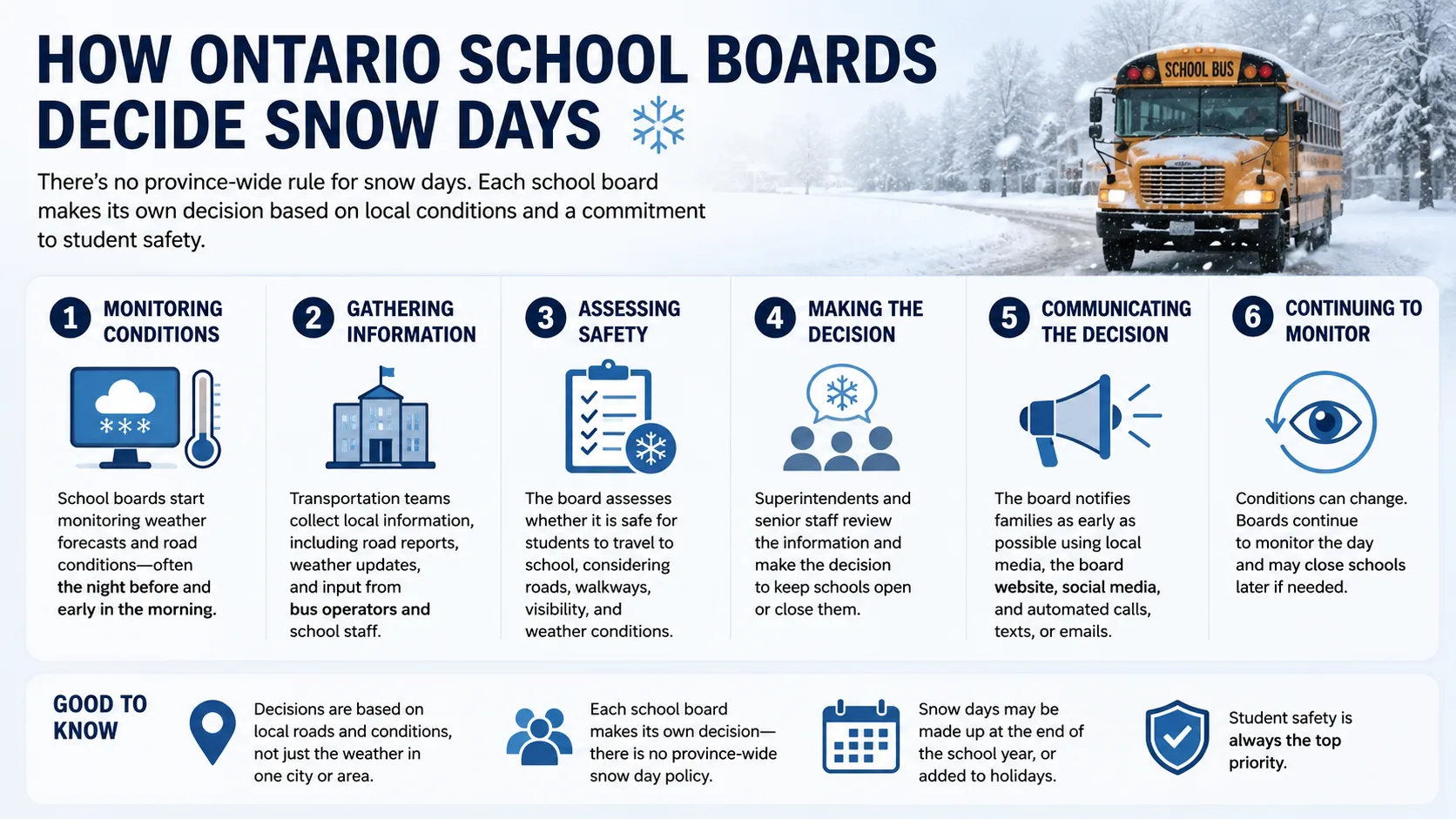
How do Ontario school boards decide snow days? In most cases, they don't cancel "school" at all. Instead, a small team made up of the director of education, transportation staff, and communications officers meets before dawn to review weather forecasts, road reports, and wind chill data. Based on that review, they usually cancel school buses first, not classes. Full school closures are rare and only happen when conditions are unsafe for everyone, not just bus riders.
This distinction confuses a lot of Ontario parents every winter. You wake up, see a "cancellation" alert, and assume school is off. Often it isn't. Below, we break down exactly how the decision gets made, who makes it, the temperature and wind chill thresholds involved, and how policies differ between boards like the TDSB, YRDSB, WRDSB, and HWDSB.
What "Snow Day" Actually Means in Ontario
In the United States, a snow day usually means school is fully closed. In Ontario, the term is used loosely to describe three very different situations, and mixing them up is the number one source of parent confusion.
- Bus cancellation day: Transportation is cancelled, but schools stay open for students who can get there another way.
- Extreme cold weather day: Buses are cancelled because dangerously low wind chills make waiting at a stop unsafe, even though roads are clear. Schools remain open.
- Inclement weather day (system closure): Road or storm conditions make it unsafe to operate buses and unsafe to keep buildings open. This is the only scenario that resembles a true American-style snow day, and it's the least common.
Most winter mornings that Ontario families call a "snow day" are actually bus cancellations. Schools stay open, and attendance is not held against students who can't get there safely.
Who Actually Makes the Decision
The decision is never made by one person checking a weather app. It's a coordinated process involving several roles.
1. The Board's Weather Response Team
At boards like the Toronto District School Board, the team includes the director of education, associate director, transportation staff, and communications officers. They gather very early on days when bad weather is expected and evaluate current and forecast conditions before deciding whether to keep schools open.
2. Student Transportation Consortia
Most Ontario boards don't run their own buses. Instead, regional consortia coordinate transportation for multiple boards at once. Examples include:
- OSTA (Ottawa Student Transportation Authority) – serves the Ottawa-Carleton District School Board and the Ottawa Catholic School Board
- STWDSTS – serves the Upper Grand and Wellington Catholic District School Boards
- Tri-Board Student Transportation Services – coordinates busing for three boards in the Kingston, Frontenac, and Lennox and Addington area
- Student Transportation Services of Waterloo Region (STSWR) – serves WRDSB and the Waterloo Catholic District School Board
These consortia monitor forecasts, check road conditions, and often consult with neighbouring transportation authorities before making a call, which is why cancellations can differ from one nearby region to the next even during the same storm.
3. Directors of Education and Board Chairs
Full school closures (as opposed to bus-only cancellations) typically require sign-off from the director of education, sometimes jointly across two boards sharing transportation, along with the board chair. This is a higher bar than a routine bus cancellation, which explains why full closures are so rare.
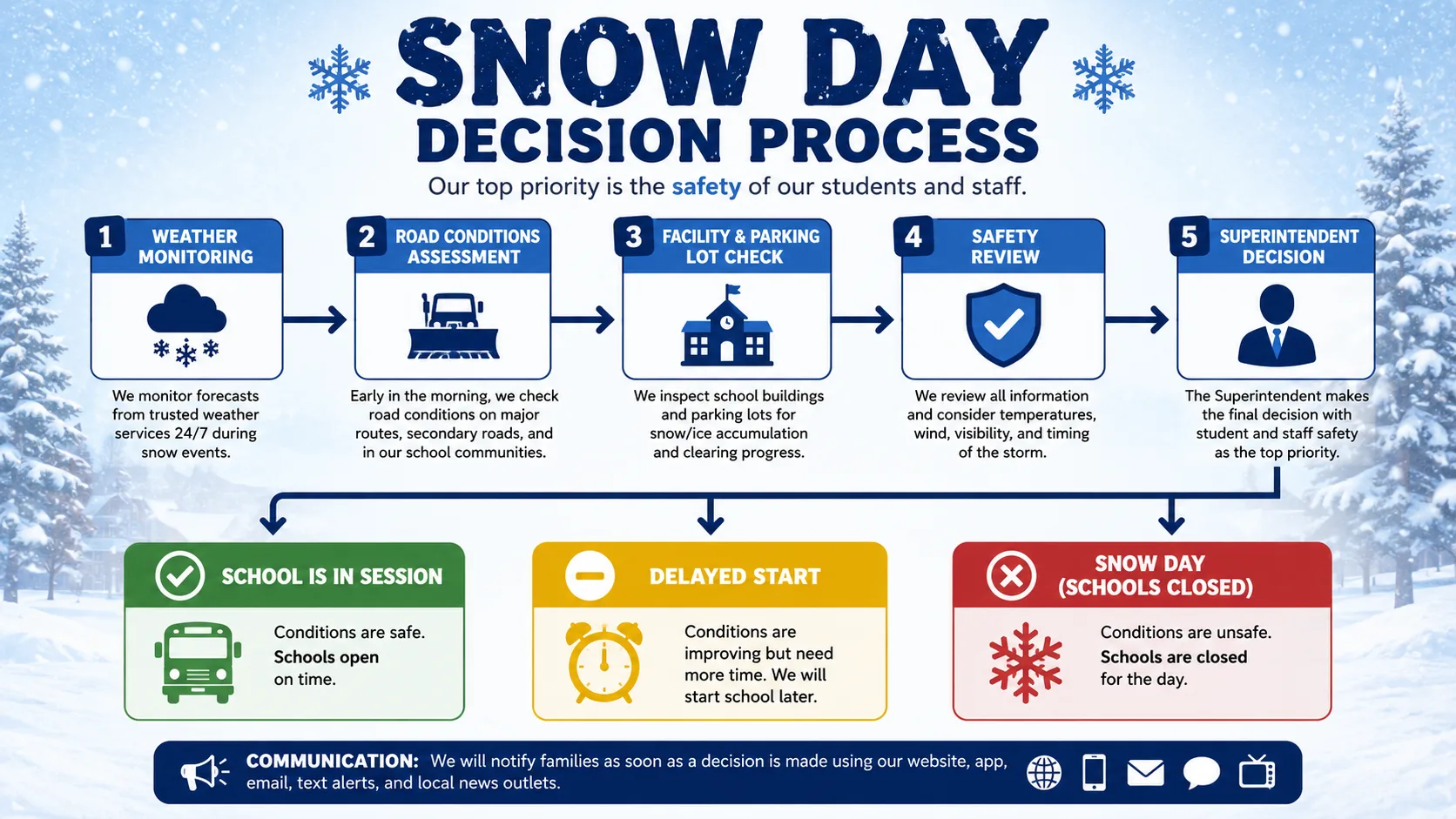
How the Snow Day Decision Process Works, Step by Step
- The evening before: Transportation staff and superintendents start watching the forecast, often communicating with municipal road crews about plowing plans and route conditions.
- Early morning (around 4:30 a.m.): Team leads from the transportation consortium begin reviewing updated radar, temperature, and wind chill data, and start conferring with neighbouring districts.
- Road and route checks (4:30–5:30 a.m.): In many regions, staff or contracted drivers physically test sample bus routes to see how roads are actually performing, not just how the forecast reads.
- The decision (5:15–6:15 a.m.): A final call is made on whether buses run, whether it's an extreme cold day, or whether a full system closure is needed.
- The announcement (by 6:00–6:30 a.m.): The decision is posted to the board's website, social media, an alert app, and often shared with local media, all before most families are getting ready for the day.
Because this entire process happens in a two-hour window before sunrise, boards rely heavily on Environment Canada forecasts and, in some cases, private forecasting services, cross-checked against real-time road reports from municipal partners.
The Wind Chill Threshold: Why -35°C Is the Magic Number
Cold, not snow, is often the real trigger for Ontario bus cancellations. Multiple boards use a wind chill of -35°C or colder, forecast for around 7 a.m., as their benchmark for cancelling buses. At that wind chill, exposed skin can experience frostbite in roughly 10 to 15 minutes, which is a genuine safety risk for kids waiting at an unsheltered stop.
| Wind Chill Range | Risk Level | Typical Board Response |
|---|---|---|
| 0°C to -24°C | Low risk | Buses and schools operate normally |
| -25°C to -34°C | Moderate risk | Boards monitor closely; recess may be shortened |
| -35°C to -39°C | High risk (frostbite in 10–15 min) | Buses commonly cancelled; schools stay open |
| -40°C or colder | Severe risk (frostbite in under 10 min) | Full closures more likely, especially in rural and northern boards |
Wind chill isn't a real temperature reading. It describes how cold exposed skin feels due to wind, which is why a day at -22°C air temperature with strong wind can feel, and behave dangerously, like -30°C. Boards build this into their thresholds because bus stop exposure, not classroom time, is usually the actual hazard.
Bus Cancellation vs. School Closure: Why They're Treated Differently
Here's the part most competitor articles skip. Boards separate "can we safely run a bus route" from "can we safely keep a building staffed and open," and those two questions have very different answers.
A bus travels dozens of kilometres on rural roads, waits at unsheltered stops, and depends on visibility for driver safety. A school building, by contrast, just needs staff and students who live nearby to arrive safely, which is a much lower bar. That's why approximately 93% of TDSB students don't rely on buses to get to school, so cancelling transportation while keeping the building open affects only a minority of families.
This is also why boards created a middle category: the extreme cold weather day. Roads may be perfectly clear, but the temperature alone makes bus stops unsafe. On these days:
- Buses and taxis are cancelled for the morning and afternoon runs
- Schools, offices, and daycare programs remain open
- Students are not marked absent if their family decides it's too cold to walk or drive them in
- Crossing guards may not be posted, since they face the same wind chill risk
Read More : What Time Do Schools Announce Snow Days?
How Policies Differ Across Ontario School Boards
There is no single provincial rule for snow days. The Ontario Ministry of Education leaves the operational decision to individual boards, which means policies genuinely differ by region, geography, and board history.
| School Board | Default Rule When Buses Are Cancelled | Decision Deadline |
|---|---|---|
| Toronto District School Board (TDSB) | Schools generally stay open | By 6:00 a.m. |
| York Region District School Board (YRDSB) | Schools stay open on both extreme cold and inclement weather days | By 6:00 a.m. |
| Waterloo Region District School Board (WRDSB) | Schools stay open unless it becomes unsafe to keep them open | By 6:00 a.m. |
| Hamilton-Wentworth District School Board (HWDSB) | Bus cancellation automatically triggers school and admin building closure | By 6:00 a.m. |
| Upper Grand District School Board (UGDSB) | Buses may be cancelled independently of schools; closure needs joint sign-off from both directors of education | Buses by 5:30 a.m., closures shortly after |
Notice that HWDSB takes the opposite approach from TDSB, YRDSB, and WRDSB. Its rule is simple: severe weather plus a bus cancellation automatically equals a full school and administrative closure. That single difference explains why two boards just a couple of hours apart can respond completely differently to the same storm.
Why Some Boards Changed Their Approach After the Pandemic
Winter weather policy in Ontario shifted noticeably after COVID-19. Several Greater Toronto Area boards, including Peel District School Board, moved toward switching students to virtual learning on days when buses were cancelled, instead of leaving classrooms half-empty with combined groups. The goal was to avoid losing instructional days while also avoiding unsafe cohort mixing.
More recently, boards like WRDSB revised their process again, this time working jointly with the Waterloo Catholic District School Board and their shared transportation service to define five specific weather scenarios, each with its own pre-set response for schools, daycares, and before-and-after care programs. This trend, moving from vague "use your judgment" language toward detailed, scenario-based policies, is likely to continue through 2026 as more boards publish clearer public procedures.
What Factors Go Into the Decision
Beyond temperature, teams weigh several inputs simultaneously before making a call:
- Forecasted wind chill at the start of the school day, usually 7 a.m.
- Road and highway conditions, often checked directly with municipal or provincial road crews
- Visibility, since snow squalls can drop visibility to near zero within minutes even without heavy accumulation
- Snowfall rate and accumulation, not just total snowfall but how fast it's falling during the morning commute window
- Route-specific conditions, since rural gravel routes may be unsafe while paved urban routes are fine
- Regional consistency, since neighbouring transportation authorities often coordinate to avoid confusing, inconsistent calls across shared communities
Rural and northern boards tend to have lower cancellation thresholds than urban boards, since gravel roads, longer routes, and fewer plows mean conditions escalate faster outside major cities.

Why This Matters for Attendance and Learning
On a bus cancellation day or extreme cold day, students are not penalized for staying home if their family judges it unsafe to travel independently. Boards generally record this without counting it against attendance-based recognitions. What changes for families is mostly logistics, not academics, since:
- Lunch programs, special events, and field trips scheduled that day are usually cancelled
- After-school and before-school care may still run even if transportation doesn't
- Some boards shift to asynchronous or take-home learning materials on full closure days
How Parents Can Stay Informed
Because the decision window is so short, usually finalized between 5 a.m. and 6:30 a.m., checking one source isn't enough. Reliable channels include:
- Your board's official website (updated first, typically by 6 a.m.)
- Your transportation consortium's website or app (OSTA, STSWR, Tri-Board, STWDSTS, or similar)
- Board and consortium social media accounts, especially X (Twitter) and Facebook
- Local news outlets, which usually publish a running list during major storms
- School-specific email or app alerts, if your board offers them
Some independent tools, sometimes marketed as "snow day predictors," estimate the odds of a cancellation using historical patterns and live forecast data. These can be a fun early indicator, but they are not official. Only your board or transportation consortium's own announcement should guide your final decision.
Common Misconceptions About Ontario Snow Days
- "No buses means no school." Usually false. Most boards keep buildings open.
- "Every board follows the same temperature rule." False. Thresholds and response rules vary by board and by transportation consortium.
- "The Ministry of Education makes the call." False. The province sets general safety expectations, but individual boards and their transportation providers make the operational decision.
- "Heavy snowfall automatically means a closure." Not necessarily. Wind chill, visibility, and road-clearing speed often matter more than total accumulation.
Conclusion
Deciding an Ontario snow day is a layered, early-morning process, not a simple weather check. A dedicated team reviews wind chill, road conditions, and visibility, then chooses between three distinct outcomes: business as usual, a bus-only cancellation, or a full closure. Because boards like TDSB, YRDSB, WRDSB, HWDSB, and UGDSB each apply their own thresholds and default rules, the safest approach for families is simple: check your specific board and transportation consortium directly by 6 a.m., rather than assuming one board's decision applies to another.
Also Checkout :