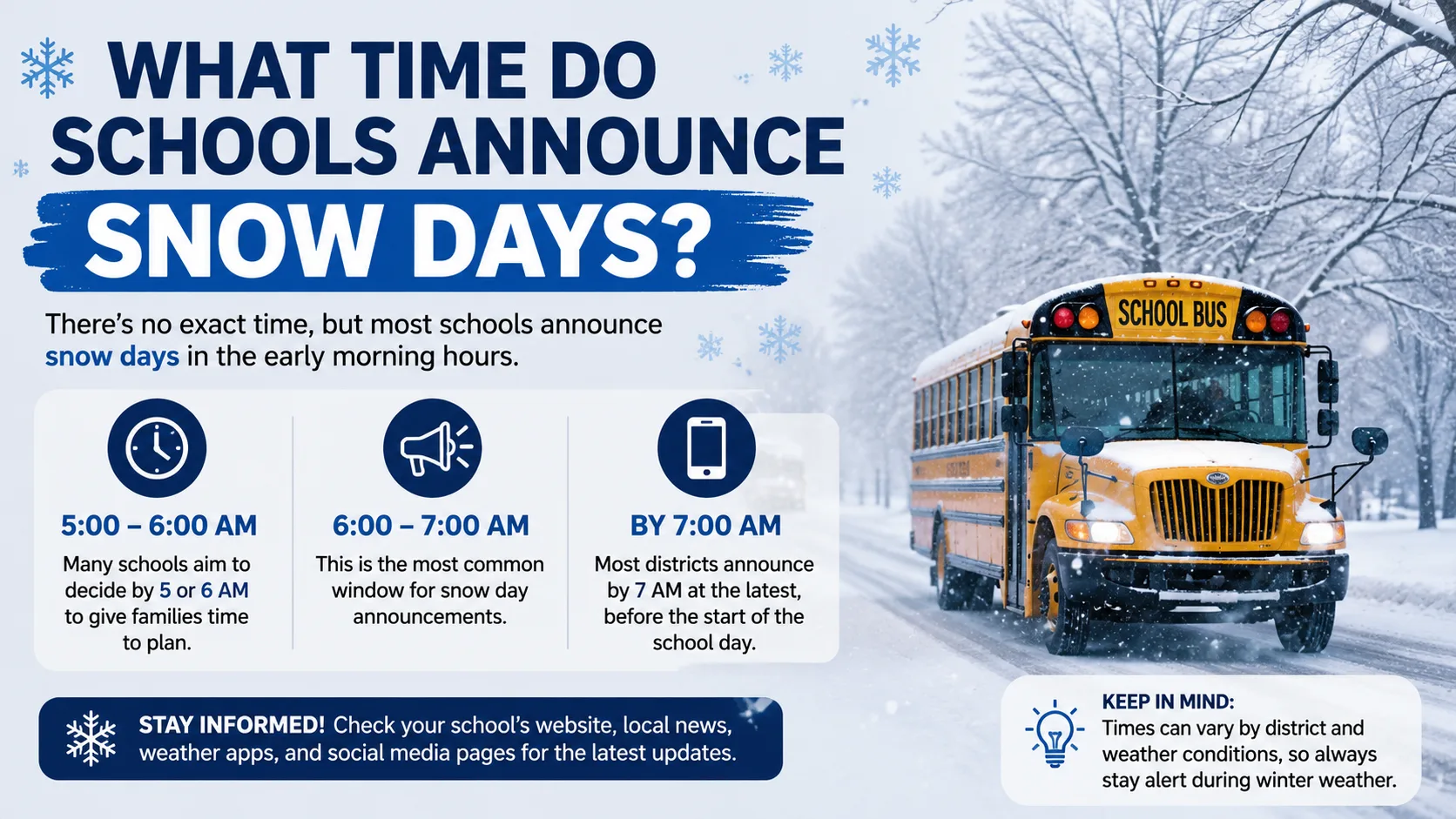
If you have ever laid awake refreshing the district website at 4 a.m., you already know the question that matters most: what time do schools announce snow days? The honest answer is that most school districts across the United States make and share their decision between 5:00 AM and 6:30 AM on the morning of the storm, though a growing number of districts now call it the night before when the forecast is certain.
But that single range does not tell the whole story. The exact timing depends on your district's start time, its transportation routes, the type of storm, and even how many "snow days" the district has already used that winter. In this guide, you will learn exactly when to expect the call, who makes it, what factors drive the timing, and how to get the alert the moment it goes out.
The Short Answer: Typical Snow Day Announcement Times
Here is a quick-reference breakdown of when schools typically announce closures, delays, and early dismissals. Bookmark this table, because it applies to most public school districts in snowy and icy climates.
| Scenario | Typical Announcement Time | Why |
|---|---|---|
| Full closure, storm confirmed overnight | 4:30 AM - 6:30 AM | Roads are checked in the early hours, then the call goes out before buses leave the yard |
| Full closure, storm is certain and severe | The evening before (6 PM - 10 PM) | Districts announce early when the forecast leaves little doubt, so families can plan |
| Two-hour delayed start | 5:00 AM - 6:00 AM | A delay gives plows extra time, so the district waits for the latest road data |
| Delay upgraded to full closure | By 8:00 AM | If conditions worsen after a delay is called, districts issue a second alert |
| Early dismissal for afternoon weather | Not before 1:00 PM | Districts wait to see how the storm develops before pulling students out early |
| After-school activity cancellations | Around 1:00 PM - 3:00 PM | A separate, later decision based on afternoon and evening conditions |
These windows are echoed by real district policies. Montclair Public Schools in New Jersey states that the announcement usually appears by 6 a.m., unless the decision is made the night before, in which case the alert goes out right away. Meanwhile, districts like Westminster Public Schools in Colorado note that if a two-hour delay later needs to become a full closure, that follow-up announcement is made by 8 a.m.
Why Snow Day Announcement Times Vary by District
Two neighboring school districts can announce closures an hour apart, and both can be making the right call. Here is why the timing shifts so much from one district to the next.
- Start time matters. A district with a 7:15 AM start needs to decide earlier than one that starts at 8:45 AM, simply because buses roll out sooner.
- Bus route length. Rural districts with long, winding routes and back roads need more lead time to confirm conditions than compact urban districts.
- Number of snow days used. Some states require a minimum number of instructional days per year, so districts that are close to their limit may wait longer or lean toward a delay instead of a full closure.
- Storm timing. A storm that hits overnight is far more disruptive than one that arrives mid-afternoon, since plows have less time to clear roads before the morning commute.
- Confidence in the forecast. When meteorologists are highly confident in a major storm, districts often announce the night before rather than making families wait until dawn.
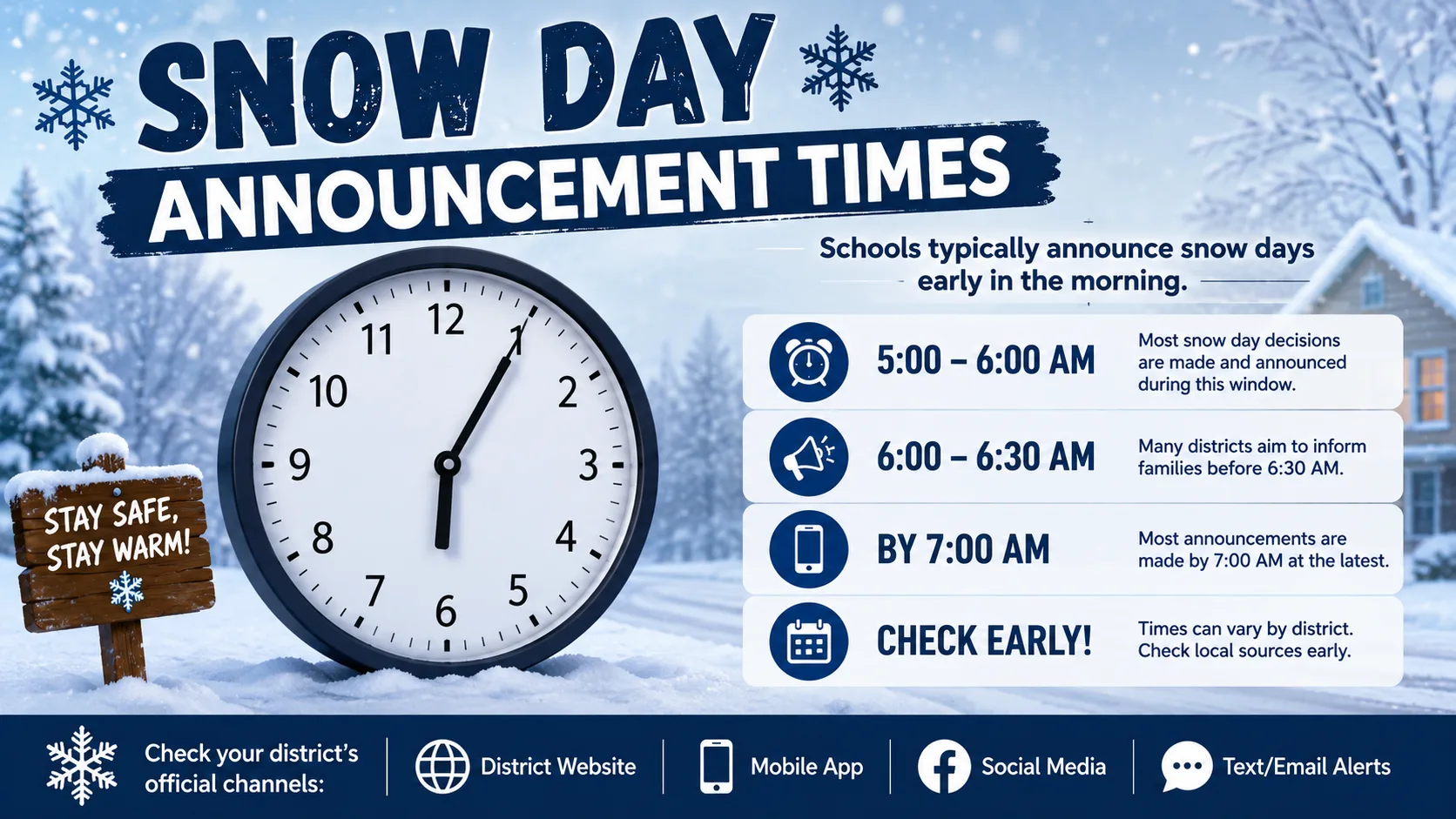
Who Actually Decides, and When: Inside the Overnight Process
The decision to close school is not made by one person glancing out a window. It is a structured, overnight process that usually starts hours before most families wake up. Here is what typically happens, hour by hour.
2:45 AM - 3:30 AM: Transportation directors hit the roads
In many districts, the Director of Transportation is the first person actively working the storm. According to Howard County Public School System (HCPSS) in Maryland, the transportation director begins reviewing temperatures and forecasts as early as 2:45 a.m., then conducts on-road observations of actual conditions starting around 3:00 a.m. They are not checking highways. They are driving the same back roads and side streets that school buses will use, because friction, not snow depth, is what actually determines whether a bus can operate safely.
3:30 AM - 4:30 AM: Local road crews and district staff compare notes
Around this window, transportation and operations staff contact county or city road departments to find out which streets have been plowed and salted, and which have not. Livonia Public Schools in Michigan says its operations personnel actively monitor conditions again at approximately 3:30 to 4 a.m. before any decision is finalized.
4:30 AM - 5:30 AM: The superintendent makes the call
With road reports, weather models, and transportation feedback in hand, the superintendent (often in consultation with neighboring district leaders) makes the final decision. Superintendents frequently text, call, or email each other overnight to coordinate a regional response, since families often cross district lines for work and childcare. Analysts at SchoolSnowDayCalculator.com note that most districts aim to communicate closure decisions by 5:30 a.m., although some announce as early as 4:30 a.m. and others wait until 6:00 a.m.
5:30 AM - 6:30 AM: The official announcement goes out
Once the decision is locked in, the district triggers its mass-notification system: automated phone calls, text messages, emails, a website banner, and posts on social media, often simultaneously. Livonia Public Schools specifically notes it does not place phone calls earlier than 5 a.m., even though the decision itself may already be finalized, simply to avoid waking families unnecessarily.
The night-before exception
When a storm's arrival and severity are not in doubt, districts increasingly skip the early-morning suspense entirely. Royal Oak Schools in Michigan states that closures are called as early as possible, and in some cases the night before when warranted. This trend has grown as forecasting technology has improved, giving officials enough confidence to commit to a decision by dinnertime rather than dawn.
What Factors Influence Both the Decision and the Timing
Understanding what superintendents are actually watching helps explain why the announcement lands when it does. The main factors include:
- Snowfall total and rate. As a rough national pattern, 1 to 2 inches may only affect southern districts, 3 to 4 inches often triggers closures across most regions, and 5 or more inches almost always does.
- Ice, not just snow. A thin glaze of ice is frequently more dangerous than several inches of snow, because it is nearly invisible and drastically increases stopping distance for a fully loaded school bus.
- Wind chill and extreme cold. Many northern districts close when wind chill drops below roughly -15°F to -20°F because students waiting at bus stops face a real frostbite risk within minutes.
- Storm timing. Snow that falls between 10 PM and 5 AM is more disruptive than daytime snow, since plow crews have far less time to clear roads before the first bell.
- Road commission updates. Districts stay in direct contact with county and city plow crews to learn which routes are treated and passable.
- Staff and bus driver availability. If enough bus drivers or staff cannot safely reach the school, that alone can force a closure or delay, regardless of snow totals.
As one Michigan superintendent explained to Bridge Michigan, districts routinely coordinate directly with road crews before making a call, since knowing when plows will actually reach the district's streets is often more useful than the snow forecast alone.
Read More : How Accurate Is a Snow Day Calculator
Delayed Openings vs. Full Closures vs. Early Dismissals: How Timing Differs
Not every winter weather day looks the same, and each type of disruption follows its own announcement timeline.
Delayed opening
A two-hour delay is often the "wait and see" option. It is usually announced between 5:00 and 6:00 AM, giving plow crews extra time while keeping the door open for a normal (delayed) school day. All schools then begin exactly two hours after their usual start time, and bus pickups shift by the same two hours.
Delay upgraded to a full closure
Sometimes conditions worsen after a delay is called. In that case, districts issue a second announcement, typically by 8:00 AM, converting the delay into a full closure before buses actually depart.
Full closure
This is either announced early the same morning (4:30 to 6:30 AM) or, increasingly, the night before if the storm's severity is not in question.
Early dismissal
Early dismissals for afternoon or evening weather work differently, since districts want to avoid triggering unnecessary panic. Many districts, including Montclair Public Schools, explicitly state that an early-dismissal decision will not be made prior to 1 p.m., even if snow begins falling earlier in the day.
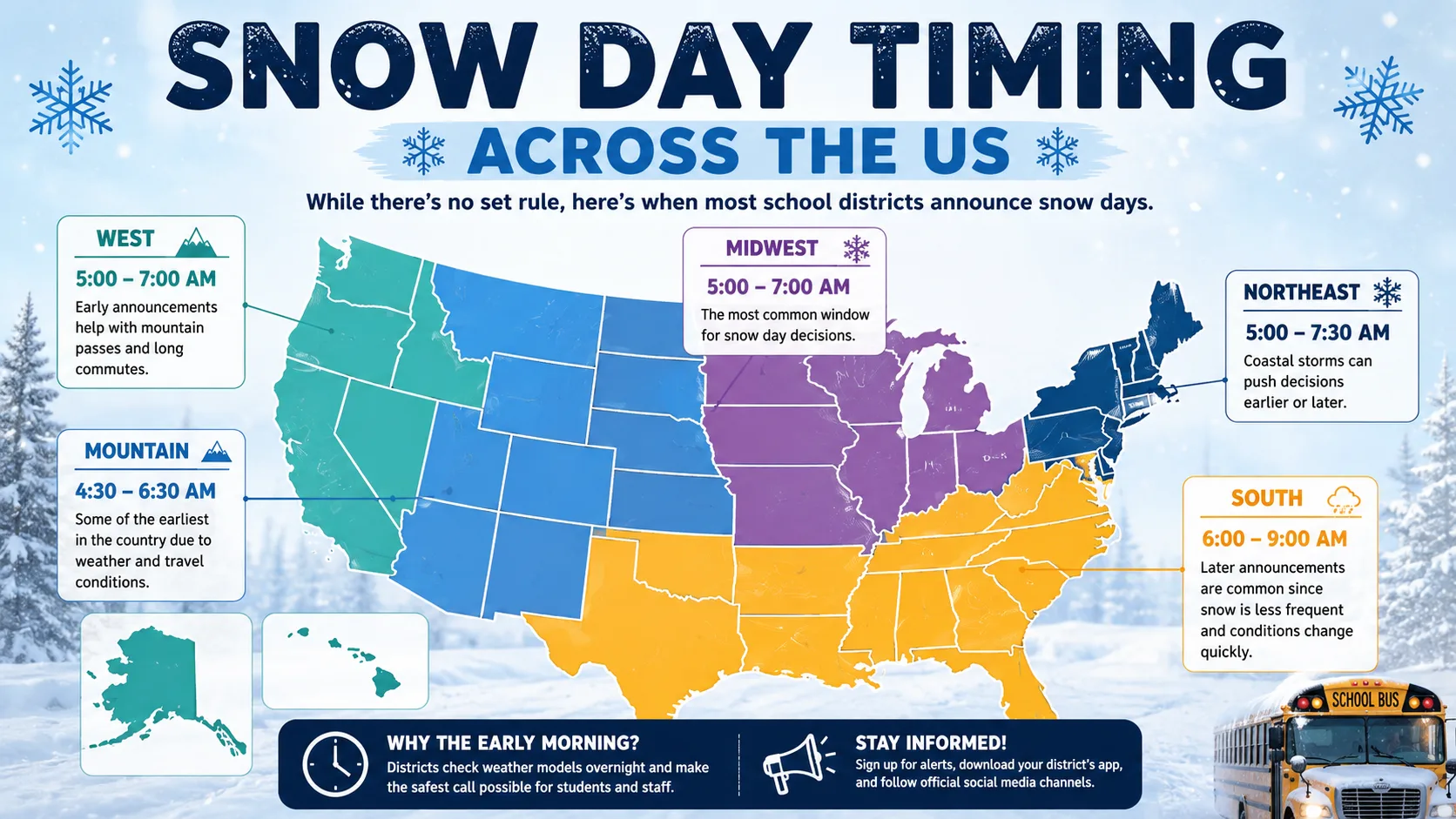
Regional Differences: Snow Day Timing Across the US
Snow day culture is not the same in Minnesota as it is in Georgia. Plowing capacity, driver experience, and community expectations all shift the threshold for closing school.
| Region | Typical Snow Threshold | Typical Announcement Window |
|---|---|---|
| Northeast / Upper Midwest (heavy plow infrastructure) | 4-6+ inches, or any significant ice | 5:00 AM - 6:30 AM, or night before for major storms |
| Mid-Atlantic / Ohio Valley | 2-4 inches, or ice | 4:30 AM - 6:00 AM |
| South / Southeast (limited plow fleets) | 1-2 inches, or any ice | Often the night before, since roads clear slowly |
| Mountain West | Varies widely by elevation and route terrain | 5:00 AM - 7:00 AM |
Plow capacity is a major reason for this gap. Cities with large fleets can clear major roads within hours, while cities with far fewer plows and salt trucks may need most of the morning, pushing districts toward earlier, more cautious closures.
How Schools Notify Families (and How to Make Sure You Get the Alert First)
Once the decision is made, districts push it out through several channels at once. To make sure you are never the last to know, set up as many of these as possible:
- District mass-notification system. Confirm your phone number, email, and preferred language are correct in the school portal, since this is usually the fastest channel.
- District website banner. Most districts post an alert directly on the homepage the moment a decision is final.
- District and school social media accounts. Many districts post to Facebook, X, or Instagram simultaneously with the phone alert.
- Local TV and radio "closings" tickers. Useful as a backup, though usually a few minutes behind the district's own channels.
- Snow day prediction tools. These do not replace an official announcement, but they can help you plan the night before based on forecast confidence.
How to Predict a Snow Day Before the Official Announcement
While no tool can guarantee an outcome, a few patterns give you a strong hint before the official alert lands:
- Overnight snow is the biggest red flag. Snow falling between 10 PM and 5 AM leaves plow crews the least time to prepare roads before the morning commute.
- Watch for freezing rain, not just snow. Even a small amount of ice accumulation can push the probability of a closure toward certainty, since it is more dangerous than several inches of snow.
- Track your district's history. Districts that have closed for similar conditions in the past are likely to do so again, especially if they still have unused snow days in the budget.
- Check neighboring districts. Superintendents frequently coordinate, so if nearby districts announce closures early, yours may follow.
- Watch the wind chill, not just the temperature. A forecast wind chill below roughly -15°F to -25°F is a strong closure signal even without fresh snow.
Common Mistakes Parents Make While Waiting for the Snow Day Call
- Calling the school directly before an announcement. Front-office staff usually do not have information earlier than the mass alert, and tying up phone lines can actually slow things down.
- Assuming one district's decision applies to all nearby districts. Even neighboring towns can make different calls based on their own bus routes and road conditions.
- Relying only on the news ticker. TV closings crawls are often a few minutes to an hour behind the district's own notification system.
- Forgetting to update contact information. If your phone number or email on file is outdated, you may miss the automated alert entirely.
- Assuming a delay means the day is guaranteed to happen. As covered above, a delay can still be upgraded to a full closure if conditions worsen.
Snow Day Announcement Time: Quick Visual Summary
| Time (Local) | What Is Happening |
|---|---|
| 2:45 AM | Transportation director begins reviewing forecasts and temperatures |
| 3:00 AM - 3:30 AM | On-road inspections of actual bus routes begin |
| 3:30 AM - 4:30 AM | District staff compare notes with county/city road crews |
| 4:30 AM - 5:30 AM | Superintendent finalizes the decision, often after consulting nearby districts |
| 5:00 AM - 6:30 AM | Official alert sent via call, text, email, website, and social media |
| 8:00 AM (if needed) | Delay-to-closure upgrade announced if conditions worsen |
| 1:00 PM (if needed) | Early dismissal or after-school activity cancellations announced |
Conclusion
So, what time do schools announce snow days? For the vast majority of districts, the answer is between 5:00 AM and 6:30 AM on the morning of the storm, following hours of overnight road checks, weather monitoring, and coordination between transportation staff and the superintendent. When a storm is severe and well-forecast, that window often shifts to the night before instead.
The exact minute will always depend on your specific district's start time, route length, and local weather patterns, so your safest bet is to make sure your contact information is current in the district's notification system and to check the district website directly first. That way, whether the call comes at 4:45 AM or the night before, you will be among the first to know.
Also Checkout :