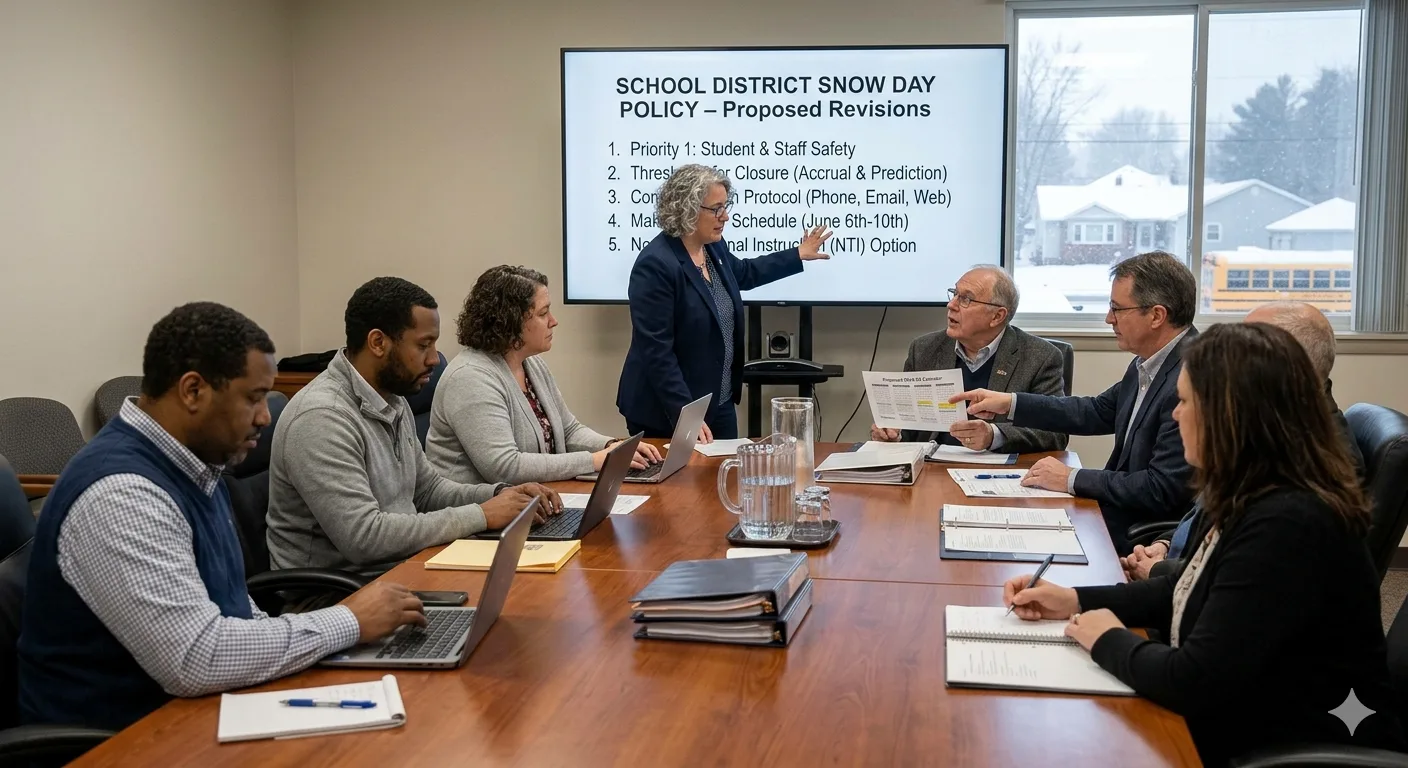
It is 4:15 AM. Somewhere nearby, a superintendent is sitting in a truck on a back road you have never heard of, checking whether a school bus can stop safely on a hill. You are still asleep.
In an hour your phone will buzz with a yes or a no. Behind that one notification sits a detailed process and a school district snow day policy is the rulebook that shapes it.
I built my snow day calculator after seeing parents in my area confused about school closures. The same questions kept coming up. Why did the next district over close when ours stayed open? Why was school canceled when barely any snow fell? Why did the call come so late?
This guide answers those questions in language. You will see who makes the decision in the US, Canada, and the UK, what they check in the dark, how wind chill and ice change everything, and what you can do to stay one step ahead.
What Is a School District Snow Day Policy?
A school district snow day policy is the set of guidelines a district uses to decide whether to close, delay the start of the day, release students early, or move to remote learning when the weather turns bad.
Here is the part that surprises most people. There is no national standard. In the US, roughly 13,000 districts each write their own approach based on local roads, bus routes, climate, and community needs. State law usually sets how many instructional days a school year must have, but the weather triggers themselves are local.
Some districts publish thresholds. Many others keep a loose policy and rely on the superintendent's judgment on the morning. Either way, safety is the first test, and the practical question is simple: can students and staff get to school and back home safely?
Who Actually Makes the Snow Day Call?
The answer depends on where you live, and that is a big reason confusion spreads so fast between neighbors, relatives, and online forums.
United States: the superintendent
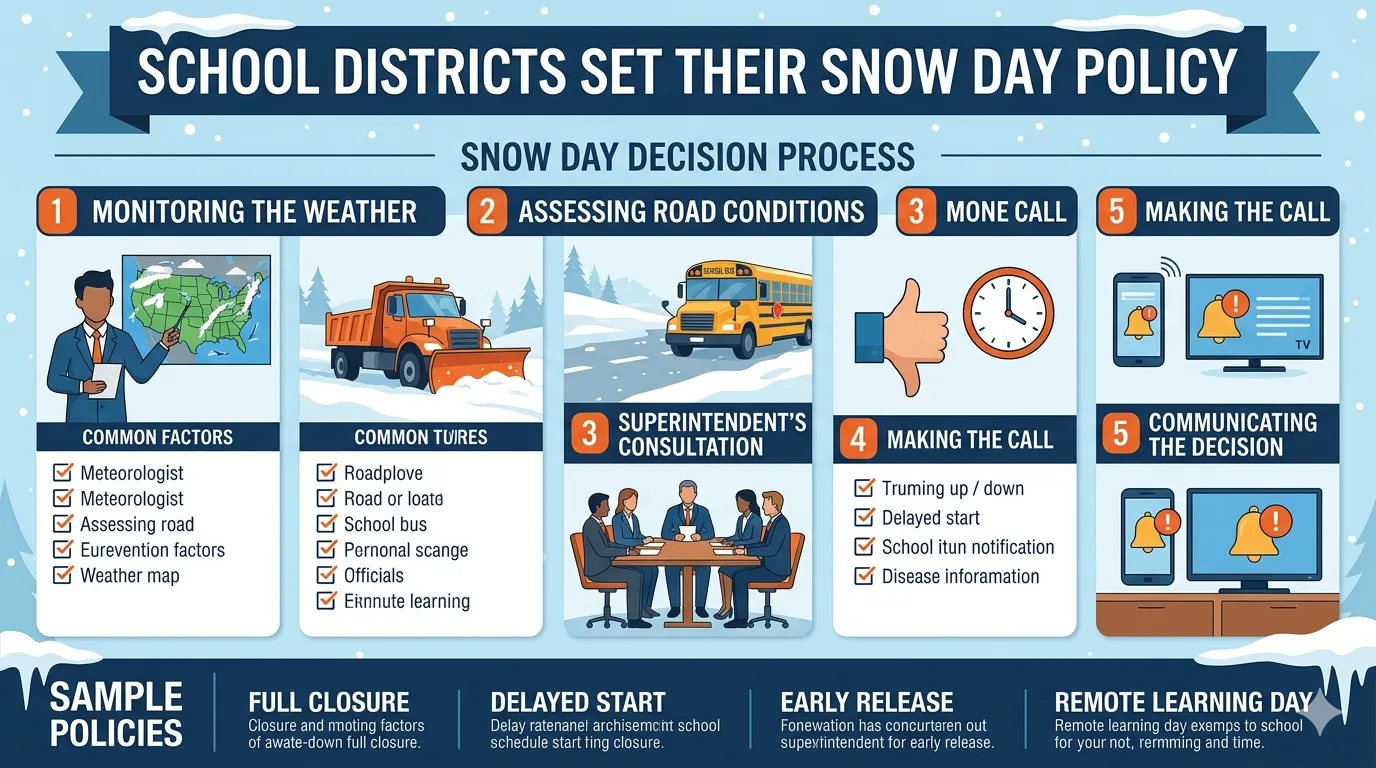
In most US districts the superintendent has the final say. It is not a vote and it is not an automated system. It is one person, usually awake well before dawn, pulling information from several people:
- The transportation director, who sends drivers or road spotters out to check real conditions on the worst routes.
- The facilities manager, who checks boilers, power, and whether parking lots and walkways can be cleared in time.
- Neighboring superintendents, who compare notes on early-morning calls so the region stays reasonably consistent.
- Meteorologists, from the National Weather Service or private forecasters, who supply hour-by-hour timing.
Some superintendents drive the roads themselves between about 3 and 4 AM. That detail matters, because it explains why a decision can feel "late" to you but is actually the earliest point at which anyone can see what the pavement looks like.
Canada: school boards and bus consortia
In Canada, the transportation side often drives the outcome. In many Ontario regions, a shared bus consortium decides whether buses will run, and the school boards then decide whether buildings stay open.
Bus cancellations can come first. Some boards have gone further and adopted rules that close schools in a zone whenever buses there are canceled. Freezing rain is a trigger since a thin layer of ice can make roads unsafe even when little snow falls. Because policies change, check your own board's current wording.
United Kingdom: the headteacher
In the UK, the decision usually belongs to the individual headteacher, not a district office. They typically consult governors, the local authority or academy trust, site staff and transport providers before acting.
Their central question is the same one American superintendents ask: is it safe to open? For a headteacher, though, staffing is a big piece. If enough teachers cannot reach the school or heating and site access are compromised opening may not be workable when the playground looks fine.
The Snow Day Decision Timeline, Hour by Hour
Times vary by district. The pattern is remarkably similar almost everywhere. Here is what a typical storm morning looks like.
- The night before: The superintendent studies the forecast. For clearly severe storms, some districts announce the closure in the evening so families can plan.
-
2:00 AM: Facilities staff check heating systems and building access. Transportation starts warming buses and checking batteries and fuel.
- 3:00 to 4:00 AM: Drivers and road spotters cover the roughest routes, including rural roads, hills, and railroad crossings, and report back.
-
4:00 to 4:30 AM: The superintendent checks updated forecasts. Calls neighboring districts to compare conditions.
- 4:45 to 5:30 AM: The decision is made, commonly around 5:00 to 5:30, so bus drivers and staff can be alerted.
- By 6:00 AM: Some districts treat this as the latest point to notify families. Others may announce a bit later so read your districts guidance.
Quick tip: Sign up for your district's automated alerts by text, email, and app notification. Those messages often land before the local news crawl does.
The 7 Factors Behind Every School Closure Decision
Snow depth gets all the attention. It is rarely the deciding factor. These seven matter more than most families realize.
1. Snowfall rate, not just total
Eight inches overnight and eight inches between 5 AM and 8 AM are two completely different problems. Plow crews can handle a moderate snowfall. A common rule of thumb says that once snow falls faster than an inch per hour plows struggle to keep up between passes.
So when you hear "the storm only started at 5 AM," that is often exactly why school closed.
2. Storm timing
Snow that ends before midnight gives crews hours to roads. Snow that starts as buses are loading leaves no recovery window at all.
That is why administrators watch hourly forecast models instead of daily totals. They are also thinking about the trip home. A storm expected to worsen at 1 PM can lead to a dismissal even if the morning looks manageable.
3. Wind chill and extreme cold
Cold days now rival snow days in many regions. Wind chill is the "feels like" temperature that describes how fast exposed skin loses heat, and it can close schools when not a single flake falls.
According to the National Weather Service, a temperature of 0°F with a 15 mph wind produces a wind chill of about -19°F, and exposed skin can freeze in roughly 30 minutes. Now picture a young child waiting at a bus stop in that.
Two caveats are worth knowing. First frostbite requires an air temperature below freezing near the skin so wind chill alone does not cause frostbite above 32°F. Second the wind chill research was done on adults, which's one reason many districts stay cautious with younger students.
Thresholds vary. One Illinois district reported watching wind chills once they reach 15 to 20 below zero. A Missouri district has used 15 degrees as a point to move activities indoors rather than a fixed closing number. If you want to see what your local forecast really feels like, try the wind chill calculator and compare it with your district's posted guidance.
4. Road and bus route conditions
A bus is not a car. It carries dozens of children takes turns and often runs narrow rural roads and steep hills. Transportation directors judge those routes in person because a weather map cannot show black ice.
They also watch whether municipal plows have reached the district's roads. If the main routes are not clear by 4 AM the odds of a delay or closure rise quickly. Many districts also consider inexperienced teen drivers heading to the high school.
5. Ice and snow type
Ice is usually a bigger threat than snow. You cannot see it, it is harder to treat, and a light dusting on top can hide it completely. Freezing rain and ice under fresh snow are among the most common reasons a "small" storm closes schools.
Snow type matters too. Meteorologists use a snow-to-liquid ratio. Around 10:1 is typical, wet and heavy snow sits below that, and very light powder reaches 15:1 or higher. Wet snow can bring down limbs and power lines. Dry, fluffy snow blows and drifts, which cuts visibility on open roads.
Ground temperature plays in as well. If the ground is still warm, early snow may melt on contact. If the ground and pavement are already below freezing, the same snowfall turns into an immediate hazard.
6. Building and infrastructure readiness
A school is a large machine. A failed boiler in a building during a cold snap can mean freezing classrooms and burst pipes. Icy parking lots and walkways create liability. A power or internet outage can end a school day before it begins.
For many districts, this is the quiet factor. Families see roads and wonder what went wrong while the real issue is a building that cannot be heated or entered safely.
7. What your region is built to handle
A district that sees snow every winter owns bigger plow fleets, better salt supplies, and students who own proper winter gear. A district that sees snow once every few years may have little equipment and many students without warm clothing.
That is why four inches can be a normal Tuesday in one place and a full shutdown in another. Neither is wrong. They are matching the decision to local capacity.
Why Districts Do Not Just Wait and See
This is one of the most common complaints parents have. If the storm has not arrived yet, why call it ahead of time?
The reason is logistics. Hundreds of bus drivers, cafeteria staff, teachers, and families need notice. Buses are scheduled in loops. Some students ride more than one route. Waiting until 7 AM would leave children stranded or already on the road.
There is also a risk imbalance. A delay that was not needed costs a few hours. A morning commute that went wrong can cost far more. That is why you will sometimes see a delay turn into a full closure, or a closure that looks "unnecessary" after the sky clears.
Typical Decision Patterns: A Simple Reference Table
Every district is different so treat this as a guide to how conditions often translate into decisions not as a rulebook.
| Condition | Risk level | Common response |
|---|---|---|
| 1 to 3 inches overnight, roads treated by 6 AM | Low | Normal day, or a short delay |
| 3 to 6 inches, still falling at 5 AM | Moderate | One or two hour delay while crews finish |
| 6+ inches, falling hard during the bus window | High | Full closure |
| Dangerous wind chill, no snow | High (cold day) | Delay or full closure, depending on the district |
| Freezing rain or black ice on bus routes | Very high | Closure or bus cancellation, often regardless of snow depth |
| Heating failure or power outage at a school | Infrastructure | Partial or full closure |
Closure, Delay, Early Release, or Remote Day?
A snow day is no longer a single outcome. Districts now choose from options and knowing the difference helps you plan.
- Full closure: Buildings are closed and the day is a traditional snow day.
- Delayed start: Usually one or two hours, used when the worst conditions should clear by mid-morning.
- Early dismissal: Used when a storm is forecast to worsen during the day.
- Bus cancellation only: More common in Canada, where schools may stay open for families who can drive.
-
Remote learning day: Buildings stay closed. Students log in or complete assigned work.
Where remote learning stands in 2026
Many people expected remote learning to end the snow day for good. It did not. A 2026 national review of district policies found that around 47% of districts still take a fully traditional approach, about 14% use virtual learning for every snow day, and the rest land somewhere in between.
Many districts use a hybrid model. Maine offers a good 2026 example. Several districts there, including Portland, Falmouth, and Auburn, allow three traditional snow days before switching to remote learning. Another allowed two. Lewiston skipped remote learning altogether and plans to make up lost days in June.
Parents are split as well. The same national review found that just over half of parents want learning for some or all snow days while many districts keep traditional days for reasons like uneven home internet access, student wellbeing and the fact that teachers face dangerous travel too.
State Law and Make-Up Days
Behind every closure sits a calendar problem. Most US states require around 175 to 180 instructional days or an equivalent number of hours. When weather closes schools, districts have to decide how, or whether, to recover that time.
Common tools include:
- Built-in "inclement weather" days in the calendar
- Adding days in June
- Turning professional development days or holidays into school days
- Using part of spring break
- Lengthening school days
- Requesting a state waiver after a severe winter
Rules differ widely from state to state. A few states, including Massachusetts and Arkansas, do not count remote days toward required instructional time, so a virtual day still has to be made up. Illinois allows e-learning days, but they are limited to the emergency days built into the calendar and must include at least five hours of schoolwork. Maine requires at least three hours of instruction for a remote day to count.
Michigan is a helpful case. Districts there can have up to six weather-related days forgiven, and may seek a waiver for more after an unusually harsh winter. Always confirm your own state's current rules, since they are updated from time to time.
The winter of 2026 showed how heavy this can get. After the January 2026 snow and ice storm, North Carolina's Wake County had already lost 23 instructional days to weather that year, and began converting a holiday and part of spring break into make-up time. In Tennessee, Memphis-Shelby County received a state waiver covering five of its ten missed days.
If you plan a spring vacation, check your district's make-up policy before you book anything non-refundable.
The Human Side: Why Closing School Is Never a Neutral Choice
A snow day is a gift for some families and a crisis for others. Parents without paid leave or backup childcare may lose income. Children who rely on school breakfast and lunch miss a meal. Older students who work or care for siblings face their own pressure.
Superintendents know this. It is one reason districts with fewer resources sometimes work harder to stay open, and why many offer meal pickup on closure days. It also explains why administrators describe these decisions as some of the stressful of the school year.
Why Your Neighbor's District Made a Different Call
You have probably seen it: one district closes, the next one over runs a normal schedule. It feels inconsistent. Several things explain it.
- Bus routes differ. A district with long rural roads faces more risk than a compact suburban one.
- Terrain differs. Hills, bridges and open farmland change how snow drifts and freezes.
- Policies differ. Some districts say they strive to hold school whenever it is safe. Others lean toward caution first.
- Storms are uneven. Lake effect snow and narrow ice bands can hit one town and skip another a few miles away.
Districts also tend to decide in clusters. When a regional education service or a larger neighboring district closes, others often follow, because nobody wants half the county in class while the rest are home.
It Is Not Only Snow: Other Weather That Changes School Days
Winter gets the headlines. Weather affects schedules all year. Early fall and late spring heat can lead to dismissals or canceled outdoor activities and the heat index calculator helps you see how hot it really feels once humidity is added.
Heavy rain and flooding can also delay buses and close campuses. If you want to gauge how a downpour might shift your morning, the rain delay calculator is a companion tool.
How to Predict a Snow Day (and Why You Should Not Rely on It Alone)
You cannot read the superintendent's mind, but you can read the same signals they do. This is the approach I would follow.
- Find your district's written policy. Search your district's website for "inclement weather" or "winter weather." Note any wind chill number, delay rules and remote learning limits.
-
Check the forecast, not the daily total. Focus on 4 AM to 8 AM, and again around dismissal time.
- Look at ice risk first. Freezing rain, or a quick drop to freezing after rain, is a bigger flag than snow depth.
- Check wind chill on cold mornings. Compare it with your district's published thresholds.
- Run the numbers. A snow day calculator mixes snowfall, timing, temperature and district tendency into a closure chance. This is far quicker than doing the math yourself.
- Make a backup plan the night before. Childcare, work flexibility, and meals should be sorted before the call arrives.
Now the important honest part. In my opinion no calculator can replace the school district announcement. A calculator is a planning tool that shows you how likely a closure is. Only your district can tell you what is actually happening. Use predictions to prepare, and the official alert to act.
Common Mistakes Parents and Students Make
- Judging only by snow depth. Ice, wind chill, and timing can close school with an inch of snow on the ground.
- Copying the neighboring district. Different roads and policies lead to different calls.
- Waiting for the morning news. Alerts from your district arrive faster.
- Assuming remote means business as usual. Some districts cancel all instruction on severe days.
- Ignoring the make-up policy. It can affect spring break plans and the last day of school.
- Sending kids out underdressed. If school is open on a very cold day, extra layers, hats, and gloves are not optional.
Read More : When Do Superintendents Decide to Cancel School
The Social and Equity Dimensions of Snow Day Policy
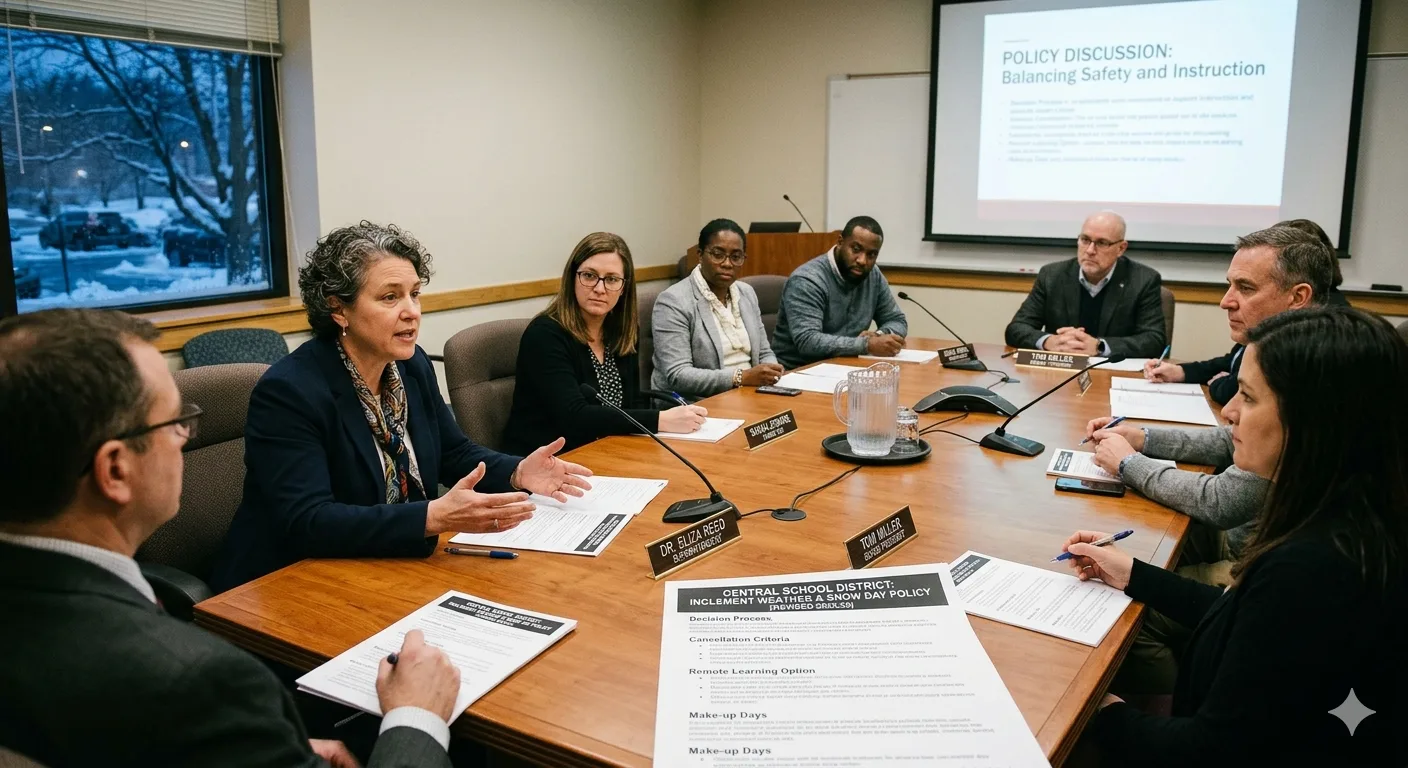
School closure decisions carry consequences that go beyond inconvenience. Risk communication expert Dr. Gina Eosco, who provides social science support to NOAA highlights that closing school is rarely an act.
For families without paid time off or access to childcare a snow day creates an immediate economic hardship. For children who rely on school meals a closure means skipping a food source. Research from Weather Underground interviews with district leaders found that funding concerns and economic inequality consistently shaped how different types of districts approached closure decisions. Affluent districts sometimes kept schools open because closures create consequences for their communities
These human dimensions explain why superintendents describe snow day decisions as, among the stressful decisions they face all year.
-
A Simple Snow Day Plan for Families
The night before
- Confirm your alert settings (text, email, and app).
- Charge phones and check backup childcare options.
- Set out boots, coats, hats, and gloves in case school runs on time.
- Plan lunch and snacks for a possible home day.
The morning of
- Check your district's official channels first.
-
If school is open. Roads look rough leave extra time. Most districts will excuse an absence if you decide conditions are unsafe though policies differ.
- If there is a delay, watch for a second update that could turn it into a closure.
If school is closed
- Look for meal pickup or remote assignments.
- Keep kids warm and limit time outside in dangerous wind chill.
- Check on elderly neighbors if you can do so safely.
Conclusion: Safety Comes First, and Preparation Helps
A school district snow day policy is really a balancing act. Superintendents, headteachers, and transportation teams weigh snowfall rate, ice, wind chill, bus routes, building readiness, state calendars, and the real-life needs of families, all before most of us have had coffee.
Once you understand those pieces those early-morning announcements stop feeling random. You can spot the signs read your districts policy and make a plan before the alert arrives.