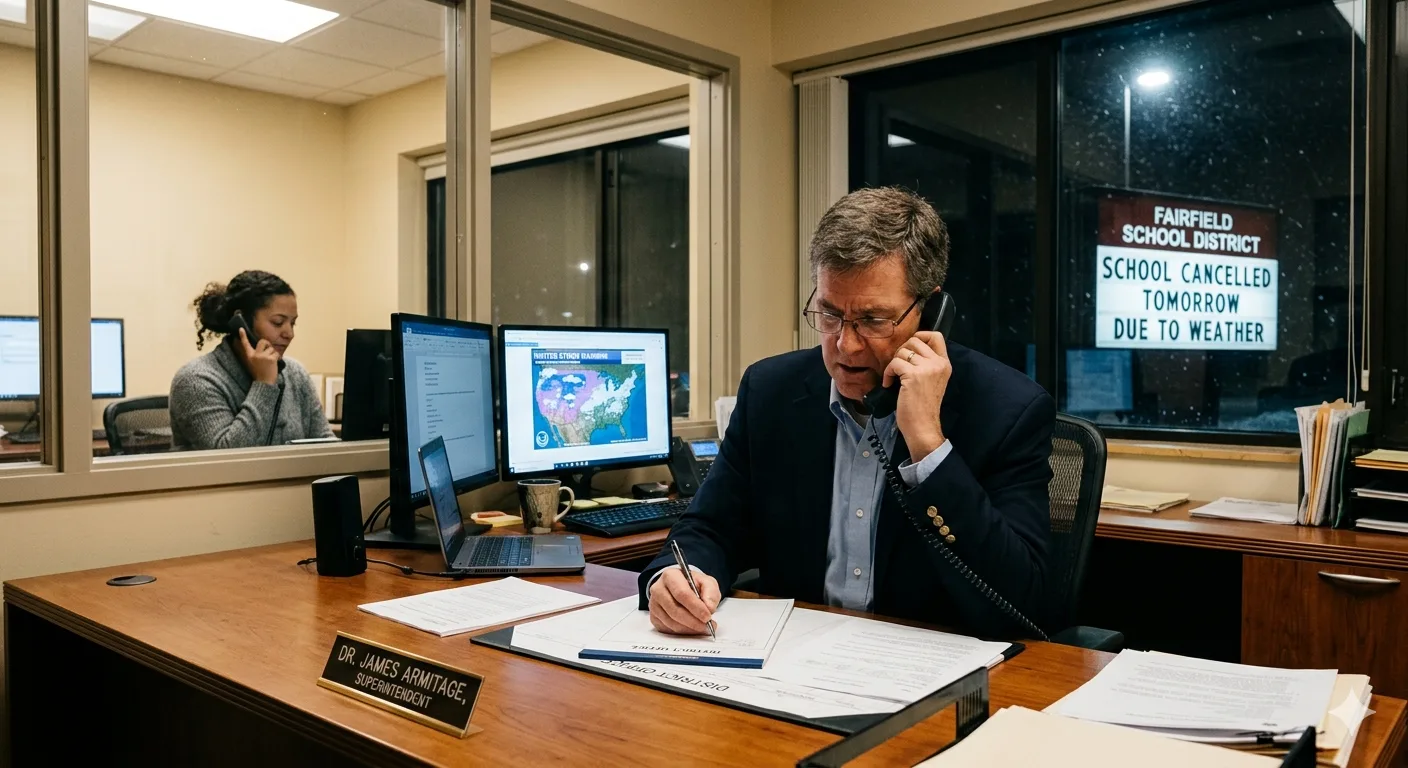
At 5:12 AM, your phone is still silent. The sky is a strange orange-grey, the plows have not come down your street, and you are staring at the screen as if it might change by force of will.
Somewhere across town, a school leader has already been awake for nearly two hours. They have driven the bus routes, called the road crew and compared notes with the neighbouring districts. The text you are waiting for is the last step of a very long morning.
I built our snow day calculator fter watching parents in my town confused about school closures. The most common question was not "how much snow?" It was "when will we actually find out?" This guide answers that one.
The short answer: most school leaders make the final call between about 4:30 and 6 AM on the day itself. They plan to announce by 5:30 in the morning. When a major storm or ice event is clearly coming, many decide the night before.
What Is a School Cancellation Decision?
A school cancellation decision is the choice to close schools, delay the start or move to remote learning because conditions are unsafe. It is not one switch. It is a set of options, and picking the right one is a skill in itself.
The three common outcomes are:
- Full closure: No in-person school for the day.
- Delayed opening: Classes start one or two hours late, usually because roads are expected to improve.
- Virtual day: Students learn from home instead of staying off entirely, in districts that use them.
Every one of these carries a cost. Closing means lost classroom time and parents scrambling. Staying open means risk of an accident on a bus route. The decision balances both sides.
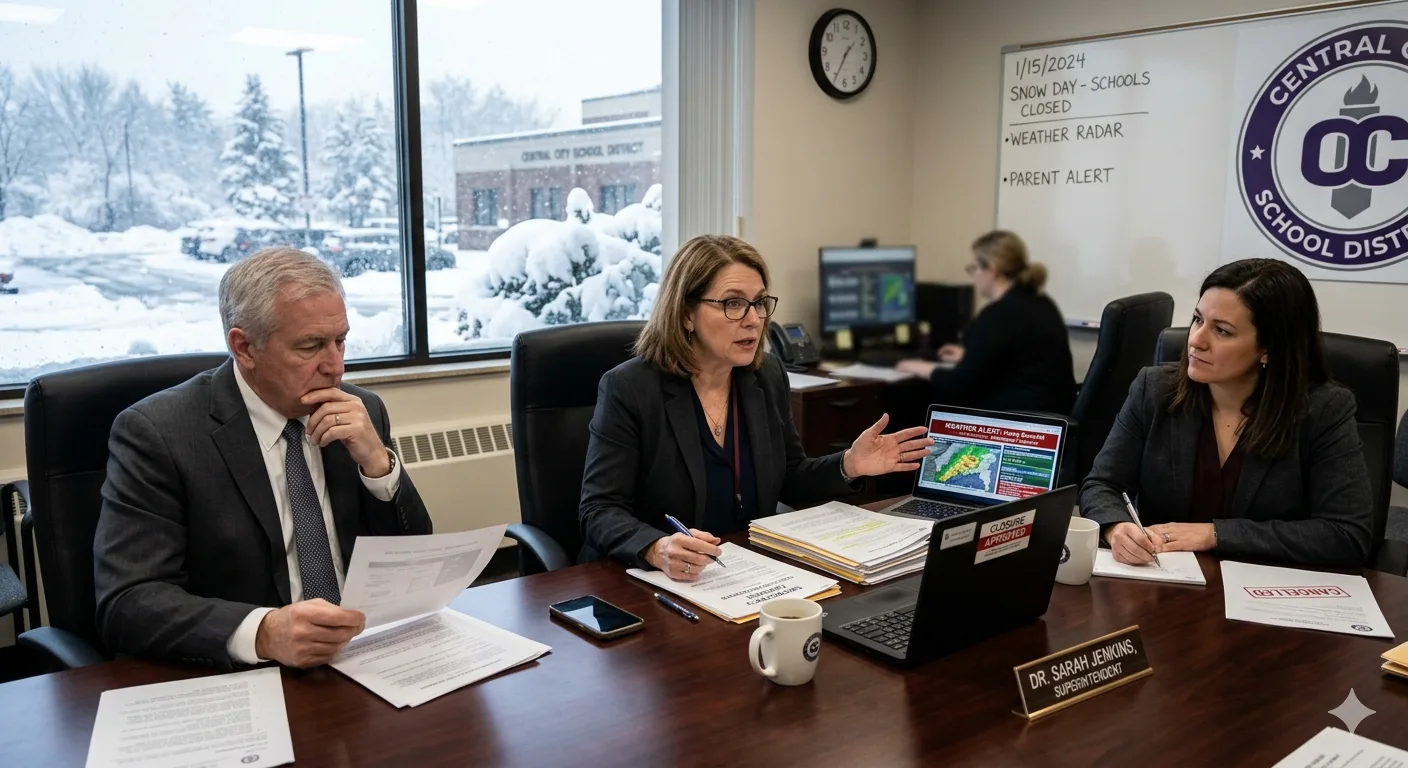
Who Actually Makes the Call?
It depends on where you live.
- United States: In most districts the superintendent makes the final decision, often with the transportation director. Rules differ by state and district so some places involve a board or a designated official.
- Canada: School boards decide on closures, but a shared transportation body often cancels buses first, sometimes before the school announcement.
- United Kingdom: The headteacher decides, usually after a risk assessment and a talk with governors. The local council tracks school closures. Rarely orders them.
In the US, the superintendent rarely acts alone. A typical call draws on:
- The transportation director, who knows which bus routes are the worst
- The facilities manager, who checks heating, boilers and building access
- Public works and road crews, who report on plowing and salting progress
- Police or emergency management, who report on accidents and closed roads
- A weather service or private meteorologist for hour-by-hour timing
- Neighbouring superintendents, who share what they are seeing on the roads
The Timeline: When the Decision Really Happens
Here is how a typical storm plays out for a school leader, from the first forecast to the final alert.
- 3 to 5 days before: The leadership team starts watching extended forecasts, mainly to avoid surprises.
- 24 to 48 hours before: They look at expected timing, temperature, ice risk and total snowfall. Some quietly start early planning with bus companies.
- The night before (roughly 8 to 11 PM): If a major storm is certain, some districts announce the closure now. Many others wait, because forecasts can still shift.
- Around 3:00 to 4:30 AM: Road spotters and transportation staff drive the trickiest routes. Facilities staff check boilers and building access.
- Around 4:00 to 5:00 AM: Superintendents in nearby districts talk to each other. They compare road conditions and often settle on a regional approach.
- Around 5:00 to 5:30 AM: The final decision lands, based on whether buses can run safely during the morning travel window.
- By about 5:30 to 6:00 AM: Families get alerts by phone call, text, email, app, website and local media.
Why not always decide the night before?
Parents often ask this, and it is a fair question. The honest answer is that conditions can change a lot overnight. Plows may clear the roads, the storm may arrive late or ice may form earlier than expected.
A leader who closes school at 9 PM for a storm that fizzles takes heat from the whole community. A leader who waits until 5 AM takes heat for the short notice. Neither option is perfect, which is why you will see both approaches.
A useful rule of thumb: if you have not heard anything by about 6 AM, school is more likely to be open. It is not a guarantee so keep checking the channels.
The 7 Factors That Drive the Decision
1. Road and bus route conditions
This is the biggest factor by far. If a bus cannot safely get down its route, school cannot really open. The worst routes (steep hills, bridges, unplowed back roads) are checked first.
2. Temperature and wind chill
Dangerously low wind chill can cancel school even with no snow. Kids waiting at a bus stop are exposed in a way adults in cars are not.
3. Snowfall rate, not just total
Heavy snow falling fast can overwhelm plows. Slow steady snow, over hours is easier to manage than the amount arriving in a burst.
4. Storm timing
A storm that ends at midnight gives crews hours to work. A storm that arrives at 5 AM lands right on the bus window. Timing alone can turn a delay into a school closure.
5. Ice
Freezing rain is a decision-maker's nightmare. A thin glaze looks harmless. Can make roads and parking lots dangerous.
6. Building readiness
Schools need working heat, safe entrances and cleared sidewalks and parking lots. A boiler failure on a freezing night can close a building even if the roads are fine.
7. Staffing
If too many bus drivers, teachers or support staff cannot get in, the school may not be able to operate safely. This matters more in rural areas and where driver shortages are common.
Closure or Delay? How Leaders Choose
A delay is the option and leaders like it because it buys time without losing a whole day. It only works when conditions are expected to improve.
| Situation | Likely decision | Why |
|---|---|---|
| Snow ending before dawn, plows making progress | Delay | Extra time lets roads improve before buses run. |
| Heavy snow expected during the bus window | Closure | Buses cannot run safely at the storm's peak. |
| Freezing rain or black ice | Closure (often) | A delay rarely fixes a glazed road. |
| Dangerous cold lasting all day | Closure | The risk at bus stops does not go away. |
| Moderate snow with warming forecast | Delay | Treatment and sunshine can do the work. |
| Late-winter storm, few snow days left | Delay if possible | The calendar adds pressure to avoid a full closure. |
If you are wondering how a wet, icy morning might affect your day, our rain delay calculator is a handy way to see how rain, sleet and slush can slow things down, even when it is not strictly snow.
Why Neighbouring Districts Make Different Choices
It is the most common complaint in any storm: "Why did they close and we did not?" A few things usually explain it.
- Bus routes: A district with long rural routes faces a different risk from a compact one.
- Equipment and crews: Some towns plow faster than others.
- Terrain: Hills and exposed roads change everything.
- Leadership judgment: Two reasonable people can read the same forecast differently.
- Calendar: A district with snow days left can afford to be more cautious.
Regional coordination helps, and leaders in the same area often agree on a general approach. But each district still owns its own decision.
Cold Days: When Temperature Alone Cancels School
In colder regions, the thermometer can matter as much as the snow. Policies vary by district, but here is a rough picture of how it tends to work.
| Wind chill | Typical response |
|---|---|
| About -10°F to -15°F | Close monitoring; a delay is possible |
| About -15°F to -25°F | Delay or closure depending on the district |
| About -25°F to -30°F | A common closing line in colder areas |
| Below about -30°F | Most districts close |
The concern is frostbite. It can set in within roughly 30 minutes at wind chills around -20°F, and much faster as it gets colder. Children are especially vulnerable.
To see what the air will really feel like at your bus stop, try our wind chill calculator. It turns temperature and wind speed into a feels-like number you can actually plan around.
Read More : How Much Snow Does It Take to Cancel School
Not Just Snow: Other Reasons Schools Close
Winter gets the attention, but it is not the only reason for a call at dawn.
- Extreme heat: New York State now has a law that requires schools to act when classroom temperatures reach 82°F, and rooms that hit 88°F cannot be used. That is not a school closure but it can lead to relocation or early dismissal. If you want to understand how hot weather feels our heat index calculator shows how humidity changes the number.
-
Air quality: Wildfire smoke can close schools. Move activities indoors, especially in the West.
- Flooding and storms: Hurricanes, tornado warnings and flash floods can all close schools.
- Power or water failures: No heat, water or internet can make a building unusable.
- Public health events: Outbreaks can force a short closure.
The Hidden Pressures on School Leaders
The weather is only part of the picture. A few quieter pressures sit in the background of every call.
- Food and safety: For some children, school is where they get a reliable meal and a safe place to be. Leaders in those communities do not close lightly.
- Make-up days: Every lost day may have to be made up later, by extending the year or adding school hours.
- Public pressure: Social media can fill with demands to close or stay open before the roads are even checked.
- The risk of being wrong: Close for a storm that never comes and people are annoyed. Stay open for one that does and the consequences are worse.
Most leaders describe the whole thing as a judgment call rather than a precise science, and honestly, that is the fairest description.
What Happens to the Calendar After a Closure
Many districts build a handful of snow days into the school year. In some states that buffer is set by habit or policy, and in Massachusetts public schools typically plan for around five. When those days run out, the district has to find another way to make up the time.
That is why you often see delays in February and March. By then the buffer may be thin, and a delay can sometimes preserve the day when a closure cannot.
Options for making up the time usually include:
- Adding days at the end of the year
- Shortening a school break
- Lengthening school days
- Using virtual instruction days, where the state allows it
One thing worth noting for families: hourly school staff, such as support and nutrition workers, may not be paid for days that are not made up.
-
What Is Changing for the 2026 to 2027 Winter
- More virtual days: Many districts now have a remote learning plan, so "no school" can mean "log in at 9 AM." Check how yours works.
-
Faster alerts: Text messages and school apps usually reach families before local TV does.
- More attention to ice and heat: Districts are paying closer attention to non-snow weather, including extreme heat in early autumn and late spring.
- Earlier planning: More leaders try to warn families the night before a major storm.
How Families Are Notified
Most districts use channels at once so a missed alert is usually a contact-details problem rather than a delay in sending.
- Automated phone calls
- Text messages
- The district app, website and social media
- Local TV and radio
Make sure your phone number and email are up to date in the school's system before winter starts. It takes two minutes and can save you a very cold, very confusing morning.
How to Stay a Step Ahead (A Parent's Checklist)
Before the season
- Update your contact details in the school system.
- Switch on text and app alerts.
- Find out whether your district uses virtual snow days.
- Line up a backup childcare option now.
When a storm is 48 hours away
- Check the forecast for timing, ice and wind chill.
- Ask your employer about flexible or remote options.
- Check your snow day calculator for a closure probability.
The night before and morning of
- Check the forecast again close to bedtime and set your alarm 30 minutes early.
- Look at larger neighbouring districts. If they close, yours is more likely to follow.
-
Check the school channels first not rumours in group chats.
-
If nothing has arrived by 6 AM check your districts website or app before heading out.
One honest note, from someone who builds these tools: in my opinion no snow day calculator can replace the school district announcement. A prediction helps you plan, but only the district can tell you what is really happening.
Common Mistakes Parents Make
- Waiting for a night-before call: Many districts simply do not make one.
- Trusting social media rumours: Check the district's own channels.
- Assuming a neighbouring district will match: They often do not.
-
Ignoring ice: A small amount can change everything.
- Forgetting a plan B: Backup care arranged at 5:30 AM is stressful and often unavailable.
Final Thoughts
So, when do superintendents decide to cancel school? Usually in the dark, in the early hours of the morning, after road checks, weather updates and a quick conversation with neighbouring districts. Many aim for about 5:30 AM, and some decide the night before when a big storm is clearly on the way.
Knowing that timeline will not make a snow day arrive any sooner. But it will help you plan, stay calm and spot the signs that matter, from ice in the forecast to a larger neighbouring district closing first.
Get ready before the next storm. Try our snow day calculator for a quick estimate, and explore the full set of tools on our weather and school calculators page. Keep your alerts switched on, and wait for the official message before you commit to the morning.