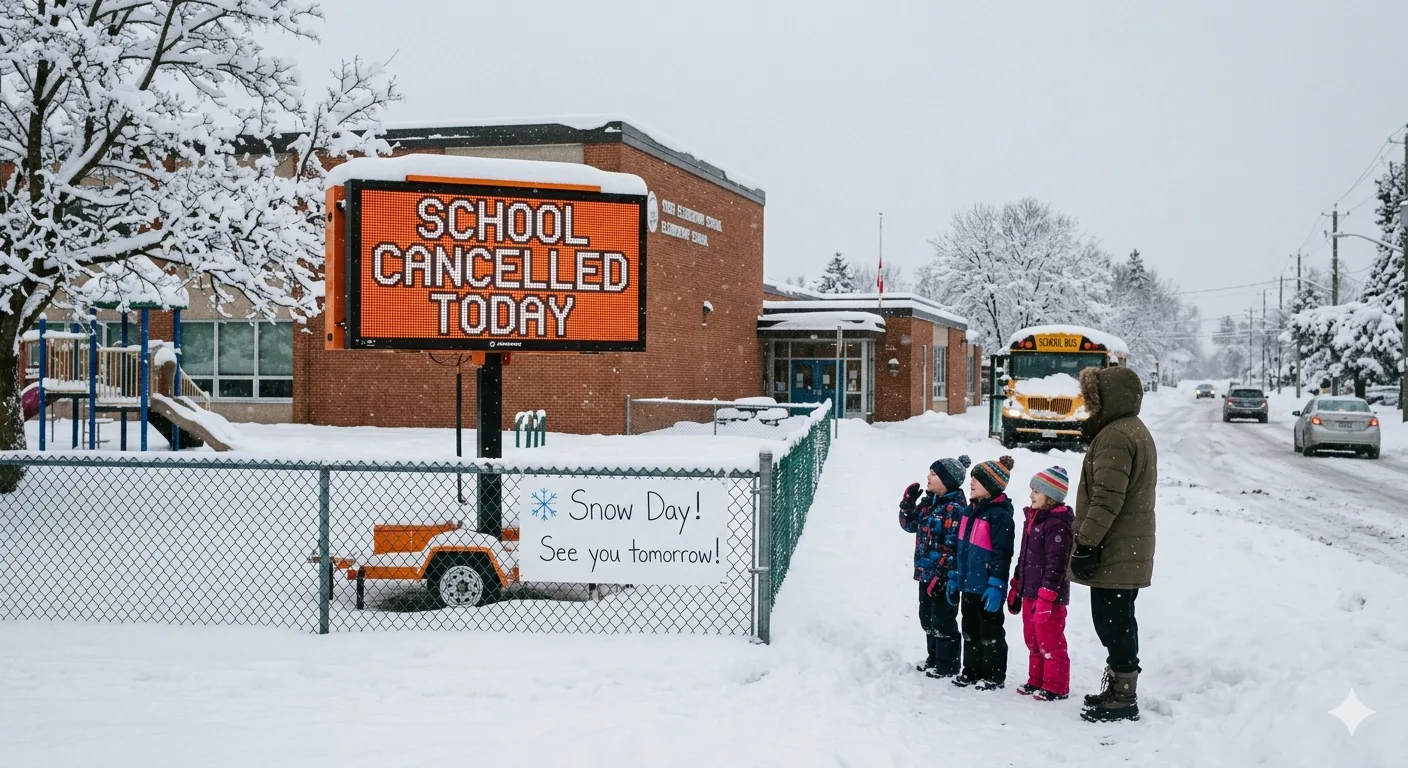
It is 5:40 on a dark winter morning. The driveway is white, your phone is buzzing, and three neighbours are texting three different guesses about whether school is open.
Nobody agrees because there is no universal answer. The same two inches that shut down a Georgia county would barely get a mention in Buffalo.
I built our snow day calculator after seeing parents in my area get tangled up in exactly this confusion. Everyone wanted an answer and the true one was always "it depends." This guide explains what it depends on so you can stop making guesses.
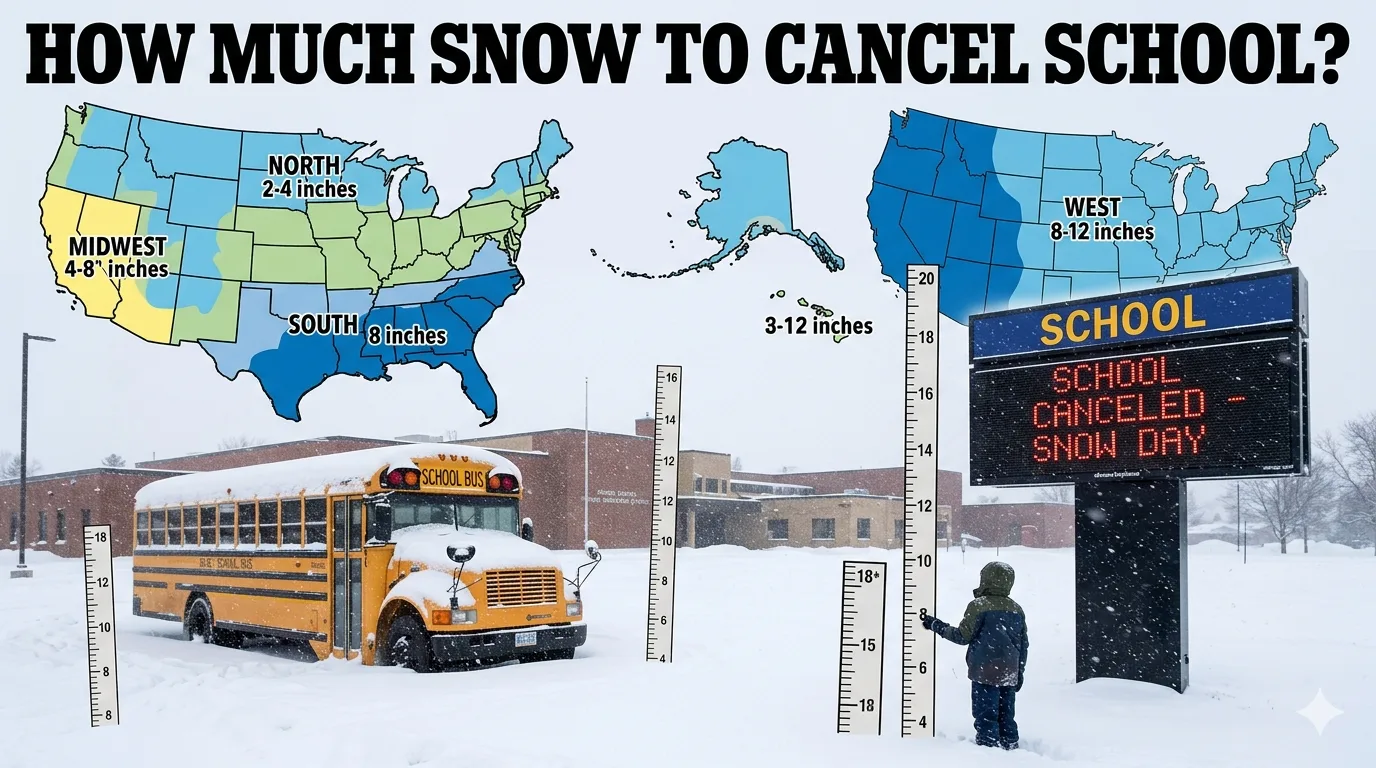
The short answer: nationally, schools tend to close somewhere around 5 to 6 inches (about 13 to 15 cm) of snow. In the Deep South it can be a trace. In the Snow Belt and Rocky Mountains it can be a foot or more. Ice, cold, timing and local equipment often matter more than the total.
What Is a Snow Day Threshold, and Who Decides?
A snow day threshold is the point where conditions become dangerous enough for a district or school to close. It is not a fixed number written in a rulebook. It is a judgment call.
The people making that call change depending on where you live:
- United States: Decisions are local. A superintendent, along with a transportation director makes the decision. There is no federal or national standard.
- Canada: School boards decide, but in many regions a shared transportation consortium cancels buses first. That is why you can see "buses cancelled, schools open" on the same morning.
- United Kingdom: The headteacher decides, usually after a risk assessment and talking with the governors. The local council collects closure notices but does not usually order them.
This explains why two districts in the county can make different choices. A district with long rural bus routes may close while its suburban neighbour stays open for the exact same storm.
8 Factors That Decide Whether School Is Cancelled
Snow depth is only one input. Here is what administrators actually weigh.
1. Total accumulation
This is the number everyone quotes, and it still matters. But it is rarely the deciding factor on its own.
2. Snowfall rate
Six inches over twelve hours is manageable. Six inches in two hours can bury roads before plows get a chance. Rate matters as much as total.
3. Ice and freezing rain
This is the big wild card. A thin glaze of ice can be more dangerous than a foot of snow, and it is why many districts close early for "wintry mix" forecasts. If your forecast talks about freezing rain our rain delay calculator can help you gauge how much a wet, icy morning might disrupt the day.
4. Wet snow versus dry snow
Heavy, wet snow clings to power lines and clogs roads. Light, dry powder blows away more easily. Eight inches of powder can be easier to handle than four inches of slush.
5. Timing
A storm that ends at midnight gives crews hours to clear roads. The same storm arriving at 5 AM leaves almost no time before buses roll. Time alone can change a decision.
6. Temperature and wind chill
In colder regions, schools sometimes close for dangerous cold with no snow at all. More on that below.
7. Terrain and bus routes
Hills, back roads and long rural routes make closures more likely. Flat urban districts with short routes can usually push through more snow.
8. Local equipment and experience
Places that see snow every winter own plows, salt trucks and brine equipment. Places that see it once a decade do not. That difference more than strength explains regional differences.
Snow Day Thresholds by Region
Before the state table, it helps to see the big patterns. In the US, snow tolerance falls into five rough zones.
The Snow Belt (Great Lakes, upstate New York, northern New England)
Crews here treat roads before storms arrive, and communities expect winter. Typical closure points run from about 10 to 14 inches or more. Blizzard winds or ice are often what tip the balance.
The Northern Tier (Minnesota, Wisconsin, Michigan, the Dakotas, Montana)
Snow is routine, so schools tend to stay open. Thresholds usually fall between 6 and 12 inches and cold temperatures can close schools even without snow.
The Mid-Atlantic and Midwest transition zone
Pennsylvania, Ohio, Illinois, Indiana and Maryland get real winter, but not constantly. Typical closure points are 3 to 6 inches, and ice often decides it.
The South and Southeast
Snow-removal equipment is minimal, and roads are rarely treated in advance. One to two inches, or sometimes just the forecast, can close schools. That is a practical response, not an overreaction.
The West (it depends on elevation)
Coastal and low-elevation areas close for almost any snow. Mountain communities in Colorado, Utah and eastern Washington may need a foot or more. In Denver wet snow during rush hour can matter more than the amount.
How Much Snow Cancels School in Each State?
The table below shows closure points for all 50 states plus Washington, D.C. Treat these as planning averages, not policy. Districts within the same state can differ a lot, especially between city and country.
| State | Typical closure point | Ice sensitivity | Good to know |
|---|---|---|---|
| Alabama | Any snow to 1" | Very high | Closures are often called on the forecast alone. |
| Alaska | 12"+ or blizzard conditions | Low | Extreme cold and wind matter more than depth. |
| Arizona | Any snow at low elevation | Very high | Flagstaff and mountain towns cope far better. |
| Arkansas | 1 to 2" | Very high | Ice storms are a bigger threat than deep snow. |
| California | Any snow (coast and valleys), 12"+ (mountains) | Very high | Elevation changes everything. |
| Colorado | 4 to 8" (Front Range), 18"+ (mountains) | Moderate | Wet snow at rush hour is harder than dry powder. |
| Connecticut | 6 to 10" | Moderate | Hilly rural towns close sooner than coastal ones. |
| Delaware | 3 to 5" | Moderate | Ice and coastal wet snow are the usual trouble. |
| District of Columbia | 2 to 4" | Very high | Hills, commuter traffic and ice make closures quick. |
| Florida | Any snow | Very high | Snow is so rare there is almost no playbook for it. |
| Georgia | 1 to 2" | Very high | Metro Atlanta closes early because roads cannot be treated quickly. |
| Hawaii | Not applicable in populated areas | Not applicable | Snow falls on the highest volcano summits only. |
| Idaho | 6 to 12" | Moderate | Valley and mountain districts behave very differently. |
| Illinois | 6 to 8" | Moderate | Chicago has big plow fleets; rural districts close sooner. |
| Indiana | 5 to 7" | Moderate | Ice often arrives with the snow. |
| Iowa | 3 to 6" | Moderate | Southern districts close sooner; cold days are common. |
| Kansas | 4 to 6" | Moderate | Wind and drifting matter as much as depth. |
| Kentucky | 2 to 4" | Very high | Hilly rural bus routes make closures likely. |
| Louisiana | Any snow or ice | Very high | Schools often close on the forecast alone. |
| Maine | 10 to 14" | Low | Wind-driven snow and poor visibility are the main threats. |
| Maryland | 3 to 5" | Very high | Storm timing and ice drive most decisions. |
| Massachusetts | 8 to 12" | Moderate | Fast-falling nor'easters can close schools sooner than the total suggests. |
| Michigan | 8 to 12" | Moderate | The Upper Peninsula and lake-effect belts tolerate even more. |
| Minnesota | 8 to 12" | Low | Dangerous cold is a more common trigger than snow. |
| Mississippi | 1 to 2" | Very high | Very limited snow-removal equipment. |
| Missouri | 2 to 4" (south), 4 to 6" (north) | Very high | Freezing rain often comes before the snow. |
| Montana | 12 to 24"+ | Low | Some eastern districts need near-blizzard conditions. |
| Nebraska | 5 to 8" | Moderate | Blowing snow can close rural roads. |
| Nevada | Any snow (Las Vegas), higher in Reno and the Sierra | Very high | Elevation-dependent, like California. |
| New Hampshire | 10 to 14" | Low | Strong road-clearing culture. |
| New Jersey | 3 to 5" (south), 6 to 8" (north) | Moderate | The north gets far more snow than the south. |
| New Mexico | 2 to 4" (lowlands), 12"+ (mountains) | Moderate | Albuquerque closes much sooner than Taos. |
| New York | 6 to 10" (NYC area), 10 to 18" (upstate) | Moderate | Lake-effect regions are far more snow-tolerant. |
| North Carolina | 1 to 3" | Very high | Mountain districts cope better than the coastal plain. |
| North Dakota | 8 to 14" | Low | Very cold days are a common reason to close. |
| Ohio | 4 to 6" | Very high | Ice is the main concern, more than pure snow. |
| Oklahoma | 1 to 3" | Very high | Some Tulsa-area districts close for under 2". |
| Oregon | 2 to 4" (Portland), 12"+ (eastern Oregon) | Very high | Hills and limited plows make Portland cautious. |
| Pennsylvania | 4 to 6" (east), 6 to 8" (west and north) | Moderate | Western districts tolerate more than the Philadelphia suburbs. |
| Rhode Island | 8 to 12" | Moderate | Small state, well-resourced crews. |
| South Carolina | 1 to 2" | Very high | Even a trace can close schools. |
| South Dakota | 8 to 12" | Low | Blizzard conditions are the main trigger. |
| Tennessee | 2 to 3" | Very high | Hilly terrain and thin equipment fleets. |
| Texas | 1 to 2" (north), any snow (south) | Very high | Roads are rarely pre-treated. |
| Utah | 6 to 12" (urban), 18"+ (mountains) | Moderate | Salt Lake City is well equipped; mountain towns are hardy. |
| Vermont | 10 to 16" | Low | Winter is built into daily life. |
| Virginia | 2 to 4" (north), 3 to 6" (west) | Very high | Northern Virginia closes quickly; mountain areas hold on longer. |
| Washington | 2 to 4" (Seattle), 18"+ (eastern Washington) | Very high | Seattle's hills make even a little snow risky. |
| West Virginia | 4 to 6" | Very high | Mountain roads turn dangerous fast when icy. |
| Wisconsin | 8 to 12" | Low | Cold days are more common than snow days. |
| Wyoming | 12 to 18" | Low | Wind and drifting often matter more than accumulation. |
Notice how often "Very high" ice sensitivity shows up in the middle and southern states. In those places, a quarter inch of freezing rain can do more damage than a snowstorm.
Snow Days in Canada
Canadian schools are generally the most winter-hardened in the world, so snowfall alone rarely closes them. What usually triggers a day off is a combination of freezing rain, whiteout conditions and dangerous cold.
Here is what is worth knowing:
- Buses are often cancelled before schools. In many regions a regional transportation body makes that call, often early in the morning. Schools may stay open for families who can get there.
- Freezing rain is the real troublemaker, especially in southern Ontario and Quebec.
- Extreme cold counts. On the Prairies, wind chill can cancel buses or school without any new snow.
- Check your board's website. Each region uses its own system and alert channels.
Snow Days in the United Kingdom
The UK works differently. Snow happens often so just a few centimeters can stop the school run especially if it settles before 8 AM.
The decision rests with the headteacher, who considers whether staff can reach the building, whether pupils can travel safely and whether the site itself (car park, paths, heating) is safe. Schools then update the local council and message parents.
The Met Office warning level is a useful early clue:
- Yellow: be aware. Some schools may close, but most will try to open.
-
Amber: closures become more likely especially if travel problems are expected.
- Red: schools often have little choice but to close.
Quick conversion: inches to centimetres
| Inches | Centimetres (approx.) |
|---|---|
| 1" | 2.5 cm |
| 2" | 5 cm |
| 4" | 10 cm |
| 6" | 15 cm |
| 8" | 20 cm |
| 12" | 30 cm |
How the Decision Is Actually Made
Most of us picture a superintendent glancing out the window. The real process is more careful. It usually follows a pattern like this:
- 48 to 72 hours out: Administrators start tracking forecasts for totals, timing and temperature.
- The evening before: Some districts announce a delay or closure early, particularly when ice is forecast. Many also check with neighbouring districts.
- Around 3 to 5 AM: Transportation staff drive key bus routes to check real conditions. This is often the most important step.
- Around 5 to 6 AM: The final call is made, often with input from road crews and emergency officials.
- By about 6 AM: Families are notified through text alerts, school apps, websites and local media.
In the UK the same idea applies,. The decision often comes a little later. Many heads aim to announce by about 7 to 7:30 AM.
Why Southern Schools Close for an Inch of Snow
It is easy to laugh at a school closing for a dusting. It is less funny when you look at the numbers behind it.
A state that sees snow once every few years cannot justify a large fleet of plows and salt trucks. Drivers have little experience on snow and ice. In the South temperatures often stay close to freezing so a thin layer of ice can hide under the snow.
The 2014 Atlanta storm is the textbook case. Roughly two inches of snow and ice triggered gridlock, stranded drivers on highways overnight and left children stuck at schools and on buses. After that, cautious closures made a lot more sense to a lot more people.
Read More : Snow Day Calculator Buffalo NY
Why Ice Beats Snow Every Time
If you only remember one thing from this guide, make it this: ice is a stronger predictor of closures than snow totals.
Freezing rain turns roads, sidewalks and bus steps into skating rinks. Salt help, but they cannot instantly fix a frozen surface. A tenth of an inch of ice can be enough to shut things down in many districts. When you check the forecast, look for these phrases:
- Freezing rain or ice accumulation
- Wintry mix or sleet
- Temperatures hovering right around 32°F (0°C)
Any of those, especially overnight, should raise your closure expectations sharply.
When Cold, Not Snow, Cancels School
In the northern US, the Prairies and parts of the Midwest, schools sometimes close for cold alone. These are often called cold days.
Thresholds vary by district and by local weather service office, but here is a rough guide:
- Around -20°F to -25°F wind chill: Many districts start considering delays or closures.
- Around -30°F wind chill: Many districts close, and warnings are often issued in colder regions.
- Around -35°F to -40°F wind chill: Nearly all districts in the northern plains close.
The worry is frostbite. At wind chills near -20°F, exposed skin can start to freeze in roughly half an hour, and in colder conditions it happens much faster. Children waiting at bus stops are especially exposed.
Not sure what the wind is really doing to the temperature? Try our wind chill calculator to see what it will feel like at the bus stop. And for the opposite side of the year, when the risk is heat rather than cold, our heat index calculator works on the same "feels like" principle.
Public Versus Private Schools
They can behave differently, and families are often caught off guard by it.
Public schools in many places have a minimum number of instructional days or hours to meet. If they use up their built-in snow days, they may need to extend the school year, which creates pressure to stay open.
Private schools often have more flexibility. Some close sooner. Others stay open in conditions that make public districts hesitate. The safest thing is to never think your private school will follow the districts choice.
What Is Changing for the 2026 to 2027 Winter
Snow days are not quite what they were a generation ago. A few shifts are worth knowing about as you plan.
- Virtual or remote learning days. Since remote learning became familiar, many districts now convert some snow days into online days. Check whether yours does, because "no school" may mean "log in at 9 AM."
- Earlier decisions. More districts announce the night before when ice or a major storm is forecast, so parents can plan.
- Faster alerts. Text messages and school apps usually get to families faster, than TV.
- Closing more readily. Many communities have become more cautious over the years, so what stayed open in your parents' day may close now.
The best preparation is simple. Before the first storm, confirm that your contact details are correct in the school's notification system.
-
How to Predict a Snow Day Before the Alert Arrives
You can never be sure, but you can get good at reading the signals. Here is the routine that works.
- Know your local threshold. Use the state table above as a starting point, then adjust for your own district's habits.
- Check the timing. Snow ending by midnight is a very different story from snow starting at 5 AM.
- Look for ice. Freezing rain in the forecast dramatically raises the odds.
- Check the temperature and wind. Extreme cold can close schools even with little snow.
- Run the numbers. Our snow day calculator pulls these inputs together into a closure probability.
-
Check again after midnight. Forecasts get better overnight. A late check often changes the situation.
Here is how to read a probability score:
- Above 80%: Plan for a closure.
- 40 to 80%: Prepare for both outcomes and set an early alarm.
- Below 30%: School is very likely on.
One thing I will always say plainly: in my opinion, no calculator can replace the official school district announcement. A calculator helps you prepare. The district's message is what tells you what is actually happening.
A Parent's Snow Day Action Plan
The night before
- Check the forecast for ice, timing and wind chill.
- Confirm your school alerts are switched on.
- Set your alarm 30 minutes early.
- Charge phones, and make sure you have fuel and warm clothing ready.
- Message your backup childcare contact now, not at 6 AM.
The morning of
- Check the official school channel first (app, text, website).
- Check your district's social media if nothing has arrived by 6 AM.
- If school is open but roads look bad, you still have the right to decide what is safe for your family. Check your school's attendance policy.
- If school is closed, confirm whether it is a full closure or a virtual day.
If you must work
- Ask your employer about flexible or remote options before the storm.
- Arrange a trusted neighbour, relative or another parent as backup.
-
Keep a list of activities and meals ready so a sudden day off does not become a mess.
Common Mistakes When Guessing a Snow Day
- Watching only snowfall totals. Timing, ice and cold often matter more.
- Comparing yourself to another state. Six inches in Ohio is not six inches in Vermont.
- Trusting what happened last winter. Policies and leadership change.
- Assuming a neighbouring district will do the same thing. Often it will not.
- Treating a prediction as an announcement. Only the school's official message counts.
Final Thoughts
So, how much snow cancels school? There is no single number. Your location, your local equipment, the amount of ice, the timing of the storm and the person making the call all play a part.
The good news is that you can read the signs. Know your area's typical threshold, watch for ice and cold, check the forecast late at night and always wait for the official word.
If you want to go a step further, try our snow day calculator before the next storm, and browse the full set of tools on our weather and school calculators page. Set your alerts, make a backup plan and enjoy the snow when it comes.