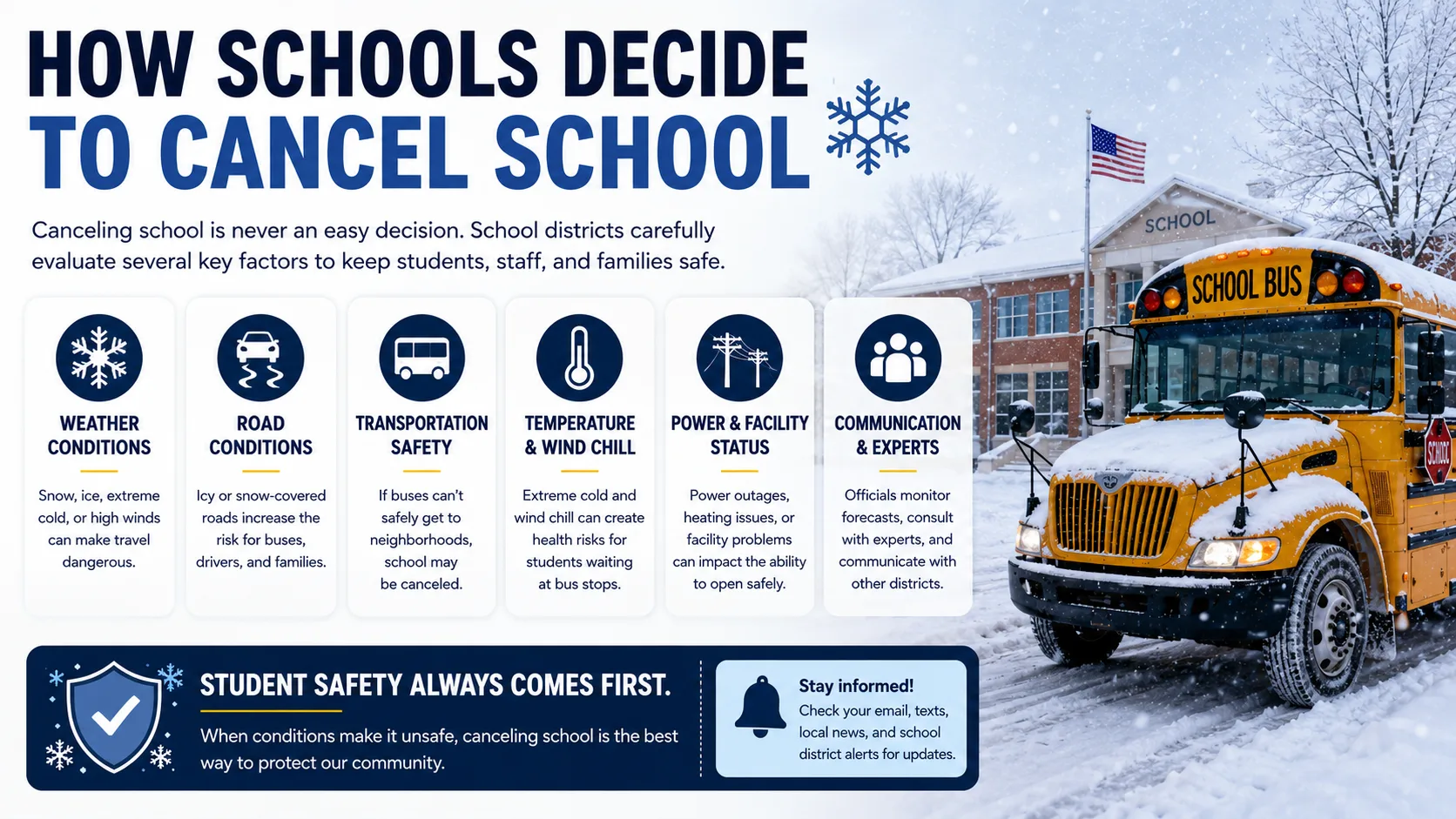
Schools decide to cancel school by weighing road and bus safety, wind chill, snowfall timing, and staffing, and the final call almost always rests with the superintendent after checking with transportation, facilities, and local weather officials. There is no single national rulebook. Each district builds its own threshold based on local roads, climate, and student population.
If you have ever refreshed a district website at 5 a.m. hoping for good news, you already know how tense that wait can feel. This guide breaks down exactly what happens behind the scenes, using real district policies and the same factors our snow day calculator uses to estimate your odds.
By the end of this guide, you will understand not just what schools look at, but why two districts a few miles apart can make completely different calls during the exact same storm, and how to use that knowledge to plan your own morning with more confidence.
Why Snow Day Decisions Feel So High Stakes
A single closure ripples far beyond the classroom. Parents scramble for last-minute childcare. Hourly workers lose a shift if they cannot bring a child to daycare. Bus drivers and cafeteria staff, many of whom are paid hourly, lose income on a canceled day. Superintendents carry all of that weight every time they weigh a decision.
At the same time, keeping school open during genuinely unsafe conditions puts students, staff, and drivers at real risk. That tension is why district leaders describe the choice as one of the hardest calls they make each winter, even when the weather outcome later looks obvious in hindsight.
What It Means When a School Cancels Classes
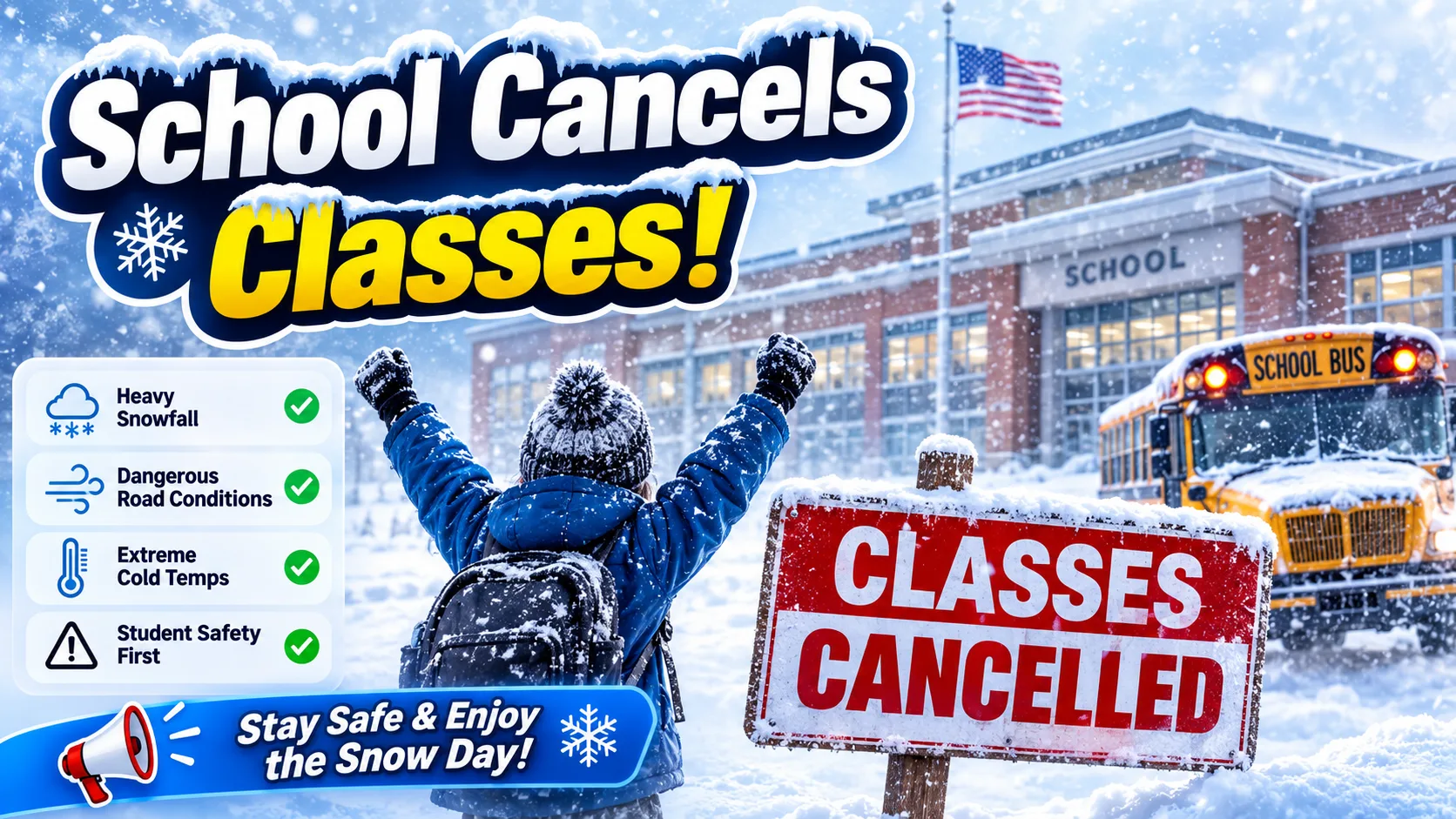
A school cancellation, commonly called a snow day, is a district-wide decision to close buildings and pause in-person classes for safety reasons. It is different from a two-hour delay, which pushes the start time back to let roads clear, and different from an early release, which sends students home before storm conditions worsen.
Cancellations are not limited to snow. Districts also close for:
- Dangerous wind chill or extreme cold
- Ice storms and freezing rain
- Power outages that affect heating or building safety
- Flooding, high winds, or other severe weather events
Understanding the full list matters because a light dusting of snow rarely triggers a closure on its own. It is almost always a combination of factors working together.
Who Actually Makes the Call
In most U.S. districts, the superintendent makes the final decision. They rarely do it alone. A typical decision team includes:
- Transportation director, who checks bus routes, road conditions, and driver availability
- Facilities manager, who confirms heating, parking lot clearing, and walkway safety
- Communications staff, who prepare the announcement across text, robocall, website, and social media
- Local officials, including police, public works departments, and sometimes neighboring superintendents
Superintendents in Massachusetts have described the process as a group effort rather than a solo judgment call, with early morning check-ins involving public works and police before any announcement goes out. In New Bedford, district leaders coordinate closely with the city's emergency management office and treat student safety as the deciding factor above all else.
This collaborative model shows why decisions can feel inconsistent between neighboring towns. Two districts can look at the same storm and land on different calls because their road crews, bus fleets, and student populations are not identical.
Key takeaway: There is no single snow depth or temperature that guarantees a closure everywhere. Each district sets its own thresholds based on local infrastructure, so the same storm can close one school and leave the district next door open.
How Schools Decide to Cancel School: The Full Process
Most closure decisions follow a similar sequence, even though the exact hour-by-hour timing varies by region. Here is the process broken into its main stages.
Monitoring the Forecast Days in Advance
Transportation and communications staff start watching National Weather Service outlooks as soon as a storm system becomes possible. Communications directors have described this early phase as tracking the storm the same way the public does, then narrowing in on exact timing and expected impact as the forecast firms up.
Districts prefer to make the call the evening before a storm whenever the forecast is confident enough. When the outlook is still uncertain, the final decision waits until the early morning hours, sometimes as late as 4:30 or 5 a.m.
Checking Road and Bus Conditions
Once snow or ice starts falling, transportation staff and local road crews assess real conditions rather than relying only on forecasts. This includes:
- How much snow or ice has actually accumulated overnight
- Whether main roads and bus routes have been plowed and salted
- Visibility for drivers during the morning commute
- Whether rural or hilly routes are passable for buses
Bus safety carries enormous weight in this decision because young drivers and inexperienced commuters share the road with buses full of children during the exact hours a storm may be at its worst.
Evaluating Wind Chill and Extreme Cold
Cold-related closures follow their own threshold, separate from snowfall. Many districts use a wind chill cutoff between -25°F and -35°F as the point where frostbite risk becomes too high for students waiting at bus stops. Some Wisconsin districts specifically cite minus 35 degrees wind chill as their closure trigger, while other regions set the line closer to minus 25.
Families can check current conditions against these thresholds using a wind chill calculator to see how close a forecast is to typical closure territory before an official announcement goes out.
Considering Staffing and Building Readiness
Even if roads are passable, a school may still close if too many teachers, bus drivers, or support staff cannot safely get to work. Facilities teams also confirm that heating systems, parking lots, and walkways are ready before opening doors to students.
Coordinating With Neighboring Districts
Because many families have children attending schools in different districts, or because roads cross district lines, superintendents often talk to each other before announcing a decision. A closure in one district can influence a neighboring one, especially in regions where students are bused across town or county lines to reach the nearest high school.
Making and Communicating the Final Call
Most districts aim to announce their decision by 6 a.m. so families can plan ahead. Announcements typically go out through:
- Automated phone calls and text alerts
- District websites and mobile apps
- Local TV and radio stations
- Social media posts
You can browse specific regional patterns and recent closure trends on our state-by-state predictions page.
The Logic Behind Snow Day Predictions
Snow day calculators do not replace a superintendent's judgment. They estimate the probability of a closure by scoring the same factors districts already weigh, then converting that score into a percentage chance of a snow day.
A typical scoring model looks at:
- Forecasted snowfall total, since heavier accumulation raises the score
- Timing of the storm, since snow falling during the morning commute scores higher than snow that clears overnight
- Ice and freezing rain risk, which scores higher than snow alone because ice is harder to treat safely
- Wind chill and temperature, compared against the district's typical cold-weather threshold
- Recent closure history, since districts that have already used several snow days may be more reluctant to close again
Each factor adds or subtracts points, and the combined score becomes your estimated odds. This is the same approach used behind our full calculator directory, where you can pick a tool tailored to your region and school type.
Step-by-Step: How to Check Your Own Odds
- Enter your location. Local forecasts vary block by block during winter storms, so ZIP-level accuracy matters.
- Select your school type. Rural districts with longer bus routes often close earlier than urban districts with shorter commutes.
- Review the forecast window. Check both the overnight forecast and the early morning commute window, since that is when most decisions are made.
- Compare against your district's known thresholds, such as wind chill cutoffs or snowfall totals mentioned on your district's website.
- Check back closer to the decision window. Predictions become more accurate as the storm gets closer, especially between 4 a.m. and 6 a.m.
For families dealing with storms that bring both snow and lightning risk during shoulder seasons, our rain delay calculator can help with similar early morning planning questions.
Real-World Examples With Numbers
The table below shows how different real conditions typically map to a district's decision, based on commonly cited thresholds across multiple regions.
| Condition | Typical Threshold | Likely Outcome |
|---|---|---|
| Light snow, clears before commute | Under 2 inches overnight | School stays open |
| Moderate snow during morning commute | 3 to 6 inches, falling 5 to 8 a.m. | Delay or cancellation likely |
| Heavy snow or blizzard conditions | 6 or more inches with high winds | Cancellation highly likely |
| Ice storm or freezing rain | Any measurable ice accumulation | Cancellation very likely |
| Extreme wind chill | -25°F to -35°F | Cancellation likely regardless of snow |
These numbers are general patterns, not fixed rules. A district in northern Minnesota may stay open through conditions that would close schools in a milder climate, simply because its roads, buses, and residents are equipped for regular snowfall.
Common Mistakes and Pro Tips
Mistake: Assuming any snowfall automatically means a closure. Most districts stay open through light or moderate snow if roads are treated in time.
Mistake: Ignoring wind chill. Cold-related closures catch families off guard because the sky can look clear while the actual air temperature is dangerous.
Mistake: Checking only the overnight forecast. Timing matters as much as total snowfall. A storm that arrives after the morning commute often has a smaller effect on the decision.
Pro tip: Sign up for your district's text and robocall alerts directly, since these are usually the fastest official source, faster than word of mouth or social media rumors.
Pro tip: Check predictions again around 4:30 to 5 a.m. This is when many districts finalize their decision after road crews report overnight conditions.
Mistake: Comparing your district directly to a friend's district in another state. Snowfall thresholds, plow budgets, and driver training vary so much by region that a "normal" snow day trigger in one place can be an unusually severe storm somewhere else.
Pro tip: If your district borders several others, watch announcements from those neighboring districts too. Shared bus routes and cross-district high schools mean one closure can influence another within the hour.

Comparison Table: Closure Criteria by Factor
| Factor | Who Evaluates It | Why It Matters |
|---|---|---|
| Snowfall total and timing | Transportation director, weather service data | Determines whether bus routes can run safely |
| Road and bridge conditions | Local public works, police | Confirms whether main routes are passable |
| Wind chill and temperature | Superintendent, transportation team | Protects students waiting outside at bus stops |
| Building readiness | Facilities manager | Ensures heating, parking, and walkways are safe |
| Staffing availability | HR and building principals | Confirms enough staff can safely reach the building |
| Neighboring district decisions | Superintendent | Affects shared bus routes and cross-district students |
How Multi-Day Storms Change the Calculation
A single-day storm is one decision. A multi-day event is several, made back to back with less recovery time in between. If snow keeps falling into a second or third day, road crews may fall behind on side streets even after main roads are clear.
Districts watching a multi-day system often weigh whether a delayed start on day two is enough, or whether another full closure is safer while crews catch up. Superintendents sometimes describe this second and third day as harder to call than the initial storm, since fatigue among road crews and drivers becomes its own safety factor.
Why Decisions Can Feel Inconsistent Between Districts
It can be frustrating to see one town close while a nearby one stays open during the same storm. The explanation almost always comes down to local infrastructure rather than inconsistency for its own sake.
A district with a strong fleet of plows, well-treated main roads, and a compact geographic footprint can often stay open through conditions that would strand buses in a more rural, hillier district. Superintendents consistently frame the decision around one central question, according to communications officials in Colorado: can students and staff get to and from school safely.
You can read more district-specific breakdowns and seasonal trends on our blog, where we track patterns across different regions throughout the winter.
How Snow Day Culture Differs by Region
Families who move between climates often notice how differently two regions treat the same storm. A district in the Deep South may close for a single inch of snow because roads, tires, and drivers are not built for winter conditions. A district in northern Minnesota or Vermont may run buses through several inches without a second thought.
This regional gap comes down to preparation, not caution. Northern districts typically own larger plow fleets, stock more salt and sand, and train bus drivers specifically for icy roads. Southern and coastal districts often rely on state or county road crews that prioritize highways over neighborhood streets, which slows recovery time after even a modest storm.
Canadian school boards follow a broadly similar process to their American counterparts, relying on transportation officials and meteorologists to assess conditions before a morning announcement. The main difference tends to be structure. Many Canadian regions centralize the decision at the school board level, while American districts usually leave the final call to an individual superintendent working with local partners.
Read More : Ice Storm vs Blizzard
Visualizing a Typical Decision Timeline
Picture a simple timeline chart running from 6 p.m. the night before a storm through 6 a.m. the following morning. At 6 p.m., communications staff post an early advisory if the forecast looks confident. Through the overnight hours, transportation and facilities teams monitor snowfall totals and road treatment in real time.
By 4:30 a.m., the transportation director typically reports back on road and bus conditions. Around 5 a.m., the superintendent reviews that report alongside the latest weather data and consults with facilities and communications staff. By 6 a.m., the final decision goes out across text alerts, robocalls, the district website, and local news.
That six-hour window is where nearly every closure decision actually happens, even though families often only see the final 6 a.m. announcement.
Suggested Visual Placement
For publishers using this article as a template, consider placing a labeled infographic near the "How Schools Decide to Cancel School" section showing the decision team (superintendent, transportation, facilities, communications) as connected nodes leading to a final announcement. Suggested alt text: "Diagram showing how schools decide to cancel school, including superintendent, transportation director, and facilities team roles."