Why Shoveling Snow Is Dangerous
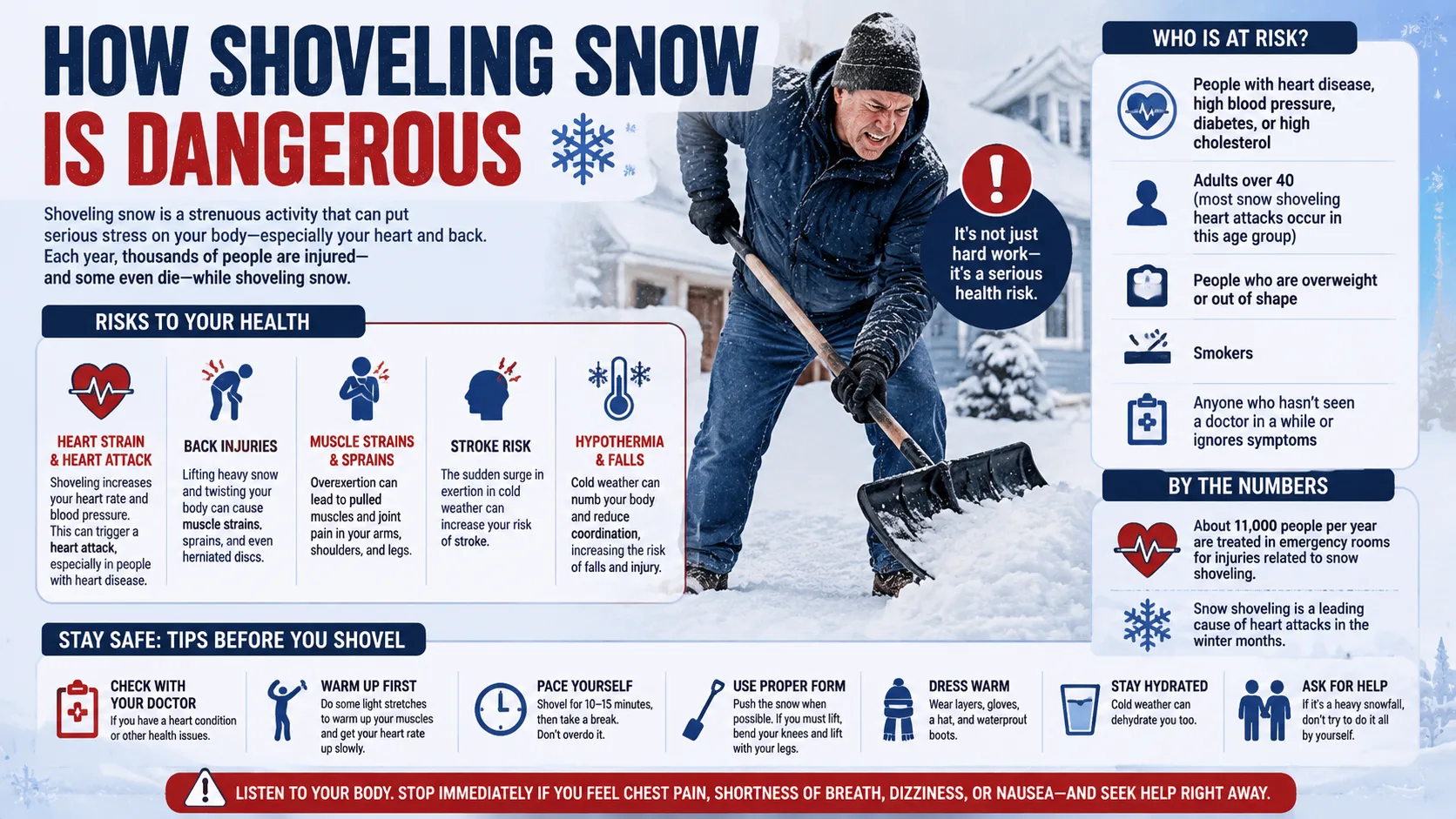
Shoveling snow is dangerous because it combines sudden heavy exertion, cold air, and awkward lifting, which together put extreme stress on your heart, back, and joints. Every year this simple chore sends thousands of people to the emergency room and is linked to close to 100 deaths in the United States, most of them from heart attacks.
The danger is not the snow itself. It is the mix of factors happening at once: your blood vessels constrict in the cold, your heart rate spikes almost immediately, and you are usually twisting, lifting, and throwing weight in ways your body is not warmed up for. If you understand exactly what is happening inside your body when you shovel, you can cut your risk dramatically.
Key takeaway: Shoveling for just 10 minutes can push your heart rate close to its maximum safe level. If you feel chest pain, shortness of breath, or dizziness while shoveling, stop immediately and seek medical help. Do not try to finish the driveway first.
How Shoveling Snow Affects Your Body
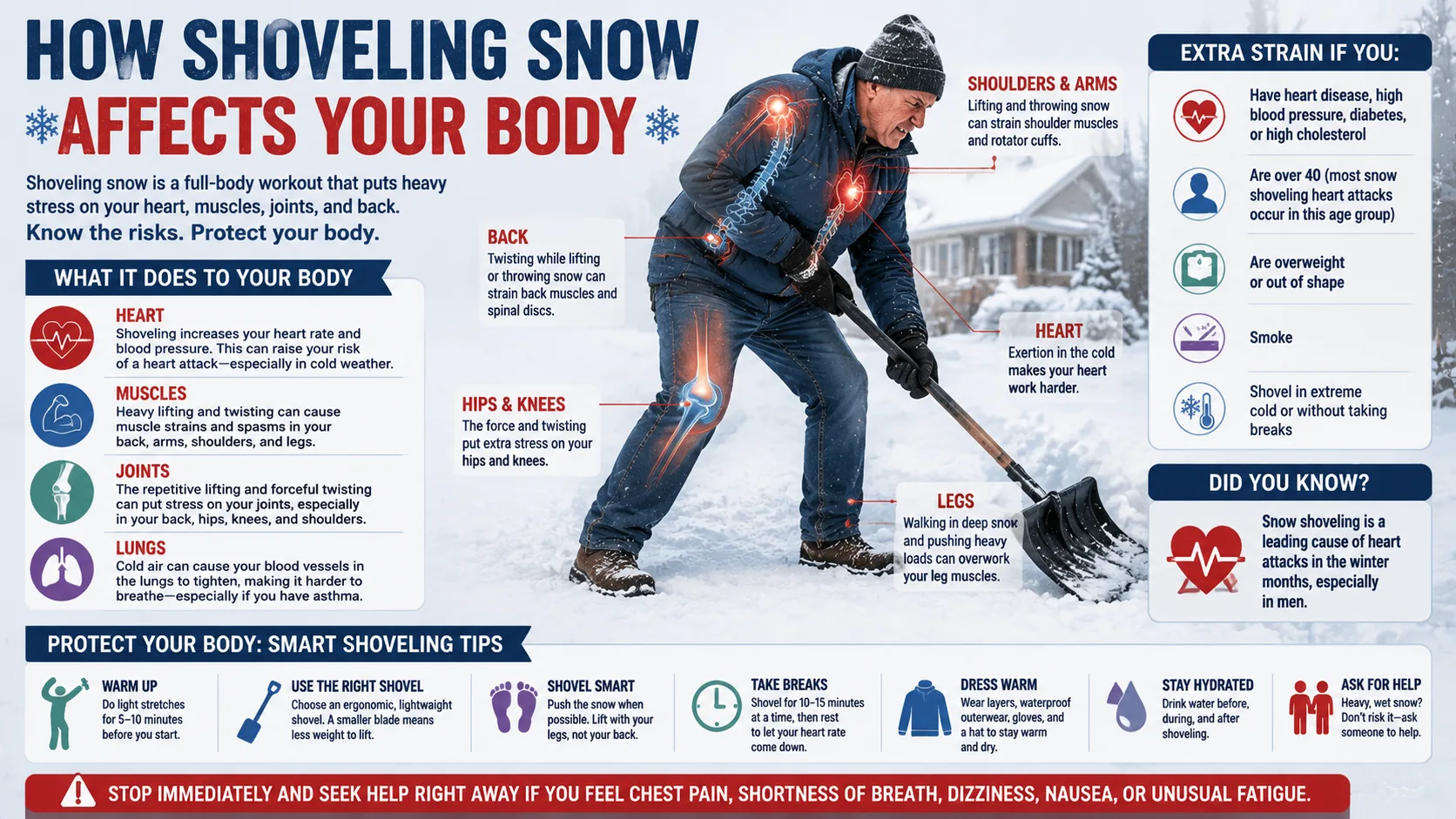
Shoveling looks like light yardwork, but physiologically it behaves more like an intense, unplanned workout performed in freezing conditions. Here is what actually happens.
1. Sudden Cardiovascular Strain
Cold air causes your blood vessels to narrow, a process called vasoconstriction. That alone raises your blood pressure before you even pick up the shovel. Add the physical effort of lifting and throwing snow, and your heart rate can climb dramatically within minutes.
Cardiologists have pointed out that shoveling is an arm-dominant activity, and using your arms strenuously places more strain on the heart than leg-based exercise like walking or jogging. That is part of why snow shoveling heart attack risk is a real, well-documented medical concern rather than a myth.
To put this in real numbers, some research has tracked heart rate during shoveling reaching close to 97 percent of a person's predicted maximum within just 10 minutes of starting. For comparison, most cardiologists recommend that even a healthy adult keep sustained exercise closer to 60 to 80 percent of that maximum. Shoveling can blow past that ceiling almost immediately, and it does so without any of the gradual warm-up that a treadmill workout or a jog would normally include.
This matters because the danger is not just about fitness level. Even people who exercise regularly can be caught off guard, since shoveling stresses the heart through an unfamiliar combination of arm work, cold air, and isometric gripping that most workout routines never replicate.
2. Lower Back and Muscle Injuries
The twisting, bending, and lifting motion of shoveling is hard on your spine. Research into snow shovel-related emergency room visits found that the lower back is the single most commonly injured body part, accounting for roughly one in three cases.
Cold, tight muscles that have not been warmed up are far more likely to strain or tear under this kind of repetitive load.
The mechanics of a typical shoveling motion make things worse. Most people bend forward at the waist, twist their torso, and then throw the load off to one side, all in a single continuous movement. That twisting motion under load is one of the most common ways people herniate a disc or pull a muscle in everyday life, and shoveling repeats it dozens or hundreds of times in a single session. A driveway that looks like a quick 20-minute job can easily involve moving several hundred pounds of snow by the time it is finished.
3. Cold Exposure and Hypothermia
Extended time outdoors in freezing temperatures, especially if you are sweating from exertion, raises your risk of hypothermia and frostbite. Wind makes this worse by pulling heat away from exposed skin much faster than still air, which is why the actual temperature on a thermometer can feel far more dangerous once wind chill is factored in.
Sweating adds a layer of risk that many people overlook. Damp clothing loses much of its insulating value, so a person who works up a sweat while shoveling and then stops to rest can cool down rapidly, sometimes faster than if they had never started moving at all. Wet gloves and socks are a common trigger for frostbite on fingers and toes during longer shoveling sessions.
Checking conditions before you head outside matters more than most people think. You can use the wind chill calculator to see how cold it actually feels before deciding how long to work and how many layers to wear.
4. Slips, Falls, and Impact Injuries
Ice hidden under fresh snow is one of the most common causes of shoveling injuries. Falls account for roughly one in five snow shovel-related emergency room visits, and wrist, ankle, and shoulder injuries are especially common when people instinctively brace themselves with an outstretched arm.
Being struck by the shovel itself, often while someone else is working nearby, is another frequent and underrated cause of injury. This is especially common when two people are clearing the same driveway at once and one person swings a loaded shovel without checking behind them.
Falls involving snow and ice tend to produce a specific pattern of injury. Wrist fractures are the single most common outcome, since the natural instinct is to catch yourself with an outstretched hand. Ankle sprains, ankle fractures, and shoulder injuries follow close behind, and older adults are disproportionately affected by the more serious versions of these injuries.
The Numbers: Snow Shoveling Injury and Death Statistics
These figures come from long-running U.S. emergency department research and public health data. They show why this everyday chore deserves real caution.
| Statistic | Figure |
|---|---|
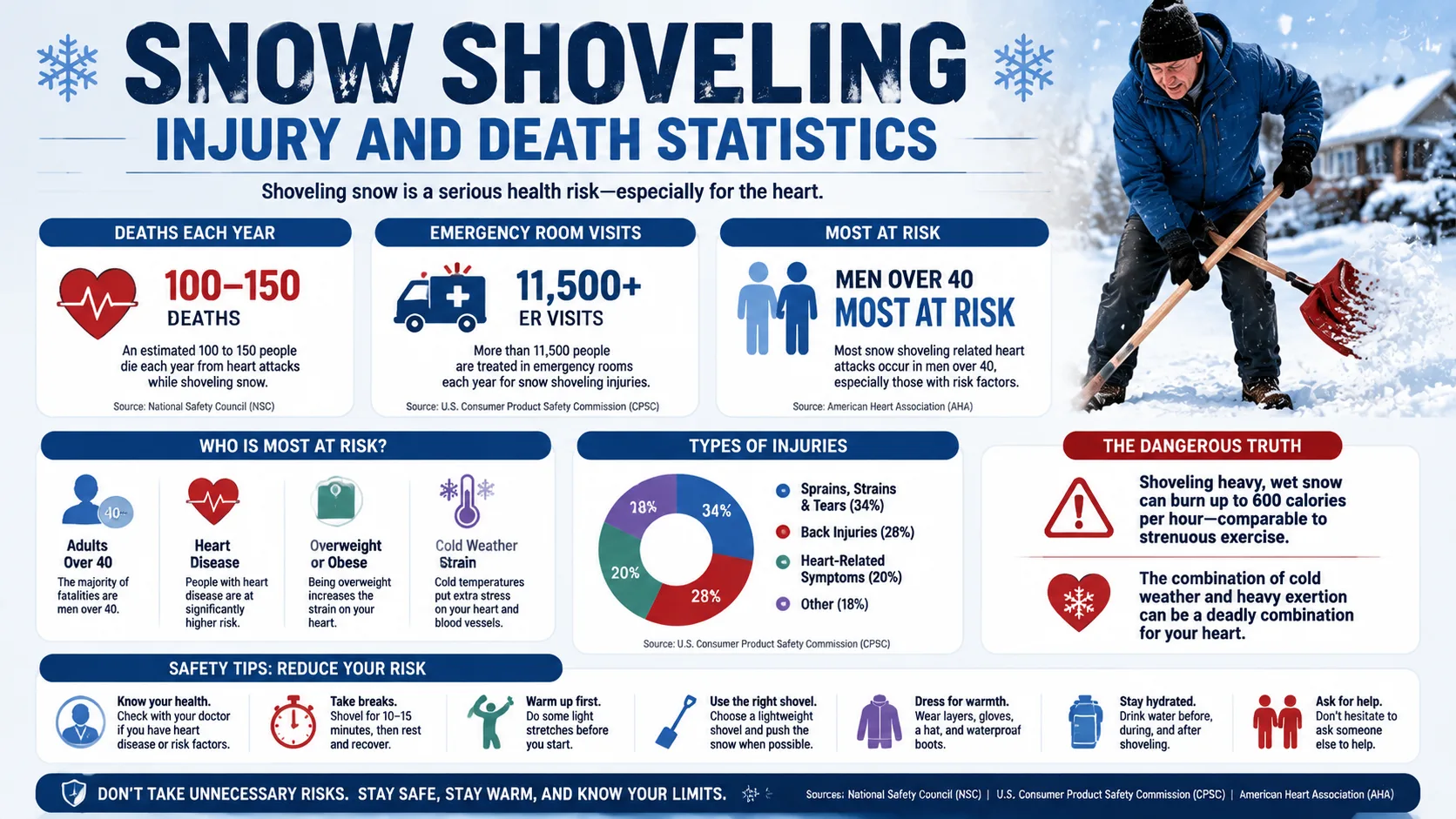
| Average annual U.S. emergency department visits from snow shoveling | About 11,500 |
| Estimated deaths linked to snow shoveling, mostly cardiac, over a 17-year study period | 1,647 |
| Share of injuries affecting the lower back | About 34 percent |
| Share of injuries caused by slips and falls | About 20 percent |
| Share of cases that were cardiac related | About 7 percent, but nearly all fatalities |
| Increased hospital admission risk for men after a heavy snowstorm (about 8 inches) | 16 percent higher |
| Increased risk of fatal heart attack for men after a heavy snowstorm | 34 percent higher |
Sources: American Journal of Emergency Medicine (17-year national study), Canadian Medical Association Journal, American Heart Association.
What This Looks Like in Real Terms
Numbers on a page can be easy to skim past, so here is what they mean in practice. In a typical snow-belt city with a population of around 200,000 people, national injury rates suggest roughly eight to nine emergency room visits related to shoveling could occur during and after just one significant snowstorm.
On the cardiac side, consider a 62-year-old man with well-controlled high blood pressure who has not exercised much since summer. If he steps outside after an 8-inch overnight snowfall and shovels a long driveway in one continuous push, research on storms of that size suggests his relative risk of a hospital-admitted heart attack is meaningfully elevated compared to a day with no snow, and that elevated risk can linger for weeks, not just for the hours right after he finishes.
Now compare that to the same man taking four short 10-minute shoveling sessions spread across the morning, warming up briefly before each one, and stopping at the first sign of chest tightness. The physical work accomplished is identical, but the strain placed on his heart at any single moment is far lower. That difference, spread out over time versus concentrated in one push, is the core idea behind almost every safety recommendation in this article.
Who Is Most at Risk
Anyone can get hurt shoveling snow, but some groups face significantly higher odds of a serious event.
- Adults over 55: More than four times as likely to experience cardiac symptoms while shoveling compared to younger adults.
- People with existing heart disease, high blood pressure, or diabetes: These conditions amplify the cardiovascular stress caused by cold and exertion.
- People who do not exercise regularly: A sudden burst of intense activity is riskier for a body that is not conditioned for it.
- Smokers and people with high cholesterol: Both are established heart attack risk factors that combine badly with shoveling.
- Men in general: Research consistently shows men face a sharper spike in cardiac risk after heavy snowfall than women.
- Children and teenagers: Younger people are less likely to face cardiac risk but still make up a meaningful share of shoveling injuries, mostly from falls, strains, and being struck by a shovel handle.
Choosing the Right Gear Before You Start
Equipment choices sound minor compared to heart rate and back strain, but they change how much effort a job actually requires. A shovel that is too large forces you to lift more weight per scoop. A shovel with a straight handle forces more bending at the waist than one with a curved or telescoping handle designed to reduce that motion.
- Shovel size: A smaller blade means less snow per scoop and less strain per lift.
- Handle design: Curved or ergonomic handles let you keep your back straighter while pushing and lifting.
- Footwear: Boots with deep, grippy tread reduce slip risk far more than regular sneakers or dress shoes.
- Layering: A moisture-wicking base layer, an insulating middle layer, and a wind-resistant outer layer beat one thick coat for regulating both cold and sweat.
- Traction aids: Ice cleats or grippers that slip over boots noticeably reduce fall risk on icy sections of driveway or sidewalk.
Warning Signs You Should Never Ignore
Stop shoveling immediately and call for help if you notice any of the following:
- Chest pain, pressure, tightness, or squeezing
- Shortness of breath that does not ease with rest
- Pain spreading to the arm, jaw, neck, or back
- Lightheadedness, dizziness, or a racing or irregular heartbeat
- Sudden cold sweat combined with nausea
These symptoms should never be pushed through. Treat them as a medical emergency, not a sign to slow down and keep going.
Step-by-Step: How to Shovel Snow Safely
- Check the conditions first. Look up the temperature, wind chill, and forecast before heading outside. The homepage calculator and the state-by-state winter predictions page can help you plan around the worst of a storm.
- Warm up for five to ten minutes. Light stretching or a short walk gets blood flowing and reduces strain on cold, tight muscles.
- Dress in layers. Trap heat without overheating, and choose a hat and gloves that keep extremities warm without restricting movement.
- Choose an ergonomic shovel. A curved handle or a smaller blade reduces how much weight you lift with each scoop.
- Push snow instead of lifting when you can. Pushing puts far less strain on your heart and back than repeatedly lifting and throwing.
- Lift with your legs, not your back. Bend your knees, keep your back straight, and avoid twisting while holding a loaded shovel.
- Take frequent breaks. Shovel in short bursts of 10 to 15 minutes rather than pushing through the whole driveway at once.
- Stay hydrated. Cold weather masks thirst, but your body still loses fluid through exertion and cold air.
- Watch your footing. Wear boots with good tread and move slowly over any icy patches.
- Know when to stop. If you feel any warning sign listed above, stop and seek help right away.
Common Mistakes People Make When Shoveling
- Skipping the warm-up. Jumping straight into heavy lifting with cold muscles is one of the fastest ways to strain your back.
- Shoveling right after eating a large meal. This adds extra cardiovascular load at a time when your body is already working to digest.
- Trying to finish everything at once. Racing to clear a large driveway in one session dramatically raises exertion and injury risk.
- Ignoring early symptoms. Many people mistake early warning signs for simple tiredness and keep working through them.
- Using the wrong shovel size. An oversized blade means more weight per scoop, which adds up fast over a full driveway.
- Shoveling alone in extreme cold. Having someone nearby, or checking in by phone, matters if something goes wrong.
Pro Tips From Health Experts
Medical researchers who study cold-weather cardiac events consistently point to a few themes. Barry Franklin, a researcher who has led scientific statements on exercise-related heart risk for the American Heart Association, has explained that deaths tied to snow removal happen every winter, often during or shortly after the activity itself.
John Osborne, a cardiologist affiliated with the American Heart Association, has described how shoveling snow places a heavy load on the heart because it rapidly raises blood pressure and heart rate at the same time that cold has already narrowed the blood vessels.
Christopher Kramer, a cardiologist and past president of the American College of Cardiology, has noted that the added risk from shoveling can persist for roughly four weeks after a major snow event, particularly for people with underlying cardiac risk factors such as diabetes, high blood pressure, high cholesterol, or a sedentary lifestyle.
Pro tip: If you have any known heart condition, ask your doctor before shoveling season whether it is safe for you to shovel at all. A snow blower, a neighbor, or a paid service may be the smarter choice.
Read More : Snow Day Calculator by Zip Code
Snow Shoveling vs. Snow Blowing: Which Is Safer
If you have a choice, the data suggests a snow blower places noticeably less strain on your heart than manual shoveling, largely because it removes the repetitive lifting and throwing motion.
| Factor | Manual Shoveling | Snow Blower |
|---|---|---|
| Typical heart rate during use | Can approach 170 beats per minute | Often closer to 120 beats per minute |
| Lower back strain | High, from repeated lifting and twisting | Lower, mostly pushing and steering |
| Fall risk on ice | Moderate to high | Moderate, machine adds weight to control |
| Best for | Light, short driveways and walkways | Larger areas or people with heart risk factors |
Neither option is completely risk free. Even snow blower operators should still watch for warning signs, avoid clearing the chute by hand, and take the same cold-weather precautions.
When to Call for Help
Call emergency services immediately if you or someone shoveling nearby experiences chest pain, sudden severe shortness of breath, confusion, or collapses. If someone collapses and is unresponsive with no pulse, call for help and begin hands-only CPR right away while waiting for emergency responders.
Do not wait to see if symptoms pass on their own. With cardiac events, minutes matter.
For more seasonal safety guidance and winter weather planning, browse the blog or explore the full calculator directory to plan ahead of the next storm.
Conclusion
Shoveling snow is dangerous because it forces your heart, back, and joints to handle intense, sudden strain in cold conditions your body is not warmed up for. The good news is that most serious incidents are preventable with a few simple precautions: check conditions first, warm up, pace yourself, and stop the moment you notice a warning sign.