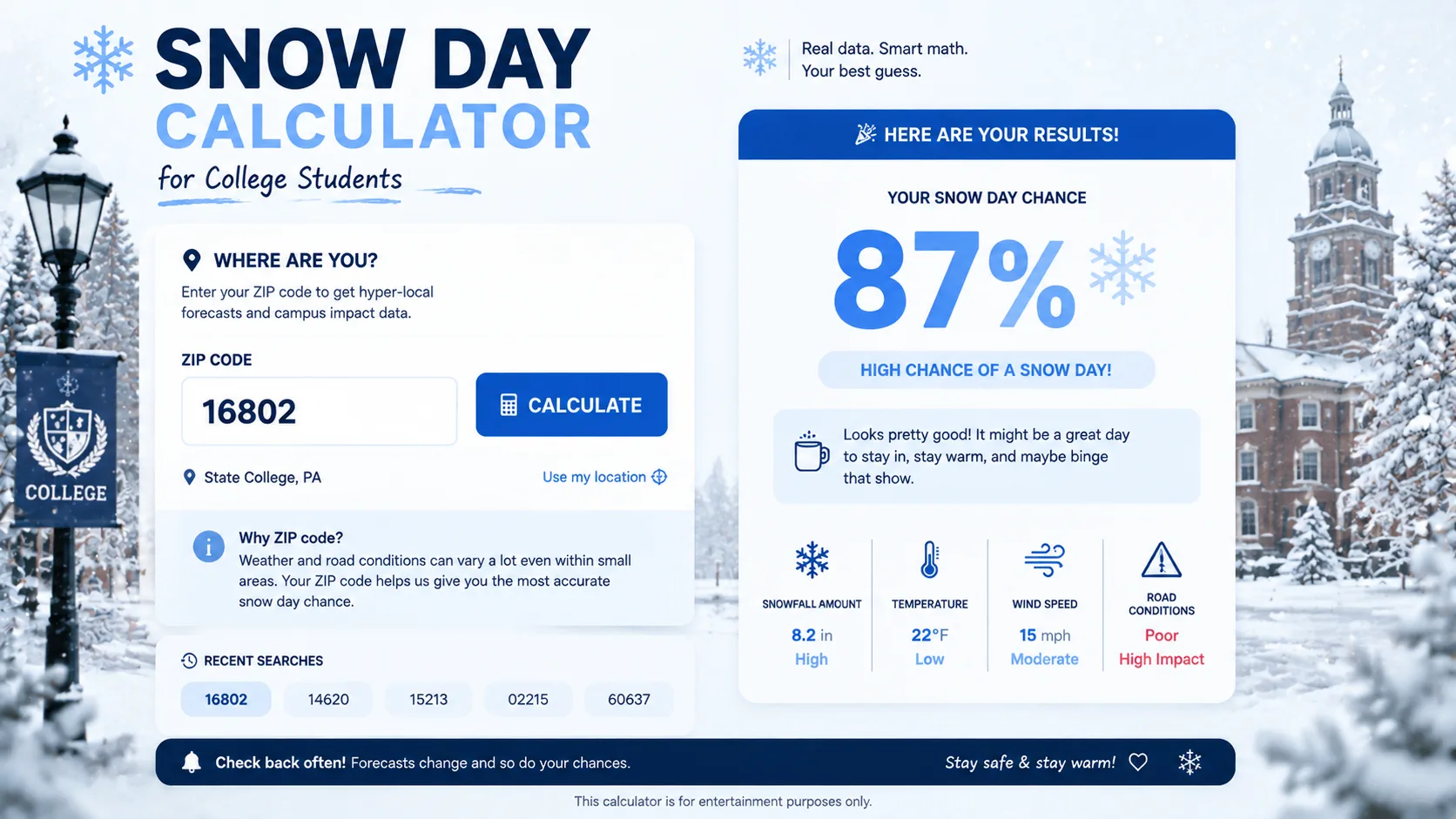
A snow day calculator by zip code gives you an instant probability score, usually between 0% and 100%, that shows how likely your local school is to close for snow, ice, or extreme cold. You simply enter your zip code, and the tool pulls live weather data for your exact location to generate a personalized prediction in seconds.
This guide breaks down exactly how a zip code snow day calculator works, the formula behind the score, and how to read your results with confidence. You can try the tool yourself on our main snow day calculator at any point while reading.
What Is a Snow Day Calculator by Zip Code
A snow day calculator by zip code is an online tool that estimates the chance a school will close, delay, or stay open the next day, based on weather forecast data tied to your specific five digit zip code. Instead of a generic regional forecast, the tool matches your zip code to a precise latitude and longitude so the prediction reflects conditions at your actual address, not just your state or metro area.
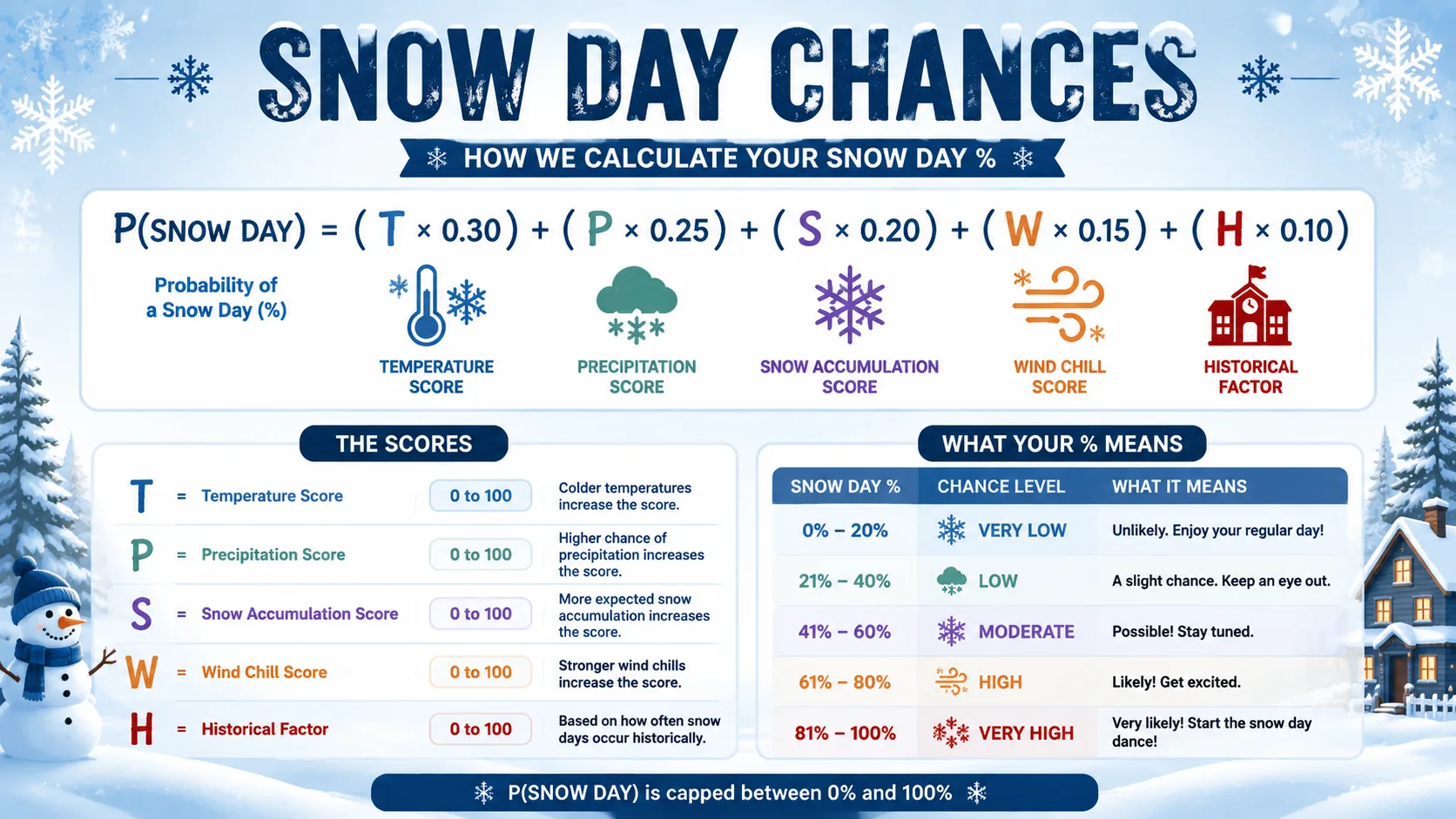
Most tools display the result as a simple percentage. A score near 90% suggests a closure is very likely. A score near 10% suggests school will almost certainly run as normal. Anything in the middle usually points to a delay or a "watch and wait" situation.
These tools have grown far more precise since the earliest versions launched in the mid 2000s. Zip code based lookups became standard once calculators began pulling live data automatically from national weather services instead of asking users to enter forecasts by hand.
How Does a Zip Code Snow Day Calculator Work
Behind the simple input box, a zip code snow day calculator runs through a short sequence of steps every time you submit a search. Understanding this sequence helps explain why your score can shift from one refresh to the next.
Step 1: Location Lookup
Your zip code is matched to a precise geographic coordinate, along with the associated city and state. This step matters because weather can vary sharply even within the same county, especially near coastlines, lake effect snow belts, or elevation changes.
Step 2: Live Weather Data Retrieval
The calculator queries forecast data for your coordinates, pulling expected snowfall totals, overnight low temperatures, wind speed and wind chill, and any ice or freezing rain in the forecast. Because forecasts update throughout the day, your score can change each time new data comes in.
Step 3: Probability Scoring
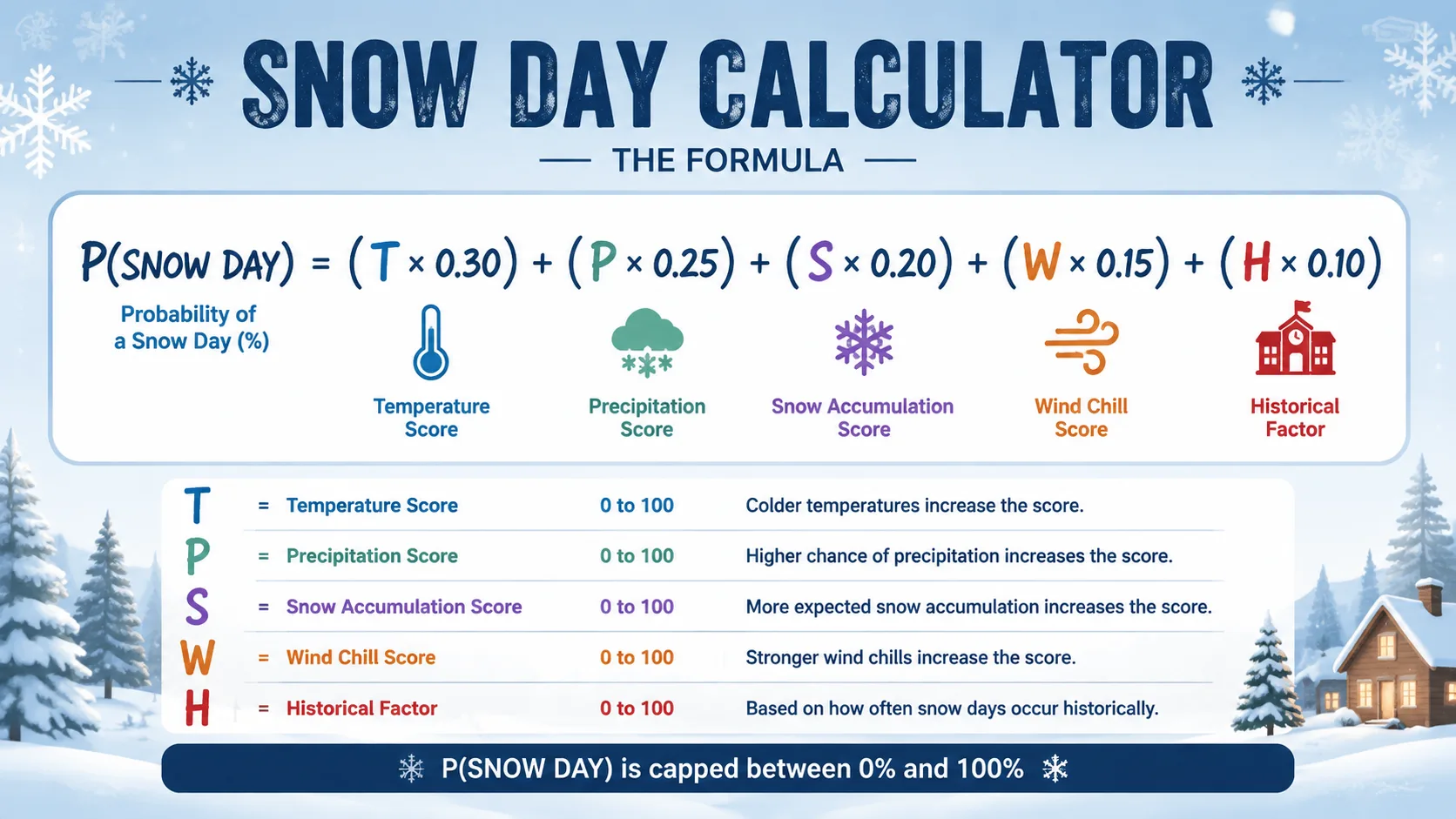
The tool runs all of the retrieved data through a weighted formula (explained in detail below) and returns a single probability score, along with a written summary of the conditions driving that score.
The Snow Day Calculator Formula Explained
There is no single universal formula used across every snow day calculator, but most reputable tools weigh a similar set of core variables. The National Weather Service publishes forecast data that many of these calculators rely on, including snowfall accumulation ranges, temperature outlooks, and winter storm warnings, which forms the raw material for the probability score.
Key Factors in the Calculation
- Snowfall accumulation: Total inches expected over the next 24 hours, weighed against your region's typical snow tolerance.
- Storm timing: Snow falling between 4 AM and 8 AM carries more weight, since it overlaps with bus routes and morning commutes.
- Temperature and wind chill: Extreme cold alone can trigger closures even without snow on the ground, particularly when wind chill drops well below freezing.
- Ice and freezing rain: A thin glaze of ice is often treated as more dangerous than several inches of powder snow, because it is harder for road crews to treat quickly.
- Regional preparedness: A snowfall total that shuts down schools in a warm climate zip code might barely register in a region that sees snow every winter.
- Recent closure history: Districts that have already used several snow days that year may be more reluctant to close again, and some calculators factor this in.
The table below shows how snowfall thresholds for closure tend to shift by region. This is one of the biggest reasons two users with very similar forecasts can see very different probability scores.
| Region | Typical Snow Threshold for Closure | Extreme Cold Weighting |
|---|---|---|
| Northeast & New England | 4 to 6+ inches | Low to Moderate |
| Upper Midwest & Great Lakes | 3 to 5 inches | High (wind chill is a standalone factor) |
| Mid-Atlantic | 2 to 4 inches | Moderate |
| South & Coastal Regions | Under 1 inch, or any ice | Moderate to High |
| Mountain West | 6+ inches | Low |
A district's own policy also matters more than the raw weather numbers. A superintendent in a snowy northern state may not flinch at six inches, while a district with little snow removal equipment may close for two.
How to Use a Snow Day Calculator With Your Zip Code
Using a zip code based snow day calculator takes less than a minute. Here is the general process most tools follow:
- Enter your five digit zip code into the input field on the calculator.
- Select your school type if the tool asks, since elementary, middle, high school, and university closures do not always follow the same threshold.
- Add how many snow days your school has already used this year, if the tool supports it, since this can adjust the score.
- Click calculate to generate your probability score.
- Read the breakdown of contributing factors, not just the headline percentage, so you understand what is actually driving the prediction.
- Recheck later in the day as forecasts firm up, especially between 9 PM and midnight, and again around 5 AM to 6 AM when most districts finalize decisions.
You can browse the full calculator directory if you want to compare tools for different situations, such as a manual calculator where you can plug in your own snowfall and wind numbers.
Real World Zip Code Examples
Snow day predictions can vary widely even on the same forecast night, depending entirely on location and local policy. Here are a few illustrative examples that show why zip code matters so much.
| Zip Code Example | Region | Typical Pattern |
|---|---|---|
| 55401 | Minneapolis, MN | Snow is routine. Closures usually require heavy accumulation or dangerous wind chill. |
| 30301 | Atlanta, GA | Even light snow or a hint of ice can close schools due to limited snow removal infrastructure. |
| 90210 | Beverly Hills, CA | Snow days are effectively never a factor, though the format is a common example used in demos. |
| 02108 | Boston, MA | Higher snow tolerance, but coastal storms with heavy wind can still trigger closures. |
This is exactly why a generic statewide forecast is not enough. A zip code snow day calculator narrows the prediction down to conditions specific to your address and, where possible, your district's own closure tendencies.
Benefits of Checking Snow Day Chances by Zip Code
- Plan childcare earlier. Parents can arrange backup care the night before instead of scrambling after a 5 AM robocall.
- Reduce morning stress. Students and staff get an early read instead of refreshing a district website repeatedly.
- Support commute decisions. Bus drivers, teachers, and staff can judge road risk earlier in the evening.
- Compare multiple locations. Families that split time between two zip codes, or grandparents who handle pickup, can check both areas at once.
- Track patterns over a season. Checking your state-by-state predictions across a winter can show how your district tends to respond compared to neighboring areas.
Common Mistakes and Pro Tips
Even a well built calculator can mislead you if it is used the wrong way. Keep these points in mind.
- Do not check too early. A score checked three days out is far less reliable than one checked the evening before, since forecasts sharpen as the storm approaches.
- Do not ignore ice. Many users focus only on snowfall totals, but a thin layer of freezing rain is frequently the real reason a district closes.
- Remember it is a probability, not a guarantee. The final decision always rests with local school administrators, who may factor in details a calculator cannot see, such as staffing shortages or a single unplowed rural road.
- Use your zip code, not your city name. City-level lookups can sometimes default to a central coordinate that misses local microclimates, especially in large or sprawling districts.
- Check again close to the decision window. Most districts announce by 5 AM to 6 AM, so a recheck in that window uses the freshest data available.
Weather forecasting professionals generally agree that road conditions, not just snowfall depth, drive most closure decisions, which is why the strongest calculators weigh ice and wind chill as heavily as raw accumulation. Meteorologists who study winter storm impacts also note that the timing of snowfall relative to the morning commute is often just as important as the total amount that falls.
Read More : Snow Day Calculator for College Students
Snow Day Calculator vs Related Winter Weather Tools
A snow day calculator is not the only tool worth checking during winter weather. Depending on the forecast, a few related tools can round out your planning.
| Tool | What It Measures | When to Use It |
|---|---|---|
| Snow Day Calculator | Probability of school closure by zip code | Any time snow, ice, or extreme cold is in the forecast |
| Wind Chill Calculator | How cold it actually feels with wind factored in | Extreme cold snaps, even without snowfall |
| Heat Index Calculator | How hot it feels with humidity factored in | Late spring or early fall heat closures |
| Rain Delay Calculator | Chance of a delayed start due to heavy rain or flooding | Storms outside the winter season |
Checking the right tool for the right forecast gives you a more complete picture than relying on snowfall totals alone.
Conclusion
A snow day calculator by zip code takes the guesswork out of winter mornings by turning live weather data into a clear, location-specific probability score. Understanding the formula behind that score, from snowfall and ice to storm timing and regional thresholds, helps you read your result with far more confidence than a raw percentage alone.