
A snow day is announced and your first instinct is pure joy. But 30 minutes later, you're deep in a Netflix hole wondering where the morning went. Sound familiar? Learning how to stay productive on a snow day is one of the most underrated academic skills a student can build.
Then the day starts to leak. One video turns into ten lunch becomes a snack that becomes another snack and by 4 PM you are wondering where the hours went and why your essay is still blank.
Knowing how to stay productive on a snow day is a skill with a big payoff. A closure hands you hours with no commute, no bells and no between-class rush. Used well one snow day can clear a week of backlog. Still leave room to enjoy the snow.
This guide gives you a plan, not a lecture about grinding for ten hours. You will find an hour-by-hour schedule, study methods that actually work a plan for power cuts advice for parents and the mistakes that quietly ruin snow days.
Make Sure It Really Is a Snow Day
Before you plan anything confirm what kind of day you have. I built the calculator on this site after seeing parents in my area confused about whether schools were closing, and that confusion is exactly how good plans fall apart. If you are still unsure the night before, our snow day calculator can give you a quick estimate of closure odds from the forecast.
Here is my honest opinion though: no calculator can replace the school district announcement. Use a prediction to prepare then check your districts website, app or text alert before you change your plans.
Once the closure is confirmed work out which of these three days you are in:
- A full day off. No assignments are expected. You can study ahead. Nobody requires it.
- A remote or e-learning day. Many districts in the US and Canada now move classes online instead of cancelling them, and some UK schools do something similar for severe weather. Check your portal first, because you may owe work today.
- A storm day with safety risks. Heavy snow, ice or a power outage changes your priorities. Warmth, food and charged devices come before homework.
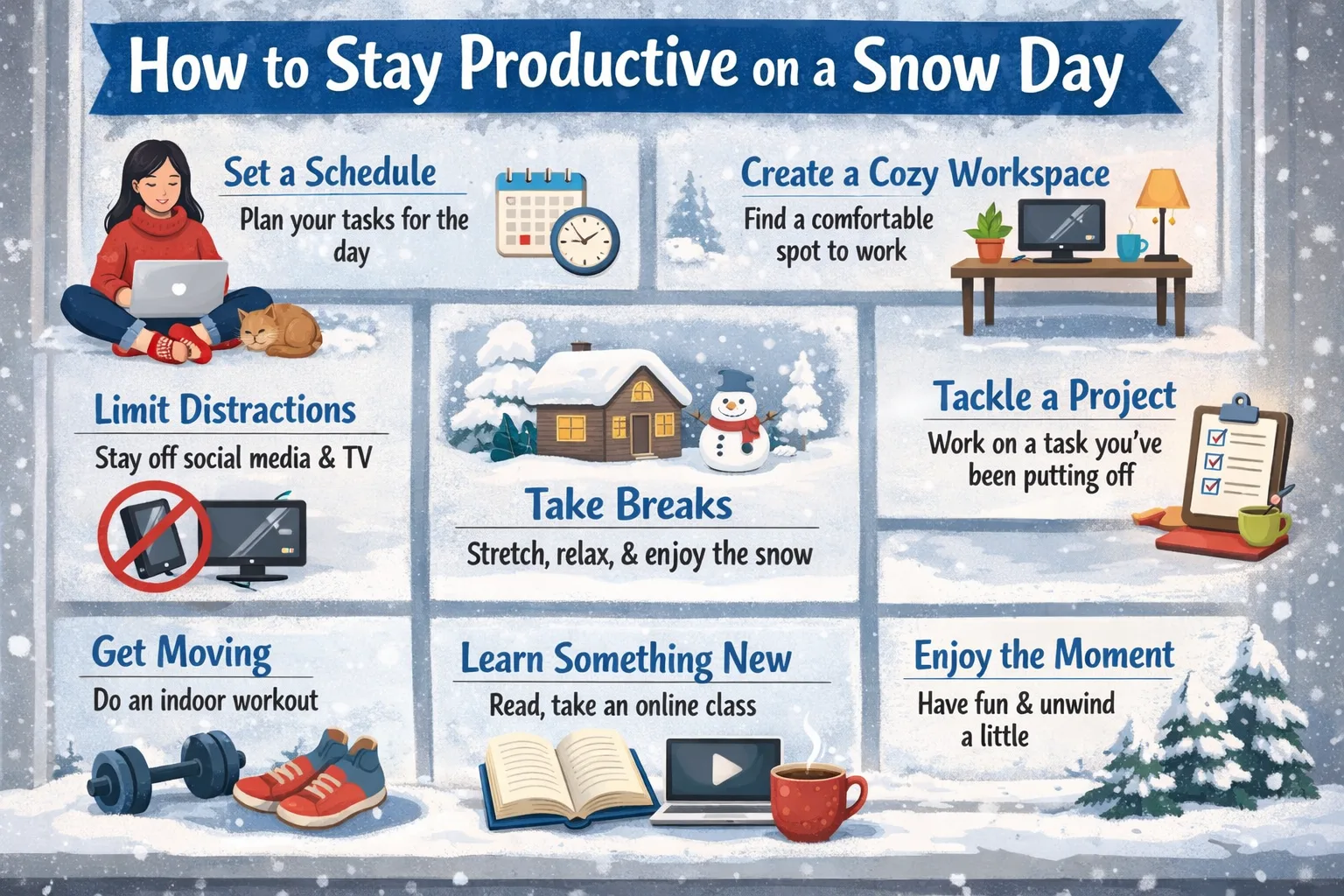
Why a Snow Day Is Such a Good Study Window
A normal school night gives you scraps of time. You study for 40 minutes get interrupted switch subjects and start over. A snow day gives you something long uninterrupted blocks.
That matters because deep work like writing a draft or working through a difficult problem set needs a warm-up period. Short bursts never let you get past it. On a snow day you can finally stay with a hard idea until it clicks.
There is a second advantage. Everyone feels the pull to treat the day as a bonus weekend so a bit of structure puts you ahead of people without much effort.
Get Your Mindset Right Before You Start
The biggest obstacle on a snow day is not the lack of a classroom. It is the cozy feeling that nothing matters today. Here are three ways to beat it.
Call it "found time"
Free time gets spent. Found time gets invested. Telling yourself "I have hours today that I did not expect" makes it easier to use them on purpose.
Pick three priorities, on paper
Write down the three things that would make today feel successful. Keep them small and specific like "finish the intro and first body paragraph" of "work on essay." If a storm is forecast do this the night
Tell one person your plan
Send a friend or family member a message: "Doing my chemistry questions this morning." It sounds minor. Saying it out loud makes you far less likely to quietly skip it.
A Morning Routine That Sets the Tone
How you spend the hour usually decides the next eight. You do not need a routine only a few anchors:
-
Wake up close to your usual time. A little extra sleep is a treat. A three-hour lie-in makes the afternoon feel like a hangover.
-
Get dressed. Pajamas tell your brain the day is for lounging. Comfortable clothes you could answer the door in tell it something
-
Eat a proper breakfast. Eggs, oats, yogurt and fruit or toast with peanut butter will keep you going longer than a bowl of sugary cereal.
-
Move for ten minutes. Stretch, do a workout or walk around the house. Gentle movement helps you feel alert.
-
Write your three priorities. Handwriting them takes ten seconds. Makes the list feel real.

Study Strategies That Work Best on a Snow Day
blocks only help if you use them well. These methods are backed by established learning research and suit an unstructured day.
Use recall instead of re-reading
Re-reading your notes feels productive because the material looks familiar. Familiar is not the same as learned. Close the book. Try to pull the information out of your head instead.
-
Make flashcards. Test yourself or use a spaced repetition app.
-
Explain a topic loud as if you were teaching a younger sibling.
-
Answer practice questions without looking at your notes
It feels harder. That difficulty is the point. Effortful retrieval is what builds lasting memory.
Tackle your task first
Do the thing you are dreading while your energy is fresh. Once it is done the rest of the day feels lighter. If you leave it until 3 PM it will probably still be there at bedtime.
Work in sessions with real breaks
The classic method is 25 minutes of work and 5 minutes of rest. On a snow day you can stretch that. Try 45 to 60 minutes of focus followed by a 10 to 15 minute break. Set a timer for both because a "quick break" that lasts an hour defeats the purpose.
Batch by subject
Jumping, between subjects every 20 minutes costs you the time it takes to refocus each time. Give each subject a block of 60 to 90 minutes instead.
Finally do the long reading
Assigned chapters are the first thing to slip during a busy school week. A snow day is perfect for getting things done. Write notes as you work. After each part write one sentence to explain what you did.
If you cannot, read it again.
Look two to three weeks ahead
Do not think about what needs to be done tomorrow. Open your calendar. Look for the next big deadline. Making an outline gathering information or listing topics for a test is some of the use of extra time. It changes stress into a head start.
Use AI tools as a coach not as someone who does the work for you
In 2026 most students have an AI assistant close by. It helps with testing yourself on a topic explaining a concept in a way or checking your thinking. It is not an idea to let it write your assignment because many schools see that as cheating and you miss out on learning. Ask it to test you not to do the work for you.
A Realistic Snow Day Plan for Students
Structure is the solution to a snow day without direction. Use this as a guide. Change it based on your classes and where you live. If your school is having classes add those live sessions into the matching time slots first.
| Time | Activity | What to do |
|---|---|---|
| 7:30 AM | Wake up and morning routine | Get dressed, eat breakfast, move for ten minutes |
| 8:15 AM | Planning (15 min) | Write your three priorities and check deadlines |
| 8:30 AM | Focus block 1 (90 min) | Hardest task: essay, problem set or research |
| 10:00 AM | Break (20 min) | Snack, stretch, step outside for a minute |
| 10:20 AM | Focus block 2 (75 min) | Reading, flashcards or project work |
| 11:35 AM | Admin (25 min) | Reply to teachers, submit work, check your portal |
| 12:00 PM | Lunch (60 min) | Eat away from your desk and rest properly |
| 1:00 PM | Focus block 3 (60 min) | Second subject or a project you care about |
| 2:00 PM | Flex time (90 min) | Hobby, nap, online course, or go play in the snow |
| 3:30 PM | Review (45 min) | Quick flashcard run and plan tomorrow |
| 4:15 PM | Free time | Games, friends, family, hot chocolate |
Notice how the day starts with the tasks and leaves the evening open. That is on purpose. You get the feeling of finishing the rest of the day feels like a real reward.
Get Your Space and Devices Ready
Your surroundings affect how focused you will be. Spend five minutes before your block on this:
-
Close every tab in the browser that you do not need.
-
Turn on Do Not Disturb.
-
Put your phone face down or even better in another room.
-
Fill a water bottle. Have a snack close by.
-
Sit in a place with light, ideally not your bed.
These tools are also worth a look:
| Tool | Best for | Cost |
|---|---|---|
| Anki | Flashcards and spaced repetition | Free on desktop and Android, paid on iOS |
| Forest | Phone-free focus timer | Free with paid upgrades |
| Notion or a plain notebook | Tracking tasks and deadlines | Free tiers available |
| Google Scholar | Finding sources for essays | Free |
| Khan Academy | Reviewing concepts you missed in class | Free |
| A website blocker | Cutting off distracting sites | Many free options |
Prices change, so check each tool before you rely on it.
Snow Day Ideas for High School Students
- Check your school portal first. Teachers may have posted online work.
- Review the last two weeks of notes while they are still fresh, instead of only finishing what is due tomorrow.
-
Start working on a project. Outlining is slow and not fun. A snow day removes the pressure.
-
Do practice questions for tests. This could be SAT, ACT or AP in the US provincial exams in Canada or GCSE and A-levels in the UK.
-
Study with a friend on a video call. Working quietly together keeps both of you honest.
Snow Day Tips for College and University Students
-
Check your learning platform (Canvas, Blackboard, Moodle or similar) for recorded videos or changes in instructions.
-
Make progress on a paper. Research in the library is slow. Fits a long quiet block perfectly.
-
Send the emails you have been avoiding like requests for office hours internship follow-ups and club replies.
-
Check your grades. Calculate what you need on tests to reach your goal. Knowing the number makes your effort more focused.
-
Invest in something like updating your resume or LinkedIn or finishing a course online.
If You Are a Parent: Helping Kids Stay on Track Without a Fight
Parents often have the snow days. You are handling work, kids and the boredom that comes by lunchtime. Some ideas that help:
-
Agree on the plan at breakfast. Explain that the first two hours are for schoolwork or reading and snow time comes after.
-
Break it into parts. Younger kids can handle 20 minutes at a time with a break in between.
-
Use the snow as the reward. "Finish your reading then we go out" works than the other way around.
-
Include learning that does not feel like school. Baking uses math measuring snow depth uses math and writing a snow day journal counts as English.
-
Check the school portal together. It avoids surprises when school starts again.
Staying Productive Without Burning Out
There is a way to be productive on a snow day: eight hours at the desk skipping lunch and feeling worse when you go to bed. Rest is part of the plan not something you take a break from.
Protect your breaks
Set a timer for rest just like you do for work. A 20 minute break that turns into two hours of scrolling costs you the afternoon.
Eat and drink properly
It is easy to forget meals when the school routine disappears. Skipping lunch to study usually backfires, because you end up tired and not focused by mid afternoon.
Do something you enjoy that has nothing to do with school
Cook something draw play a game read for fun or call a friend. Enjoyment is not a reward you get after being productive. It is part of what keeps you going.
Get outside, safely
Fifteen minutes of fresh air can refresh your mood and attention. Before you go out check how cold it really is. Our wind chill calculator shows the "feels like" temperature, which's what matters for frostbite risk and for how many layers to wear. Cover your ears, hands and face. Keep outdoor time short when the wind is strong.
The same "feels like" thinking applies in summer when you can use a heat index calculator to judge how hot the air really feels once humidity is included.
Read More : School Bus Safety During Snowstorms
What to Do If the Power Goes Out
A big winter storm can cause power and internet outages for hours or days. Your main focus is staying safe and warm. Once that is covered you can still get things done without power.
-
Download what you need the night. Save readings, slides and videos on your device. Charge everything.
-
Keep a paper copy. Textbooks, notebooks and printed notes do not need a battery.
-
Plan tasks that do not need power. Handwritten flashcards, reading outlining an essay and summarizing chapters all work without electricity.
-
Save battery. Lower your screen brightness and close apps you are not using.
-
Never use a barbecue, camping stove or generator inside. Carbon monoxide is a danger during winter outages.
When a storm turns into freezing rain or a wet mix delays can change quickly. Our rain delay calculator is a handy way to think through how wet weather might disrupt your plans for the day.

Common Snow Day Mistakes to Avoid
-
No plan all. Without a plan the day slips away. Three written goals fix most of this.
-
Much on the schedule. If you plan ten hours you will stop by noon. Aim for three blocks.
-
Studying in bed. Your brain connects the bed with sleep. Focus disappears fast.
-
Keeping the phone nearby. Even a silent phone on the desk reduces focus.
- Treating re-reading as studying. Test yourself instead.
- Ignoring the portal. Many districts now assign online work on closure days.
- Counting on future snow days. You cannot know whether another one is coming, so do not postpone work in the hope of one.
Snow Day Productivity Checklist
The night before
- Write your top three priorities
- Check your upcoming deadlines
- Gather books, notes and chargers
- Download anything you may need offline
In the morning
- Confirm the closure with your school or district
- Check your portal for assigned work
- Get dressed, eat, and move for ten minutes
- Set up your space and silence your phone
During the day
- Use a timer for both work and breaks
- Drink water and eat at normal mealtimes
- Get outside for 15 minutes if conditions are safe
- Do at least one thing just for fun
At the end of the day
- Tick off what you finished
- Note what carries over to tomorrow
- Tidy your notes and pack your bag
- Start winding down at a sensible time
Final Thoughts: Make Your Next Snow Day Count
Being productive on a snow day is not about guilt or working hard. It is about using a gift of extra time on purpose so you feel good, about it the next morning.
Plan the day do the hardest work first protect your rest and leave time to enjoy the snow. That balance is what makes it work, and it is much easier to repeat than an all-day marathon.
Start with the basics before the next storm arrives. Try our snow day calculator to see how likely a closure is, then keep the official district announcement as your final word. When you are ready for more, browse the full range of weather and planning calculators and bookmark the ones you will use again.
Also Checkout :