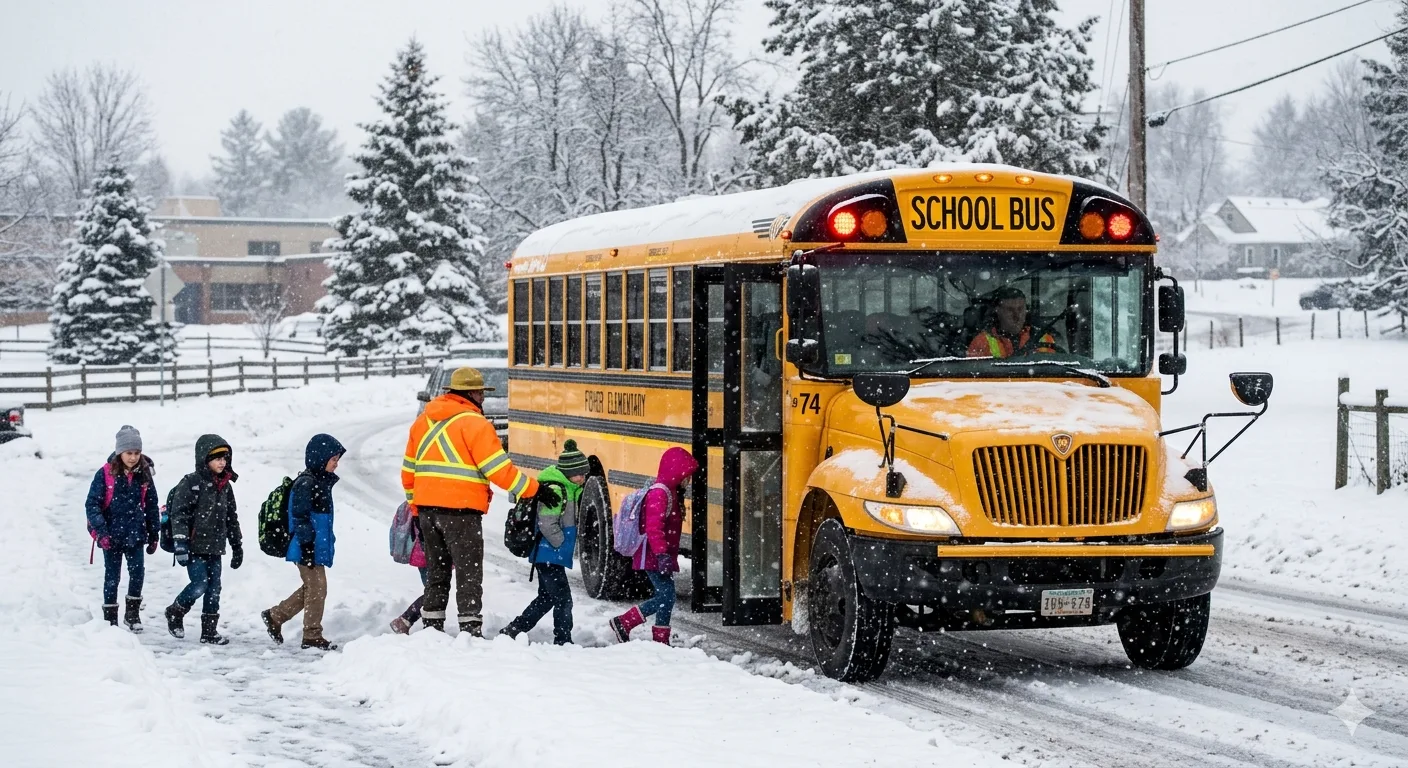
Your phone is silent. The street outside is white. Your child is standing at the door in two mismatched gloves, asking the one question you can't answer yet: "Is the bus coming?"
That small moment is what school bus safety during snowstorms is really about. Not statistics, not policy documents, just a parent trying to make a good call before the first coffee.
I built the snow day calculator on this site after seeing parents in my area get confused about school closures. Predicting when a school bus will close is only half the story. Once the school bus does run you need to know what is safe what is normal and what to do when the school bus goes sideways. That is what this guide covers.
This complete 2026 guide covers everything parents need to know about school bus safety during snowstorms, from how districts decide to cancel or delay school to what your child should do at the bus stop on a morning. We have dug into the data, consulted transportation safety protocols. Organized the information so you can act on it right away.
Whether you are a first‑time school parent or a veteran winter commuter this guide will give you an understanding of the systems in place the gaps you need to fill and the simple steps that can make a life‑saving difference.
First, the Reassuring Part
School buses are still one of the safest ways for kids to get to school, and that doesn't change in winter. They're large, built to protect passengers, and driven by people who train for exactly this kind of weather.
Snow just changes the details. Roads grip less, windows fog, and everything takes longer. The part that surprises most parents is where the danger actually sits. It's often not on the bus at all. It's the icy driveway, the snow pile at the curb, or the car that can't stop in time.
And that's good news, because those are things you can do something about.
What Snow Does to a Bus on the Road
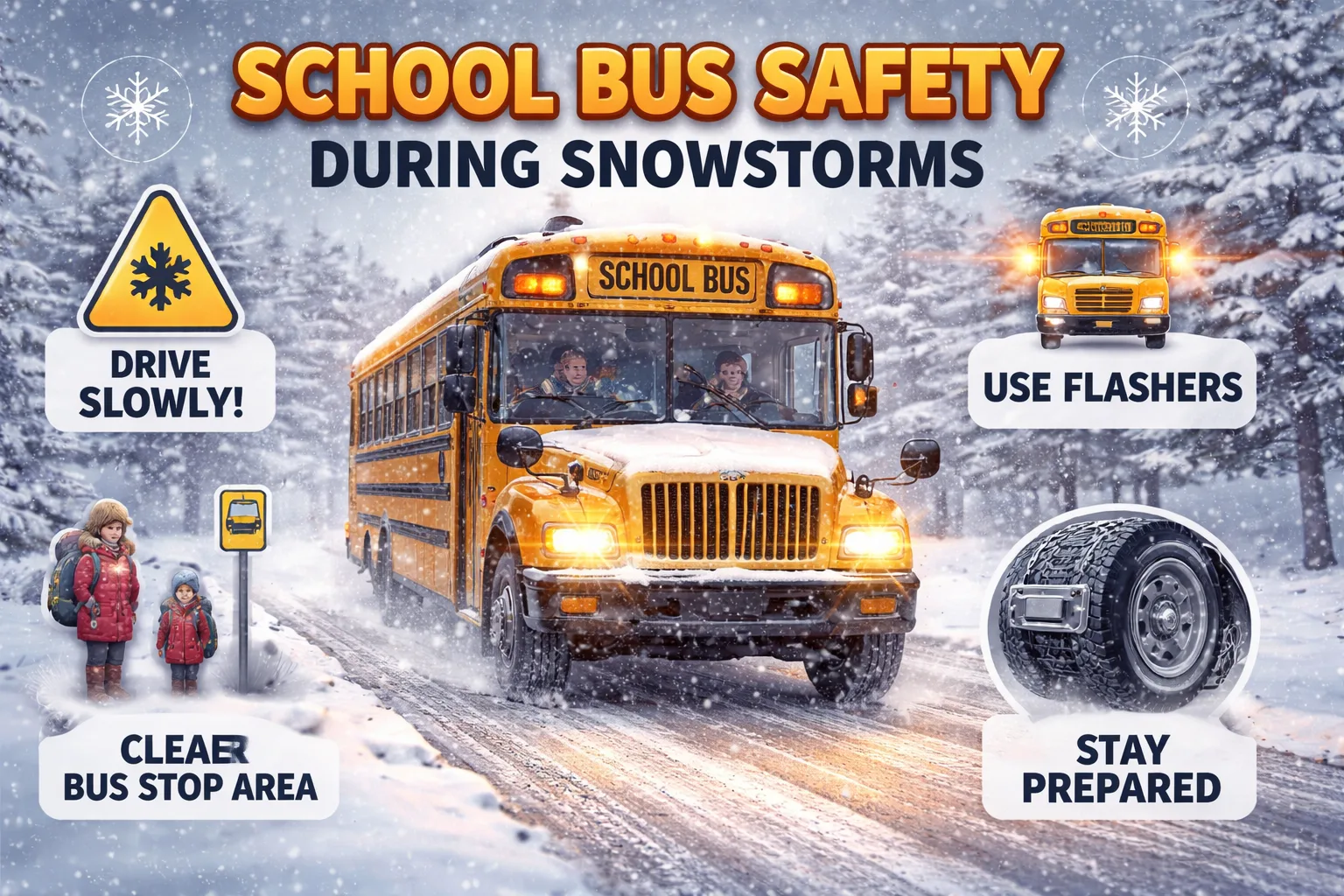
Picture a vehicle that's long, heavy and full of kids. Now put it on packed snow. It can't swerve, and it can't stop quickly. Drivers handle this by slowing down a lot. FMCSA guidance points to cutting speed by about a third on wet roads and by half or more on snow and ice. So a bus that normally cruises at 45 mph may crawl along at 20 to 25.
Bridges and overpasses freeze first. Shaded corners stay slick long after the main road is clear. Black ice looks like a harmless wet patch until the tires hit it.
All of this adds up to one simple rule worth remembering: a late bus is usually a careful bus. If yours is 15 minutes behind, that's often the driver doing the right thing.
How Districts Decide Whether Buses Run
Parents often picture someone looking out a window at 6 a.m. and guessing. It's rarely like that.
Transportation staff usually watch the forecast a day or two. On storm mornings supervisors often drive the routes before dawn and check with road crews about what has been plowed and salted. Then the final decision goes to the superintendent in the US and Canada or to the head teacher or trust in the UK. They are balancing safety against learning and no choice pleases everyone.
Here's what the different announcements actually mean for your morning:
| Announcement | What it means for you |
|---|---|
| Closure | No school and no buses. Sort out childcare early. |
| Delayed start | School and pickup both move later. Confirm the new pickup time, don't guess it. |
| Snow routes | Some stops are moved or skipped. Your regular stop might not be served. |
| Early dismissal | The storm is building during the day. Have your backup plan ready. |
| Normal operation | Buses run, but expect delays and extra caution. |
Two Things Worth Knowing If You're Not in the US
In parts of Canada, the bus can be cancelled while the school stays open. Transportation consortia often handle that decision separately and post it on their own page. If that's your area, check both notices before you leave the house.
In the UK, many children travel on council-arranged transport instead of a classic yellow bus. The school and the local authority will each tell you what's running, so look at both.
Where Predictions Fit In
A calculator is handy for planning. It tells you the night before whether a closure is likely, so you aren't scrambling at dawn. That's the whole reason I made one.
But in my opinion, no calculator can replace the official school district announcement. Use a prediction to get ready. Use the official message to decide.
A Storm Morning, Step by Step
Most winter bus stress comes from rushing. A simple order of events takes a lot of that away.
The night before. Check the forecast. Make sure your phone is charged. Set out boots gloves, a hat and a windproof coat. Confirm that the school has your number and decide who would collect your child if school buses stop mid‑day.
When you wake up. read the notice before anything else. If there is a delay look up the pickup time and open the school bus tracking app if your district has one. Clear the steps and path with salt or sand before anyone walks out.
On the way to the stop. Leave about 10 minutes earlier than usual, because icy sidewalks slow everyone down. Walk, don't run. Arrive around five minutes before pickup, not 20. Standing in the cold doesn't make the bus come faster.
After school. Check for early dismissal or route changes, keep your phone nearby, and look at that path again. It may have refrozen by the afternoon.
Bus Stop Rules That Actually Stick
Long safety lists get forgotten by the second morning. Short rules get remembered. These six are worth practicing once on a calm day:
- Stand well back from the curb. Buses and cars need extra room to stop on ice, and they can slide.
- Stay off the snow piles. Plowed mounds are tempting and can collapse toward the road.
- No running, no sliding. A slip near the wheels is the last thing anyone wants.
- Heads up. Phones and headphones away while waiting.
- Wait for a full stop. Move only when the bus has stopped and the doors are open.
- Cross in front, with the driver's signal. Never behind the bus.
Younger kids need you there, holding a hand near the road. Upper elementary kids can often wait alone, but walk the path with them first. Teenagers have a different problem: earbuds. Agree that they come out as the bus approaches.
Dressing for the Wait
Layers beat one coat. Start with a base layer add something top it with a windproof shell. Boots with tread matter more than most people expect since smooth soles on ice are an easy way to end up on the ground.
Keep scarves short and hoods loose enough that your child can still turn their head and hear traffic. Then add something. A reflective patch on the backpack costs next to nothing and on a dark morning it can be the difference between being seen and not.
Don't Trust the Thermometer Alone
Wind steals heat from skin quickly. In cold frostbite can start in around 30 minutes sometimes faster. Before a morning check the number on our wind chill calculator and decide whether your child should wait inside until the last minute or whether it is a day to drive them.
Getting On and Off Without a Slip
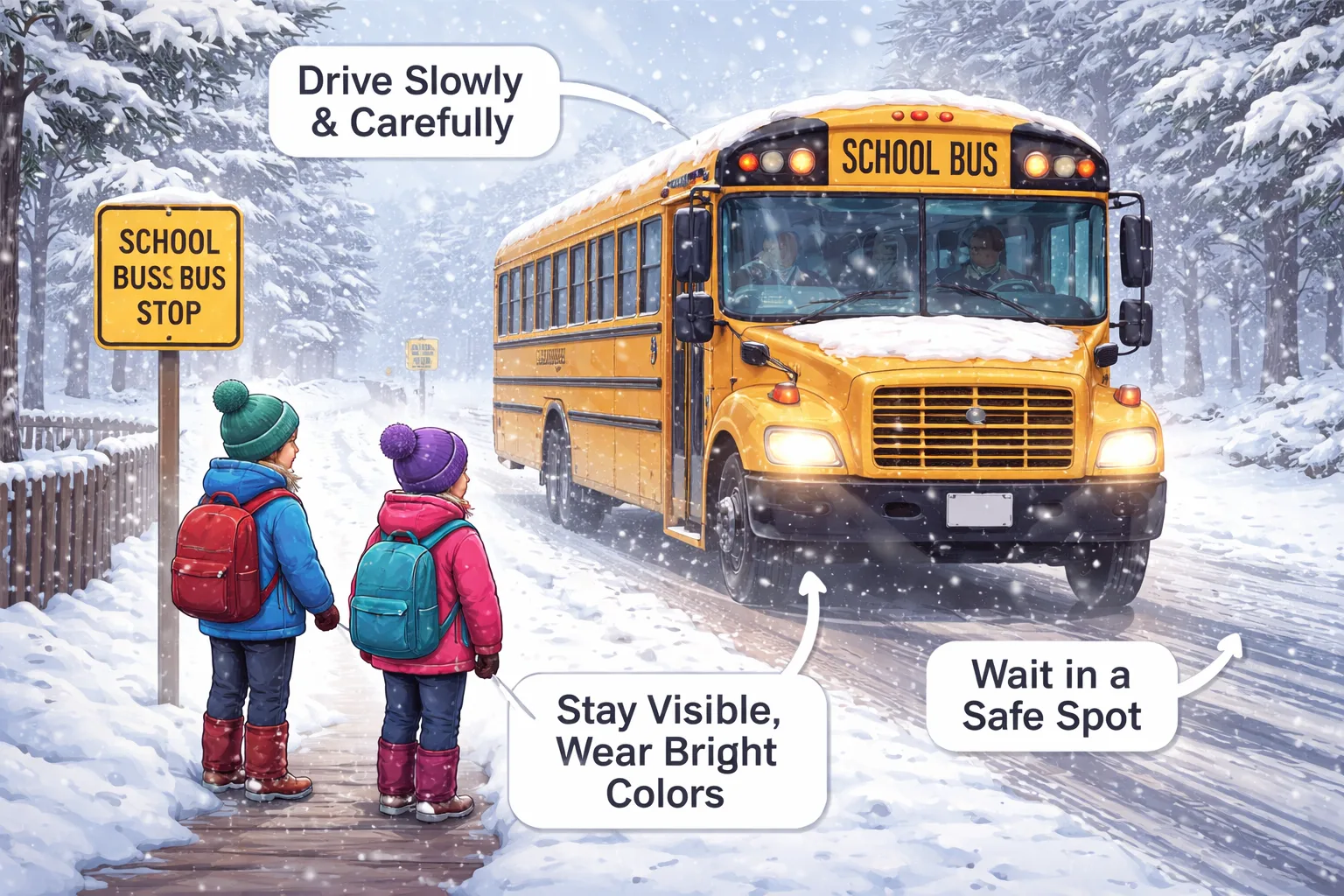
Wet steps and bulky winter coats are a mix. If your child remembers one habit make it this: hand on the rail every step, every time.
Knock the snow off boots before climbing on. Take the steps one at a time even if classmates are pushing forward. Keep backpack straps short so nothing catches on the doors or rails.. Once they are off they should step clear of the school bus right away.
The space within 10 feet of the school bus is often called the danger zone because the driver has a hard time seeing you there. Snow makes it worse. Slush hides patches and plowed banks can hide a small child from passing cars.
When the Bus Is Late
This is the question parents ask most, and it's the one many articles skip. A late bus in a storm is normal. The goal is to have a plan so your child isn't standing in the cold wondering what's going on.
Start by checking the tracking app. If the bus is close and moving, wait indoors until it's nearly there. If there's no app, call the transportation office rather than the school. Dispatch can usually reach the driver and tell you what's happening.
Then set a limit. As a rule of thumb, if it's very cold and the bus is 15 to 20 minutes late, bring your child inside or drive them yourself. Follow your district's own guidance if it has one, and go shorter for young kids.
Whatever you do, don't chase the bus to a different stop. Drive your child straight to school, and let the office know they're on their way.
If Conditions Get Worse After the Bus Leaves
Storms do not always follow the forecast. When things change dispatchers stay in radio or GPS contact with drivers. A route might be shortened students might be kept on board until a guardian can be reached or the school bus might wait at a spot until roads improve.
If a school bus gets stuck the usual advice is for everyone to stay put. The school bus is warm compared to outdoors. It is far easier for other drivers to spot than a child on a snowy road.
Talk about this with your child ahead of time. They should stay seated. Not leave the school bus unless the driver says so. A spare hat and gloves in the backpack are worth having on mild‑looking mornings.. Make sure the school has at least two working emergency contacts because a backup who does not answer is not much of a backup.
What Happens Behind the Scenes
Most parents never see how much work goes into winter bus service. Before the season starts good fleets check heaters, defrosters, wipers, lights, batteries, brakes and tire tread. On storm mornings drivers snow and ice from the roof, windows, mirrors, lights and stop arm and warm the engine so the windshield is clear, before anyone boards.
I think drivers also train for winter. Drivers practice braking, smooth acceleration longer following gaps and what to do if the bus starts to skid. Many buses carry blankets, flashlights, first aid kits and warning triangles for emergencies.
It's fair to ask your district what its winter plan looks like. Good transportation departments are usually glad to explain.
If You Drive Near a School Bus
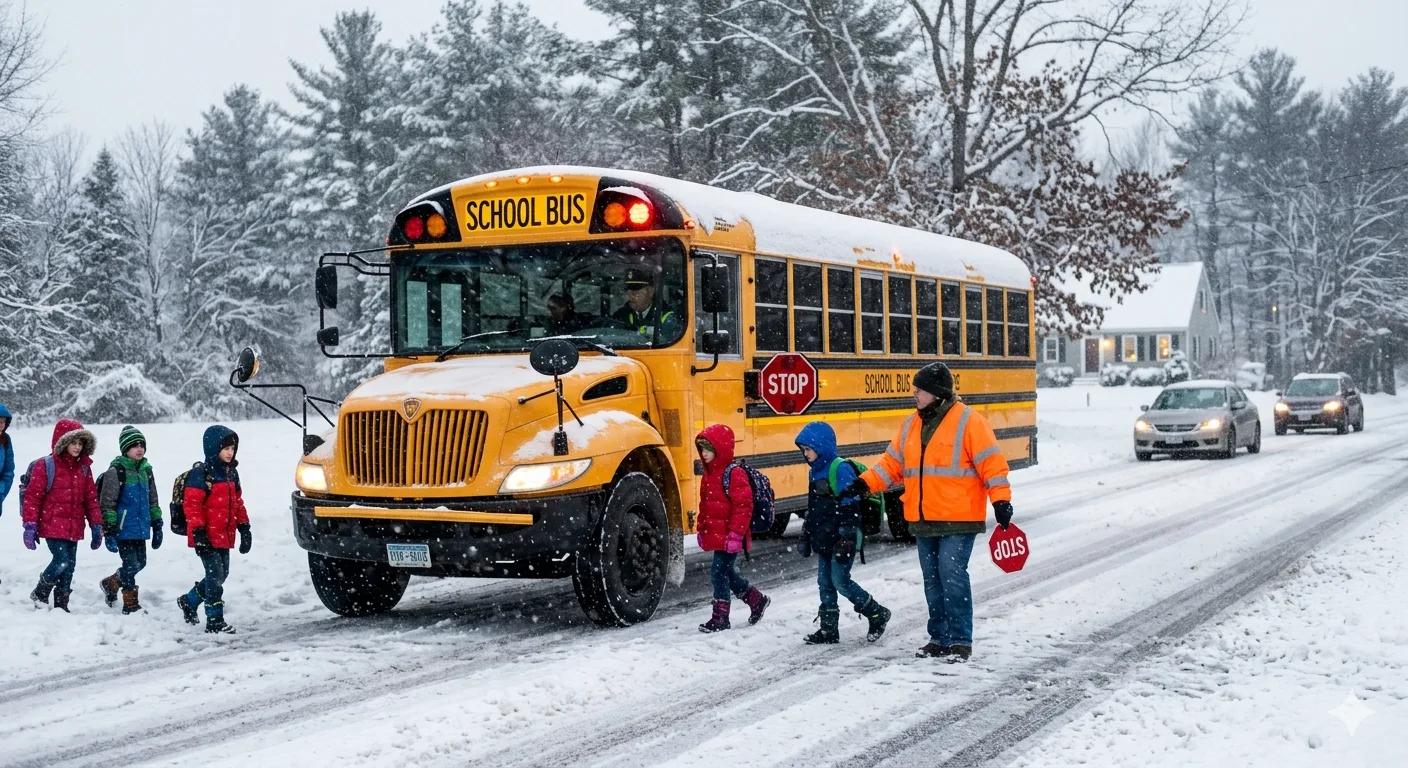
You're part of this too. Never pass a bus with flashing red lights and an extended stop arm. That's illegal across the US and Canada, and in snow it's even more dangerous. Flashing yellow means slow down, not speed up.
I know that leaving more room behind a bus on icy roads is important. A bus may need to stop and your car will need even more space than usual. Slow down near stops and school zones because a child can step out from behind a snow bank without warning.
Tech That Helps in 2026
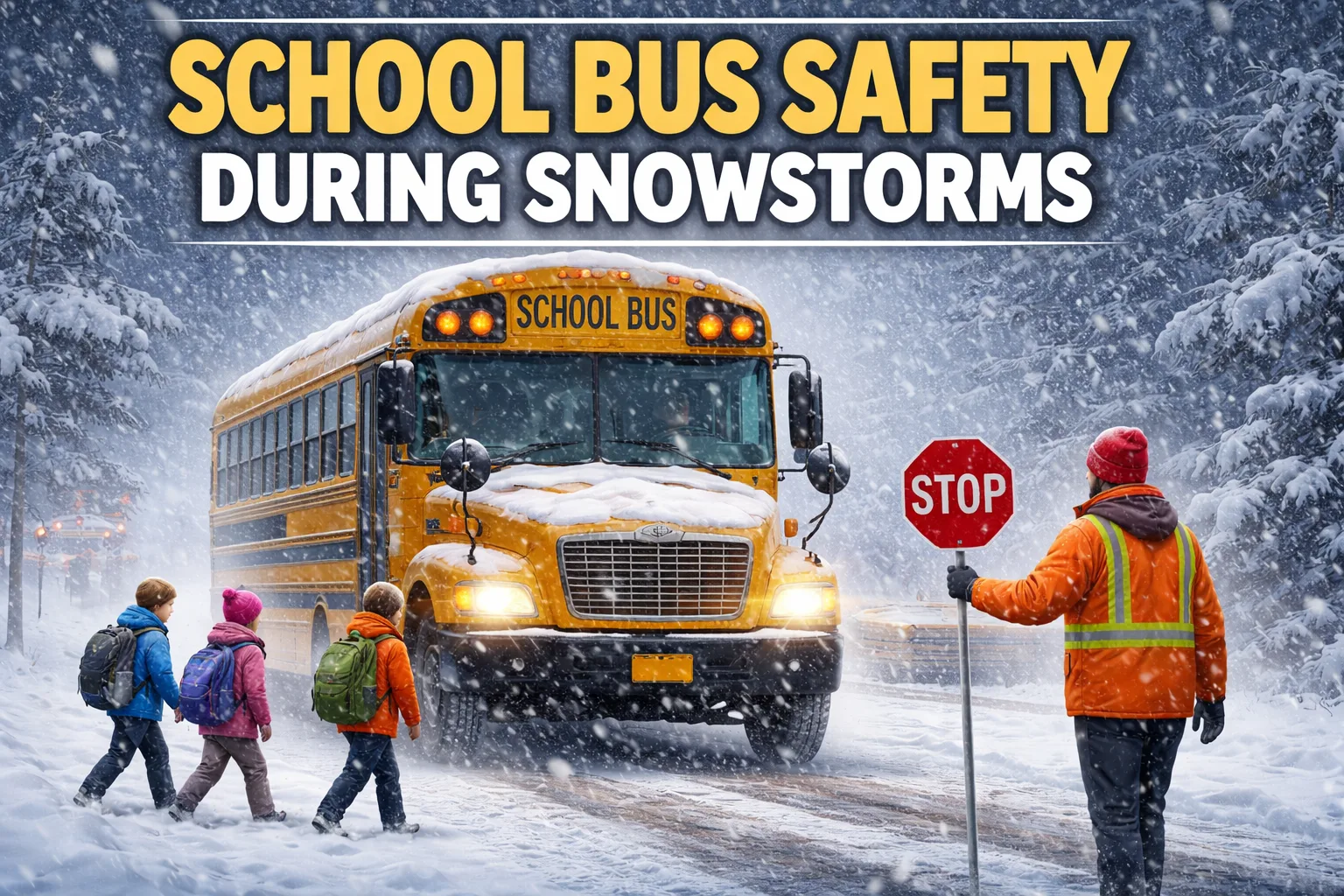
Technology won't replace careful driving, but it takes away some of the guesswork.
Live GPS tracking is the one parents notice most. Many districts offer apps that show where the bus is and when it'll arrive, so your child doesn't wait outside longer than needed. Behind the scenes, telematics lets dispatchers see speed and braking patterns and flag a bus that's going too fast for conditions.
Stop-arm cameras are used in a growing number of places to record drivers who pass illegally. Rules differ by region, and in many places a citation is still reviewed before it's issued. Electric buses are also appearing in more districts, and since cold weather cuts battery range, it's worth asking how your district handles winter operation if yours is switching.
The Worst Mornings Aren't Always the Snowiest
I have seen that freezing rain can glaze roads with any visible accumulation. A light dusting of ice can be riskier than a well-plowed snowfall. So do not judge a morning by how snow you see out the window.
If rain is in the forecast and temperatures hover near freezing our rain delay calculator can help you judge how likely a disruption is.
The same habit works in other seasons. Hot afternoons on a bus are a real concern in early fall and late spring, and our heat index calculator shows how humid heat can feel much more dangerous than the thermometer suggests.
Mistakes Parents Make Without Realizing
Almost everyone makes at least one of these. Assuming a two-hour delay means pickup is exactly two hours later is the big one. Sending kids out early "just in case" is another, and it leaves them standing in the cold. Letting children wait on top of snow piles, relying on a single alert source, and forgetting to update emergency contacts all come up often too.
The most common mistake, though, is treating a closure prediction as an official decision. Predictions help you prepare. They don't replace the school's announcement.
Read More : Snow Day Preparation Checklist
Motorists and School Bus Safety in Winter: What Every Driver Must Know
I have heard that school bus safety during snowstorms is not about buses and students. Passenger vehicle drivers share the road. Their behavior has enormous impact, on bus safety. According to First Student Inc. it is estimated that 70,000 drivers illegally pass a stopped school bus every school day in the U.S. In conditions the consequences of this behavior are potentially catastrophic.
Critical Rules for Motorists in Winter
- Never pass a bus with flashing red lights and the stop arm extended. This is illegal in all 50 U.S. states, regardless of weather conditions.
- Increase following distance to at least 6 seconds when behind a school bus in snowy conditions. Remember, the bus's braking distance may be triple that of your car.
- Watch for children at bus stops. Snow banks can hide children who suddenly step toward the road. Slow down in residential areas and near bus stops.
- Do not rush through a yellow caution phase. A school bus flashing yellow lights is slowing to stop. That is not a signal to accelerate and pass; it is a warning to slow down.
- Adjust your own speed for winter conditions. Slippery conditions mean your vehicle will need more distance to stop even if you are driving carefully.
Emergency Preparedness: What Happens if the Bus Gets Stuck or Breaks Down
Even the best-prepared fleets can face unexpected situations: a bus stuck in a snowdrift, a mechanical failure in sub-zero temperatures, or a road closure that strands students. Knowing what the protocol is and how to respond as a parent is essential.
The Driver's Emergency Protocol
When a bus becomes stuck or disabled during a snowstorm, trained drivers follow a clear protocol:
- Secure the bus in a safe position, apply the emergency brake, and turn on hazard lights and four-way flashers.
- Contact dispatch immediately via radio or cell phone to report the situation and provide GPS coordinates.
- Keep students on the bus. In nearly all emergency scenarios, remaining on the bus is safer than allowing students to exit onto a snowy roadway. The bus provides shelter and visibility to other drivers.
- Use emergency supplies to keep students warm and calm while waiting for assistance.
- Deploy warning devices (road flares or triangles) to alert approaching traffic, if safe to do so.
- Communicate with parents through dispatch once the situation is stabilized.
What Parents Can Do to Prepare for This Scenario
- Make sure your child knows not to exit the bus unless instructed by the driver.
- Ensure your child is dressed warmly enough to wait in a cold bus for up to an hour.
- Keep your phone accessible during bad weather days so you can be reached quickly.
- Have a backup plan for who can collect your child if you are unavailable and the bus is stranded near school.
Your 30-Second Storm Check
Screenshot this and keep it on your phone:
- Official notice: closed, delayed, or running?
- Pickup time: confirmed, not assumed?
- Wind and cold: safe to wait outside?
- Clothing: layered, good boots, something bright?
- Backup plan: who picks up my child if things change?
Final Thoughts: Plan Ahead, Then Stay Flexible
School bus safety during snowstorms isn't about one big thing. It's lots of small, sensible habits: districts preparing buses and drivers, parents preparing kids and routines, and everyone else giving buses extra room.
You can't control the weather. You can control your plan. Check the official notice, confirm the pickup time, dress your child for the real conditions, and keep a backup ready.
If you'd like a head start, try the snow day calculator the night before a storm, then confirm with your district in the morning. And when you want to keep an eye on other weather risks, browse our full collection of weather calculators. Stay warm out there.
Also Checkout :