
If you are searching is school closed tomorrow, the short answer is this: it depends on your district's official call, which usually comes out between 5:00 AM and 6:00 AM the morning of, or the evening before if a storm's timing is already obvious. Until that announcement lands, you can get a strong early read by checking a snow day calculator that factors in your local forecast, temperature, and typical district behavior.
This guide breaks down exactly how schools make the closing decision, how a snow day calculator works behind the scenes, and how to read your odds like a pro before the official text or robocall arrives.
Whether you are a parent trying to line up childcare, a teacher planning tomorrow's lesson, or a student hoping for a surprise day off, understanding the real decision process behind school closures will save you a lot of anxious refreshing tonight.
What Does "Is School Closed Tomorrow" Actually Mean
When people search this phrase, they are usually asking one of three things: will there be a full closure, a delayed start, or an early dismissal. Each outcome is different, and districts often choose between them depending on how a storm is expected to unfold overnight.
- Full closure: No in-person classes for the day, sometimes replaced by a remote learning day.
- Delayed start: School opens one or two hours later so crews have time to treat roads.
- Early dismissal: Classes run as normal but end early, usually because a storm is arriving mid-afternoon.
A snow day calculator can help you estimate which of these is most likely by comparing your forecast against patterns typically used in closure decisions. You can browse tools built for each scenario in the full calculator directory.
There is also a fourth outcome that catches many families off guard: the remote or e-learning day. Instead of canceling instruction entirely, some districts now shift students to virtual lessons for the day, which counts as a full instructional day rather than a missed one. This matters because it changes how the district makes up lost time later in the year, and it means a "closed" school building does not always mean a day off from schoolwork.
Understanding which of these four outcomes your district tends to favor is just as useful as checking the forecast. Some districts almost always default to a full closure during a major storm, while others lean on remote days to protect the academic calendar. Checking your district's past closure pattern, alongside the current forecast, gives you a much sharper read on tomorrow.
How Schools Really Decide to Close
Contrary to popular belief, snowfall totals alone rarely decide the outcome. Districts weigh black ice, snowdrifts, and visibility together with driver safety concerns that go beyond the school bus, since many students also walk to school or ride with parents.
Superintendents describe the call as a genuine balancing act. One Ohio superintendent explained that heating problems and unsafe travel are two of the biggest factors weighed before a closure is announced, and district leaders often admit the decision never gets easier, year after year.
Weather Forecast and Storm Timing
District officials track five-day forecasts closely so a major storm never catches them off guard. Timing matters as much as intensity. A storm that peaks during the morning commute is far more likely to trigger a closure than one that arrives after school lets out.
Most districts hold a call, sometimes with a transportation director, facilities manager, and superintendent all on the line, in the early morning hours before the first bus route begins. During that call, they compare the latest radar and forecast update against what they saw a few hours earlier. If the storm has slowed down or shifted track, a delay can turn into a normal day, and a normal day can turn into a delay, all within a single hour.
This is exactly why a closure decision often is not final until the morning of, even when a forecast the night before looked severe. A snow day calculator that pulls live forecast data can help you track these late shifts instead of relying on a single evening check.
Road and Sidewalk Conditions
Officials evaluate weather forecasts, road conditions, transportation safety, visibility, and temperatures, often consulting local authorities before making a final call. Rural districts with long bus routes and fewer plows tend to close more readily than dense urban districts with faster road treatment.
Extreme Cold and Wind Chill
Cold alone can close schools even when the ground is dry. Districts commonly use wind chill thresholds as a guide. When wind chill drops toward -25°F or lower, frostbite risk at bus stops rises within minutes, which pushes many districts toward a closure or delay.
Wind chill closures often surprise families more than snow closures do, since the sky can look completely clear. A sunny, windless morning can hide a dangerous combination of low temperature and gusty wind that drops the "feels like" reading far below the actual thermometer reading. Districts that serve younger children, especially elementary schools with shorter outdoor wait times built into the schedule, are usually the most cautious about extreme cold thresholds.
Bus Route and Rural Access Issues
Long rural bus routes create a unique challenge that city districts rarely face. A single unplowed country road can strand a bus or delay dozens of students by an hour or more, even if the rest of the district's roads are perfectly clear. Transportation directors often drive test routes before sunrise specifically to check for these isolated trouble spots, and a single bad stretch of road can be enough to tip the entire district toward a delay or closure.
Staffing, Buildings, and Meals
Weather is not the only variable. If too many bus drivers or teachers cannot safely get to work, a district may close even on a lighter snow day. Some administrators also weigh how many students rely on school meals, since a closure can mean missed breakfast and lunch for families who depend on it.
Local Policy and Geography
There is no national rulebook. Closure thresholds vary by region and infrastructure, which is why two nearby districts can see identical weather and still reach different decisions. Southern districts often close for snowfall that a northern district would barely notice, simply because they lack the same plows, salt supply, and driver experience with ice.
Regional habits are worth knowing before you check tomorrow's odds:
- Northeast and Midwest: Districts typically own large plow fleets and salt reserves, so it usually takes heavy accumulation, ice, or a fast-moving storm during the commute to trigger a closure.
- South and mid-Atlantic: Even one or two inches can shut schools down for a day or more, since roads, tires, and driver experience are not built for winter weather.
- Mountain and high-plains regions: Wind chill and blowing snow often matter more than total accumulation, since visibility on open roads can drop to near zero.
- Coastal areas: Freezing rain and ice are usually the bigger concern, since even light ice accumulation makes sidewalks and steps dangerous for walkers.
Because these patterns differ so much by region, checking a state-level breakdown is often more useful than a national snow day statistic. You can see how your state's districts have historically behaved on the state-by-state predictions page.
Key Takeaway: Snow day decisions are made locally, hours before the bell, and depend on far more than how much snow falls. Road safety, wind chill, staffing, and even meal access all factor into the final call.
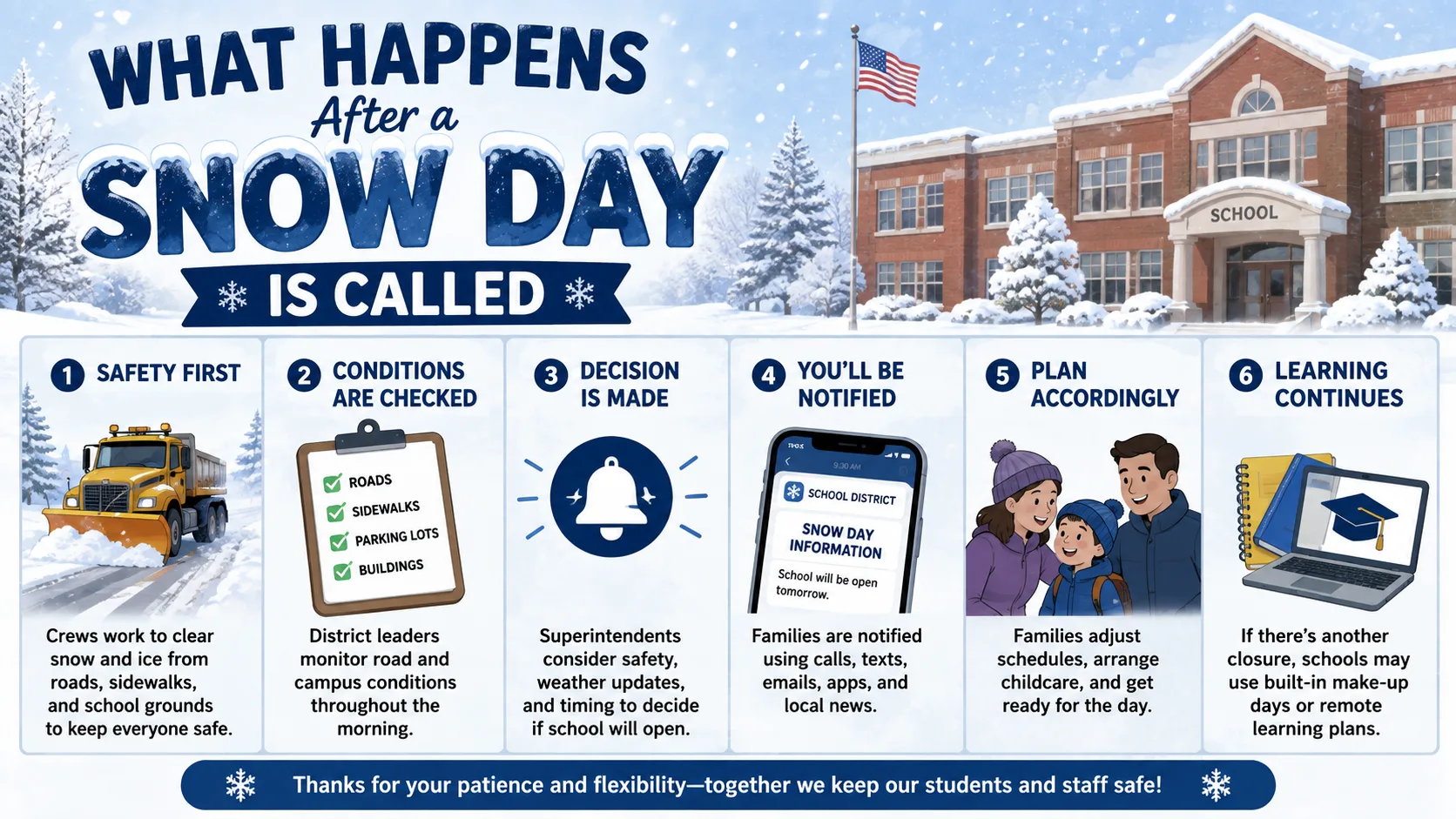
What Happens After a Snow Day Is Called
Once a closure posts, most districts trigger a short chain of follow-up decisions that families rarely see. Knowing what comes next can help you plan beyond just the day off.
Makeup Days and the School Calendar
Many states require districts to make up lost instructional time, either by adding days to the end of the school year, converting a scheduled holiday into a school day, or extending each remaining day by a few minutes. A handful of closures rarely changes much, but a heavy winter can push graduation or summer break back by several days.
Remote Learning Activation
Districts that adopted e-learning days after 2020 often have a short window, sometimes just an hour, to decide whether a snow day becomes a virtual instructional day instead. If your district uses this model, check your school's app or portal shortly after the closure announcement, since assignments may be posted quickly.
Extracurricular and Athletic Impact
A closed building usually means canceled or rescheduled practices, games, and after-school programs as well, even if the weather clears by afternoon. Many districts post separate updates for athletics, so it is worth checking both the general closure notice and any sports-specific communication.
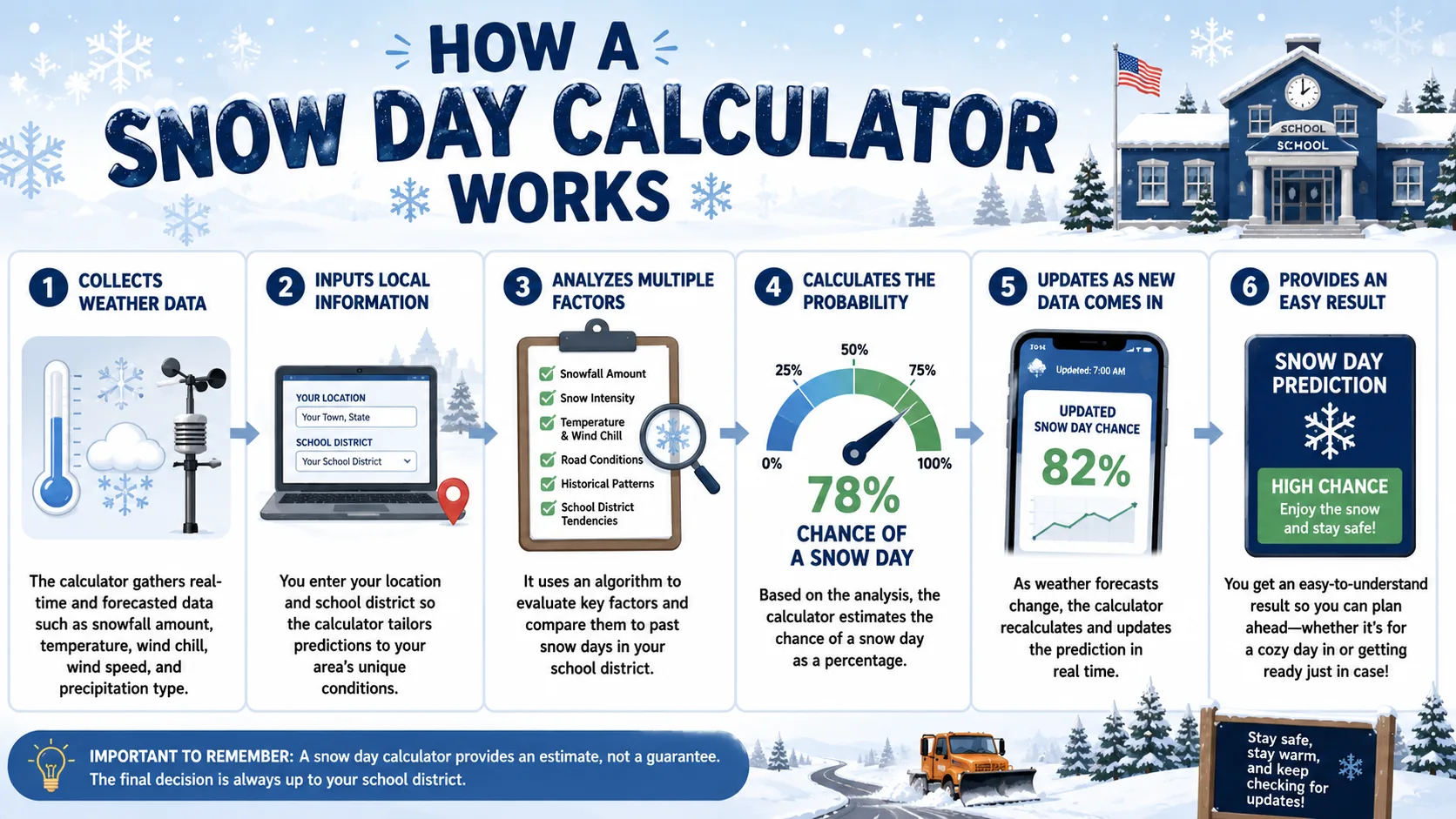
How a Snow Day Calculator Works
A snow day calculator does not predict the future. It estimates probability by scoring the same variables districts actually use, then converting that score into a percentage chance of closure.
The typical scoring logic looks at:
- Predicted snowfall in inches over the relevant window (usually the overnight hours through morning commute)
- Wind chill and air temperature at bus-stop times
- Ice or freezing rain probability, which weighs more heavily than snow alone
- District closure history, since some districts call closures more cautiously than others
- Timing of the storm relative to the morning bell
Each factor is weighted and combined into a single score, which is then translated into a simple percentage, for example a 72% chance of closure. The exact weighting differs by tool, but the underlying formula generally rewards heavier snowfall, colder wind chill, and storms that land squarely on the morning commute.
Step-by-Step: Using the Calculator Tonight
Here is how to get the most accurate read the night before a possible snow day.
- Enter your zip code or select your state so the tool pulls your local forecast rather than a regional average. State-level trends are also broken down on the state-by-state predictions page.
- Check the overnight snowfall and wind chill numbers the tool displays, since these drive most of the score.
- Look at the calculated percentage and treat anything above roughly 60% as a strong sign to prep for a closure or delay.
- Recheck before bed, since forecasts can shift in the final hours before a storm.
- Confirm with your district once the official announcement posts, since the calculator is an estimate, not the final word.
A Real-World Example With Numbers
Say a forecast shows 6 inches of snow arriving between 3:00 AM and 7:00 AM, with a morning wind chill of -18°F, in a district that has closed for similar storms in the past. Here is how that might score out.
| Factor | Forecast Value | Closure Weight |
|---|---|---|
| Snowfall | 6 inches | High |
| Wind chill | -18°F | High |
| Storm timing | 3 AM to 7 AM | High |
| District history | Closes early, historically | Medium |
| Estimated closure odds | — | ~80% |
Compare that to a forecast of 1 inch of snow arriving at 11:00 PM with mild wind chill in a district known for staying open through light snow. That scenario would likely land closer to 15 to 20% on the same scale, since the timing, amount, and district history all point away from a closure.
Benefits of Checking Early
- Better sleep for parents. Knowing the likely odds the night before beats refreshing your phone at 5 AM.
- Smarter childcare planning. A high probability score gives working parents time to line up backup care.
- Fewer wasted commutes. Teachers and staff can plan around a likely delay instead of guessing.
- Realistic expectations. Even a moderate score helps families avoid being blindsided either way.
- Faster meal planning. Families that depend on school breakfast and lunch can prepare backup meals ahead of time instead of scrambling in the morning.
- Less last-minute stress for kids. Students can lay out snow gear or homework the night before instead of a rushed morning switch.
Teachers and school staff use these odds a little differently than parents do. A high probability score can be a signal to finish grading or prep lesson plans early, since a closure the next day often shifts an entire week's schedule. Bus drivers and crossing guards also benefit from an early estimate, since it gives them more notice to plan alternate routes if a delay rather than a full closure ends up being called.
Snow Day Calculator vs. Waiting for the Official Call
| Approach | When You Get an Answer | Accuracy | Best For |
|---|---|---|---|
| Snow day calculator | Anytime, hours in advance | Probability estimate, not final | Early planning, backup care, packing |
| Official district announcement | Usually 5 to 6 AM, sometimes the evening before | Final and authoritative | Confirming the actual decision |
The two are not competitors. A calculator helps you prepare while you wait, and the official announcement is still the one that counts. Many parents check a snow day calculator to estimate closure likelihood before any official announcement, even though these tools are not official sources.
Read More : Snow Day Tracker
Common Mistakes and Pro Tips
Mistakes to Avoid
- Assuming snow totals alone decide the outcome. Wind chill, ice, and timing often matter more.
- Comparing your district to a neighboring one. Policy and infrastructure differ block by block.
- Skipping the official confirmation. A calculator score is a strong hint, never a substitute for your district's actual notice.
- Checking only once. Forecasts, especially overnight ice risk, can shift right up until the morning call.
Pro Tips
- Turn on push notifications from your district's official app so you get the confirmation the moment it posts.
- Check the calculator again right before bed, since late-night forecast updates often move the score.
- If wind chill is the driving factor, expect a delay rather than a full closure more often than not.
- Use the wind chill calculator alongside the snow day tool when extreme cold, not snowfall, is the main concern.
- Keep an eye on your district's history with delays versus closures. Some districts almost always try a delay first and only close if conditions worsen by mid-morning.
- If you commute across district lines for work, check the calculator for both your home district and your workplace's district, since travel conditions between the two can differ sharply.
It also helps to understand what a calculator cannot do. It cannot see a downed power line on your specific street, a black ice patch that formed overnight on one particular hill, or a last-minute staffing shortage at your school. These hyper-local details are exactly why the official district announcement, not the calculator score, always has the final say.
Try It Before You Wait on the Official Call
You do not have to sit by your phone hoping for a 5 AM text. Plug in your zip code now and get an instant probability estimate built from the same factors districts actually weigh. Try the calculator above to see your odds tonight, and check back in the morning once your district posts its official decision.