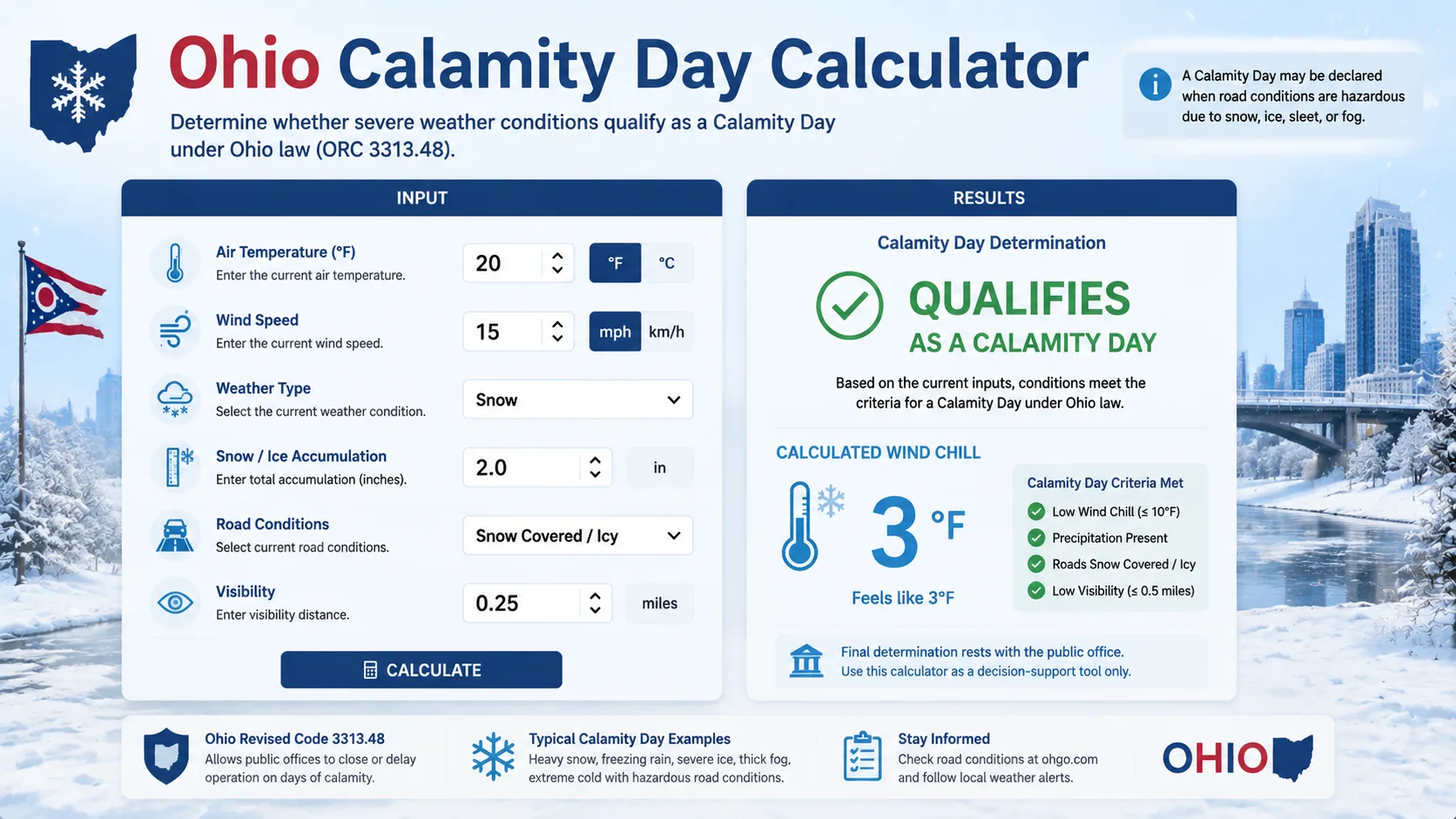
If you're searching for an Ohio calamity day calculator, here's the most important thing to know first: Ohio no longer counts "calamity days" at all. The state scrapped the old day-based system years ago in favor of a minimum instructional hours requirement, so the real question isn't "how many calamity days does my district have left," it's "how many excess hours does my district have before makeup time is required."
This guide walks through exactly how that hours-based system works, the real formula districts use to figure out their buffer, and how you can build your own simple calculator to track it for your kids' school. We'll also cover what the old calamity day system looked like, since a lot of outdated advice online still references it.
What Calamity Days Used to Mean in Ohio
For decades, Ohio law required public schools to hold 180 instructional days per year. Districts were typically allowed to miss a set number of "calamity days," usually weather-related closures, before they were required to make up the lost time by adding days to the calendar.
That allotment changed several times over the years. At one point districts were limited to five calamity days before triggering makeup requirements, and lawmakers periodically passed bills granting extra days during especially harsh winters. A 2013-2014 bill, for example, provided four additional calamity days to districts, but only after they had already made up four of their earlier missed days and formally requested the waiver.
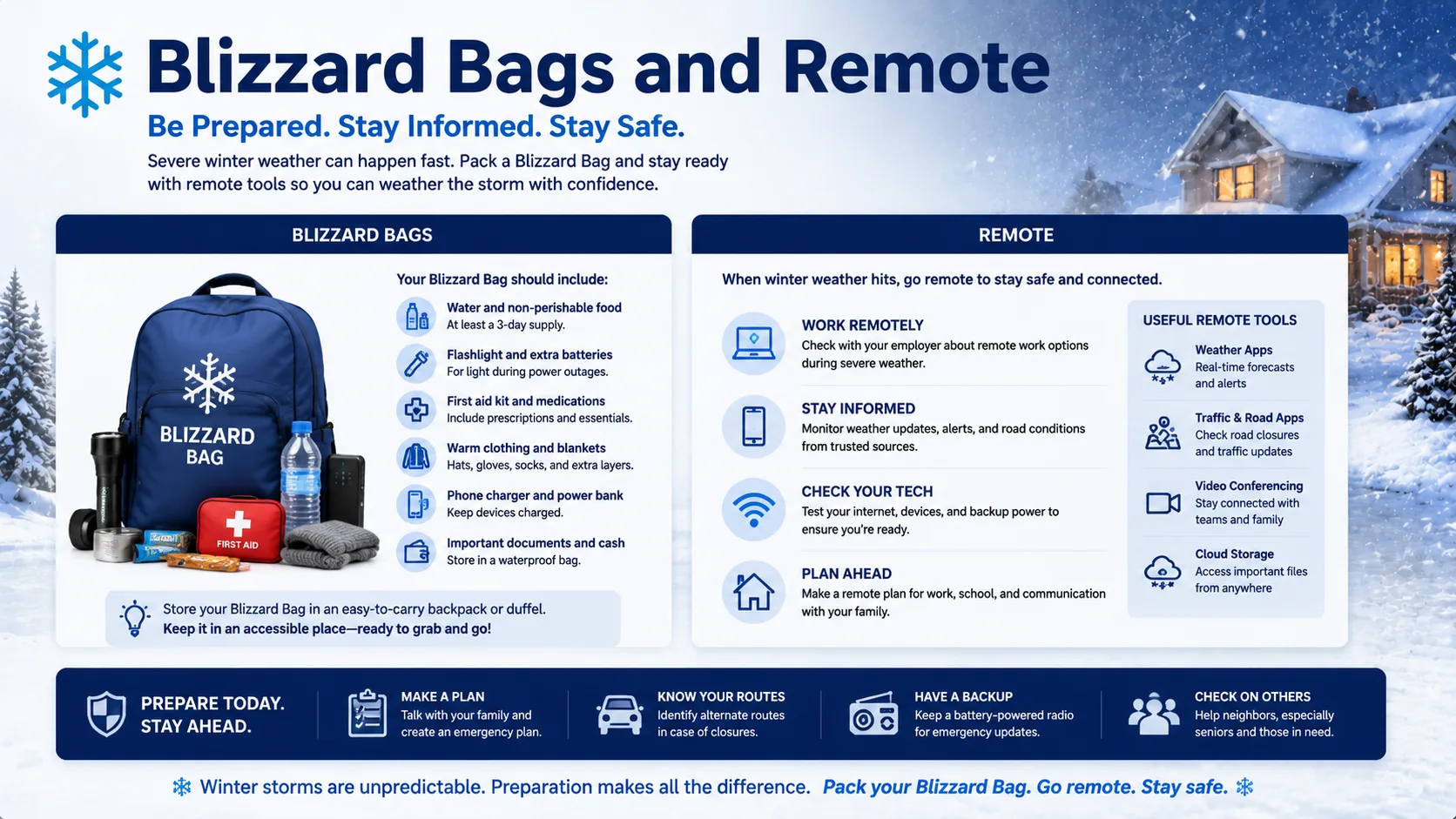
Districts also experimented with "blizzard bags," take-home learning packets that could count toward a limited number of the required makeup days when a snowstorm closed schools too many times in one winter.
The Law Changed: Ohio Moved From Days to Hours
Under current Ohio law, public school districts and community schools no longer operate on a fixed 180-day calendar with a set calamity day allowance. Instead, they must meet a minimum number of instructional hours each school year, and only time when students are actively receiving instruction counts toward that total. Lunch, recess, and unstructured time are excluded.
The Ohio Department of Education and Workforce states it plainly: Ohio districts and schools are now on hour-based schedules, so there are no longer calamity days in Ohio schools, and hours missed above the required minimum do not have to be made up. If a district falls below the minimum, it must extend its scheduled year to make up the difference.
This shift gives districts more flexibility than the old system did. A district that builds extra instructional hours into its calendar, longer school days, more scheduled days than the bare minimum, effectively banks a bigger buffer against winter closures before it ever has to worry about makeup days.
Ohio's Minimum Instructional Hour Requirements by Grade Band
The specific minimums vary by grade level. Here's the current breakdown used by Ohio public schools.
| Grade Level | Minimum Required Hours Per Year |
|---|---|
| Half-day Kindergarten | 455 hours |
| Grades K through 6 | 910 hours |
| Grades 7 through 12 | 1,001 hours |
Districts build their school calendars with some cushion above these minimums. That cushion, the gap between what's actually scheduled and what's legally required, is the real number that determines how many snow days a district can absorb without extending the school year.
So What Is an "Ohio Calamity Day Calculator," Really?
Because Ohio's Department of Education doesn't publish a single statewide calamity day tracking tool for the public, most of what shows up in search results under this term is either outdated information about the old day-based system, or a district's own FAQ page explaining its individual hours budget.
What people actually want when they search this term is a way to answer one practical question: how many more snow days, delays, or early releases can my child's district absorb this year before it has to add time back onto the calendar? That's answerable, but it requires a simple hours-based formula rather than a single number of "days."
The Formula Behind a Real Calamity Day Calculator
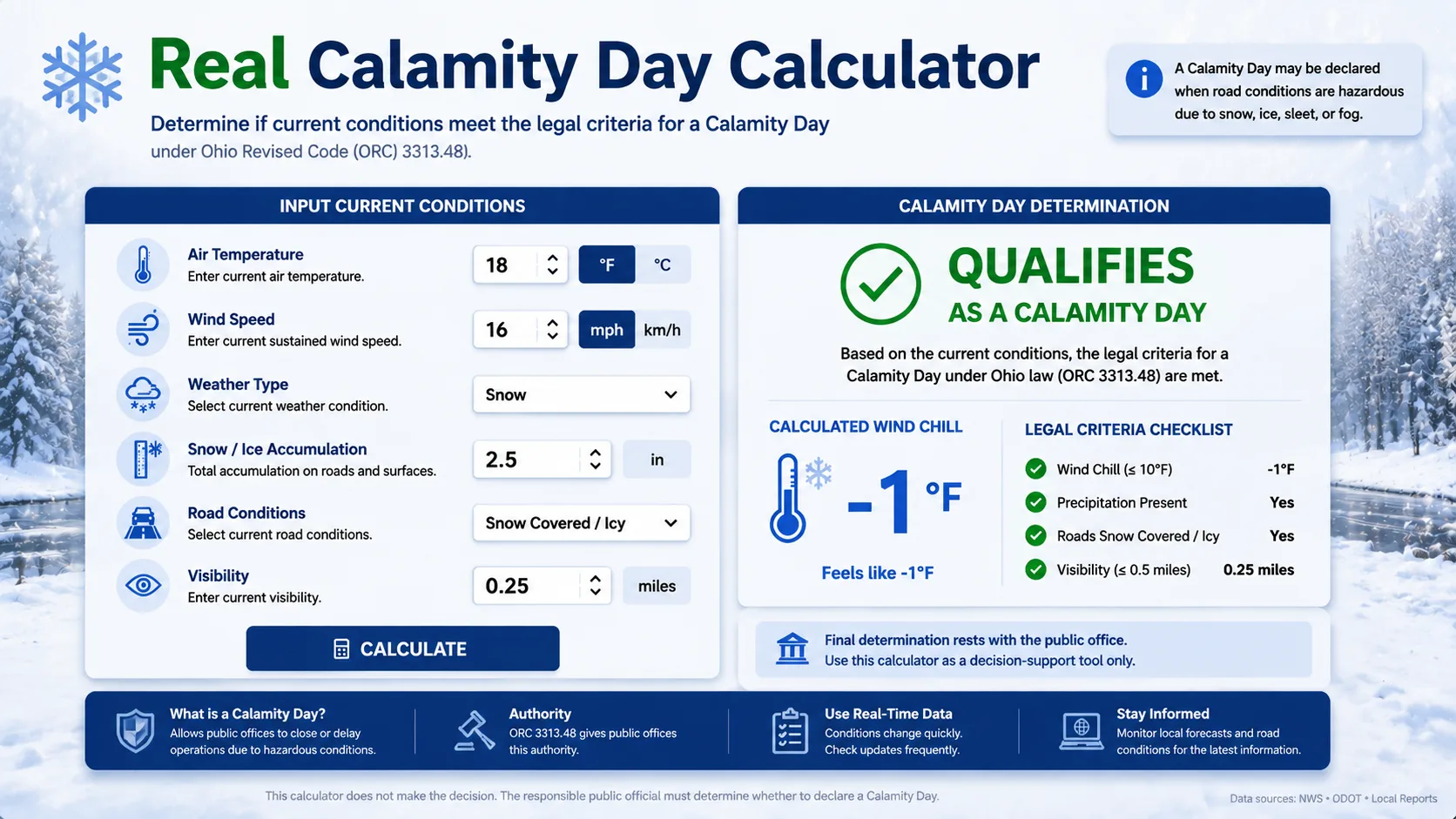
You can build a working calculator for your own district using three numbers: the district's total scheduled hours, the state's minimum required hours, and the hours lost per closure. Here's the core formula.
Excess Hours Available = District's Total Scheduled Hours − State Minimum Required Hours
Once you know your excess hours, you can calculate how many closures that buffer actually covers.
Remaining Closure Buffer (in days) = Excess Hours Available ÷ Average Hours Per School Day
Every time a school closes for a full day, a two-hour delay, or an early release, you subtract those specific hours from the excess balance, not a flat "one day" count, since a two-hour delay uses far fewer hours than a full closure.
Step-by-Step: How to Calculate Your District's Buffer
- Find your district's scheduled instructional hours for the year. This is usually published in the approved school calendar or available from the district office.
- Find your grade band's minimum required hours using Table 1 above.
- Subtract the minimum from the scheduled total to get your excess hours available.
- Track each closure by actual hours lost, not by day. A full closure typically removes 6 to 7 hours; a two-hour delay removes about 2 hours; an early release removes whatever portion of the day was cut.
- Subtract hours lost as the winter progresses to see your running buffer.
- Watch for the zero point. Once the excess hours are used up, any additional closure pushes the district below the state minimum, which legally requires the district to extend the school year.
A Real Example Walkthrough
Some Ohio districts already publish their own numbers this way, which makes a great real-world example. One central Ohio district explains it to parents like this: high school students can be out of school for calamity-related closures for up to 187 hours, the equivalent of about 28 school days, before makeup time is required, while middle school students can miss up to 158 hours, or about 24 days.
Let's build a simplified version of that same calculation for a hypothetical secondary school.
| Item | Value |
|---|---|
| District's scheduled instructional hours | 1,150 hours |
| State minimum required hours (grades 7-12) | 1,001 hours |
| Excess hours available | 149 hours |
| Average school day length | 6.5 hours |
| Approximate closure buffer | Roughly 22 to 23 full closure days |
Now imagine that district uses six full closure days (about 39 hours) and two two-hour delays (about 4 hours) during a rough January. That's 43 hours used, leaving roughly 106 excess hours, or about 16 more full closure days, before makeup time would legally be required.
What Happens If a District Runs Out of Excess Hours
If closures push a district below its required minimum hours, the district must extend its scheduled year to make up the shortfall. This can look different depending on the district's approach:
- Adding days to the end of the school year, the traditional approach that used to be common under the old day-based system
- Adding minutes to each remaining school day for the rest of the year to recover lost hours without extending the calendar
- Using approved remote learning or blizzard-bag-style days, where students complete structured instruction at home, provided the district meets state requirements for the hours to count
- Removing planned professional development or non-instructional days and converting them to instructional time
As one Northeast Ohio superintendent described the process during a rough winter stretch, once a district burns through its excess time, it has to work with staff and employee unions to decide whether to add days at the end of the year or add time earlier, and try to communicate the plan to families as early as possible.
Read More : School Bus Safety in Snow
Do Blizzard Bags and Remote Learning Days Still Count?
Yes, with conditions. Ohio has continued to allow districts to use remote learning days as a substitute for lost instructional time, but the district must actually deliver structured instruction and meet attendance requirements on those days for the hours to count toward the minimum. Simply sending home a packet without structured accountability doesn't automatically satisfy the requirement.
Common Misconceptions About Ohio Calamity Days
- "Ohio schools get five calamity days a year." Outdated. That was the old day-based system; there's no fixed day allotment anymore.
- "Every district has the same buffer." False. Buffer size depends entirely on how many excess hours a specific district builds into its own calendar.
- "A two-hour delay counts as a full calamity day." No. Delays and early releases only subtract the actual hours missed, not a full day's worth.
- "There's an official state calamity day calculator parents can check." Not currently. The Ohio Department of Education publishes the hour requirements and general guidance, but tracking a specific district's real-time buffer is typically handled at the district level.
Why Ohio Made the Switch From Days to Hours
The old day-based system created a rigid problem: a district could deliver plenty of instructional time on paper, full days, extended hours, and still be forced to add extra days at the end of the year simply because it hit its day count, regardless of actual instructional minutes delivered. Districts had little flexibility beyond tacking days onto June, often pushing the school year deep into summer after a rough winter.
The hours-based model was designed to reflect how schools actually operate and to give districts local control over how they structure their calendars. It also reduces the odds of an extended school year purely because of a hard day-count trigger, since a district that schedules extra hours throughout the year builds in its own natural cushion.
Conclusion
There's no official Ohio calamity day calculator because Ohio doesn't count calamity days anymore, it counts instructional hours. The real number that matters is the gap between what your district schedules and the state's minimum requirement, a buffer you can track yourself using the formula in this guide. Once you know your district's scheduled hours and grade-level minimum, tracking your family's realistic snow day buffer is simple arithmetic, not guesswork.
Also Checkout :