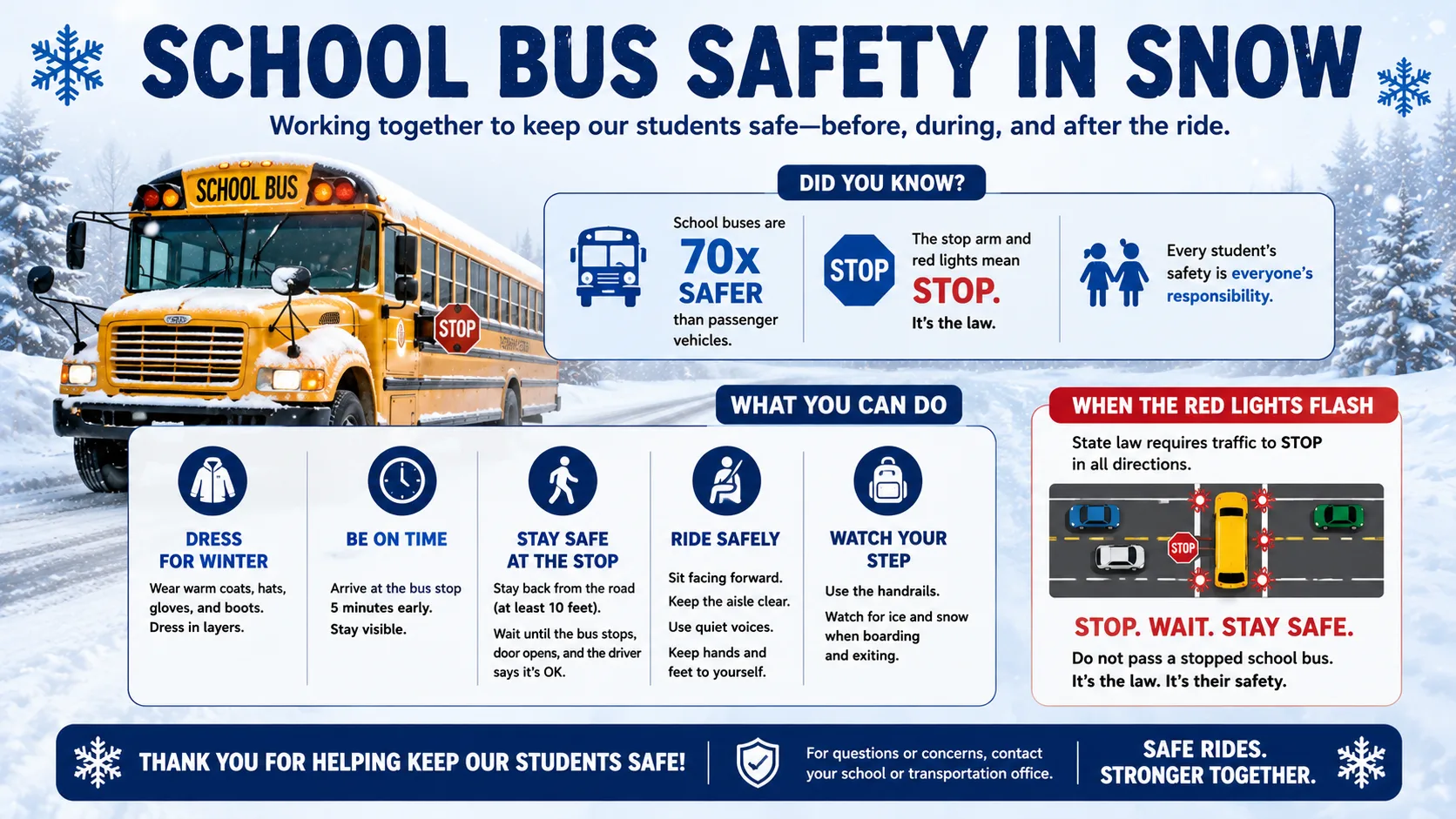
School bus safety in snow comes down to three things: longer stopping distances for the bus itself, reduced visibility around the vehicle, and a "danger zone" that becomes far more hazardous once snowbanks and darkness are added to the mix. Snow doesn't just make roads slippery. It hides children behind plowed piles, delays reaction time for every driver on the road, and turns a routine pickup into the riskiest few seconds of a child's school day.
This guide covers what actually changes when snow enters the picture, what bus drivers are trained to do differently, what other motorists need to watch for, and exactly how parents and kids should behave at a snowy bus stop. We'll also walk through the real crash statistics behind these rules, not just generic advice.
Why Snow Changes the Risk Equation for School Buses
A school bus is already one of the heaviest, longest vehicles on most residential streets. Add snow or ice, and two things happen at once: the bus needs far more room to stop, and the people around it, especially small children, become harder to see.
School buses are the safest way for kids to get to school, and less than 1% of all annual traffic fatalities involve children on school transportation vehicles. But that safety record depends heavily on drivers, motorists, and families all following winter-specific precautions. Most of the danger isn't inside the bus. It's in the seconds before boarding and after stepping off.
The Numbers: School Bus Safety Statistics You Should Know
Understanding why winter procedures matter starts with the data. Here's what national crash reporting shows about school bus safety overall.
| Statistic | Figure |
|---|---|
| School bus-related deaths nationwide, 2024 | 110 (down 14% from 128 in 2023) |
| Share of deaths who were occupants of other vehicles (2015–2024) | About 71% |
| Share of deaths who were pedestrians (2015–2024) | About 15% |
| Share of deaths who were school bus passengers | About 6% |
| Average school-age pedestrians killed near buses each year | Roughly 30 |
| Age group most affected among pedestrian deaths | Nearly half are ages 5 to 7 |
Two patterns stand out. First, most fatalities involve people outside the bus, not the children riding in it. Second, young children in the 5 to 7 age range are disproportionately represented in pedestrian deaths, largely because they're small, unpredictable, and easily hidden from a driver's sightline. Snow makes both problems worse, since it slows every vehicle's stopping ability and physically blocks visibility with drifts and plowed banks.
Understanding the School Bus "Danger Zone"
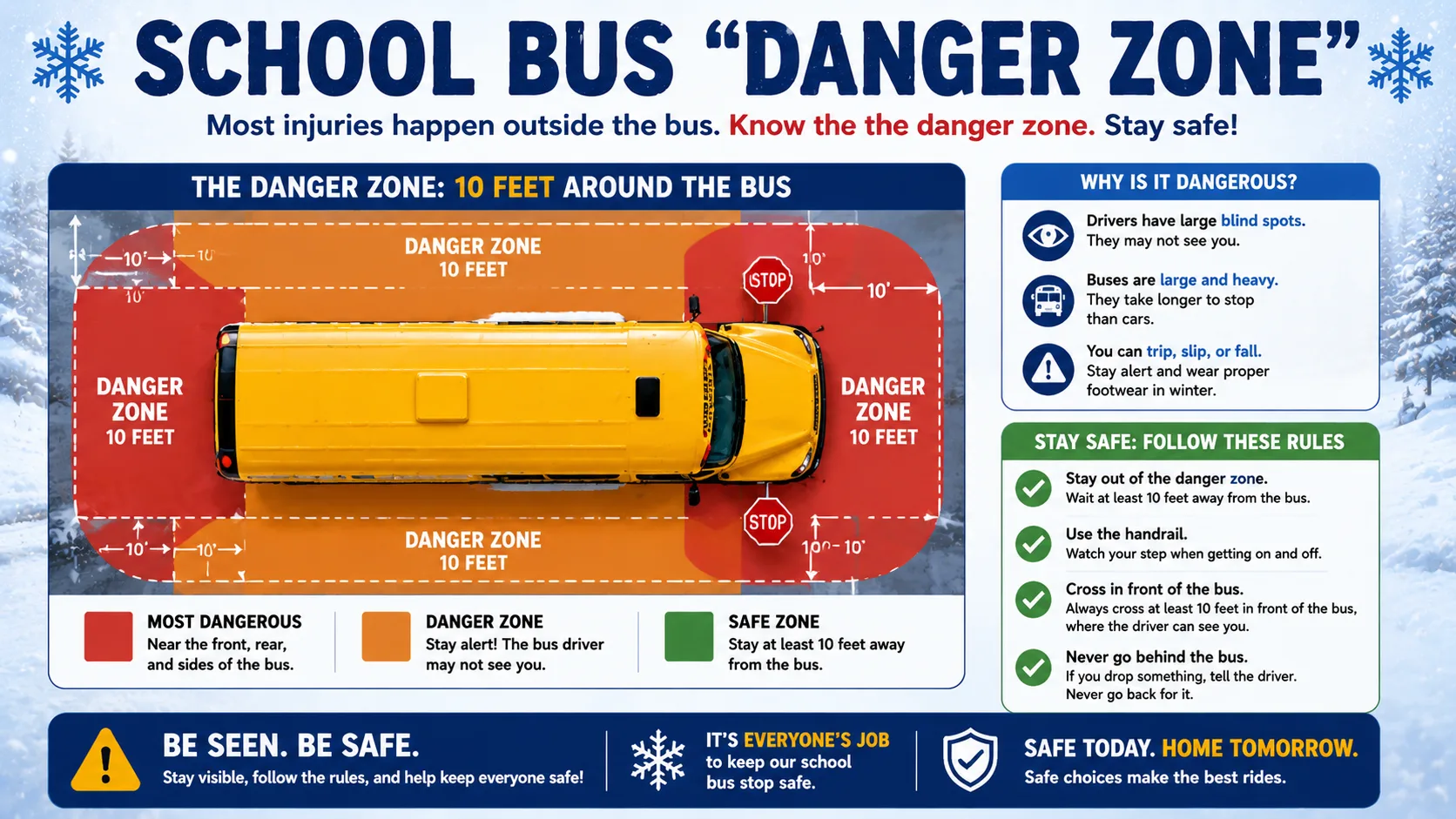
The danger zone is the area immediately surrounding a school bus where a driver's visibility is limited or blocked entirely. It's defined as roughly 10 feet in front of the bus, 10 feet on each side, and the area directly behind it. Children inside this zone may be completely invisible to the driver, even though the driver is looking directly at the mirrors.
Most children hit near buses are struck within this zone, either by the bus itself or by a passing vehicle that failed to stop. That's why national guidance consistently repeats the same core instruction: stand at least five giant steps, about 10 feet, back from the curb while waiting, and never walk behind the bus at any time.
How Snow Makes the Danger Zone Even More Dangerous
- Snowbanks block sightlines. Plowed piles at the curb can hide a small child from both the bus driver and passing motorists until the last second.
- Kids hurry more in the cold. Children rushing to get out of the cold and onto a warm bus are more likely to dart across the danger zone without pausing to check for traffic.
- Early darkness reduces visibility. Shorter winter daylight hours mean many afternoon and some morning routes happen in low light or full darkness.
- Snow glare and windshield fog can reduce a driver's ability to spot a child's silhouette against a white background.
For Bus Drivers: Winter Driving Rules That Actually Matter
Professional pupil transportation programs train drivers around a simple framework often called the Six S's of school bus safety: space, speed, starts, stops, steering, and sight. In snow, every one of these needs adjustment.
1. Increase Following Distance
Under normal conditions, drivers are trained to keep a four-second cushion behind the vehicle ahead. In winter conditions, that gap should stretch to five or six seconds, and some transportation safety programs recommend planning for up to three times the normal braking distance on icy roads.
2. Reduce Speed Below the Posted Limit
The Federal Motor Carrier Safety Administration (FMCSA) recommends that drivers cut their speed by about one-third on wet roads and by half or more on snow-packed or icy roads. The posted speed limit assumes dry pavement, not winter conditions, so it's rarely the safest speed to actually drive on a snowy morning.
3. Brake and Accelerate Gently
Sudden acceleration is one of the most common causes of skids on snow and ice. Drivers are trained to apply the accelerator gradually and to begin braking earlier than usual, both to avoid loss of control and to give other drivers advance warning of an upcoming stop.
4. Know How to Recover From a Skid
In a front-wheel skid, the bus tends to continue in a straight line no matter how the wheel is turned. The correct response is to stop turning and ease off the accelerator rather than fighting the wheel. If the rear of the bus starts to slide sideways, drivers are trained to steer gently into the direction of the skid while taking their foot off the gas.
5. Complete a Full Pre-Trip Inspection
Before every winter route, drivers should check:
- Windows, mirrors, headlights, and the stop-arm are completely clear of snow and ice
- Wiper blades and washer fluid are in good condition
- Defrosters and heaters are functioning properly
- Tire tread and pressure meet winter safety standards
- Fuel levels are topped up in case of delays or detours
6. Watch for Black Ice
Black ice is a thin, nearly invisible layer that looks like ordinary wet pavement. It typically forms first on bridges, overpasses, and shaded sections of road. Drivers are trained to treat any suspiciously glossy patch of road as ice, even when the rest of the route looks clear.
For Motorists: How to Drive Safely Around School Buses in Snow
Everyone sharing the road with a school bus, not just the driver, plays a role in winter safety. Because buses are significantly heavier than passenger vehicles, they simply cannot stop as quickly, and drivers around them need to account for that.
- Give buses extra room. Stay farther back than you would in dry conditions to allow for the bus's longer stopping distance.
- Always stop for flashing lights and the stop-arm, and never attempt to pass a stopped bus, even if you think you have time.
- Watch for children near snowbanks. A child can appear from behind a plowed pile with almost no warning.
- Slow down earlier than usual when approaching a bus stop, since braking distances on snow and ice can be dramatically longer than on dry pavement.
- Turn on headlights during snowfall or early darkness, even if visibility still feels adequate, so both the bus driver and children can see you coming.
| Road Condition | Recommended Following Distance | Speed Adjustment |
|---|---|---|
| Dry pavement | 4 seconds | Posted speed limit |
| Wet pavement | 4–5 seconds | Reduce speed by about 1/3 |
| Snow-packed roads | 5–6 seconds | Reduce speed by 1/2 or more |
| Icy roads / black ice risk | 6+ seconds, up to 3x normal braking distance | Well below posted limit; gentle inputs only |
For Parents and Students: Bus Stop Safety in Winter
Most of the riskiest moments happen before a child even steps onto the bus. A few consistent habits make a measurable difference.
At the Bus Stop
- Arrive at least five minutes early. Running for a bus in snow or ice is one of the easiest ways to slip or misjudge traffic.
- Stand at least 10 feet back from the curb, and further back if snowbanks reduce the usable sidewalk space.
- Wear bright or reflective clothing. Dark winter coats can blend into early-morning darkness and snowy backgrounds.
- Avoid playing in snow piles near the road while waiting, since it's easy to lose track of traffic while distracted.
Boarding and Exiting
- Wait for the bus to come to a complete stop and for the driver's signal before approaching.
- Use handrails when climbing steps that may be wet, icy, or packed with snow and slush.
- Never walk behind the bus. If crossing in front is necessary, walk to a point at least 10 feet (five giant steps) ahead of the bus, make eye contact with the driver, and only then cross.
- If something is dropped near the bus, such as a mitten or a phone, tell the driver rather than reaching for it near the wheels.
Read More : How Ontario School Boards Decide Snow Days
Common Mistakes That Increase Risk in Winter
- Assuming a stopped bus can be passed quickly. Stop-arm violations remain a leading cause of pedestrian deaths near buses, and snow only extends the danger window.
- Letting kids wait in the roadway because a snowbank has swallowed the sidewalk. Move the waiting area, don't skip the setback distance.
- Dressing for warmth instead of visibility. Warm and reflective aren't mutually exclusive; look for coats and backpacks with reflective strips.
- Underestimating stopping distance as a driver following a bus, especially on the first snowfall of the season when tires and roads are least prepared.
- Skipping the pre-trip inspection on a "light" snow day. Visibility and traction problems don't require a major storm to become dangerous.
What School Districts and Transportation Teams Do Behind the Scenes
Winter readiness isn't just a driver's responsibility. Transportation departments typically prepare in several coordinated ways before and during snow season:
- Running full mechanical inspections across the fleet, checking brakes, tires, heaters, and defrosters
- Providing drivers with additional winter-specific training, often including skid-recovery practice
- Coordinating with municipal road crews so routes near schools and bus stops are plowed and salted early
- Adjusting start times or dismissal times on storm days to avoid the worst of a commute window
- Identifying and avoiding known problem areas, like unplowed rural roads or steep hills, even if it lengthens a route
As one national pupil transportation safety team put it, keeping students safe around winter weather and school buses takes cooperation from everyone on the road, not just the transportation department. That single point, shared responsibility, is really the core message behind every winter bus safety rule.
Conclusion
School bus safety in snow isn't a single rule, it's a layered system involving drivers, motorists, parents, and kids all doing their part at the same time. Drivers slow down and lengthen their following distance. Motorists give buses extra room and always stop for the flashing lights. Parents and students respect the 10-foot danger zone and dress to be seen. None of these steps are complicated on their own, but together they explain why school buses remain one of the safest ways for children to get to school, even in the middle of winter.
Also Checkout :