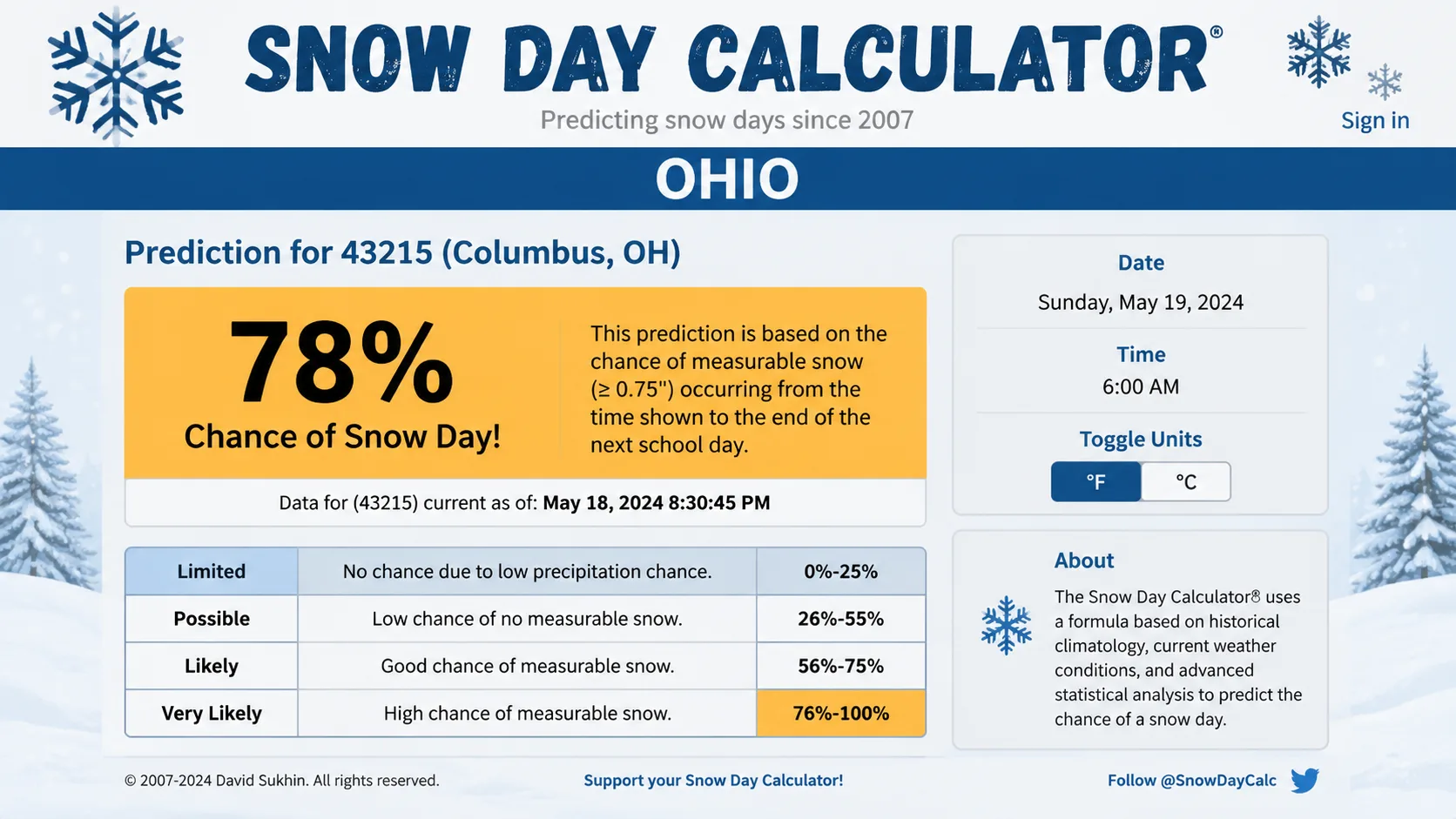
Every Ohio parent has been there: it's 10 p.m., a winter storm is rolling in, and you need to know whether to set two alarms or one. That is exactly the problem the Snow Day Calculator for Ohio was built to solve. But there is a second, equally important question most families never think about until it is too late: what happens to those lost school hours? That is where calamity days come in, and Ohio's rules around them have changed significantly in recent years.
This complete 2026 guide covers both topics in depth. You will learn how Ohio's snow day prediction tool works, how schools decide to cancel classes, and how the state's switch from a day-based to an hour-based school calendar changed everything about how calamity days are counted and made up.
Ohio no longer has a fixed number of "calamity days." Under the current hour-based system, districts schedule buffer hours above the state minimum. As long as they stay above that minimum, missed days do not have to be made up at all. Only when a district dips below the required hours does a makeup obligation kick in.
❄️What Is the Snow Day Calculator for Ohio?
A Snow Day Calculator for Ohio is an online prediction tool that estimates the probability your child's school will close due to winter weather. You enter your ZIP code or city, and the tool pulls real-time weather data to generate a closure probability ranging from 0 to 100 percent.
The original Snow Day Calculator was created by a student at MIT and gained national popularity for its surprisingly accurate predictions. Modern versions have evolved well beyond that foundation, using artificial intelligence and machine learning to analyze weather patterns and district-specific closure histories together.
For Ohio families specifically, these tools matter more than in most states because Ohio's weather is notoriously variable. Northeast Ohio, for example, sits in the Great Lakes snowbelt where lake-effect snow can dump a foot of snow on one district while a neighboring town sees barely an inch. A ZIP-code-level prediction is far more useful than a regional forecast in these cases.
🔬How Does the Snow Day Calculator Work?
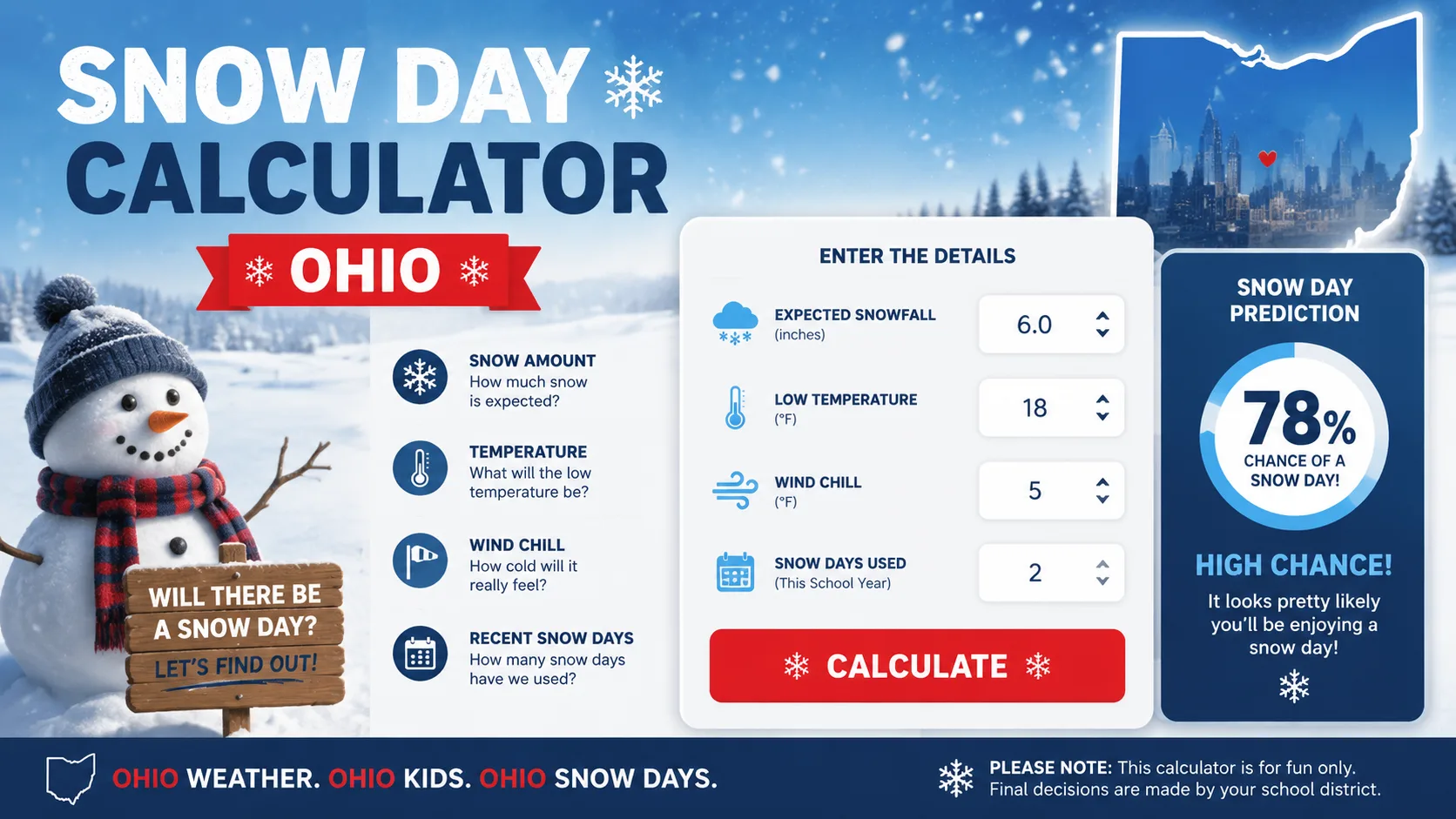
The calculator is not simply reading a weather forecast and making a guess. Modern tools analyze seven key weather variables and cross-reference them against years of historical school closure decisions in your specific district. Here is how the process breaks down.
The 7 Factors Every Snow Day Calculator Analyzes
| Factor | Why It Matters | High-Risk Threshold (Ohio) |
|---|---|---|
| Snowfall accumulation | Total inches expected overnight and morning | 3+ inches in Northeast OH; 1+ inch in Southern OH |
| Precipitation rate | Inches per hour; plows cannot keep up at 2+ in/hr | Above 1 inch per hour |
| Wind chill temperature | Feels-like temperature for waiting students | Below 0°F wind chill |
| Ice accumulation | Freezing rain creates more closures than snow alone | Any measurable ice on roads |
| Storm timing | Snow at 2 a.m. vs. noon affects the decision entirely | Peak snow between midnight and 7 a.m. |
| Road conditions | Bus route safety is paramount for superintendents | ODOT Level 2 or Level 3 advisories |
| District history | Some Ohio districts are conservative; others push through | Based on 10+ years of closure data per ZIP |
The algorithm does not treat all of these factors equally. Research from multiple snow day prediction services shows that ice accumulation and storm timing are weighted most heavily, because a superintendent is far more likely to cancel school for overnight ice than for daytime snow that road crews can address before buses roll.
The Prediction Formula
While exact formulas vary by tool, the underlying logic of every reputable snow day calculator follows a weighted probability model. Here is a simplified representation:
The key insight here is the regional adjustment factor. A district in Cleveland's snowbelt may need 8 inches before closing, while a district near Cincinnati may close for 2 inches because its road maintenance infrastructure and driver experience are calibrated for much lower snowfall averages.
📍How to Use the Ohio Snow Day Calculator: Step-by-Step
Using the tool is straightforward, but knowing what to do with the result makes all the difference. Follow these steps to get the most accurate prediction for your Ohio school district.
- Enter your ZIP code or city name. Always use your ZIP code rather than a city name for the most hyperlocal forecast. Two ZIP codes in the same county can receive dramatically different snowfall amounts, especially in the lake-effect corridor near Cleveland, Akron, or Youngstown.
- Select school type if prompted. Public K-12 schools in Ohio have different closure thresholds than private schools or universities. Public elementary schools tend to close earliest because bus safety for younger children is weighted most heavily.
- Check the prediction the evening before, then again at 4:30 a.m. Forecasts change rapidly as storms develop. A prediction checked the night before and another checked at 4:30 a.m. will together give you a much better picture than a single reading. Most Ohio districts make their official cancellation decision between 4 a.m. and 5:30 a.m.
- Read the breakdown, not just the percentage. A good snow day calculator will show you which factors drove the prediction. If ice is the primary driver, a 60% probability is much more meaningful than a 60% driven only by moderate snow accumulation.
- Cross-check with your district's official channels. The calculator predicts. Your superintendent decides. Always verify using your district's automated phone system, official website, local TV stations (WEWS, WJW, WDTN, WCMH, WKRC), or the Ohio School Closure system.
🏫What Are Calamity Days in Ohio? (The Full Explanation)
The term "calamity day" has been part of Ohio school culture for decades, but its legal meaning has changed dramatically. Understanding the current rules will help you know exactly what happens when your child's school closes repeatedly throughout a winter.
The Old System: Days-Based Calendar
Under Ohio's previous law, public schools were required to be open for a minimum of 182 days per school year. Within that framework, districts were allowed up to five calamity days per year, meaning five days of closure due to hazardous weather or comparable emergencies that did not need to be made up. Beyond five closures, the school year had to be extended.
The New System: Hours-Based Calendar
Ohio shifted to an hour-based minimum and, as a direct result, formally eliminated the concept of calamity days as a fixed number. Here is what the law now requires, according to the Ohio Department of Education and Workforce:
| Grade Level | Minimum Annual Hours Required | Equivalent School Days (approx.) |
|---|---|---|
| Half-day Kindergarten | 455 hours | ~91 days |
| Full-day Kindergarten through Grade 6 | 910 hours | ~182 days |
| Grades 7 through 12 | 1,001 hours | ~167 days |
What This Means in Plain Language
Suppose your district schedules 1,100 instructional hours for high school students (1,001 is the minimum required). That means the district has built in a 99-hour buffer, roughly equivalent to 16 or 17 school days' worth of cushion. If the district uses 10 of those days for winter closures, no makeup is required because students still received more than the minimum 1,001 hours.
Only if closures eat through the entire buffer and push the district below 1,001 hours does the district become legally required to schedule makeup days or extend the school year.
📊How Districts Decide to Cancel Classes in Ohio
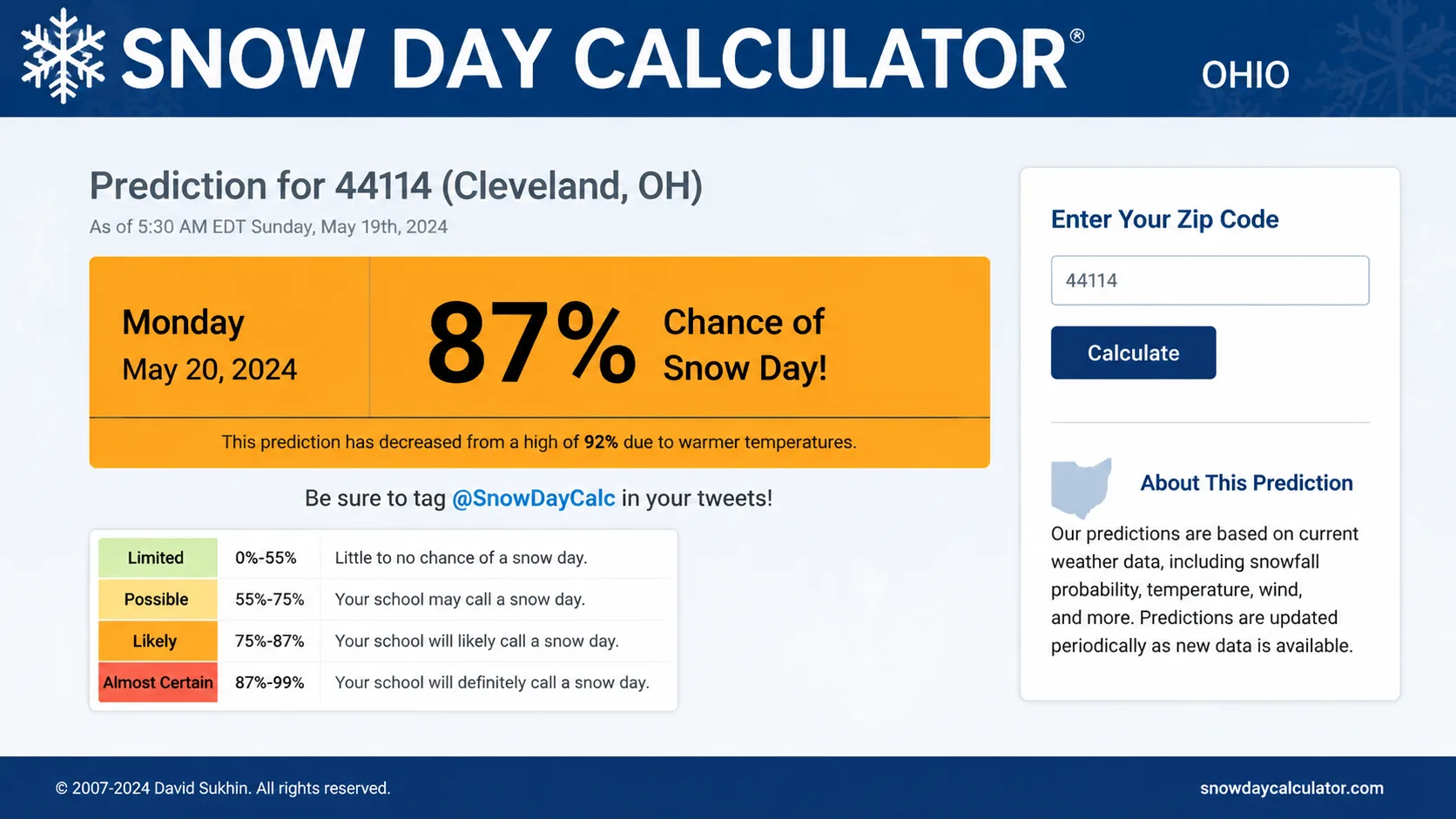
The snow day calculator makes a prediction. The superintendent makes the decision. Understanding the human decision-making process helps you appreciate both why the tool is usually right and why it is occasionally wrong.
The Ohio Superintendent's Morning Protocol
- 2:00 a.m. Road crew assessment begins. Maintenance teams begin clearing parking lots and driveways at school buildings. Road crews for larger districts cover 100+ square miles of bus route territory.
- 2:00 a.m. to 4:00 a.m. Bus route survey. Administrative staff or dedicated road teams physically drive bus routes to assess pavement conditions. This is not based on weather forecasts alone; it is a real-world road check.
- 4:00 a.m. to 4:30 a.m. Analysis and consultation. The superintendent reviews road survey results alongside weather forecasts, temperature readings, and ODOT road condition reports. Many districts check whether neighboring districts are canceling, as this can signal widespread road hazards.
- By 5:30 a.m. Official decision announced. The vast majority of Ohio districts aim to announce closures, delays, or normal operation by 5:30 a.m. so families have time to make childcare arrangements before the normal school start time.
Factors Beyond Just Snow Accumulation
- Wind chill below 0°F: Even without precipitation, extreme wind chill can trigger a closure to protect students waiting at bus stops.
- Freezing rain over snow: Ice consistently drives more closures than heavy snow because it creates unpredictable road surfaces that road crews cannot reliably treat before buses roll.
- Power outages at school buildings: If HVAC systems fail overnight due to storm damage, a building may be deemed unsafe regardless of road conditions.
- Forecast uncertainty: A well-designed snow day calculator accounts for forecast confidence levels. A low-confidence 4-inch forecast is treated differently than a high-confidence 4-inch forecast.
Ohio School Closure Trigger Factors by Impact Weight
Data synthesized from Ohio superintendent surveys and snow day algorithm transparency reports (2025-26). Higher weight = more likely to trigger a closure decision.
📅Blizzard Bags and E-Learning Days: Ohio's Modern Snow Day Alternative
Many Ohio districts have adopted "blizzard bags" or online learning alternatives as a strategy to avoid losing instructional hours entirely on snow days. This innovation is important to understand because it changes the snow day experience for students.
What Is a Blizzard Bag?
A blizzard bag is a pre-assembled packet of educational assignments that students complete at home on a snow day. When a district designates a closure day as an "online learning day" or "blizzard bag day," it does not count against the district's instructional hour buffer because students are technically receiving instruction even though school is canceled.
How Ohio Districts Use E-Learning Days
- Districts must have a board-approved e-learning or blizzard bag plan in place before the school year begins in order to count those days as instructional hours.
- The Ohio Department of Education requires that these plans describe how students will access assignments, how teachers will be available, and how attendance will be documented.
- Most districts that use this system limit e-learning designations to a specific number of days per year (commonly three to five days) to prevent overuse.
- Days beyond those approved e-learning designations revert to non-instructional closures that draw from the district's hour buffer.
Check your district's school year calendar in August or September. It will tell you exactly how many instructional hours are scheduled, how many e-learning days are pre-approved, and what your district's closure notification procedures are. This information is public and typically posted on the district website.
🌡️Real-Life Ohio Snow Day Scenarios with Examples
Abstract rules are hard to remember. Here are three concrete examples that illustrate how Ohio's calamity day system works in practice.
Example 1: Northeast Ohio Lake-Effect Storm (Chardon, Ohio)
Scenario: A lake-effect band stalls over Geauga County. Chardon schools receive 14 inches of snow between 2 a.m. and 8 a.m. The district cancels school.
Snow Day Calculator prediction the night before: 94% chance of closure.
Calamity day impact: Chardon's district calendar is built with 980 scheduled instructional hours for grades 7-12 (minimum required: 1,001). Wait, that is already below minimum. Chardon would instead schedule 1,080 hours, providing a 79-hour buffer. Fourteen closures at roughly 5.5 hours per day would consume 77 hours, leaving just 2 buffer hours remaining before makeup obligations begin.
Takeaway: In heavy snowbelt districts, a severe winter can exhaust the buffer and trigger extended school years.
Example 2: Central Ohio Freezing Rain (Columbus City Schools)
Scenario: A narrow band of freezing rain falls overnight across Franklin County. Total accumulation is only 0.2 inches of ice. Morning temperature is 28°F.
Snow Day Calculator prediction: 78% closure probability despite low precipitation, because ice consistently weighs heavier than snow in the algorithm.
Actual result: Columbus City Schools cancels classes. The decision is driven by ODOT Level 2 (Residents urged to stay off roads) road condition designations on major bus corridors.
Example 3: Southern Ohio Moderate Snow (Dayton area)
Scenario: Three inches of snow falls with temperatures around 30°F. Roads are treatable. Dayton area districts experienced this type of event six times the prior winter with mixed cancellation decisions.
Snow Day Calculator prediction: 45% closure probability. The tool reflects the district's historical pattern of pushing through moderate accumulations when road temperatures are above 28°F and treatment is effective.
Actual result: Two-hour delay. The calculator may show a separate probability for delays vs. full closures in advanced versions.
Read More : Winter Weather Guide
✅Benefits of Using an Ohio Snow Day Calculator
- Plan ahead: Parents can arrange childcare or work-from-home logistics the evening before rather than scrambling at 5:45 a.m.
- Reduce morning anxiety: A high probability alert the night before signals families to prepare. A low probability signals a normal morning routine.
- Understand your district: Over a full winter season, the tool helps families understand how conservative or aggressive their district is with closure decisions, which has practical planning value.
- Track patterns: Some tools let you see multi-day forecasts, flagging potential closure windows three to five days out so parents can plan extended childcare in advance.
- More accurate than gut feeling: Short-term snow day predictions from modern calculators achieve 85 to 92% accuracy in the 24-48 hour window before a weather event.
⚠️Common Mistakes Parents Make with Snow Day Predictions
- Checking only once the night before: Forecasts shift significantly overnight. A 40% probability at 9 p.m. can become 85% by 4 a.m. as a storm intensifies. Always check again at 4:30 a.m.
- Using city-level forecasts for ZIP-code decisions: "Cleveland gets 6 inches" may mean your specific suburb gets 2 or 12. Always use your ZIP code.
- Confusing the calculator's prediction with an official announcement: The calculator predicts. Your superintendent decides. A 95% prediction is not a cancellation. It is a strong signal to prepare. Watch your district's official channels.
- Ignoring delays: A two-hour delay has different childcare implications than a full closure. Many calculators show both probabilities separately. Failing to notice the delay probability leads to unnecessary early morning chaos.
- Assuming neighboring districts predict yours: District A canceling does not mean District B will. Each district makes its own call based on its specific road network, board policies, and hour buffer situation.
🔔How to Get Ohio School Closing Notifications
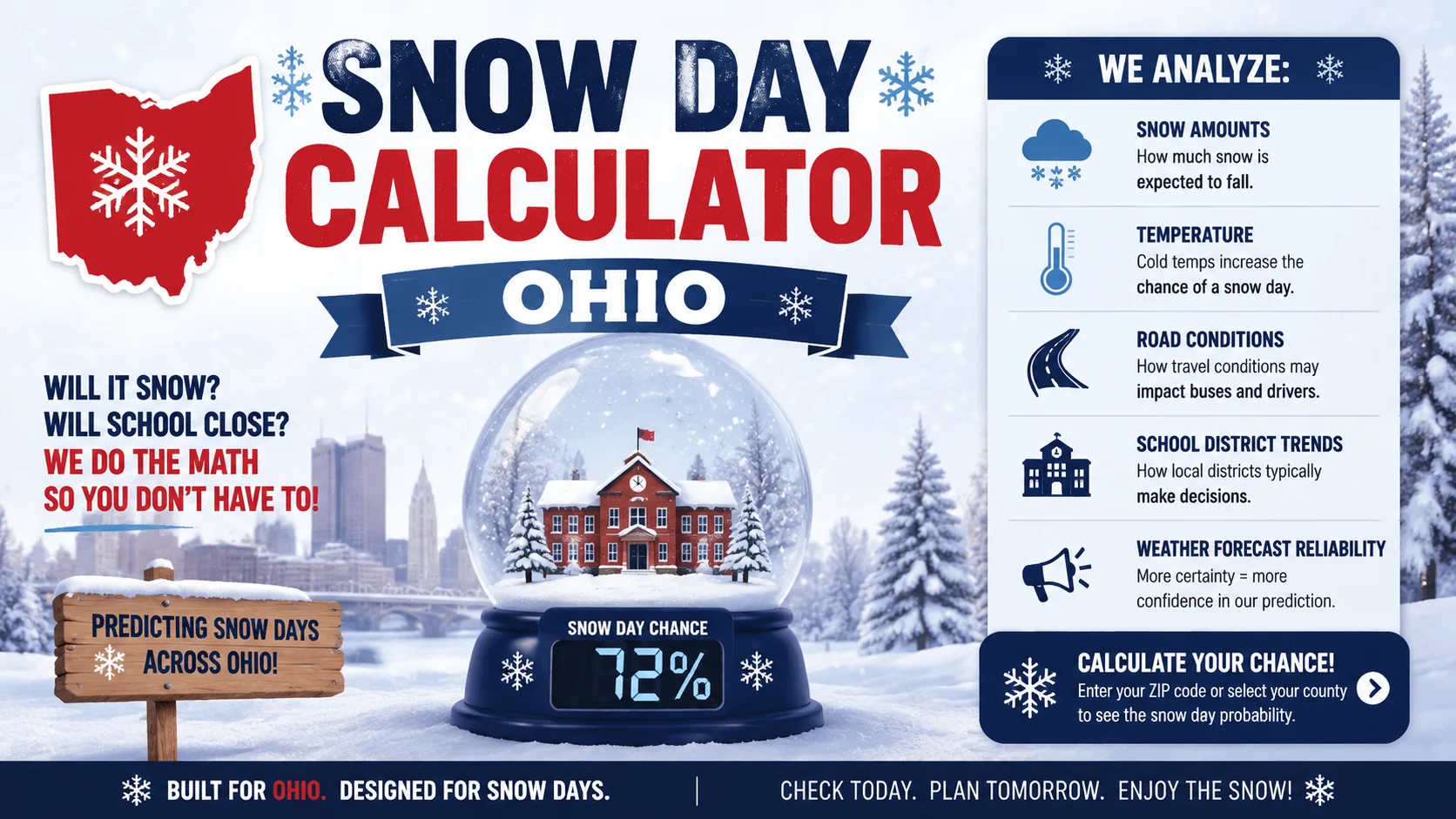
Beyond the snow day calculator, Ohio families have several reliable official notification channels.
| Channel | How to Access | Speed |
|---|---|---|
| District automated call/text | Register in your district's parent portal (PowerSchool, Infinite Campus, etc.) | Fastest: 4:30-5:30 a.m. |
| District website | Bookmark your district's homepage; most post a banner on closure days | Fast |
| Local TV stations | WEWS (Cleveland), WJW Fox 8, WCMH (Columbus), WHIO (Dayton), WKBN (Youngstown) | By 6 a.m. broadcast |
| SchoolMessenger / Remind app | Many Ohio districts use these third-party platforms; enroll at the start of school year | Fast |
| NOAA Weather Radio | Battery-powered radio receiver; broadcasts official alerts 24/7 | Real-time |
🎯Conclusion
The Snow Day Calculator for Ohio is one of the most practical winter weather tools available to families, combining real-time National Weather Service data with AI-driven analysis of district-specific closure patterns to deliver predictions accurate 85 to 92 percent of the time in the 24-48 hour window before a storm.
At the same time, understanding Ohio's calamity day system gives parents a complete picture of the situation. Ohio's shift from a day-based to an hour-based school year means that most districts have built in a meaningful buffer of excess instructional hours. This lets them absorb typical Ohio winter closures without triggering makeup obligations. Only in severe winters, or in snowbelt districts with limited buffers, do students face extended school years.
Use the calculator every time a winter storm threatens. Understand your district's hour buffer before the season starts. And always verify any prediction against your district's official communication channels before making the childcare call.
Also Checkout :