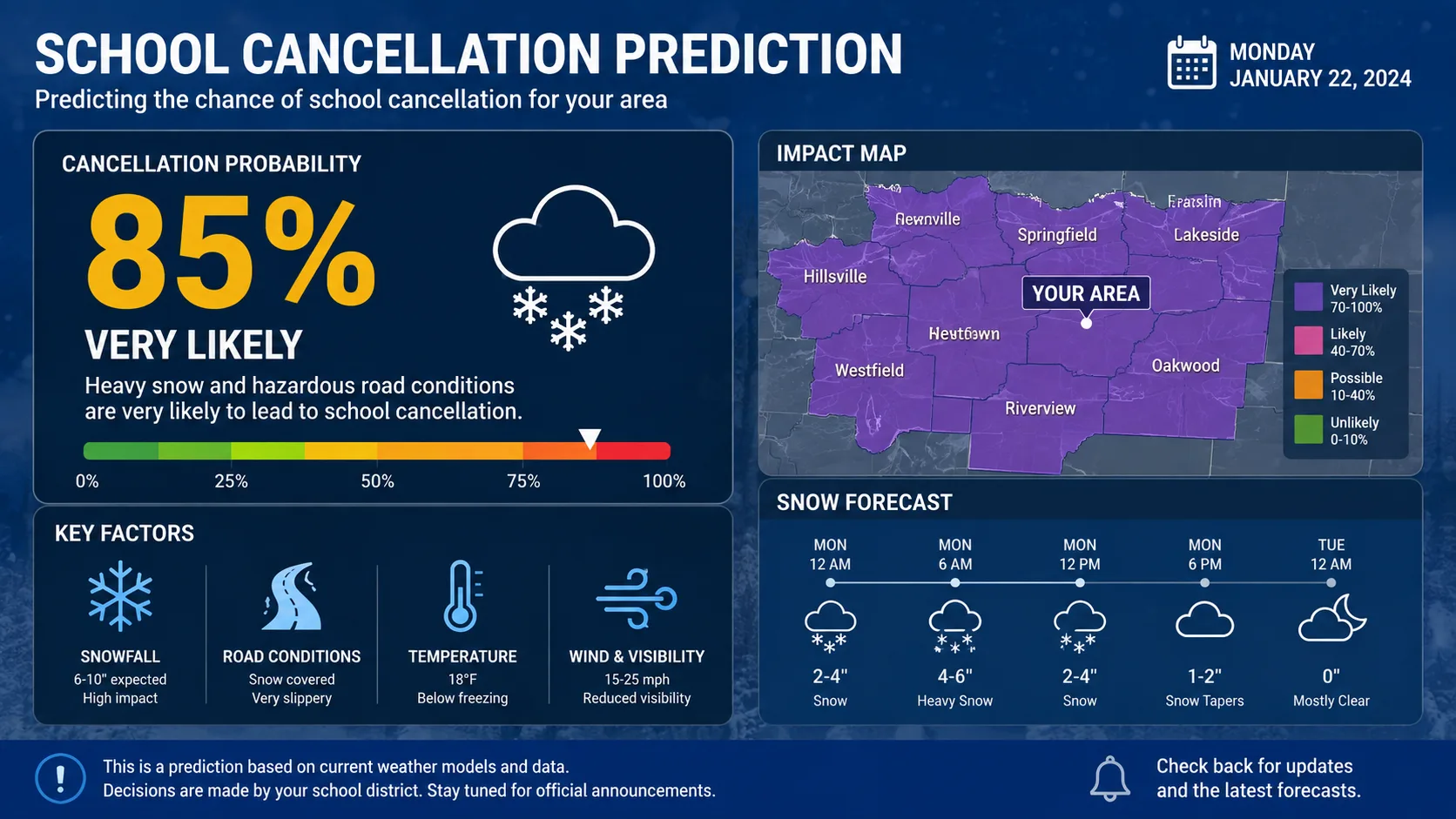
What Is School Cancellation Prediction
School cancellation prediction is the process of estimating whether a school district will close, delay, or hold classes as normal because of weather conditions like snow, ice, extreme cold, or flooding. It combines local weather forecasts, road condition data, and historical district behavior to produce a probability, rather than a guess.
Parents, students, and teachers use school cancellation prediction tools to plan mornings ahead of time instead of waiting for a 5 a.m. phone alert. A good prediction tool looks at more than just snowfall totals. It weighs temperature, wind chill, timing of the storm, and how a specific district has responded to similar conditions in the past.
You can try this yourself with the snow day calculator, which pulls current forecast data and compares it against a district's closure history to generate a same day estimate.
How Does School Cancellation Prediction Work
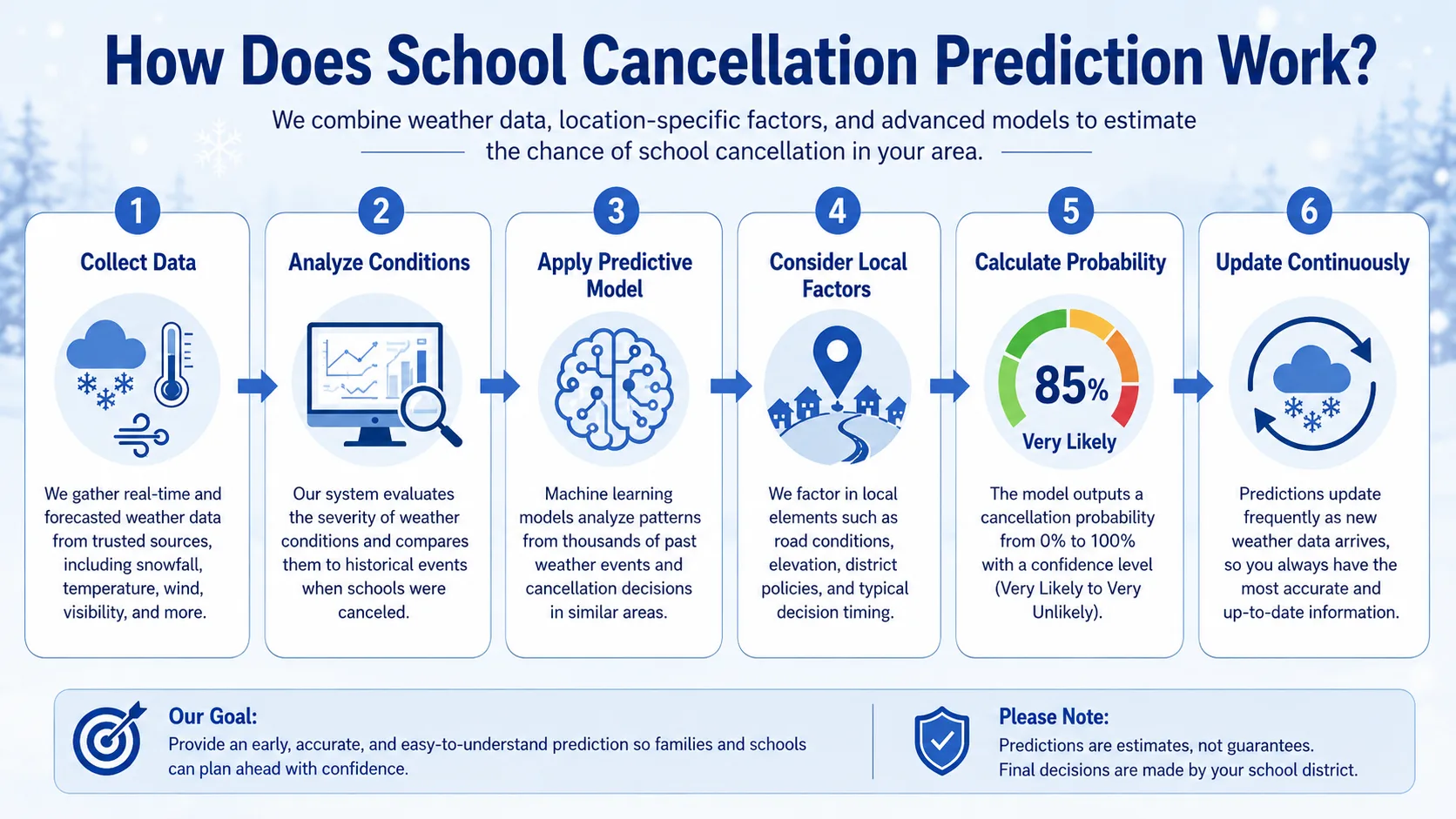
At a basic level, school cancellation prediction works by scoring several weather and logistics factors, then combining those scores into a single probability. Here are the core inputs most tools rely on:
- Snowfall accumulation expected before and during school hours
- Ice accumulation, which is often weighted more heavily than snow because of how dangerous it is for buses
- Wind chill and temperature, since extreme cold alone can trigger closures
- Timing of the storm, because a storm that peaks during the morning commute is riskier than one that clears overnight
- Road treatment capacity in the district, which varies a lot between rural and urban areas
- District closure history, since some districts close early and often while others rarely cancel
Each factor gets weighted differently depending on the region. A half inch of snow might close schools in a warm climate district with no salt trucks, while the same half inch barely registers in a district that handles heavy snow every winter.
The Formula and Calculation Logic
Most snow day calculators use a version of a weighted risk score. A simplified version looks like this:
Closure Risk Score = (Snowfall Weight × Snow Inches) + (Ice Weight × Ice Inches) + (Wind Chill Weight × Wind Chill Severity) + (Timing Weight × Storm Overlap With Commute) − (District Preparedness Score)
The resulting score is translated into a percentage. A score above roughly 80 percent usually means a full closure is likely. A score between 50 and 79 percent often points to a two hour delay. Anything below 50 percent typically means schools will run on a normal schedule.
Step by Step Guide to Using a Snow Day Calculator
Here is how to get an accurate school cancellation prediction in under two minutes:
- Select your state and district. Closure patterns differ widely by region, so start at the state by state predictions page to find your local district.
- Enter or confirm the forecast window. Most tools auto-pull the next 12 to 24 hours of weather data for your ZIP code.
- Review the risk score. Look at the percentage and the plain language summary (closed, delayed, or open).
- Check secondary conditions. If wind chill or ice is a factor, use a companion tool like the wind chill calculator to see how dangerous the temperature drop actually is.
- Refresh in the morning. Forecasts shift overnight, so check again before 6 a.m. for the most current prediction.
Benefits and Use Cases
School cancellation prediction tools are useful for more than curiosity. Here are the most common use cases:
- Parents can arrange childcare the night before instead of scrambling at dawn.
- Teachers can prep remote learning materials in advance if a closure looks likely.
- Bus companies and district staff can plan road treatment and staffing around predicted risk windows.
- Students can budget their evening study time if a delay or closure is probable.
Browsing the full calculator directory also lets you compare related tools, like rain delay risk for spring sports seasons.
Real World Examples With Numbers
Consider a mid-sized suburban district expecting 4 inches of snow overnight, with the heaviest snowfall ending by 5 a.m. and roads treated by 6 a.m. Using the weighted formula above, this scenario typically scores around 55 to 65 percent, which usually results in a two hour delay rather than a full closure.
Now compare that to a rural district expecting 2 inches of snow followed by a flash freeze and ice glaze on untreated roads. Even with less total precipitation, the ice factor pushes the score above 80 percent, which often means a full closure.
| Scenario | Snowfall | Ice | Risk Score | Likely Outcome |
|---|---|---|---|---|
| Suburban, treated roads | 4 in | None | 58% | 2 Hour Delay |
| Rural, untreated roads with ice | 2 in | 0.25 in | 84% | Full Closure |
| Urban, overnight snow clears by 5 a.m. | 6 in | None | 42% | Normal Schedule |
| Extreme cold, no snowfall | 0 in | None | 76% | Closure (Cold-Related) |
Comparing Prediction Methods
Not all prediction methods are equally reliable. Here is how the main approaches stack up:
| Method | Accuracy | Speed | Best For |
|---|---|---|---|
| Weighted risk calculator | High | Instant | Daily planning, quick checks |
| Raw weather app forecast | Medium | Instant | General weather awareness |
| Social media rumor tracking | Low | Fast but unreliable | Not recommended as a sole source |
| Official district announcement | Highest (final word) | Slowest, usually early morning | Confirmed decisions |
Read More : What Are the Chances of a Snow Day Tomorrow?
Common Mistakes and Pro Tips
Mistake 1: Relying only on snowfall totals. Ice, wind chill, and storm timing often matter more than the number of inches.
Mistake 2: Checking the forecast too early. Overnight forecasts change quickly. Check again between 5 and 6 a.m. for the most accurate read.
Mistake 3: Ignoring district history. Some districts almost never close, while neighboring districts close at the first sign of snow. A generic weather app cannot capture that pattern, but a district-specific calculator can.
Pro tip: Bookmark your district's page on the state predictions page so you can check it in seconds during a storm week instead of searching from scratch.
Conclusion
School cancellation prediction takes the guesswork out of stormy mornings by combining snowfall, ice, wind chill, timing, and district history into one clear risk score. It will not replace the official announcement, but it gives you a strong head start on planning your day. Try the snow day calculator above the next time a storm is in the forecast.