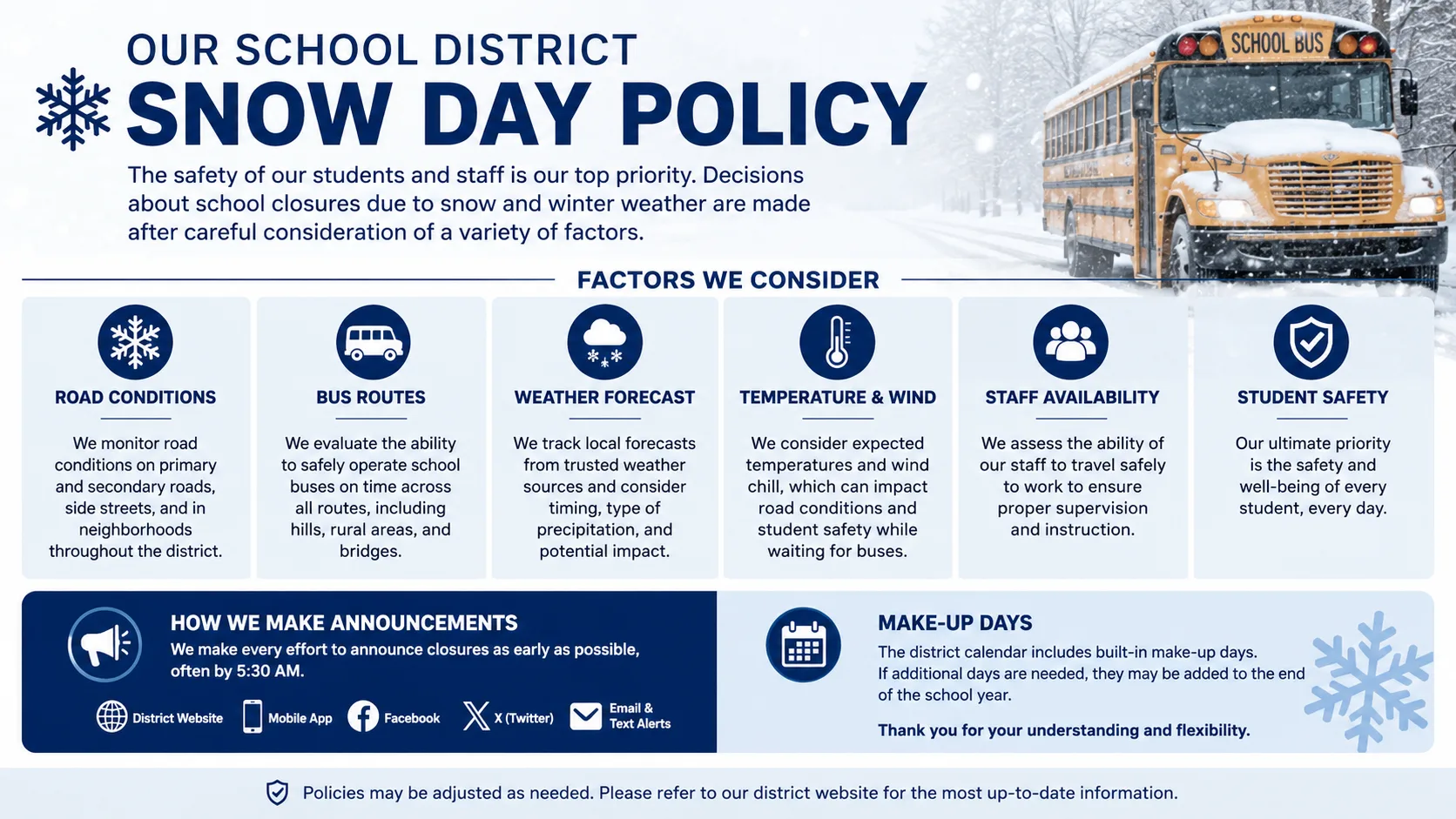
A school district snow day policy is the set of rules and decision steps a district follows to decide whether to close school, delay the start time, or move to remote learning because of winter weather. Most policies rely on road conditions, temperature, visibility, and staffing availability rather than a fixed snowfall number. If you want a fast, personalized read on your own district's odds, you can run our snow day calculator before you dig into the details below.
What Is a School District Snow Day Policy
A school district snow day policy is a written or informal framework that guides how administrators respond to winter weather. It usually covers three possible outcomes: a full closure, a delayed start, or a shift to remote learning.
Policies are not one-size-fits-all. A district in a northern state with hilly, rural bus routes will close far more easily than a district in a flatter, more urban area with the same snowfall total. That is because the policy is built around local infrastructure, not a national standard.
Most policies also include a make-up day plan, since many states require a minimum number of instructional days per year. When districts use too many snow days, they may need to extend the school year or convert remaining snow days into remote learning days instead.
How the Decision Process Works
The decision process almost always starts the night before a storm and continues into the early morning. Superintendents monitor forecasts for several days leading up to a potential storm, then narrow their focus as the timeline gets closer.
Night-Before vs. Early-Morning Decisions
Districts generally fall into one of two decision windows:
- Night before (roughly 8:30 PM to midnight): Used when a major storm is already confirmed and an early call helps families plan.
- Early morning (roughly 4:00 AM to 6:30 AM): The most common window, used so officials can review overnight radar, actual accumulation, and live road checks before deciding.
In many regions, transportation staff physically drive bus routes before sunrise to check conditions firsthand. That live information often matters more than the forecast itself.
Who Actually Makes the Call
In most districts, the superintendent makes the final decision, but rarely alone. Josh Patchak, an operations officer at a Wisconsin district, has described a process built around repeated check-ins with the National Weather Service throughout the day and evening before a final call is made close to the deadline for notifying families.
Many superintendents also coordinate informally with neighboring districts, since families often cross district lines for work, childcare, and shared bus routes. This regional coordination helps avoid a situation where one district closes and an adjacent one stays open under nearly identical conditions.
The Core Factors Behind Every Closure
Weather alone rarely tells the whole story. Districts typically weigh a combination of the following:
- Road and route conditions: Narrow, rural, or hilly bus routes raise closure odds even with lower snowfall totals than a flat, urban route would need.
- Ice, not just snow: A small amount of freezing rain can trigger a closure faster than several inches of dry, powdery snow.
- Temperature and wind chill: Extreme cold, especially below 0°F, can close schools even without snow, largely because of the risk to students waiting at bus stops.
- Visibility: Whiteout conditions or heavy wind gusts can make roads impassable well before snow totals look dangerous on paper.
- Staffing: If enough bus drivers, custodians, or teachers cannot safely reach the building, a district may close even with passable roads.
- Timing of the storm: A storm that arrives overnight and clears by morning affects the decision very differently than one still falling during the morning commute.
Fairborn, Ohio superintendent Amy Gayheart has pointed to heating problems and unsafe travel as two separate triggers she weighs, showing that closures are not only about the roads. Some districts also factor in whether students rely on school meals, since a closure can affect food access for families who depend on it.
For a deeper look at how temperature interacts with these decisions, our wind chill calculator shows how quickly perceived cold can cross a district's safety threshold.
Step-by-Step: Using a Snow Day Calculator
A snow day calculator cannot replace an official district announcement, but it can give you a realistic, data-informed estimate hours or days ahead of time.
- Enter your location. Local terrain and typical district behavior matter more than statewide averages.
- Add expected snowfall and timing. Overnight snowfall behaves differently than snow still falling during the morning commute.
- Include temperature and wind. Extreme cold can push the odds up even with light snow.
- Check your district's historical pattern. Some districts close conservatively, others rarely close at all.
- Review the probability output. Treat it as a planning tool, and confirm with your district's official notification channel closer to the decision window.
You can run all five steps directly on our full calculator directory, which includes tools tailored to different regions and weather patterns.
Why a Clear Policy Matters
A well-communicated snow day policy reduces stress for families, staff, and students. When parents understand the general decision window and the main factors involved, they can plan childcare and commutes with far less last-minute scrambling.
Clear policies also help districts stay consistent. Without a defined process, decisions can look arbitrary from the outside, even when officials are following a careful internal method.
Finally, a documented policy supports better emergency planning. Districts that formalize their process tend to update it after each winter based on what worked and what caused confusion, which improves accuracy over time.
Real-World Examples
Consider two districts hit by the same regional storm system:
- District A sits in a hilly, rural area with narrow county roads. With just 2 inches of snow overnight and a temperature of 15°F, buses cannot safely navigate several routes, so the district closes.
- District B is 20 miles away in a flatter, more urbanized area with well-plowed main roads. With the same 2 inches of snow and similar temperature, most routes remain passable, so the district opens on a 2-hour delay instead of a full closure.
This kind of split decision is common and explains why neighboring districts often make different calls during the same storm. It is not inconsistency. It reflects genuinely different road infrastructure and route risk.
Read More : How Schools Decide to Cancel School
Common Mistakes and Pro Tips
Mistakes Families Make
- Assuming a fixed snowfall threshold exists. Most districts do not use one.
- Ignoring wind chill. Extreme cold alone can trigger a closure even without snow.
- Waiting until the morning of to check. Night-before decisions are common for major storms.
- Assuming neighboring districts will match. Route conditions vary block by block, not just district by district.
Pro Tips
- Sign up for your district's official notification system, not just local news alerts.
- Check your district's historical closure pattern for the past three winters.
- Use a rain delay calculator for fall and spring storms when freezing rain, not snow, is the bigger risk.
- Have a backup childcare plan ready during any week with a storm in the forecast, rather than waiting for a confirmed closure.
Closure Type Comparison Table
| Closure Type | Typical Trigger | Decision Timing | Impact on Calendar |
|---|---|---|---|
| Full Closure | Heavy snow, ice, or extreme cold making roads unsafe | Night before or early morning | Often requires a make-up day |
| 2-Hour Delay | Roads expected to clear by mid-morning | Early morning (after route checks) | Usually no make-up day required |
| Remote Learning Day | Unsafe travel but instruction can continue virtually | Night before or early morning | May count as an instructional day depending on state rules |
| Early Dismissal | Storm expected to worsen during the school day | Mid-morning to early afternoon | Rarely requires a make-up day |
Suggested image placement: a simple decision-flow graphic showing "Forecast reviewed → Route check → Superintendent decision → Family notification," placed after this table. Suggested alt text: "school district snow day policy decision flow chart showing forecast review, route check, and superintendent call."
Conclusion
A school district snow day policy is really a layered decision process built around road safety, staffing, temperature, and timing, not a simple snowfall cutoff. Understanding these factors helps you read the situation ahead of the official announcement instead of just waiting for a phone alert. For a personalized, data-based estimate before your district makes the call, try the calculator above or explore our state-by-state predictions for a regional view of closure patterns.