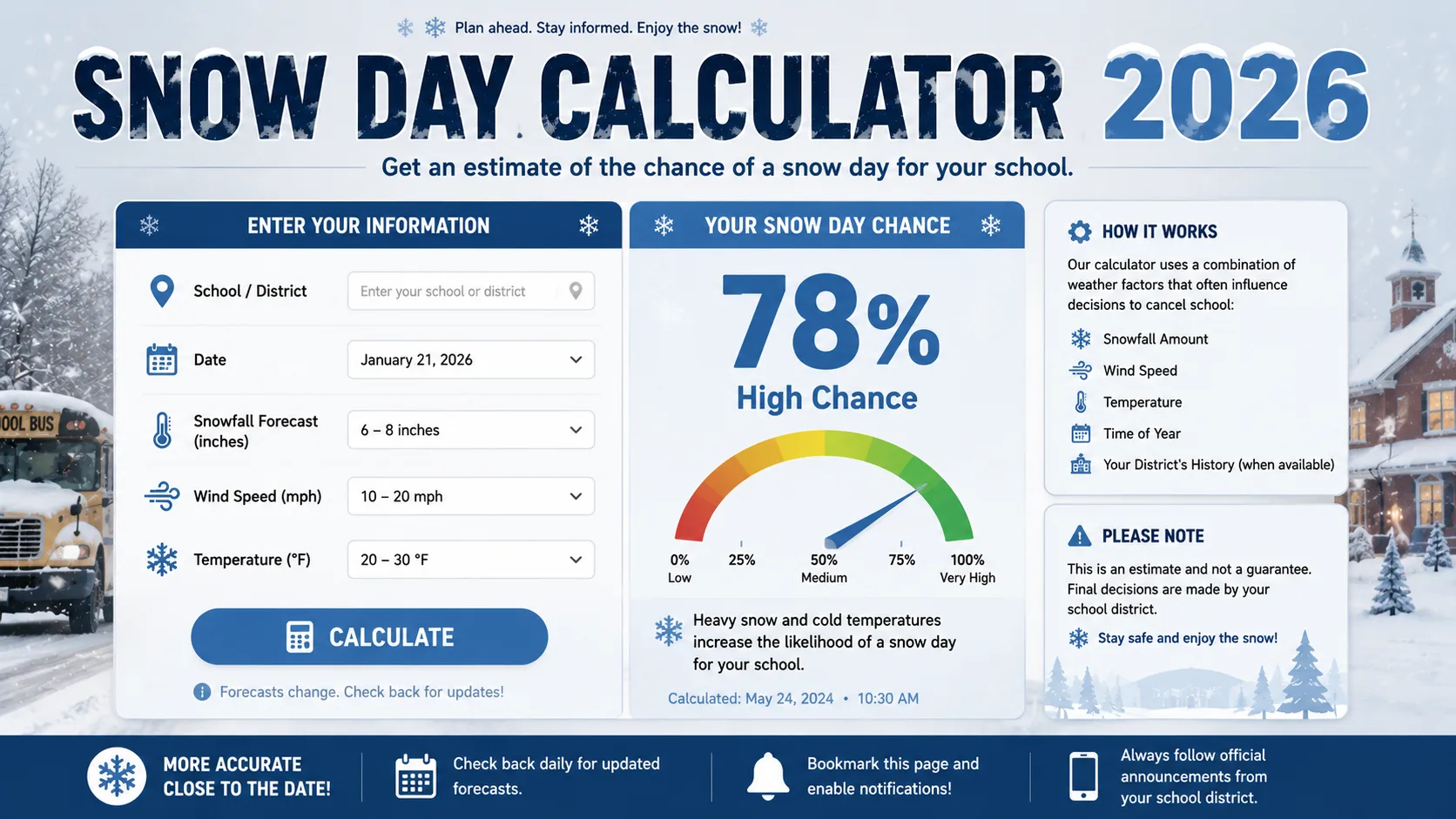
A snow day calculator uses live weather data, like snowfall totals, wind chill, and ice accumulation, to estimate the odds that your school will close, delay, or run as scheduled. In 2026, these tools pull from real-time forecasts instead of guesswork, so you can plan your morning before the district makes an announcement. This guide explains exactly how the scoring works, walks you through using the snow day calculator step by step, and shows real examples so you know what a given percentage actually means for your family.
What Is a Snow Day Calculator
A snow day calculator is a free online tool that estimates the probability of a school closing due to winter weather. You enter your ZIP code, postal code, or city name, and the tool returns a percentage score, usually somewhere between 0% and 100%, along with the weather factors driving that score.
These tools do not replace an official announcement from your school district. Think of them as an early warning system. They give you a data-backed estimate hours, or sometimes days, before the district makes a final call.
A Short History of the Snow Day Calculator
The idea behind these tools isn't new. The earliest version traces back to 2007, when a middle school student built a simple prediction tool as a class project, asking users to manually enter local weather details in exchange for a rough forecast. It was clunky by today's standards, but it proved something important: students and parents wanted a way to estimate closures before the official word came down.
Modern versions look nothing like that early project. Today's snow day calculator pulls live data automatically from weather services the moment you enter your location, so there's no manual data entry required. The scoring logic has also matured, moving from a single snowfall number to a multi-factor model that accounts for wind, ice, and timing.
What hasn't changed is the underlying appeal. Long before any calculator existed, students and parents were doing rough versions of this same math in their heads, watching the sky, checking the thermometer, and trying to guess whether the morning bell would ring. A snow day calculator just formalizes that instinct with actual data instead of a hopeful glance out the window.
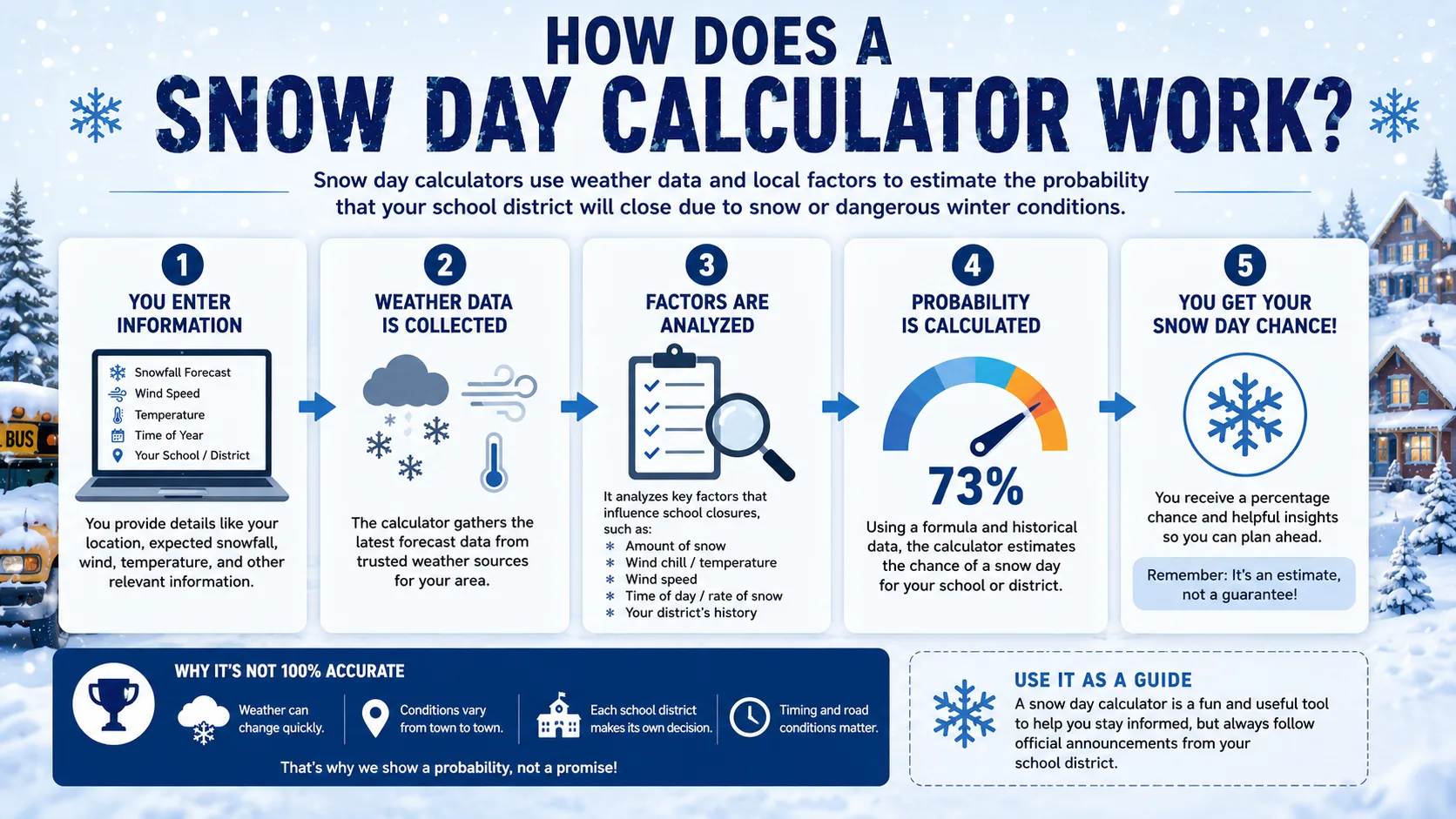
How Does a Snow Day Calculator Work
Snow day calculators combine live weather forecasts with location-specific closure patterns. Most tools pull hourly or 3-hour updated data covering snowfall, temperature, wind speed, and precipitation type, then convert those numbers into a single score.
The Data Behind the Prediction
The most reliable calculators weigh several factors together rather than looking at snowfall alone:
- Snowfall accumulation: Total inches expected over the next 24 hours
- Wind chill: How cold it actually feels at a bus stop, not just the air temperature
- Ice and freezing rain: Often more disruptive than snow, since even a thin layer makes roads unsafe
- Timing of the storm: A storm that peaks at 6 a.m. matters more than one that clears out overnight
- Regional infrastructure: Districts with more plows and salt trucks tolerate more snow before closing
Meteorologists generally agree that wind chill is an underrated factor in closure decisions. Frostbite risk climbs sharply once wind chill drops below negative 20 degrees Fahrenheit, which is part of why cold-weather closures have become more common in states like Minnesota and Wisconsin even on days with little or no snow. If wind is a bigger concern than snowfall where you live, the wind chill calculator breaks that risk down on its own.
Why the Same Storm Affects Different Districts Differently
Two schools can see identical weather and make opposite decisions. That's because closure decisions depend on more than the forecast itself. Superintendents weigh road conditions on specific bus routes, how many hours of daylight the storm eats into, whether neighboring districts are closing, and how quickly local crews can clear roads before the first bell.
A snow day calculator can't read a superintendent's mind, but it can account for the patterns those decisions tend to follow. Districts in snowier climates generally have more plows per mile of road, larger salt reserves, and bus drivers experienced with winter conditions. Districts in milder climates often have none of that infrastructure, which is why a small amount of snow or ice causes an outsized reaction.
Snow Day Calculator Formula and Scoring Logic
Every calculator weighs its factors slightly differently, but most follow a similar structure. Each variable gets a point value, and the total determines the closure probability band.
| Factor | Low Impact | Moderate Impact | High Impact |
|---|---|---|---|
| Snowfall (24 hrs) | Under 2 inches | 2 to 5 inches | Over 5 inches |
| Wind chill | Above 0°F | -10°F to 0°F | Below -10°F |
| Ice accumulation | None | Trace to 0.1 inch | Over 0.1 inch |
| Storm timing | Clears overnight | Ends near sunrise | Peaks during commute |
The combined score generally lands in one of three bands:
- 0 to 49 percent: School will most likely remain open
- 50 to 79 percent: Possible delay or early dismissal
- 80 percent and above: High likelihood of a full closure
Key takeaway: A calculator showing 60% doesn't mean a coin flip. It means the weather conditions are trending toward disruption, so a two-hour delay is more likely than an all-day closure. Check back as the score updates, since it can shift quickly as new forecast data comes in.
How Accuracy Changes as the Storm Gets Closer
Weather forecasting gets more reliable the closer you are to the event, and snow day calculators inherit that same pattern. A prediction made five days out is really just an early trend line. A prediction made the morning of the storm, once actual snowfall and temperatures are being observed rather than forecast, is far more dependable.
- 3 to 5 days out: Expect roughly 70 to 80 percent reliability. Useful for early planning, not for locking in decisions.
- 24 to 48 hours out: Reliability climbs to around 85 to 92 percent as models converge on a consistent forecast.
- Morning of the event: Reliability is highest here, since the calculator can incorporate real-time observed conditions instead of a forecast alone.
How to Use the Snow Day Calculator
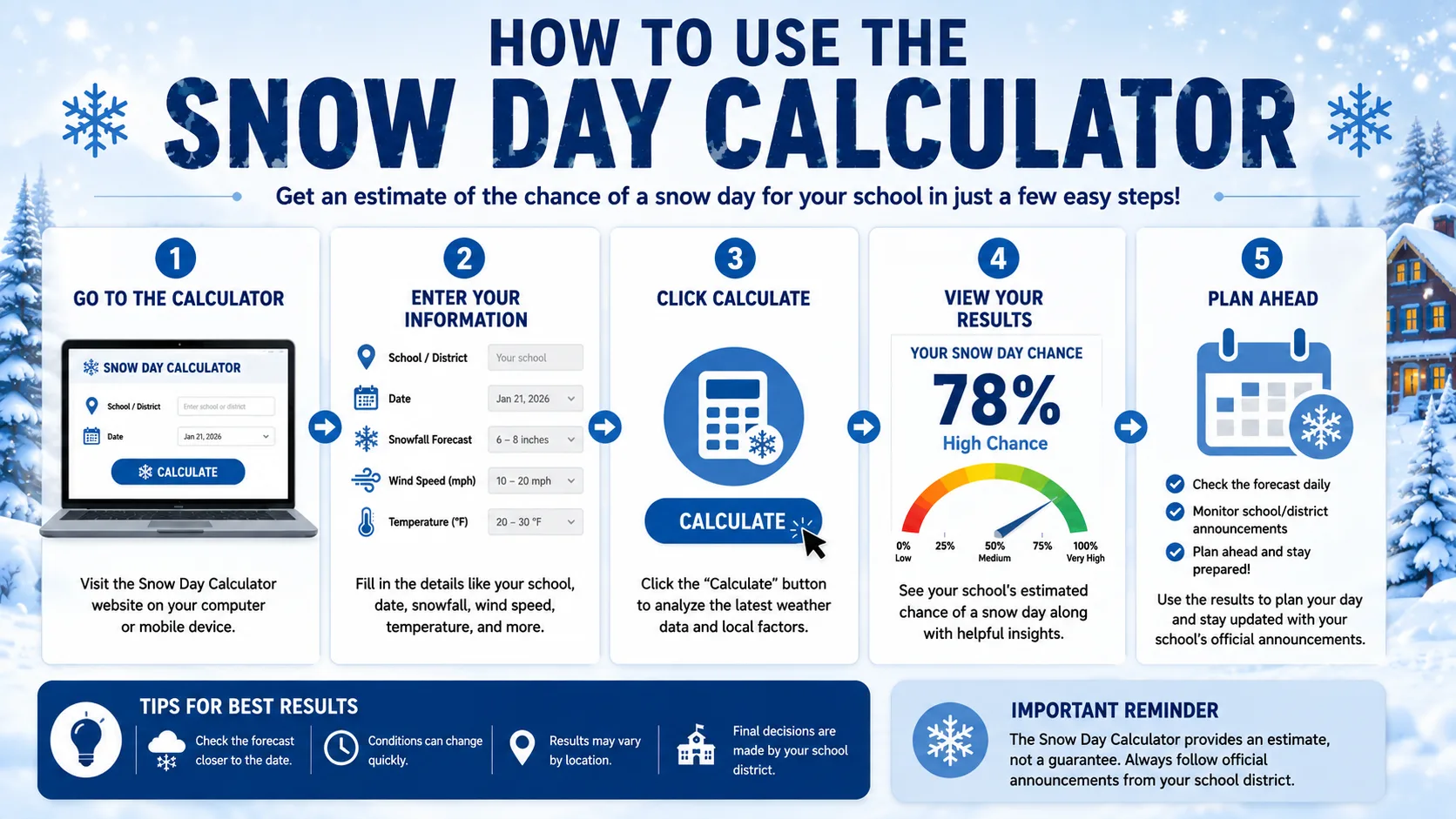
Using the calculator takes less than a minute. Here's the process from start to finish.
- Go to the calculator page. Open the snow day calculator on your phone or computer.
- Enter your location. Type your ZIP code, Canadian postal code, or city name. Adding a state or country code helps if your city name is shared by multiple locations.
- Select your school type, if prompted. Public school districts, private schools, and universities often have different closure thresholds.
- Review your percentage score. The result shows your closure probability along with the specific weather factors driving it.
- Check the factor breakdown. Look at expected snowfall, wind chill, and ice separately so you understand what's pushing the score up or down.
- Recheck the evening before and the morning of. Scores update as new forecast data comes in, and predictions get more accurate the closer you get to the event.
- Confirm with your district. Use the calculator to plan ahead, then confirm with your school's official closure announcement before finalizing your day.
For a broader range of tools beyond your local forecast, the full calculator directory includes region-specific versions and related winter weather tools.
Real-World Examples: Snow Day Predictions by Region
The same storm produces very different closure odds depending on where it lands. Regional infrastructure and district habits matter as much as the raw numbers.
- Minneapolis, Minnesota: 6 inches of snow with a wind chill of -15°F might score around 55 to 65 percent, since northern districts are equipped to handle heavier snow but still respect extreme cold.
- Atlanta, Georgia: Just 1 inch of snow, or even a light ice glaze, can push the score above 85 percent. Southern districts have far fewer plows and salt trucks, so even small amounts of snow or ice create major disruption.
- Boston, Massachusetts: 8 inches of snow arriving overnight and clearing by dawn might only score 40 to 50 percent, since the storm timing works in the district's favor.
- Toronto, Ontario: Heavy lake-effect snow combined with high wind can score 70 percent or higher, particularly when visibility drops for school bus routes.
- Nashville, Tennessee: A half inch of freezing rain, without any real snowfall, can push the score above 80 percent, since ice on untreated roads is often more dangerous than several inches of dry snow.
- Denver, Colorado: 5 inches of snow with clear roads by mid-morning might only score in the 45 to 55 percent range, since Front Range districts are well equipped for routine snow events.
- Chicago, Illinois: A wind chill of -25°F with only light snow can still push the score past 75 percent, showing how extreme cold alone drives closures even without heavy accumulation.
These examples highlight the core pattern behind every accurate snow day calculator: the same raw numbers mean different things depending on where you live. A calculator that ignores regional context will consistently over-predict closures in the North and under-predict them in the South.
For a look at how thresholds vary across the country, the state-by-state predictions page breaks down typical closure patterns by region.
Benefits of Using a Snow Day Calculator
A snow day calculator saves you from refreshing your district's website or social media at midnight. Here's what it actually helps with:
- Childcare planning: Line up a babysitter or adjust your work schedule a day in advance instead of scrambling at 6 a.m.
- Commute decisions: Decide whether to leave earlier, work from home, or brace for slow traffic near schools.
- Homework and testing: Students can plan study time around a likely delay instead of guessing.
- Peace of mind: A data-backed percentage is more useful than rumors circulating in a parent group chat.
- Teacher and staff planning: Educators can prep lesson plans for either scenario instead of scrambling to adjust the night before.
- Event planning: Coaches, tutors, and after-school program coordinators can make earlier calls on practices, rehearsals, or pickups.
Read More : Blizzard vs Winter Storm
Common Mistakes and Pro Tips
A few habits separate people who use these tools well from people who get caught off guard.
- Mistake: Checking too early. A score from three days out can shift a lot. Treat early scores as a heads-up, not a final answer.
- Mistake: Ignoring wind chill. Snowfall gets all the attention, but extreme cold closes schools just as often, especially in the upper Midwest.
- Mistake: Comparing your score to a friend's in another state. An 85% in Atlanta and an 85% in Minneapolis reflect very different storms, because thresholds are regional.
- Pro tip: Check your score the night before and again between 5 and 6 a.m., since most districts announce closures by 6 a.m.
- Pro tip: Pair the snow day score with your district's official alert system so you get both the early estimate and the final confirmation.
- Mistake: Assuming the calculator overrides the school. The calculator is a planning aid, not an official source. Superintendents can and do make decisions the data alone wouldn't predict, such as closing early for a staffing shortage during a storm.
- Pro tip: If your score sits right on the edge between two bands, like 78 or 79 percent, treat it as a coin flip and prepare for both outcomes rather than assuming one or the other.
What to Do While You Wait for the Score to Update
A high percentage score is useful mainly because of what it lets you do before the official announcement. Instead of just waiting, use the lead time productively.
If Your Score Is Above 70 Percent
- Line up backup childcare in case the closure is confirmed overnight or early morning
- Charge devices and pack a bag of activities in case kids are home for the day
- Check whether your workplace has a remote-work option ready to go
- Fill your car with gas and check your phone's emergency alert settings, since storms strong enough to close schools often disrupt other plans too
If Your Score Is Between 40 and 69 Percent
- Set an alarm to recheck the calculator between 5 and 6 a.m., when the score is most reliable
- Prepare for a possible two-hour delay rather than a full closure, and plan a flexible morning schedule
- Keep an eye on your district's text or email alert system, since a moderate score often means the decision comes down to the wire
If Your Score Is Below 40 Percent
- Proceed with your normal routine, but still leave a few extra minutes for the commute in case road conditions are worse than expected
- Recheck once in the early morning if the forecast has shifted overnight, since a low score close to a storm system can move quickly
This kind of tiered planning is really the whole point of a snow day calculator. It's less about getting a single perfect number and more about giving you a realistic window to prepare, whichever way the morning goes.
Snow Day Calculator vs. Other Winter Weather Tools
Snow day calculators focus specifically on school closures, but they work best alongside other condition-specific tools when the weather is mixed.
| Tool | Best For | Key Output |
|---|---|---|
| Snow Day Calculator | Predicting school closures from snow, ice, and cold | Closure probability percentage |
| Wind Chill Calculator | Checking how dangerous the cold feels at bus stops | Wind chill temperature and frostbite risk time |
| Heat Index Calculator | Warm-weather safety planning outside winter months | Feels-like temperature |
| Rain Delay Calculator | Estimating delays for outdoor events and sports | Delay probability |
Browsing the site's blog is a good next step if you want deeper explainers on how each of these tools builds its score.
Conclusion
A snow day calculator turns a stressful morning of guesswork into a quick, data-backed check. By combining snowfall, wind chill, ice, and regional closure patterns into one percentage score, it gives you a real head start on planning your day, whether that means lining up childcare or simply setting an alarm a little later. It's not a replacement for your district's official word, but it's the best early signal available. Whether you're deciding on childcare, adjusting a work-from-home plan, or just curious if tomorrow will bring a lie-in, checking the score ahead of time beats waiting up for a midnight announcement. Try the calculator above to see your school's current closure odds.