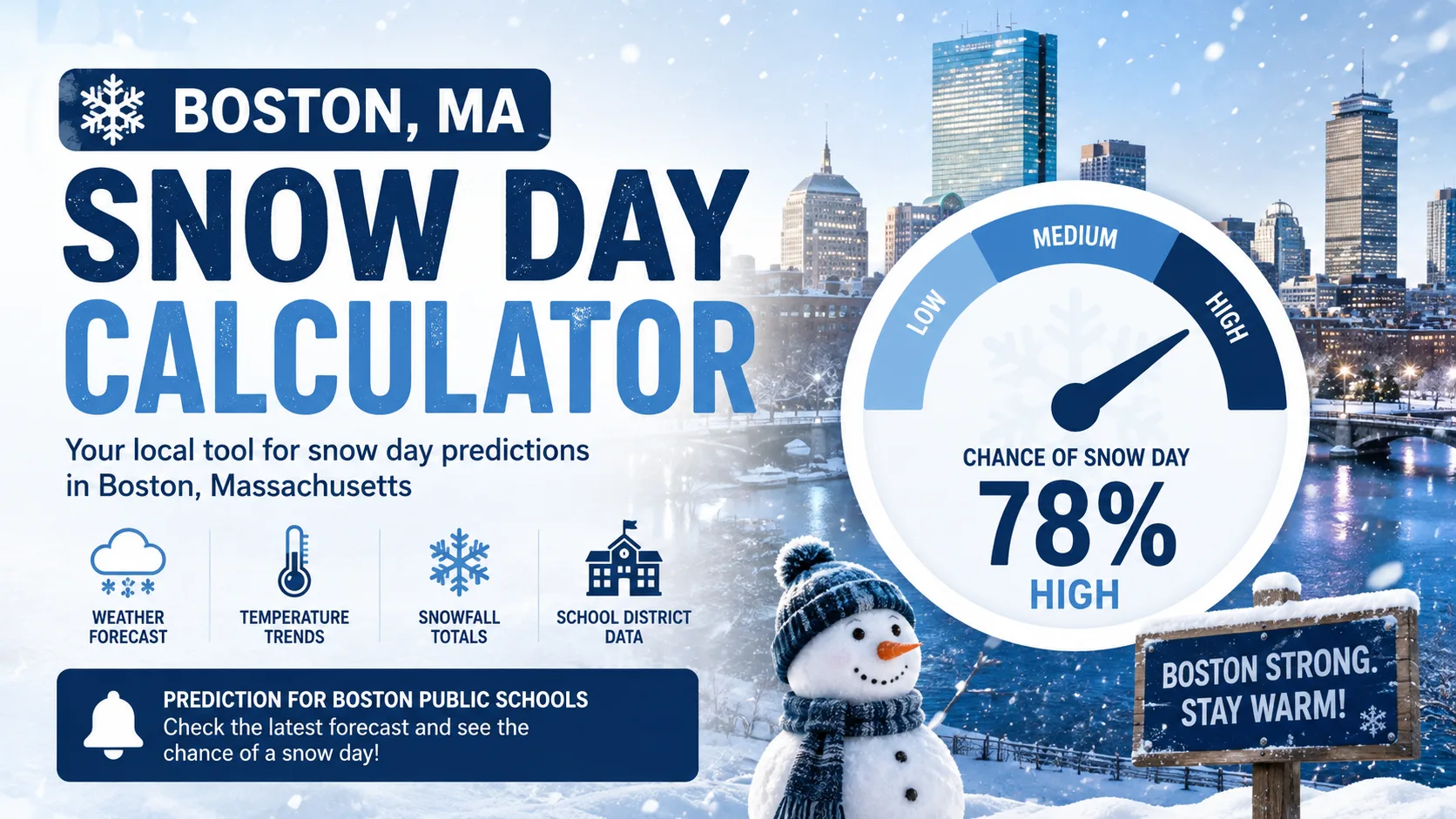
Wondering if Boston schools will close tomorrow? A snow day calculator for Boston, MA estimates the odds of a closure, delay, or early dismissal by combining live snowfall forecasts, ice risk, wind chill, and storm timing with how Boston-area districts have historically handled winter weather.
Boston is one of the trickier cities to predict for. It has a large, well-equipped snow removal fleet and a lot of practice with winter storms, so it takes more snow to close schools here than in cities further south. This guide explains exactly how the Boston snow day calculator works, walks through a real example, and answers the questions parents and students ask most.
What Is a Snow Day Calculator
A snow day calculator is a free online tool that turns a weather forecast into a simple closure probability, usually shown as a percentage. Instead of manually checking snowfall totals, ice risk, and wind chill across three different weather apps, you enter your location and get one number.
For Boston specifically, the calculator pulls forecast data for the metro area and layers on local closure patterns. This matters because national tools built for the whole country tend to underweight how storm timing and road conditions affect Boston's decision-makers.
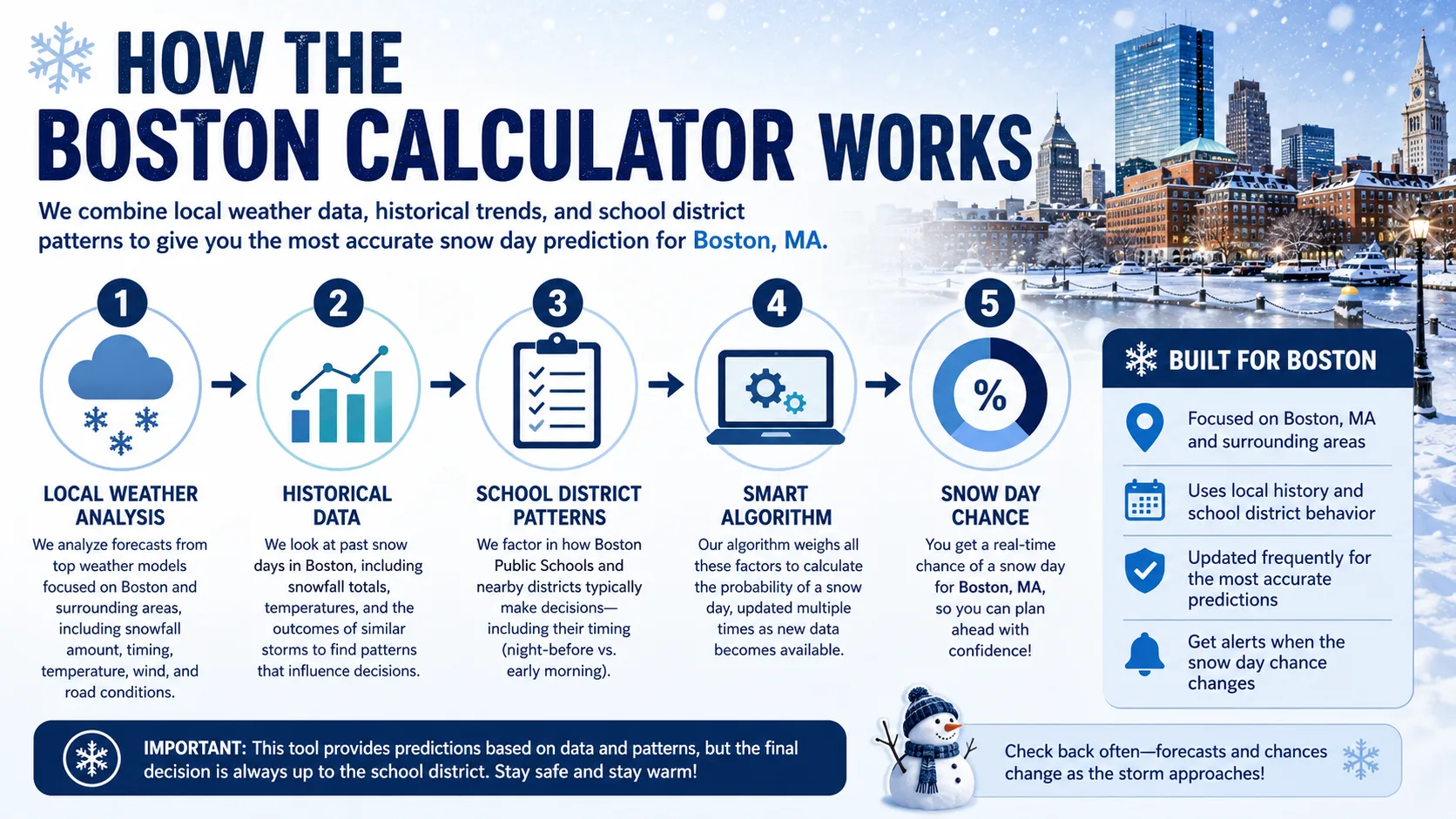
How the Boston Calculator Works
The Boston snow day calculator looks at six main inputs:
- Snowfall total, the expected accumulation over the storm window
- Ice and freezing rain risk, which is often more disruptive than snow alone
- Wind chill and air temperature, since extreme cold raises closure odds even with light snow
- Storm timing, especially whether snow is falling during the 4 a.m. to 7 a.m. commute window
- Forecast confidence, how certain meteorologists are about the storm track
- Road and sidewalk conditions, including how quickly plows can clear routes before buses run
Each factor is weighted differently depending on the school type you select. Public districts like Boston Public Schools tend to weigh bus route safety across a wide geographic area, while private and charter schools often make independent calls and may close at somewhat lower thresholds.
The Prediction Logic
Most snow day calculators, including this one, use a weighted scoring model rather than a single fixed formula. In simple terms, it looks something like this:
Closure Score = (Snowfall Weight) + (Ice Weight) + (Timing Weight) + (Wind Chill Weight) + (Historical Pattern Adjustment)
Each weight increases as conditions worsen. Ice contributes more per inch than snow does, because even a thin layer of ice can make roads and sidewalks unsafe. The historical pattern adjustment accounts for how a specific district has responded to similar storms in the past, which is why the same forecast can produce different probabilities for Boston versus a nearby suburb.
The resulting score is converted into a percentage and translated into a plain-language result, such as "high chance of a snow day" or "more likely a two-hour delay."
Step-by-Step: How to Use the Calculator
- Enter your location. Use your ZIP code, city, or neighborhood so the tool pulls the right local forecast.
- Select your school type. Public, private, and charter schools often have different closure thresholds.
- Review the current prediction. You will see a percentage for closure, delay, and early dismissal.
- Check the 5-day outlook. This helps you plan child care or travel a few days ahead, though confidence is lower further out.
- Recheck the evening before. Predictions become far more accurate within 12 to 24 hours of the storm, so a check the night before beats an early-week glance.
If you want to test a hypothetical, most calculators, including the manual mode on the calculator directory, let you adjust snowfall and temperature sliders yourself to see how the odds shift.
What Makes Boston Different
Boston has a few characteristics that shape its snow day pattern:
- A large, experienced snow removal operation. The city runs a sizeable fleet of plows and salt trucks during major storms, which means routine snow gets cleared faster than in cities with less winter infrastructure.
- Higher snowfall thresholds. Because the city is set up to handle winter weather, it typically takes more accumulation to trigger a closure compared with cities in the Mid-Atlantic or South.
- Coastal storm variability. Nor'easters can shift track quickly, which is why forecast confidence is one of the calculator's weighted factors rather than snowfall alone.
- Public transit and walking routes. Boston Public Schools also has to account for students who walk or use public transit, not just those on buses, which can push closure decisions earlier than a purely bus-based calculation would suggest.
Weather professionals who cover New England winters generally agree that timing relative to the morning commute, not just total snowfall, is one of the strongest predictors of a closure call in cities with strong snow removal infrastructure like Boston.
Benefits and Use Cases
A snow day calculator is useful for more than just excited kids checking before bed. Common use cases include:
- Parents planning child care or adjusting work-from-home schedules a day in advance
- Commuters deciding whether to leave earlier, work remotely, or expect transit delays
- Teachers and staff preparing remote learning materials in case of a closure
- School administrators cross-checking their own internal weather sources against an independent estimate
Because the tool updates as new forecast data comes in, it also saves time compared with refreshing multiple weather apps throughout the evening.
Real Example With Numbers
Here is a realistic worked example for a mid-winter storm in Boston:
| Factor | Forecast Value | Effect on Score |
|---|---|---|
| Expected snowfall | 5 inches | Moderate increase |
| Ice risk | Low | Minimal increase |
| Storm timing | 11 p.m. to 6 a.m. | Significant increase, overlaps commute |
| Overnight low | 8°F | Moderate increase |
| Wind chill | -5°F | Moderate increase |
| Forecast confidence | High | Increases weight of all factors |
In this scenario, the combined score lands in the high probability range, typically 80 to 90 percent, for a full closure rather than a delay. That is because the snow is timed directly over the morning commute and the wind chill adds enough risk that a two-hour delay would not fully resolve the road conditions.
Compare that with a storm dropping the same 5 inches but finishing by 9 p.m. the night before. With several hours for plows to clear main roads before the morning commute, the same snowfall total might only produce a 40 to 50 percent probability, or a delay instead of a full closure.
Common Mistakes and Pro Tips
- Mistake: Only checking snowfall totals and ignoring timing. A storm that ends by dinnertime clears very differently than one still falling at 6 a.m.
- Mistake: Assuming every school in the Boston area follows the same threshold. Private and charter schools frequently make independent decisions.
- Mistake: Checking only once, days in advance, and treating that number as final. Forecasts tighten up considerably within 24 hours.
- Pro tip: Recheck the calculator the evening before and again first thing in the morning, since overnight forecast updates can shift the odds meaningfully.
- Pro tip: If wind chill is expected to drop sharply, treat that as seriously as snowfall. Extreme cold alone can trigger closures or delays.
- Pro tip: Sign up for your district's official alert system as a backup. A calculator is a strong estimate, but the district makes the final call.
Storms that arrive as a mix of rain and snow can be just as disruptive as pure snowfall. If your area is on the edge of a rain-snow line this winter, the Rain Delay Calculator is worth checking alongside your snow day prediction, especially for shoulder-season storms in late fall or early spring.
Read More : Snow Day Calculator Detroit, MI
Calculator vs. Other Methods
| Method | Speed | Boston-Specific Accuracy | Best For |
|---|---|---|---|
| Snow day calculator | Instant | High, tuned to local patterns | Quick planning, one clear number |
| Checking multiple weather apps | Slow, requires interpretation | Variable, no closure context | Raw forecast detail |
| Waiting for district announcement | Very slow, often night-before or early morning | Highest, but least advance notice | Final confirmation only |
| Social media rumors | Fast but unreliable | Low, frequently inaccurate | Not recommended as a primary source |
The most reliable approach combines all three real methods: use the calculator for early planning, watch the forecast trend the day before, and confirm with your district's official announcement before making final arrangements.
Extreme cold snaps outside of snowstorms also raise closure risk on their own. If a dangerous cold snap is forecast without much snow, the Wind Chill Calculator can help you judge how serious the conditions actually are.
For families outside the immediate Boston area, the state-by-state predictions page covers closure patterns across Massachusetts and neighboring New England states, since thresholds can vary a lot even within the same commuting region.
Conclusion
A Boston snow day calculator will not replace your district's official announcement, but it gives you a clear, fast estimate so you are not caught off guard by tomorrow's forecast. Try the calculator above, check back the evening before your next storm, and browse the full calculator directory if you also want wind chill or rain delay predictions for the same storm.