It's 9:40 p.m. Snowflakes are landing on the streetlights your group chat has 63 messages and someone shared a picture of a "90% chance" with six fire emojis. You have an 8 a.m. lecture and a nagging feeling that you shouldn't set your alarm yet.
Here's the catch: that percentage was probably built for elementary and high schools, not for your university.
The January 2026 storm made this very clear. While a foot of snow was falling in Cambridge, Harvard College told students to come to in-person classes on Monday. Syracuse moved every class online. Texas State, where a little ice goes a long way, shut down completely and canceled even its online classes. Same storm system, wildly different calls.
So can a snow day calculator help a college student at all? Yes,. Only if you know how to read it. This guide shows you how to use a snow day calculator for college the way why college campuses act differently from K-12 schools and how to make your own quick forecast before you decide whether to hit snooze.
What a Snow Day Calculator for College Really Tells You
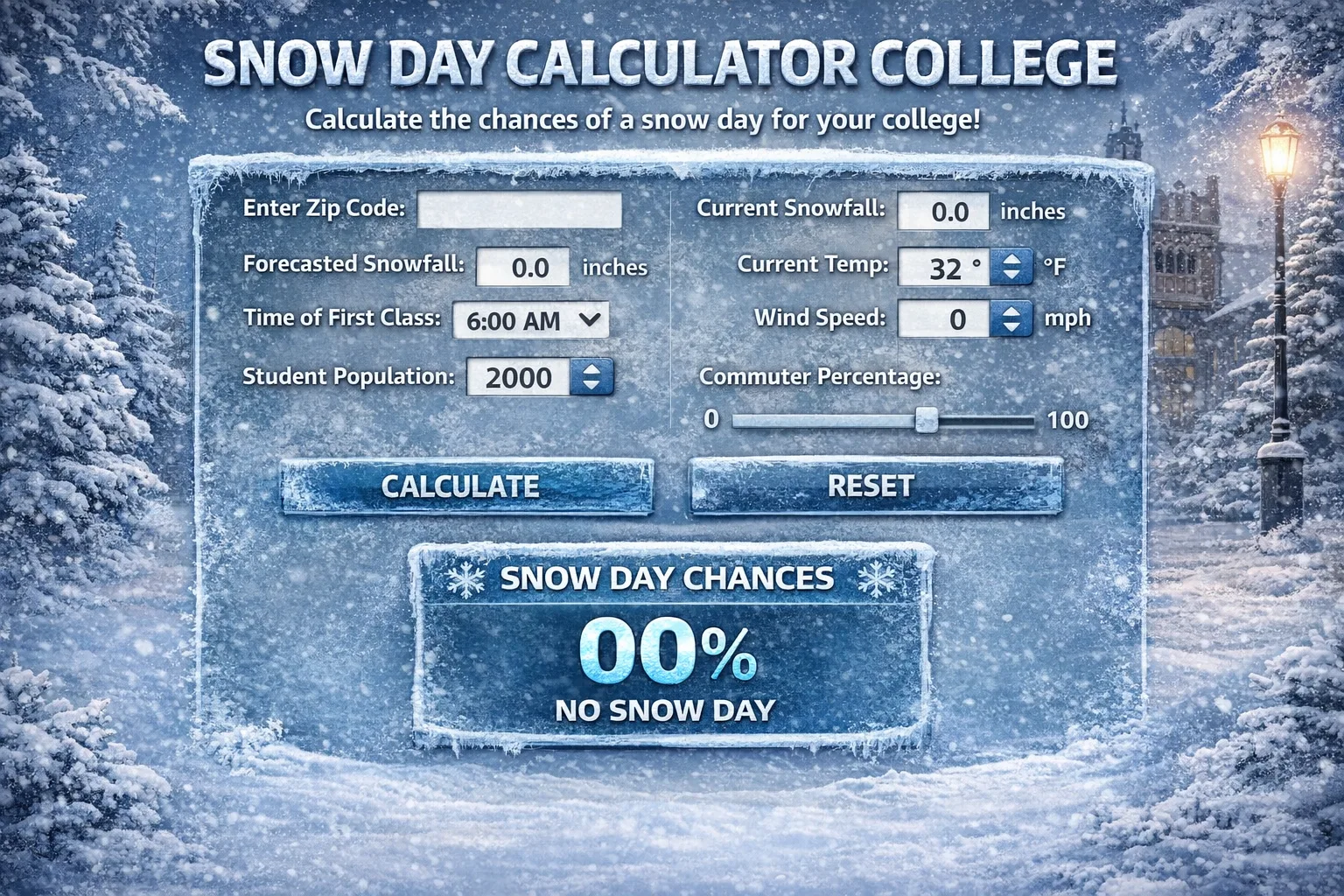
A snow day calculator takes weather data. Turns it into a likelihood. It checks things like how snow is expected the temperature, the wind, ice and when the storm is happening then gives an estimate of how likely a school closure is.
Most of these tools were built for K-12 school districts. That matters, because a district superintendent and a university emergency team think about different things. A district is worried about school buses on country roads. A university is worried about a 24/7 campus, thousands of people coming and going and a schedule full of credit hours.
Think of the percentage as a weather-risk score, not a promise. It tells you how nasty the conditions look. It can't tell you how stubborn your particular administration is.
Why Colleges Close Less Often Than K-12 Schools
If you came straight from high school, this part stings. Colleges have a much higher bar for canceling everything. There are a few reasons.
Students are adults (in the eyes of the policy)
Universities generally expect you to judge your own travel safety. Many policies explicitly say that if you can't get to campus safely, you should talk to your instructor rather than assume the whole school is closed.
A campus never really shuts down
Dining halls, dorms, police, health services, research labs and heating plants keep working no what. "Closed" on a college campus usually means that classes and non-essential work stop not that everything shuts down. Because of that school leaders often choose options first: a delayed start, online classes or a partial shutdown.
Missed class time is expensive to fix
Every missed class has to be made up. College schedules are tight. Labs, clinicals, exams and big lectures are hard to move. That's why you'll see many campuses keep going on a day when the local elementary school's empty.
Remote learning gave everyone a fallback
Since the pandemic, "we'll just go online" has become the default answer at a lot of schools. The traditional day off is less common than it used to be. It hasn't disappeared, though. Some schools still cancel everything both in-person and online, for fairness. Not all students have internet and many students and staff are also taking care of children when local schools close.
Closed, Remote, or "Open, Good Luck": What Campus Announcements Actually Mean
Half the confusion on storm mornings comes from vocabulary. Here's how to decode the usual announcements. The words used can be different at each school so always look at your schools policy page.
- Delayed opening: Classes that start before a time are canceled or moved to a later time so that workers can clean the parking lots and walkways. If your class starts after the delay is over you can assume it will happen.
- Classes canceled offices open: Students get the day off; many workers still need to go to work. This is not very common. It does happen sometimes.
- Campus closed: In-person classes are not held and people who do not need to be on campus stay. Whether online classes continue depends on the school.
- Remote instruction: The building may be closed, but class still meets on video or through your learning platform. This is the most common modern "snow day."
- Instructor discretion: The university stays open, but individual professors can cancel or move their own class. Watch your email.
- Early dismissal: Evening classes and events are usually. Daytime classes might end early if the weather gets worse.
A quick reality check on that last group: the 2026 storm showed how patchy this can be even inside a single university. Harvard's undergraduate college stayed in person, yet several of its graduate schools announced they would go fully virtual. Your program, not just your school, can decide your day.
Step One: Figure Out What Kind of Campus You're On
Before you trust any percentage, classify your school. This one habit does more for your accuracy than any algorithm tweak. These are rules of thumb, not hard statistics, but they hold up well.
Commuter campus or community college
If most students drive in, the campus behaves a lot like a school district. Icy highways are a real problem for thousands of people at once, and these schools often follow what nearby K-12 districts do. When local public schools close, a community college closing too is a very reasonable bet.
Residential campus (small college or big flagship)
If most students live within walking distance, the "roads are unsafe" argument loses force. These schools lean toward staying open, delaying, or going remote. Treat a high closure percentage with healthy skepticism.
Urban campus with a mix
City schools depend on transit, and transit is often what breaks first. If buses and trains are suspended, your odds of a remote day jump. If the subway is running, expect business as usual.
Campuses in warmer regions
Schools in the South and other mild-winter areas don't own much snow-clearing equipment, so a modest freeze can shut things down. The Texas State closure in January 2026 is a good example. The reverse is also true in snowy northern states: a foot of snow is ordinary, and campuses there are built and staffed for it.
How to Use a Snow Day Calculator for College, Step by Step
- Enter your campus location, not your home address. Use the ZIP code where you actually attend class. If you travel to campus check the weather twice: for the campus and once for where you live and focus on whichever looks worse.
- Use the calculator the night before and again the morning after. Forecasts become more accurate as the storm gets closer. A number you saw three days out is a hint, not a plan. Try the snow day calculator again around 5 a.m., when many schools make their call.
- Adjust the result for your campus type. A commuter college can take the number closer to face value. A residential university deserves a mental discount.
- Look at what's driving the number. Heavy snow at noon is very different from a layer of ice, at 6 a.m. even if both have the same percentage of chance.
- Check real-life signs well. Are local K-12 districts closing? Has the county issued a travel advisory? Are transit agencies cutting service?
- Wait for the official word. Only your school's own emergency alert counts. Treat everything else as a forecast.
The College Snow Day Scorecard (Build Your Own Forecast in 60 Seconds)
Calculators are helpful. They can't see everything. This quick scorecard covers things they can't. It is my way of thinking, not a scientific model but it is a good way to check if you should stay up or go to bed.
Give yourself 0, 1, or 2 points for each row, then add them up.
| Factor | 0 points | 1 point | 2 points |
|---|---|---|---|
| Type of precipitation | Light snow | Heavy, wet snow | Freezing rain or ice |
| Timing | Ends before midnight | Lingers into the morning | Heaviest between 4 and 9 a.m. |
| Cold and wind | Normal for your area | Wind chill advisory | Extreme cold warning |
| Local K-12 and county | Business as usual | A few delays announced | Widespread closures or a travel advisory |
| Campus type | Residential and walkable | Mixed | Commuter-heavy |
| Your school's track record | Almost never changes operations | Delays or goes remote sometimes | Cancels fairly often |
| Forecast confidence | Models disagree | Mostly agree | Warnings in effect, storm nearly here |
How to read your total:
- 0 to 4: Expect a normal day. Set the alarm.
- 5 to 8: Expect a delay, a remote day, or professors canceling individual classes. Stay flexible and check email early.
- 9 to 14: A real chance of a full closure. Start planning as if you might be home, but don't skip the official alert.
Pair that score with your calculator result and you've got a much sturdier prediction than either one alone.
Ice Beats Snow Every Time
Ask any person who works in facilities and they will say the thing: snow is annoying ice is dangerous. You can. Clear snow. A thin layer of freezing rain on sidewalks, steps and parking areas is a problem because it makes the whole campus a place where people can fall.
That's why a modest ice forecast can close a campus that shrugged off six inches of powder. If your forecast mentions freezing rain, sleet, or "wintry mix" around your commute, give the closure odds a serious bump, and take the ice score in the table above at full value.
Timing matters almost as much as totals
Snow that falls during the night and stops by 3 a.m. Gives workers time to clean up. Snow that starts at 5 a.m. And gets worse during rush hour is very difficult. When you look at the forecast check when the worst part is, not just how much is coming.
Don't ignore dangerous cold
Extreme wind chills can shut down a campus even when there's barely any snow. Walking across an open quad in dangerous cold is a real health risk, and aging heating systems sometimes fail in a deep freeze.
Power and internet outages are the wild cards
Ice-laden branches and power lines cause outages that no snow forecast will predict. If you're an online student, this matters even more. Universities routinely advise students to submit work early and message instructors if an outage hits.
When Do Colleges Announce Snow Day Decisions?
Most schools have a pattern though the exact details are different. Find your schools policy so you know what to expect.
- The evening before: If a big storm is clearly coming, some schools announce plans early, especially for a Monday after a weekend storm. In January 2026, several campuses announced remote days on the Sunday before.
- Early morning: Many policies say the decision comes before roughly 6 a.m. for morning classes. Have your phone nearby by 5:30.
- Midday: If a storm develops during the day, teams keep monitoring and may cancel evening classes or dismiss early.
- Backup updates: Conditions can change. A campus that says "open" at 6 a.m. can switch to "remote" by 10.
Where to Get the Official Answer
Set this up now, before the first storm, not when you're panicking at 5:45 a.m.
- Sign up for your school's emergency alerts. Text and email alerts are the fastest way to hear anything. Confirm your phone number is current in your student account.
- Bookmark your inclement weather policy. It will tell you who decides, when, and what "closed" means, including whether online classes continue.
- Check your learning platform and school email. Instructors often send their own notices, and some move class online without a campus-wide announcement.
- Follow the official social accounts. They're usually updated right alongside the alert system.
- Watch local news and transit updates. They're useful for commuters, especially when buses or trains are affected.
What About Online Classes, Labs, Exams, and Clinicals?
This is where a lot of students get caught out.
- Fully online courses: These usually continue, unless the university suspends everything or your power goes out. Some schools pause online classes during full closures. Check your policy.
- Hybrid classes: The in-person day may switch to online. Your instructor will tell you how to handle things.
- Labs and studios: These are harder to move so they are more likely to be canceled completely or moved to a different time.
- Exams: Many schools push back the exam of a day that has been delayed. If you cannot get to campus reach out to the professor before the exam and ask about a make-up.
- Clinicals and placements: Nursing and education programs usually have their own rules and processes.
Read More : AccuWeather Snow Day Calculator
Regional Differences: What "Snow Day" Means Where You Live
Where your campus sits changes everything.
Midwest: Snow is normal there are a lot of snow plows and most schools stay open unless the storm is really serious. Big lake-effect and nor'easter events are the exceptions, and remote days have become common for those.
Mid-Atlantic: This is the in-between zone. A couple of inches can stir up delays, and ice is a frequent troublemaker. Expect more variation from school to school.
South and Southwest: Snow and ice are rare, so infrastructure is thin. Even a small event can close a campus, particularly with ice on the roads.
Mountain West and Pacific Northwest: Mountain campuses tend to be prepared for heavy snow. Coastal areas struggle more with freezing rain and black ice, which don't look dramatic on a forecast but are hard to travel on.
Your Night-Before Snow Day Plan
Whatever the calculator says, a bit of preparation makes a surprise closure (or a surprise "we're open") much less stressful.
- Charge everything. Phone, laptop, power bank.
- Download what you need. Readings, lecture slides, and assignment files should be saved offline in case the internet goes down.
- Finish anything due tomorrow. Submit early if you can. Storm weather is not a great time to rely on a spotty connection.
- Especially if you live away from campus: Make sure you have food, water, medications and a flashlight.
- Plan your path and dress in layers. If classes are happening, leave time than usual wear shoes that have good grip and don't assume that the sidewalks have been cleared.
- Set two alarms. One for 5:30 to check alerts and one for whatever time you'd need to leave.
If the campus stays open but you can't travel safely
This happens more than students think. Most policies say your safety comes first. Don't just disappear. Send an email to your instructors soon as you can explain the situation and ask how to keep up with the work. A short polite message and a screenshot of the weather advisory, for your area can help a lot.
If the campus is closed
Read the message carefully. "Closed" does not always mean "no classes." Check to see if instructors are planning to meet if assignments have changed and if any exams have been moved.
The Limits of Any Snow Day Calculator (Be Honest About Them)
A calculator is a tool, not a guide. Here is what it cannot do
- It can't read minds. Final decisions come from administrators, who may weigh things no algorithm sees: events, staffing, budgets, or a recent storm that went badly.
- It doesn't always know your campus. A school that almost never closes and one that closes quickly may look the same to a generic model.
- It struggles with far-off forecasts. A prediction made several days ahead is only a heads-up. It gets better within the last day or so.
- It can't predict outages or last-minute ice. Small shifts in temperature can turn snow into a glaze.
Use it to understand the risk, not to justify skipping something important. If you have an exam or a required lab, always confirm with your school before making a call.
What to Expect for the 2026-27 Winter
A few trends are worth watching this season.
- Remote days will keep spreading. Many schools now treat a virtual day as their standard response to a big storm, and the January 2026 storm gave plenty of them a real-world test.
- Alerts are getting smarter. Schools increasingly send targeted messages by text, email, and app, sometimes separating commuters from residents.
- Policies are still being rewritten. After each big storm, schools review what worked. Reread your inclement weather policy at the start of every winter, because it may have changed since last year.
- Forecasting tools keep improving. That means better odds for the weather half of the equation, though the human decision-making half will always be a bit unpredictable.
Final Thoughts: Use the Calculator, Trust the Official Alert
Colleges and universities aren't K-12 schools, and that's exactly why a college snow day prediction takes a bit more thought. The weather is only half the story. Your campus type, your school's habits, the timing of the storm, and whether ice is involved all shape the final call.
The best approach is simple. Get a first read from a calculator, adjust it with the scorecard above, keep an eye on local conditions, and let your school's official alert have the last word. Do that and you'll rarely be caught trudging through the snow to a canceled class, or sleeping through one that's still on.