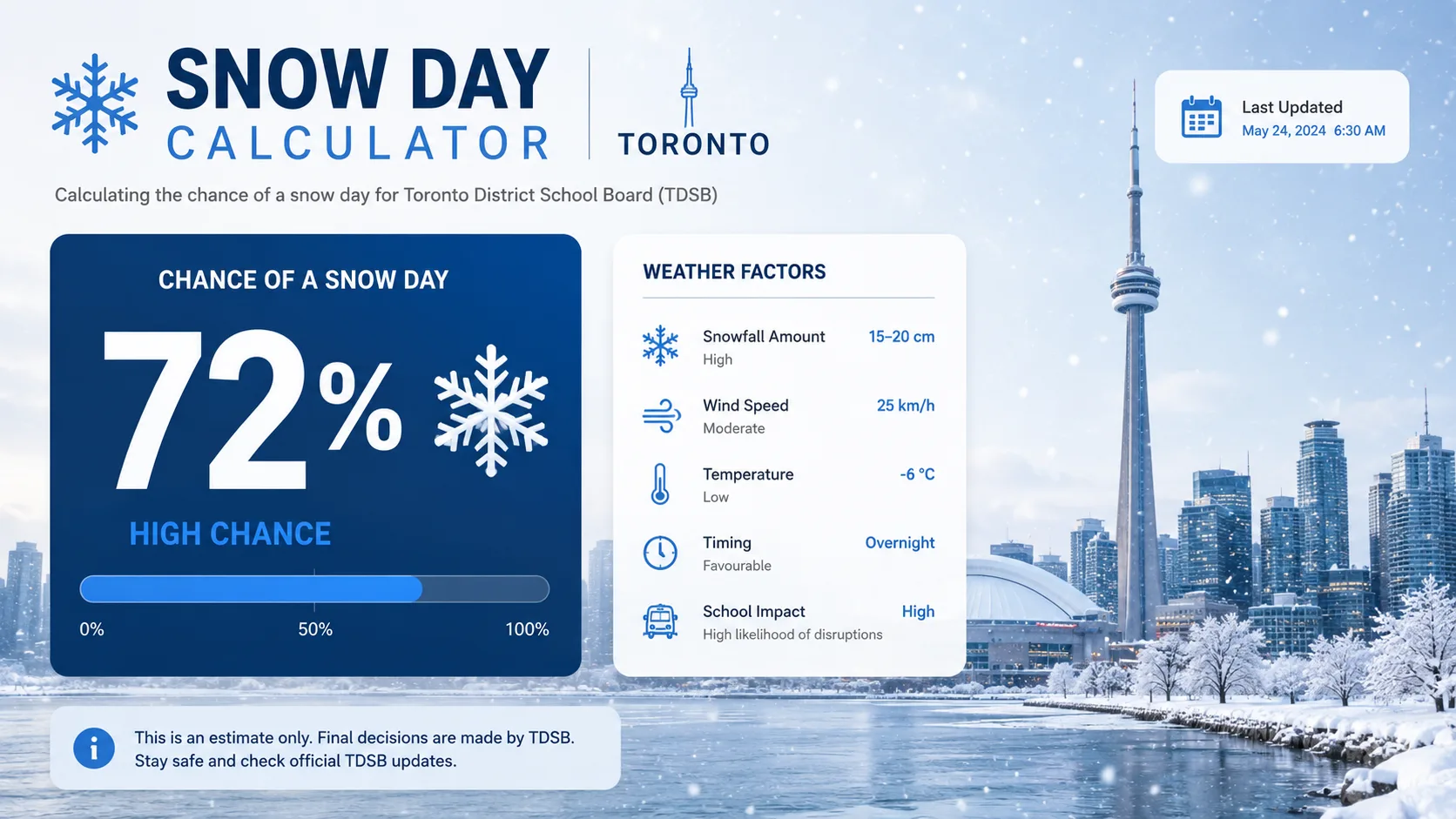
If you have ever assumed a big snowfall automatically means Toronto schools are closed, the data says otherwise. A snow day calculator Toronto tool exists precisely because the Toronto District School Board behaves very differently from smaller, surrounding boards, even under identical winter weather.
This guide breaks down exactly how a Toronto-specific snow day calculator works, why TDSB has one of the lowest closure rates in Ontario, and how to read your odds accurately whether you live downtown, in Scarborough, Etobicoke or North York.
What Is a Snow Day Calculator for Toronto?
A snow day calculator Toronto tool estimates the probability that TDSB, Toronto Catholic (TCDSB), or nearby Peel District schools will cancel buses or close entirely due to snow, ice or extreme cold. It converts a weather forecast into a single percentage calibrated specifically to how Toronto boards historically respond.
This matters because a calculator tuned for a rural or northern Ontario board will consistently overestimate Toronto's real closure risk. Toronto needs its own model, not a generic provincial average.
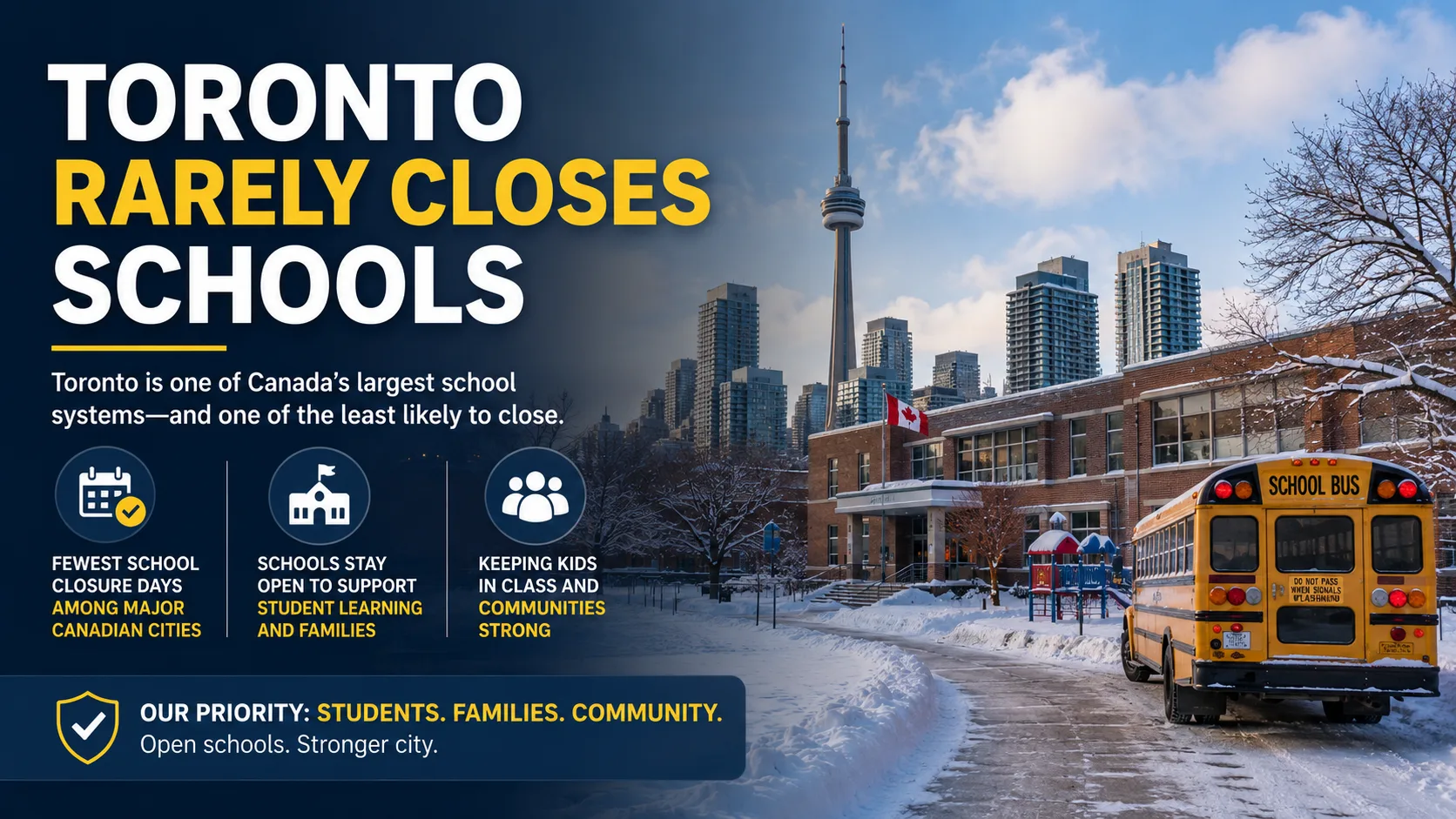
Why Toronto Rarely Closes Schools, Even With Heavy Snow
This is the single biggest thing a good Toronto snow day calculator has to get right, and it is the part most generic tools miss entirely.
TDSB by the Numbers
- TDSB is Canada's largest school board, serving roughly 235,000 students across 582 schools.
- Toronto averages well over 100 cm of snowfall per winter, yet still has one of the lowest full-closure rates of any major Ontario city that receives significant snow.
- Roughly 93% of TDSB students do not take a school bus, which is a major reason the board leans toward cancelling transportation rather than closing schools outright.
TTC, Road Crews and the "582 School" Problem
Toronto's extensive road maintenance fleet, combined with the TTC subway and streetcar network, keeps most of the city moving even during moderate snow events. Many central neighbourhoods are also walkable enough that families are not entirely dependent on buses or cars.
There is also a practical, logistical reality: closing 582 schools at once affects hundreds of thousands of families, childcare arrangements, and staff. Because of this scale, TDSB sets the bar for a full closure noticeably higher than a smaller board managing a few dozen schools.
How the Calculator Works for Toronto Specifically
The scoring logic behind a Toronto-calibrated calculator follows the same general structure as other Ontario tools, but the thresholds are shifted higher to reflect the city's infrastructure.
| Factor | Approximate Weight | Toronto-Specific Trigger |
|---|---|---|
| Snowfall accumulation | Up to 50% | Often needs 15 to 20+ cm before scores climb sharply |
| Temperature / wind chill | Up to 25% | Wind chill approaching -20°C or colder |
| Storm timing | Up to 15% | Heaviest snow overlapping the 5 to 8 a.m. commute |
| Ice / freezing rain | Up to 10%+ | Any freezing rain risk, treated seriously regardless of snowfall |
Because TDSB's real-world threshold sits higher than most surrounding boards, a Toronto calculator that simply reused a rural Ontario formula would overpredict closures constantly. That is the exact content gap most generic province-wide tools ignore.
How Toronto's Snow Day Decision Timeline Works
- Evening before (around 10 p.m.): For major storms, watch for early advance notices on TDSB's social channels.
- Early morning (4 a.m. onward): Transportation staff and road crews assess live conditions across the city.
- By approximately 6:00 a.m.: TDSB posts its confirmed decision on tdsb.on.ca, its official social media, and through local media partners like CP24 and 680 NEWS.
- Fastest updates: The TDSB social media account is sometimes updated 10 to 15 minutes before the main website reflects the change.
How to Use a Snow Day Calculator for Toronto (Step by Step)
- Enter your Toronto postal code or neighbourhood rather than just "Toronto," since outer areas can differ from the downtown core.
- Check the night before for an early estimate, ideally around 9 to 10 p.m.
- Note whether it is a snowfall-driven or cold-driven score, since extreme wind chill can push odds up even with modest snow.
- Recheck close to 5 to 6 a.m., after the overnight weather model has updated with fresh data.
- Confirm with TDSB's official channel before finalizing your morning plans.
Real Toronto Examples With Calculations
Example 1: Downtown Toronto (Core)
- Forecast: 12 cm overnight, temperature -8°C, plowed arterial roads
- Snowfall score: 30/50
- Temperature score: 12/25
- Timing score: 6/15
- Estimated probability: around 30 to 35%, likely normal school day, minor delay at most
Example 2: Scarborough / Outer Suburbs
- Forecast: 18 cm overnight, longer bus routes, temperature -11°C
- Snowfall score: 42/50
- Temperature score: 15/25
- Timing score: 10/15
- Estimated probability: around 60 to 65%, bus cancellation realistic, school likely still open
Example 3: City-Wide Major Storm
- Forecast: 25+ cm, blowing snow, wind chill -18°C
- Snowfall score: 50/50
- Temperature score: 20/25
- Timing score: 13/15
- Estimated probability: 85%+, this is the rarer scenario where a full TDSB closure becomes realistic
These examples highlight the core pattern: within Toronto itself, outer neighbourhoods with longer bus routes see meaningfully higher odds than the dense downtown core, even on the exact same storm day.
Read More : Snow Day Predictor Ontario Tomorrow
Toronto's Winter Weather Pattern: What Makes It Unique
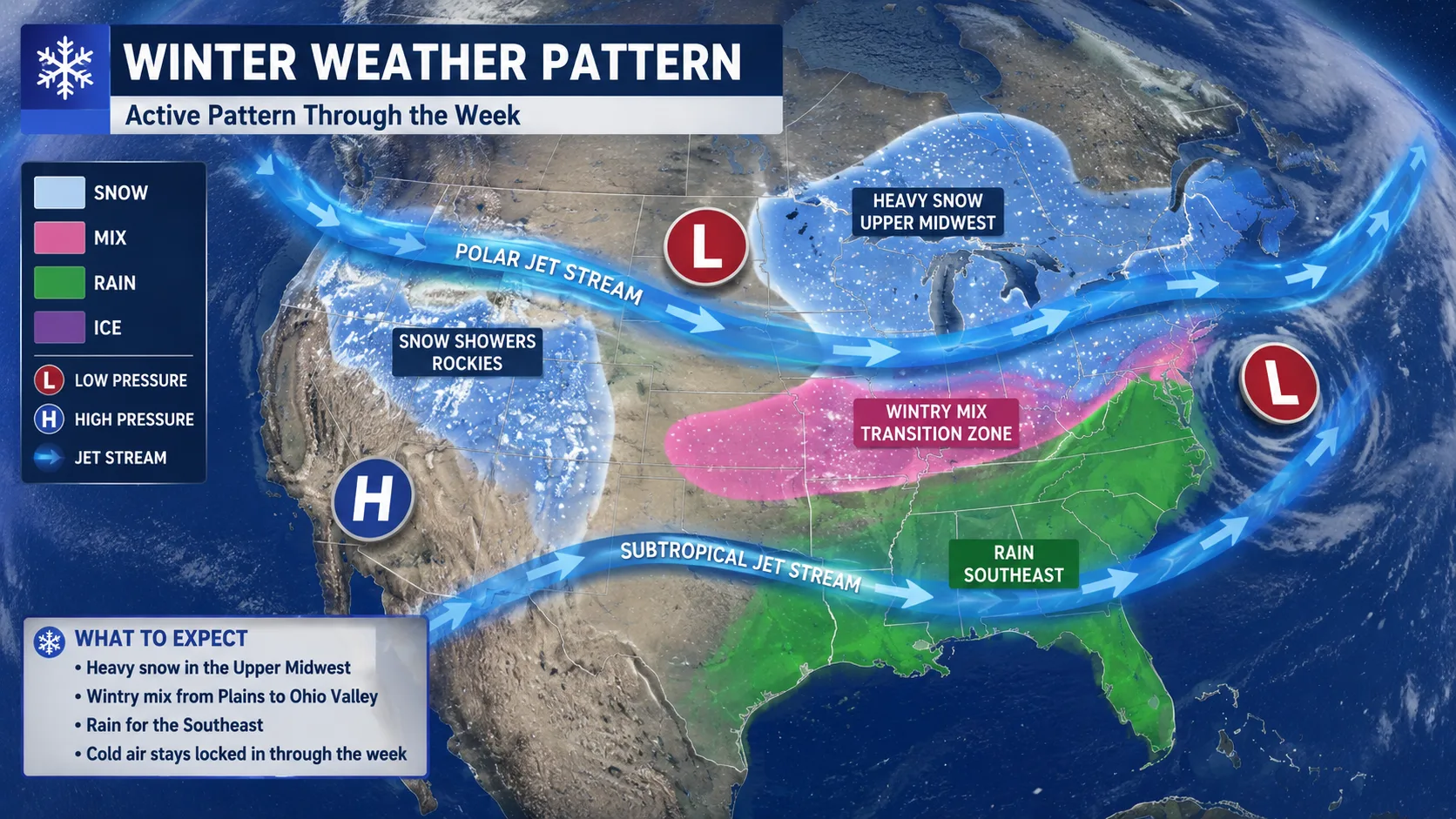
Toronto sits on the north shore of Lake Ontario, which shapes its snow in a way that is different from inland Ontario cities. The lake can delay the onset of snow in early winter, but it can also fuel sudden squalls once temperatures drop far enough for lake-effect bands to form.
This is part of why a single province-wide number is unreliable for the city. A storm that dumps heavy lake-effect snow on Barrie's snow belt, north of Toronto, can leave the downtown core with only a light dusting on the very same morning, simply because of how far each area sits from the lake and the direction the wind is blowing.
Environment Canada's public forecasts are a good starting point for raw snowfall and wind data, but they are not built to translate that data into a TDSB-specific closure probability, which is exactly the gap a dedicated Toronto snow day calculator is designed to fill.
TDSB vs. TCDSB vs. Peel: Do They Always Match?
No, and this trips up a lot of families. TDSB and the Toronto Catholic District School Board (TCDSB) make completely independent decisions. Neighbouring Peel District School Board, covering Mississauga and Brampton, is a separate board again, with its own transportation consortium.
- It is entirely possible for TDSB to stay open while TCDSB cancels buses, or the reverse.
- Peel decisions do not automatically apply to Toronto schools, and vice versa.
- Always check the calculator and official page for your specific board, not just your city.
Benefits and Use Cases
- Parents across Toronto's many neighbourhoods can plan childcare with a location-specific estimate instead of a generic city-wide guess.
- Students get a realistic read on whether tonight's homework will matter tomorrow.
- Commuting staff can anticipate whether transportation delays are likely, even if the school itself stays open.
- Families near the outer boundary of TDSB get a more accurate picture than a downtown-only estimate would provide.
- Anyone comparing TDSB, TCDSB or Peel can see how the same storm affects each board differently.
Common Mistakes to Avoid
- Assuming heavy snowfall automatically means TDSB will close. Toronto's infrastructure regularly absorbs snow totals that would close smaller boards.
- Using a generic Ontario-wide percentage for Toronto specifically. Toronto's real threshold is meaningfully higher than the provincial average.
- Confusing TDSB with TCDSB decisions. They are separate boards with separate announcements.
- Ignoring neighbourhood differences. Outer Toronto routes can see cancellations that downtown routes do not.
- Checking only once the night before. The most accurate number comes from a recheck close to 6 a.m.
Pro Tips
- Follow TDSB's official social media account directly, since it is sometimes updated slightly before the main website.
- Bookmark tdsb.on.ca and check it alongside the calculator for the fastest confirmed answer.
- Remember that a bus cancellation is the far more common outcome in Toronto, not a full school closure.
- If you live near the edge of TDSB boundaries, treat your result as a slightly conservative estimate and confirm locally.
Conclusion
A snow day calculator Toronto tool is only as good as the model behind it, and Toronto is genuinely different from the rest of Ontario. Between the TTC network, an extensive road maintenance fleet, and the logistics of coordinating 582 schools, TDSB's real closure threshold sits well above what raw snowfall totals alone would suggest.
Check your estimate the night before, recheck close to 6 a.m., and always confirm with TDSB's official channel before making final plans. Whether you are downtown, in Scarborough, or near the edge of the board's boundary, understanding Toronto's specific patterns will always beat a generic province-wide guess.
Also Checkout :