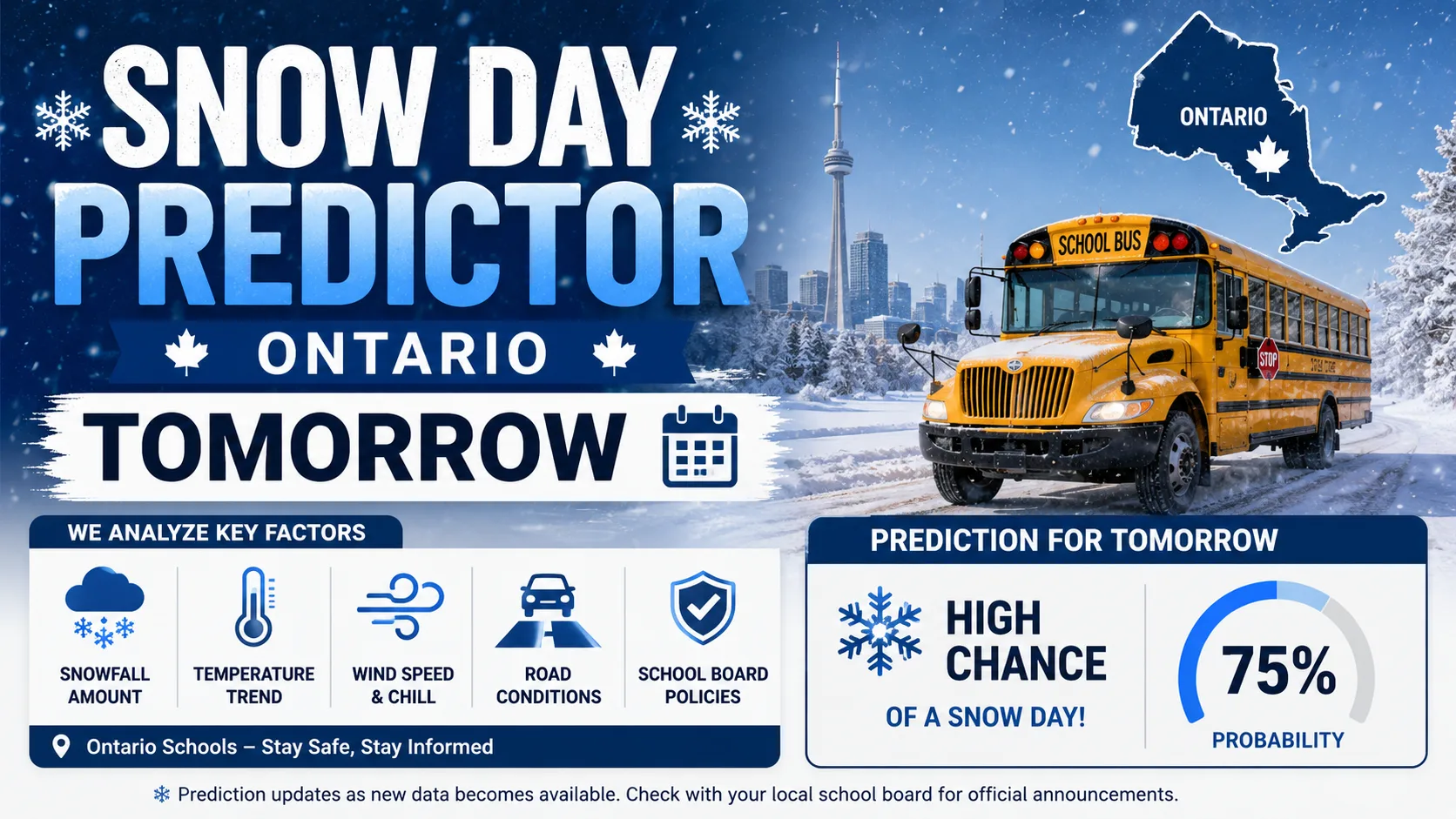
It is 9 p.m., snow is in the forecast, and you are refreshing your phone trying to answer one question: will school actually be closed tomorrow? A good snow day predictor Ontario tomorrow tool exists exactly for this moment, turning tonight's forecast into a real probability instead of a guess.
This guide walks through exactly how "tomorrow" predictions work, the real timeline Ontario boards follow overnight and into the morning, and how to read a probability score with confidence, whether you are checking at bedtime or right before the bus is supposed to arrive.
What Is a Snow Day Predictor for Tomorrow?
A snow day predictor Ontario tomorrow tool is a forward-looking version of a snow day calculator. Instead of only reflecting the day's current weather, it pulls tomorrow's forecast, snowfall, temperature, wind and timing, and scores how closely it resembles conditions that have historically triggered school closures.
The result is a simple percentage, along with a short explanation of what is driving the score. It is designed to answer one specific, time-sensitive question: what are the odds tomorrow looks like a snow day, based on what we know right now?
Why "Tomorrow" Predictions Are Different From a General Forecast
A weather app forecast and a snow day prediction are not the same thing, even though they use the same raw data. A forecast tells you it will snow 15 cm overnight. A snow day predictor tells you what that 15 cm is likely to mean for your specific school board.
The "tomorrow" version of the tool also has to deal with something a same-day check does not: uncertainty. Storm tracks, snowfall totals and temperature can all shift in the 12 to 18 hours between your evening check and the actual morning commute.
The Real Timeline: When Ontario Boards Decide About Tomorrow
Understanding the actual decision-making timeline is the single biggest thing that separates a useful prediction from a random guess. Here is how it typically plays out across Ontario boards.
This means your snow day predictor Ontario tomorrow check the night before is really an early estimate, while a check during the morning crunch window is your most reliable read before the official word arrives.
How the Predictor Calculates Tomorrow's Odds
The underlying scoring logic behind most tools looks similar to a weighted point system. Here is a simplified version of how it works.
| Factor | Approximate Weight | What Increases the Score |
|---|---|---|
| Overnight snowfall total | Up to 55% | 15+ cm expected before the morning commute |
| Temperature / wind chill | Up to 25% | Wind chill below -18°C to -20°C |
| Storm timing | Up to 15% | Heaviest snow overlapping the 5–8 a.m. bus window |
| Visibility / blowing snow | Up to 10%+ | Highway visibility warnings, drifting snow |
All four scores combine into a single capped percentage. A score above roughly 70% usually signals a strong chance of at least a bus cancellation, while anything above 85% starts to look like conditions boards have historically used for full closures.
Bus Cancellation vs. Full Snow Day Tomorrow
This distinction gets missed constantly, and it matters a lot for tomorrow's planning. A bus cancellation means transportation is suspended, but the school building stays open for students who can get there another way. A full snow day means the school itself is closed to everyone.
- High predictor percentage + urban board = usually a bus cancellation, school likely still open.
- High predictor percentage + rural or northern board = higher chance of a full closure.
- Students who normally ride the bus are generally excused from attendance on a bus cancellation day, even though the school is open.
How to Use a Snow Day Predictor for Tomorrow (Step by Step)
- Check tonight, between 8 and 10 p.m. Enter your city or postal code and note the early percentage as a planning baseline.
- Watch for an advance notice. If a major storm is expected, some boards post a heads-up between 9 and 11 p.m.
- Set an early alarm. Since the real decision happens during the 4 to 7 a.m. window, checking too early gives you outdated data.
- Recheck between 5 and 6:30 a.m. This is when the forecast is most accurate and closest to what your board is actually seeing.
- Compare the new percentage to last night's. A rising percentage confirms the storm tracked as expected; a dropping one means conditions likely improved overnight.
- Confirm on your board's official channel. Treat the predictor as your early warning, not the final word.
Real Examples: Checking the Night Before
Example 1: Barrie, Checked at 9 p.m.
- Forecast: 20 cm overnight, heaviest snow expected 4–7 a.m., wind chill -14°C
- Predicted chance at 9 p.m.: 75%
- Rechecked at 5:30 a.m.: snowfall confirmed on track, chance rises to 88%
- Outcome pattern: high likelihood of bus cancellation, possible full closure in surrounding rural zones
Example 2: Toronto, Checked at 9 p.m.
- Forecast: 6 cm overnight, tapering off by 5 a.m., temperature -5°C
- Predicted chance at 9 p.m.: 28%
- Rechecked at 5:30 a.m.: snow ended earlier than forecast, chance drops to 15%
- Outcome pattern: normal school day, at most a minor delay
Example 3: Ottawa, Checked at 9 p.m.
- Forecast: 8 cm snow plus wind chill warning near -28°C
- Predicted chance at 9 p.m.: 52%
- Rechecked at 5:30 a.m.: cold snap intensified, chance rises to 66%
- Outcome pattern: cold-driven bus cancellation is realistic even with modest snowfall
These examples highlight the core lesson: your tonight check and your tomorrow-morning check can tell two different stories, and the morning number is almost always the one that matters most.
Benefits of Checking a Snow Day Predictor the Night Before
- Parents can arrange backup childcare in advance instead of scrambling after a 6 a.m. announcement.
- Students can decide whether finishing tonight's homework is worth prioritizing.
- Shift workers and commuters can plan an earlier departure if roads are likely to be affected regardless of school status.
- Rural families get an early signal for routes that are historically the first to be cancelled.
- Anyone with an early morning gets one less unknown to deal with before the school day even starts.
Common Mistakes When Checking Tomorrow's Prediction
- Only checking once, at night, and never rechecking in the morning. Overnight forecasts shift, sometimes significantly.
- Assuming a province-wide percentage applies to your exact board. Northern and rural boards often close far more easily than urban ones under the same storm.
- Confusing a bus cancellation with a full snow day. They are not the same outcome, and mixing them up leads to bad planning.
- Ignoring wind chill in favour of snowfall totals alone. Extreme cold can drive cancellations even with light snow.
- Treating the predictor as an official announcement. It is a planning tool, not a confirmed decision from your board.
Pro Tips for the Most Accurate "Tomorrow" Prediction
- Check twice: once at night for early planning, once during the morning crunch window for accuracy.
- Pay attention to whether the heaviest snow is forecast to fall during the 5–8 a.m. bus window specifically, not just the overnight total.
- Bookmark your board's official closure page so the final confirmation is one click away.
- During active storm season, sign up for your board's text or email alert system as a backup to any predictor.
Conclusion
A snow day predictor Ontario tomorrow check is most useful when you treat it as a two-step routine rather than a single glance. Check tonight for early planning, then recheck during the morning crunch window between 4 and 7 a.m. for the most accurate probability before your board makes its official call.
Understanding the real timeline, the difference between a bus cancellation and a full closure, and how storm timing shifts overnight will always give you a clearer picture than a single generic percentage. Bookmark your predictor and your board's official page together, and you will never be caught off guard by tomorrow's forecast again.
Also Checkout :