
A snow day for teachers is any day a school district cancels in-person classes because of snow, ice, or dangerously cold temperatures. For teachers, it means no classroom instruction, but it rarely means a true day off. Most teachers still owe that day back to the calendar, and many spend it grading, planning, or preparing digital lessons instead.
This guide explains exactly how snow day predictions work, whether teachers get paid, what a typical snow day actually looks like for staff, and how to use a snow day calculator to plan ahead with confidence.
What Is a Snow Day for Teachers
A snow day happens when a superintendent or district official decides that road conditions, sidewalks, or bus routes are too dangerous for students and staff to travel safely. The decision usually comes early in the morning, often between 4:30 AM and 6:00 AM, based on overnight snowfall, ice accumulation, and wind chill.
The term covers more ground than most people realize. A true snow day is a full closure, but districts also use related terms that mean something slightly different for staff:
- Emergency closure day: The broader legal term many state education departments use, covering snow, ice, flooding, or power outages, not just snowfall.
- Calamity day: A term common in the Midwest for any weather-related closure that counts against a district's built-in allowance.
- Cold day: A closure triggered purely by dangerous wind chill, even when little or no snow has fallen.
Every district sets its own threshold for calling a closure, and that threshold is shaped by geography as much as by the forecast. A district in Minnesota with a full fleet of plows and drivers experienced in winter conditions might stay open through 5 inches of snow, while a district in coastal Georgia could close for a light dusting because roads, tires, and driver experience simply are not built for it. This is why a snow day calculator has to be localized rather than based on a single national snowfall threshold.
For teachers, a snow day changes the workday but does not always cancel it. Districts handle this in one of three ways:
- Traditional snow day: School is fully closed. No instruction happens, and the day is typically made up later in the year.
- Remote learning day: Teachers run lessons virtually through Google Classroom, Canvas, or Zoom instead of losing the instructional day.
- Staff-only closure: Rare, but some districts close for students while asking certain staff to report if conditions allow.
[Suggested image placement: A wide banner photo of an empty snow-covered school parking lot at sunrise. Alt text: "Empty school parking lot covered in snow on a canceled school day for teachers."]
How Snow Day Predictions Work
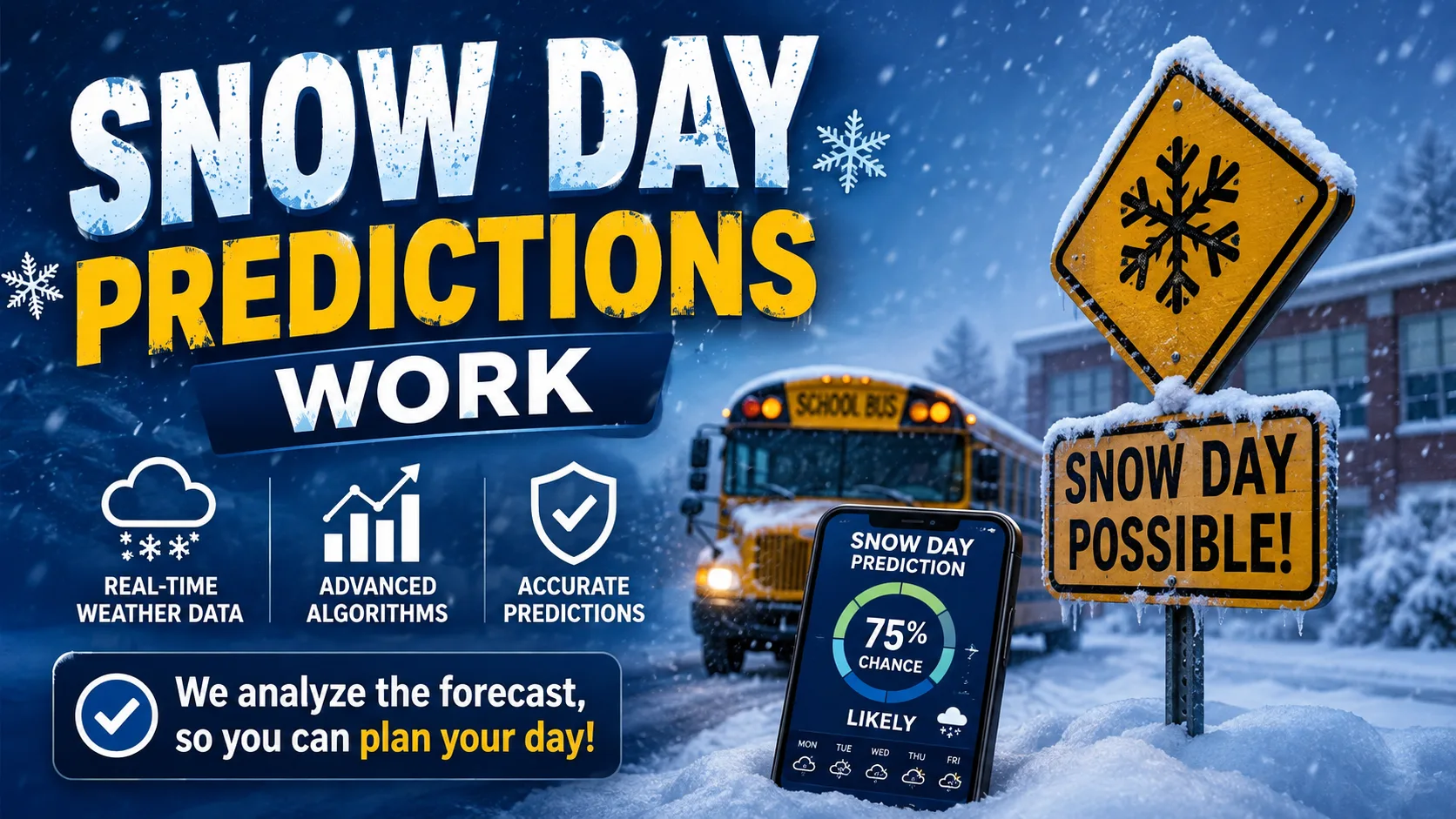
Snow day calculators do not just look at how many inches are forecast. They combine several data points into one probability score so teachers and families can plan the night before instead of waiting for a 5 AM phone alert.
The main inputs behind a reliable prediction include:
- Forecasted snowfall totals for your exact ZIP code or district boundary
- Timing of the storm, since snow that falls overnight matters more than snow that falls midday
- Temperature and wind chill, which affect ice formation on roads and sidewalks
- Road and sidewalk conditions, including whether ice is expected under the snow layer
- Historical closure patterns for that specific district, since a coastal district and a mountain district react very differently to the same forecast
Districts in the South or coastal regions tend to close for far less snow than districts in the Midwest or Northeast, simply because they lack the plows, salt trucks, and driver experience to handle it safely. A calculator that ignores this local history will overpredict or underpredict closures constantly.
There is also a human factor behind every prediction. Superintendents weigh more than raw weather data before making a call. They typically consider:
- Bus route safety, since rural districts often have longer routes on unplowed roads than urban districts
- Staff commute distance, especially in districts where many teachers live outside the community they teach in
- State minimum instructional-day rules, which discourage unnecessary closures once a district is close to its built-in limit
- Neighboring district decisions, since districts that share bus contractors or road crews often coordinate closures
This is why two districts fifteen minutes apart can make opposite calls on the same morning. A calculator can model the weather side of the equation with strong accuracy, but the human decision-making layer is why predictions are labeled as probabilities rather than guarantees.
[Suggested image placement: A simple infographic showing a thermometer, snowflake icon, and road icon feeding into a percentage gauge. Alt text: "Snow day calculator inputs including snowfall, ice risk, and temperature for teachers."]
The Prediction Formula
Most snow day calculators, including the model used on this site, boil the inputs down into a weighted percentage. A simplified version of the logic looks like this:
| Factor | Weight in Prediction | Why It Matters |
|---|---|---|
| Overnight snowfall total | 35% | Snow that accumulates while buses are idle overnight is the strongest closure signal |
| Ice or freezing rain risk | 25% | Ice is more dangerous than snow and closes schools with far less accumulation |
| District closure history | 20% | Some districts close at 2 inches, others need 8 or more |
| Wind chill and temperature | 10% | Extreme cold alone can trigger closures even without snow |
| Timing of the storm | 10% | Late-night and early-morning storms affect bus routes the most |
The result is displayed as a percentage, such as 78% likely, so you can gauge your odds instead of guessing. It is an estimate, not a guarantee. The final call always belongs to your superintendent.
Step-by-Step: Using the Calculator
Here is how to check your snow day odds in under a minute:
- Go to the calculator. Visit the main snow day calculator and enter your school's ZIP code or district name.
- Review the percentage. The tool returns a closure probability along with the reasoning behind it, such as expected snowfall and ice risk.
- Check the full directory if needed. If your district is not listed by name, browse the calculator directory for a nearby match.
- Compare against your state trend. Use the state-by-state predictions page to see how your state is trending for the week, which is useful for planning sub coverage days in advance.
- Recheck the morning of. Predictions update as new weather data comes in, so a 9 PM check and a 5 AM check can look different.
- Have a backup plan ready. If your odds are above 60%, prep a short digital assignment the night before so you are not scrambling at 6 AM.
Do Teachers Get Paid on Snow Days?
In most public school districts, salaried teachers still get paid on snow days. Teacher pay is typically spread across annual pay periods rather than tied to individual days worked, so a single closure does not usually reduce a paycheck.
What changes is the school calendar, not the paycheck. Districts generally handle missed instructional time in one of these ways:
- Built-in calamity days: Many state calendars already include a set number of snow days (often 3 to 6) that never need to be made up.
- Make-up days added later: If closures exceed the built-in allowance, days are commonly added to the end of the school year or subtracted from spring break.
- Remote instruction credit: Some states let districts count a remote learning day as a full instructional day, avoiding the need for a make-up day entirely.
Hourly staff are the exception to watch. Bus drivers, paraprofessionals, cafeteria workers, and other hourly employees are far more likely to lose pay on a closure day unless their district specifically guarantees it in the contract.
"Districts often have a set number of required instructional days. If closures exceed the built-in emergency days, the district may add make-up days rather than withhold teacher pay." — summarized from employment policy guidance cited by Quora contributors familiar with district contract language
"On snow days, teaching and clerical staff are not required to report to work, and those days amount to paid time off, though a make-up day can sometimes be scheduled later." — Cincinnati Federation of Teachers, staff weather-day guidance
Real-world example: A district with a 180-day contract year and 4 built-in calamity days can close for snow up to 4 times with zero schedule changes. On the 5th closure, the district typically adds one make-up day, often at the end of the year or by trimming a scheduled break. Teacher pay does not change either way, since salary is already distributed across the full contract term.
State rules add another layer. Some states set a hard minimum number of instructional hours or days that every district must hit, regardless of weather. If a district falls short, it can lose state funding tied to attendance, which is part of why some states now allow "remote instruction" closures instead of a full calendar extension. Other states grant waivers after unusually severe winters, letting districts skip make-up days entirely once they can show the closures were unavoidable.
For teachers weighing a new contract offer, it is worth asking two direct questions during hiring: how many built-in calamity days does the calendar include, and does the district guarantee pay during closures that exceed that number. Those two answers tell you almost everything about how a rough winter will affect your schedule and your paycheck.
What Teachers Actually Do on a Snow Day
Contrary to the stereotype of teachers relaxing all day, most spend at least part of a snow day working. Common tasks include:
- Grading papers and entering report card data
- Responding to parent and student emails
- Building or updating lesson plans for the week ahead
- Preparing sub plans in case the closure extends another day
- Uploading assignments to Google Classroom or Canvas for students to complete at home
Special education teachers often use the time to write required progress reports and IEP documentation, since those deadlines do not pause for weather. Even so, most teachers still treat part of the day as genuine rest, since a snow day is one of the few unscheduled breaks in a school year.
Twelve-month staff, including administrators, front-office employees, and building custodians, often have a very different snow day than classroom teachers. Many are still expected to report to the building to manage boilers, clear walkways, or keep the office running for phone calls from families. This is a common point of confusion, since students and even some teachers assume the whole campus shuts down when in reality a smaller staff is still on site.
A useful way to think about it: a snow day pauses instruction, not the operation of the school. Teachers get relief from the classroom schedule, but the paperwork, planning, and communication side of the job rarely stops completely, especially during the weeks leading up to report cards or state testing windows.
Read More : School District Snow Day Policy
Snow Day vs. Remote Day vs. Late Start
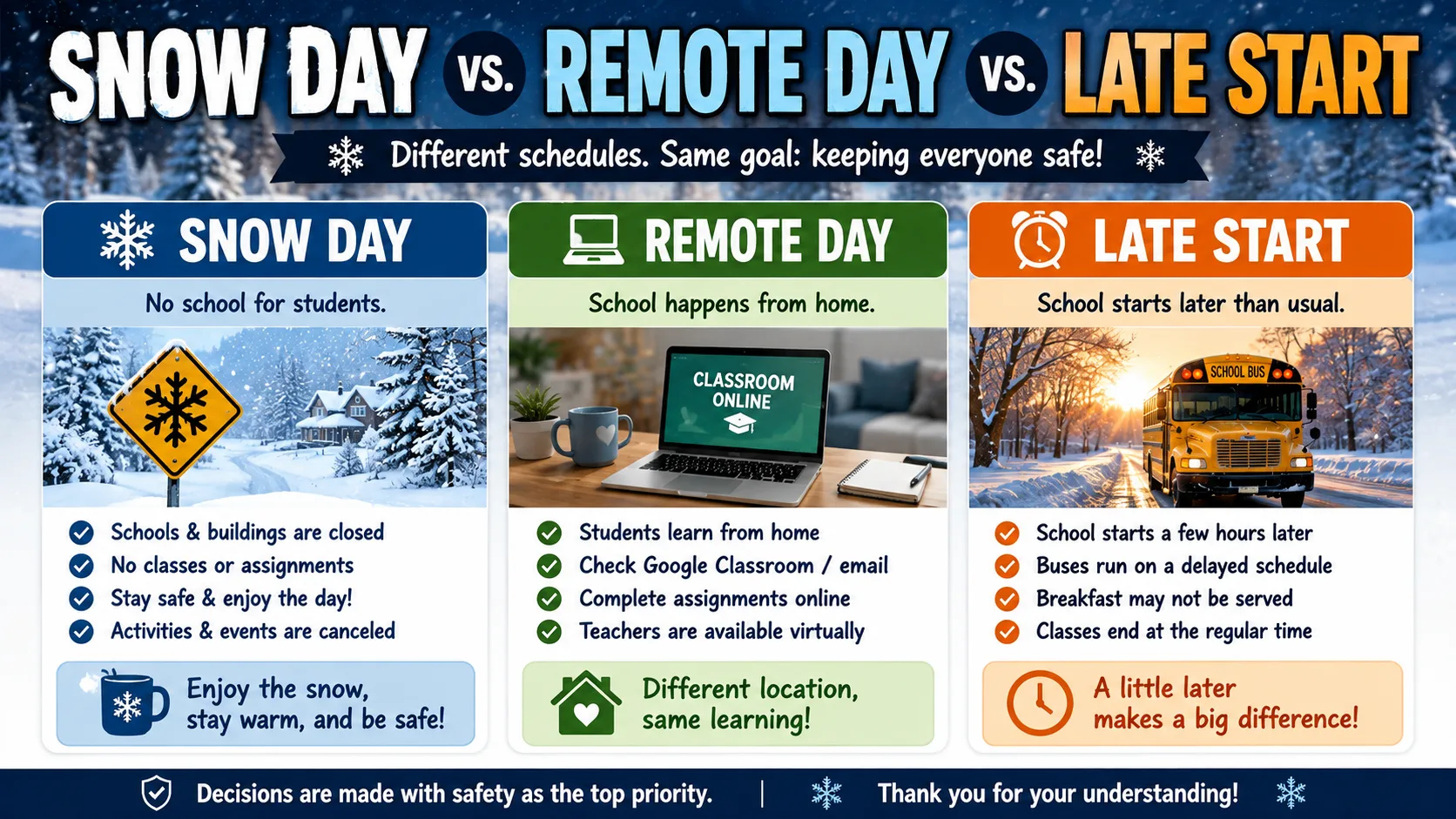
Not every winter weather closure looks the same. Here is how the three most common options compare for teachers:
| Type | Instruction Required? | Counts as School Day? | Typical Teacher Workload |
|---|---|---|---|
| Traditional snow day | No | Often no, unless a built-in calamity day | Light, mostly optional prep work |
| Remote learning day | Yes, virtual | Usually yes | Full teaching workload from home |
| Late start / early dismissal | Partial | Yes | Normal, on a shortened schedule |
Regional Snowfall Thresholds: A Real Example
One of the biggest sources of confusion for new teachers, especially those relocating to a different climate, is assuming snowfall thresholds are the same everywhere. They are not. Here is a general pattern based on regional infrastructure and driving norms:
| Region Type | Typical Snow Needed to Close | Why |
|---|---|---|
| Deep South / coastal | Under 1 inch, or any ice | Few plows, limited driver experience with snow |
| Mid-Atlantic / transitional climates | 2 to 4 inches | Moderate plowing capacity, mixed driver experience |
| Midwest / Northeast | 4 to 8 inches | Strong plow fleets, drivers accustomed to snow |
| Mountain West | 8 inches or more, unless ice is present | Heavy winter infrastructure built into daily operations |
A teacher moving from a snowy Northeastern district to a coastal Southern district often has to unlearn their old expectations. A forecast that would barely register as "a light dusting" up north can shut down an entire coastal district for a day or two, simply because the roads, tires, and salt supply are not built for winter weather.
Common Mistakes and Pro Tips
Mistake 1: Waiting until the last minute to prep a sub plan. If your calculator prediction is above 50%, prep a short backup lesson the night before instead of scrambling at 6 AM.
Mistake 2: Assuming pay is guaranteed everywhere. Contract language varies widely by district and employment type. Check your specific handbook rather than relying on general assumptions.
Mistake 3: Ignoring extreme cold as a closure trigger. Wind chill alone can cancel school even without fresh snowfall. Our wind chill calculator is a useful companion check during deep-freeze weeks.
Pro tip: Check the prediction twice, once the night before and again between 5 and 6 AM, since most districts finalize closure decisions in that window.
Mistake 4: Not clarifying make-up day policy at the start of the year. Ask during your first staff meeting how the district plans to handle missed days once the built-in allowance runs out. It saves confusion later in a rough winter.
Mistake 5: Overloading a remote learning day with too much content. Students and families are often dealing with the same weather disruption at home. Keep virtual assignments short and focused rather than trying to replicate a full class period.
Pro tip: If your area is prone to sudden cold snaps, keep an eye on the heat index calculator and wind chill tool together throughout the year so you get used to reading both extremes the same way your district's weather policy does.
Conclusion
A snow day for teachers means no classroom instruction, but it rarely means zero responsibility. Pay usually continues as normal for salaried staff, while the missed instructional time gets handled through built-in calamity days, added make-up days, or remote learning credit depending on your state and district.
The best way to plan ahead is to check your odds before the alarm goes off. Whether you are a first-year teacher trying to understand your district's calamity day policy, or a veteran educator just looking to know if you should prep a sub plan tonight, a quick check of the numbers beats waiting on a 5 AM phone call.