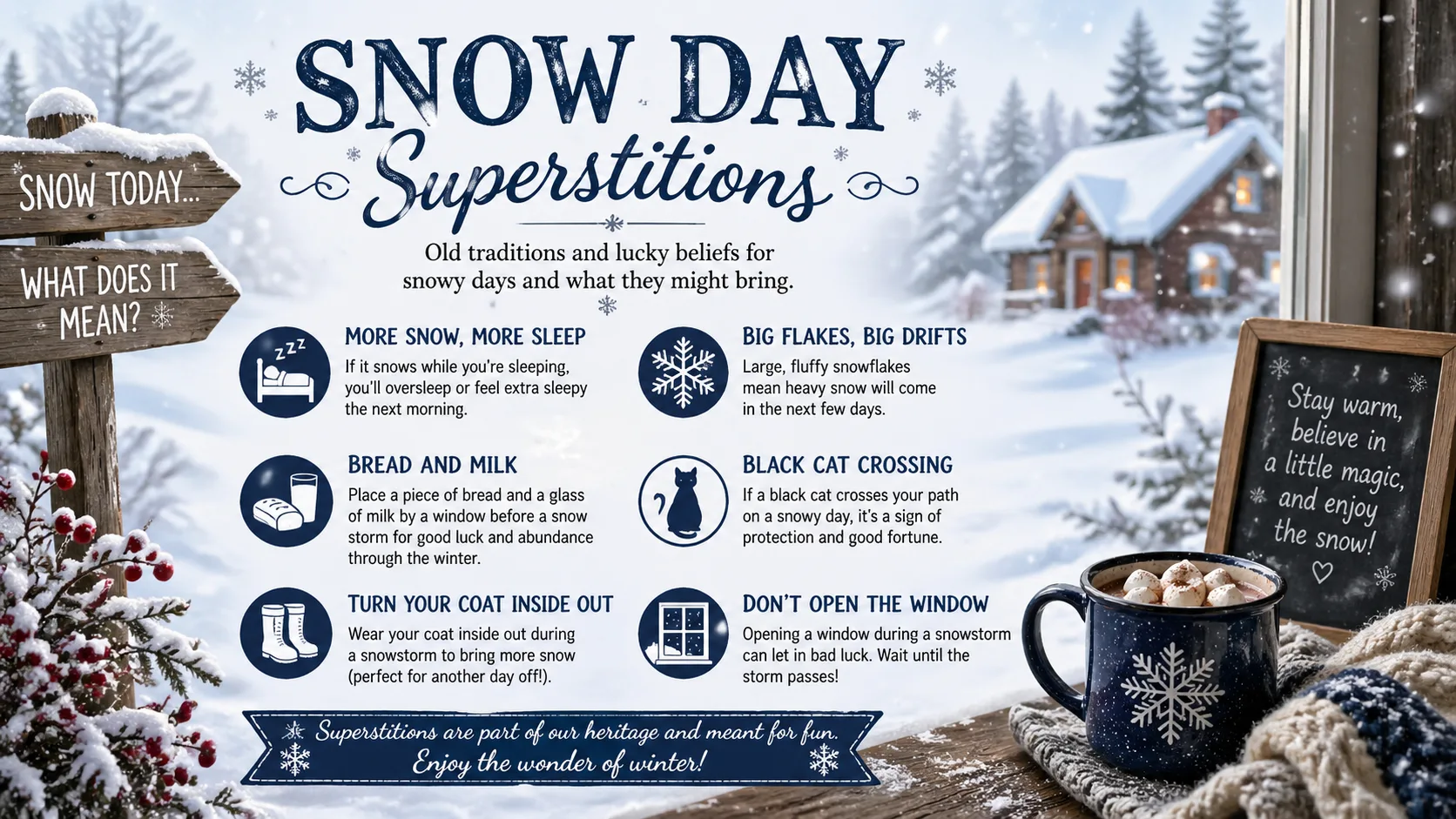
It's 9 p.m. The forecast shows snow, and your kid is standing in front of the open freezer, counting ice cubes into a bowl. Pajamas are on inside out. A spoon is already hiding under the pillow.
If you grew up anywhere near a snowy winter, you probably did the same thing. Snow day superstitions are one of those childhood rituals that nobody officially teaches, yet almost everybody knows. So do they work? Short answer: no. Long answer: they do something else that's worth knowing about. This guide covers every ritual, where the habits probably came from what psychology says about them and what actually decides whether your school closes.
If you want a real estimate for tomorrow morning, our snow day calculator is there for that.
What Are Snow Day Superstitions?
A snow day superstition is any small ritual you perform the night before a storm in the hope that school (or work) gets cancelled. Most are free, silly and take about two minutes.
They show up across the northern United States, Canada and cold parts of Europe. They've also been reported in places that barely see snow, like Tennessee, where a single flurry can empty a school.
Nobody knows who invented them. They spread the fashioned way: older siblings pass them to younger ones kids swap them on the bus and teachers sometimes join in. Social media has now pushed them well beyond the classroom, so a ritual from one town can go national in a week.
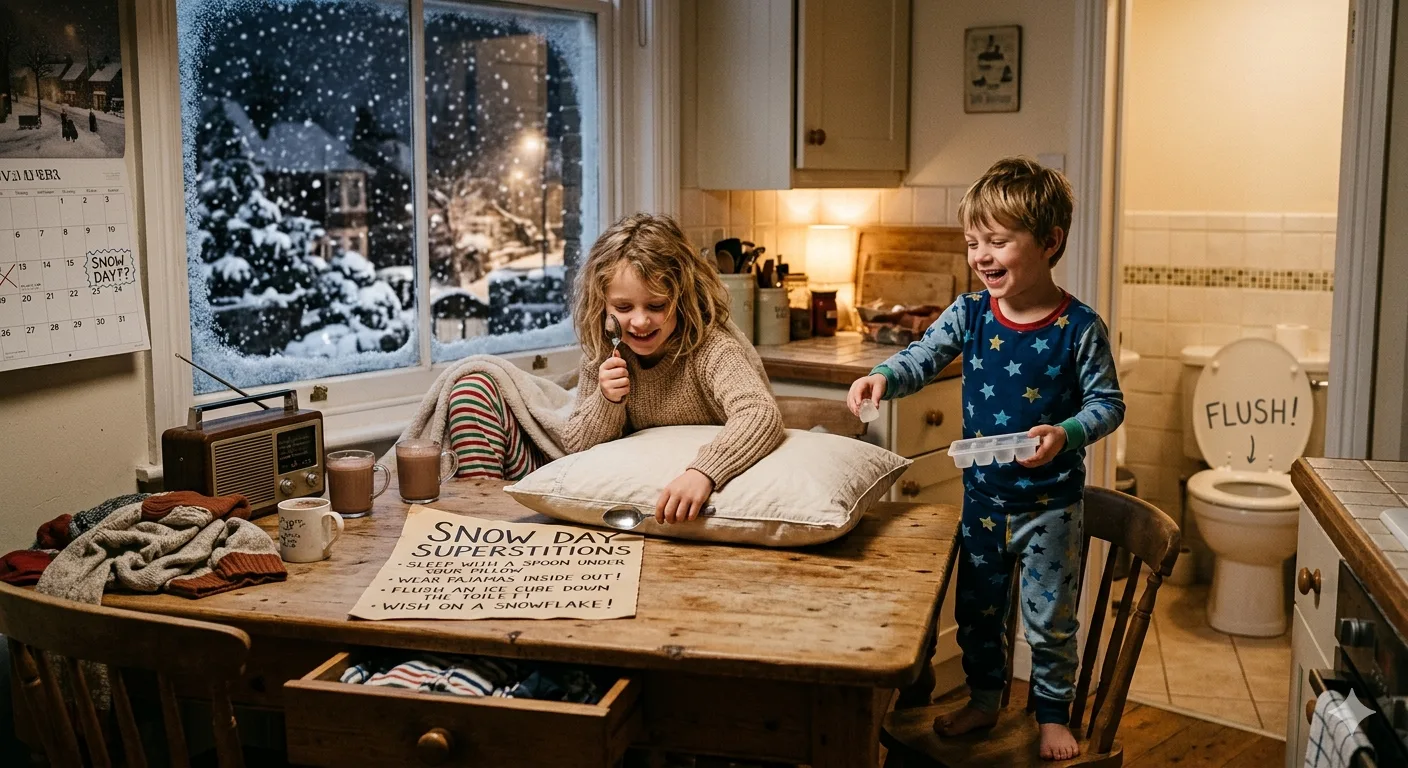
The Most Famous Ritual: Flushing Ice Cubes Down the Toilet
If you only know one snow day superstition, it's this one. Ask a group of adults who grew up with winters and most will recognize it right away.
How the Ice Cube Ritual Is Supposed to Work
- Before bed, grab ice cubes from the freezer.
- Decide how much snow you want. The tradition says one cube per inch, so six cubes for six inches.
- Drop the cubes into the toilet and flush them one at a time.
- Say "snow day" with each flush if you're feeling committed.
- Finish the rest of your routine and go to sleep.
Why People Think It Works
The logic is that cold water sent down the pipes will somehow "cool the region" enough for snow to fall. It's charming reasoning. It's also not how weather works.
Snow depends on temperature at several levels of the atmosphere, moisture, and lift in the air. A few melted cubes disappear into a sewer line and have no way of influencing any of that. Meteorologists have said so repeatedly.
Verdict: a myth, but a harmless and very fun one.
The Complete List of Snow Day Superstitions
Here are the 14 rituals you'll hear about most, with how each one is done and what it supposedly means. Treat them as a menu. Pick the ones your family enjoys.
1. Flush Ice Cubes
The classic. One cube per inch of snow you'd like, flushed one at a time.
2. Wear Pajamas Inside Out and Backwards
The idea is to "confuse" the weather by turning your own routine upside down. Some families only do one of the two. Purists insist on both at once.
3. Sleep With a Spoon Under Your Pillow
A metal spoon stands in for a snow shovel, a sign you're ready for the pile that's coming. Some people say the cold metal "calls" cold air.
4. Put a White Crayon on the Windowsill
White crayon, white snow. Place one on every windowsill to invite the flakes in. Some families put the crayon in the freezer instead.
5. Yell "Snow Day!" Into the Freezer
Open the door, lean in, and announce your wish. If the freezer is convinced, the sky might be next.
6. Brush Your Teeth With Your Non-Dominant Hand
This is the "sacrifice" ritual. A little discomfort is the offering you make to the snow gods.
7. Eat Ice Cream at Night
Not really a superstition so much as a reasonable excuse. Still, it shows up on almost every list, and no kid has ever complained.
8. Run Around the Kitchen Table Five Times
Exactly five, according to the people who care. It also happens to burn off bedtime energy, which parents may quietly appreciate.
9. Sleep Backwards in Bed
Put your head where your feet normally go. It's another "reverse the weather" move.
10. Toss Ice Cubes Into the Yard
Scatter a few outside to "seed" the ground with cold. Some people shave the ice and sprinkle it on trees instead.
11. Tape a Quarter to the Window
A small payment to Jack Frost. Cheap, and you get the coin back if the snow doesn't come.
12. Do a Snow Dance
Dance around the living room as if you were shaking a snow globe. Everyone looks ridiculous, which is the point.
13. Hang Ice Skates on the Door
This one is a regional favorite in some areas. The skates are a signal that you're ready for ice and snow.
14. Wish on a Shooting Star
If you happen to spot one on a clear night, some kids add a snow wish. It's the only ritual on this list that depends entirely on luck.
Where Do These Rituals Come From?
Honestly, nobody knows. There's no single origin story, and anyone who gives you one with total confidence is guessing.
What we can say is that humans have tried to nudge the weather for a very long time, through rain dances, charms and folk sayings in many cultures. Snow day rituals feel like a playful version of that same urge.
These rituals even have a presence in higher education. The Johns Hopkins University admissions blog has a student post listing its favorite snow day superstitions, with the spoon, the ice cubes and the backwards pajamas all making the cut. When a research university writes about it, you know the habit goes deep.
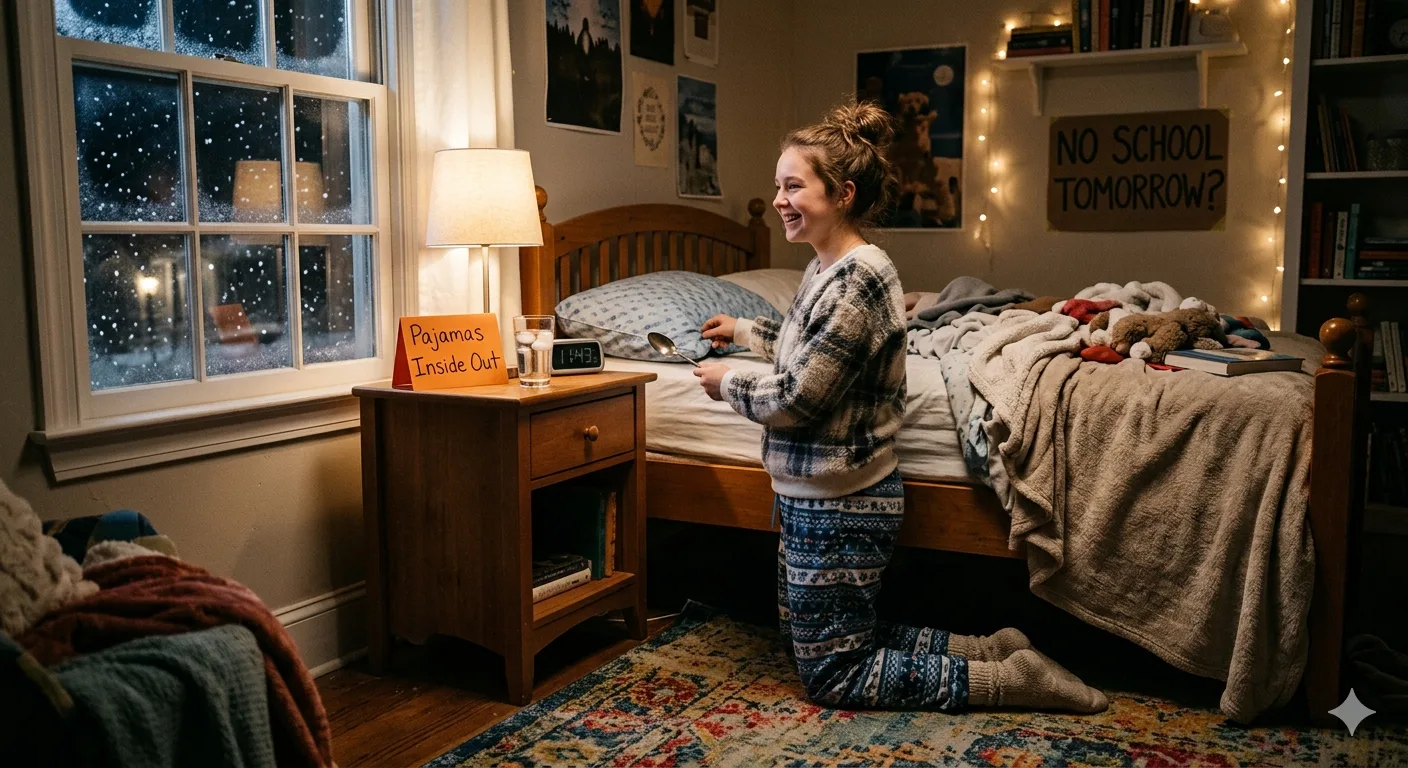
What Psychology Says About Snow Day Rituals
Rituals don't change the weather, but they clearly do something to us. Three ideas explain most of it.
Magical Thinking Is Normal
Young children often believe their thoughts or actions can shape events in the outside world. Psychologists call this magical thinking, and it's a normal stage of development. A kid flushing ice cubes is doing what kids do.
The Illusion of Control
Adults do it too. Athletes wear lucky socks, fans refuse to move from the couch when their team is winning, and students eat the same breakfast before every exam. When an outcome is out of our hands, a small ritual gives us a feeling of control. A snow day is a perfect example, because the weather and the school district decide it, not you.
Confirmation Bias Does the Rest
If you did the ritual and school closed, you remember it. If you did the ritual and school stayed open, you forget it, or decide you missed a step. Over the years that selective memory builds a long list of times it "worked".
There's also a social side. Doing the ritual together turns a wait into a family event and that shared feeling may be the real reward.
What Actually Decides a Snow Day
This is the part most superstition articles skip, and it's the part that helps you plan. Closures usually come down to a handful of practical factors.
- Timing of the snow. Snow that falls overnight and is still falling at 5 a.m. is far more likely to close schools than snow that arrives mid-morning.
- Total accumulation. A dusting rarely closes anything. Several inches on untreated roads is a different story.
- Ice and freezing rain. Ice is often worse than snow for school buses and sidewalks when the amounts look small.
- Temperature. Very cold mornings can cause delays or closures on their own, because buses struggle to start and kids wait outside.
- Wind. Strong wind causes drifting. Makes roads harder to clear and it makes the air feel much colder than the thermometer says.
- Road clearing capacity. Some districts, especially rural ones with long bus routes, close sooner than a compact city district would.
- The district's own habits. Every district has its own comfort level, and that varies a lot from one place to the next.
On very cold mornings, check the real "feels like" temperature before the kids head out. Our wind chill calculator turns temperature and wind speed into a number you can use to decide how many layers to put on and how long it's safe to stand at the bus stop.
When the Forecast Flips to Rain
A storm that starts as snow can change over to rain or freezing rain, and that changes everything. A district that was ready to close may decide to open late or run on a delay instead.
If you're trying to figure out how a wet messy morning might affect your day the rain delay calculator is a companion to keep open alongside the forecast.
How to Estimate Your Chances Before Bed
I built this site after noticing how confused parents in my area were about school closures. Everyone was refreshing five different tabs and texting each other at 5 a.m., and nobody was sure what was going on.
A tool can't replace gut feeling and local knowledge. It can make the guessing a lot less stressful. Here's how I'd use it.
- Check the forecast first. Look at when the snow starts and stops, not just the total.
- Run the numbers. Open the snow day calculator. Enter your details for a probability estimate.
- Re-check in the evening. Forecasts shift, so look again before bed and once more early in the morning.
- Plan for both outcomes. Prepare as if school might close and as if it might not.
- Wait for the official word. This is the most important step.
In my opinion, no calculator can replace the official announcement from your school district. A probability is an estimate. The district's decision is the fact. Use any tool, mine included, to prepare, and let the official announcement make the final call.
How Closures Work in the US, Canada and the UK
The same snowfall can lead to different outcomes depending on where you live, because the decision-makers are different.
- United States: Usually the school district decides, often early in the morning and sometimes the night before. Announcements typically go out by text, email, app, local news and the district website.
- Canada: In some regions, school bus cancellations are decided separately from school closures, so schools may technically be open while buses aren't running. Always check which one your announcement refers to.
- United Kingdom: Individual schools often make the call, so one school may close while another a few miles away stays open. Check your own school's website, app or message system.
Whichever country you're in, the rule is the same. Find out in advance where your school posts its announcement, and save that page or app on your phone before the storm.
The 2026 Reality: Snow Days Are Changing
Snow days feel rarer than they used to. Part of that is milder winters in some areas, and part of it is technology. Many districts now use remote learning days so a storm might mean logging in from home of a true day off.
That makes it more important than ever to read the announcement carefully. "School is closed" and "school is virtual today" are very different messages for a kid hoping to sled all day.
Another 2026 trend is how fast rituals spread. A new variation can start with one family's video and be copied across the country within days. The ritual is the same old idea, just faster.
The Full Snow Day Ritual, Step by Step
Want to go all in? This is the full routine, combined for maximum (completely fictional) snow-summoning power. It takes about ten minutes and works best with kids.
- Check the forecast. Rituals feel better when snow is actually possible.
- Flush the cubes. One cube per inch you're hoping for, using whole cubes rather than crushed ice.
- Toss a few cubes in the yard. Seed the ground with a little cold.
- Place a white crayon on each windowsill. If you run out of white, blue works in a pinch.
- Eat a scoop of ice cream. Vanilla is traditional.
- Run around the table five times. Five exactly, not four and not six.
- Shout "Snow day!" into the freezer. Then close the door and walk away calmly.
- Put on pajamas inside out and backwards.
- Slide a spoon under your pillow.
- Sleep with your head at the foot of the bed. Cross your fingers if you like.
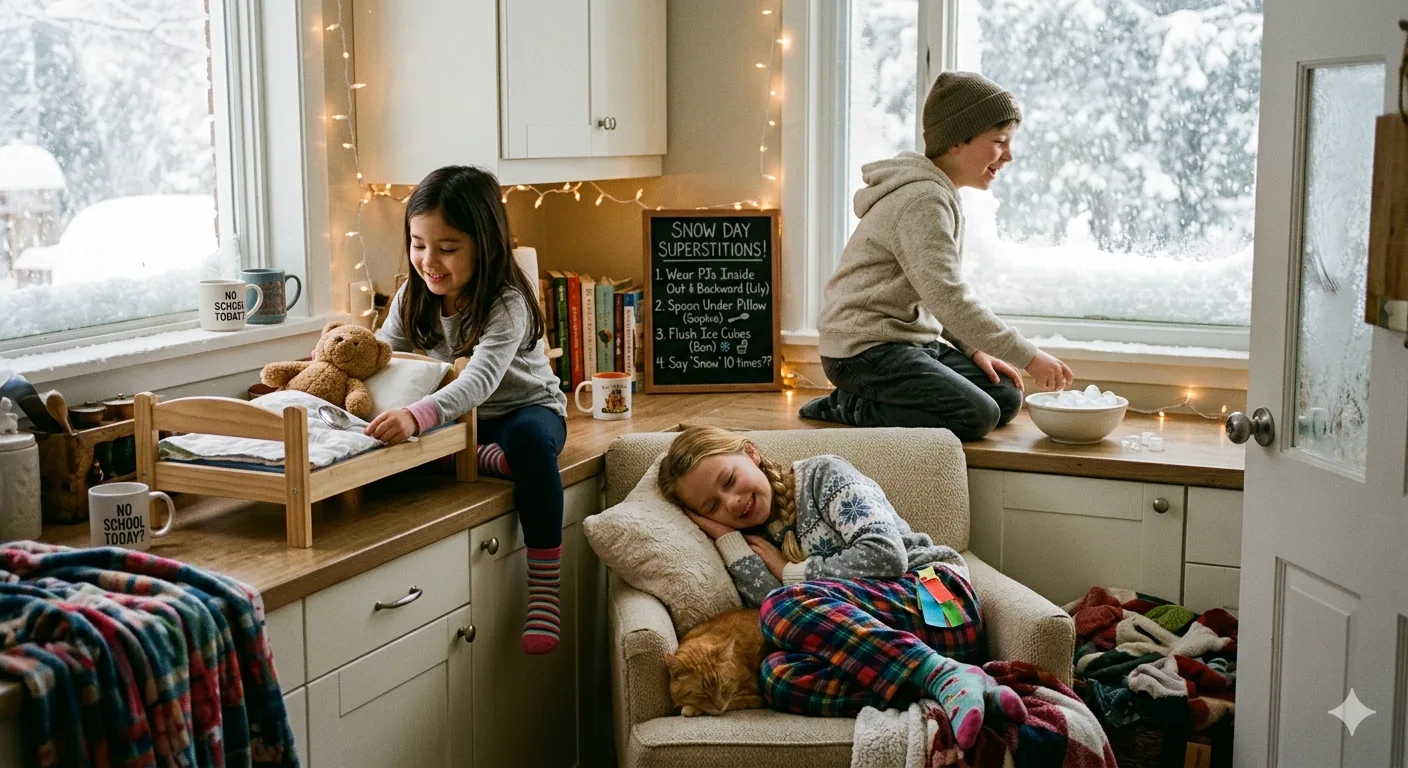
Common Mistakes (With and Without the Ritual)
Ritual Mistakes
- Using crushed ice instead of whole cubes.
- Wearing pajamas inside out but not backwards, or the other way around.
- Forgetting the white crayon, which is the step people blame most often.
- Doing the ritual with zero chance of snow in the forecast.
Real-Life Planning Mistakes
- Assuming the rumor from another parent is the official word.
- Not knowing where your district posts closures.
- Forgetting that a closure might mean a remote learning day.
- Waiting until morning to arrange childcare or a work-from-home plan.
- Skipping layers and gear for the kids on very cold days.
A Practical Night-Before Checklist for Parents
The ritual covers the fun. This list covers everything and it'll make your morning smoother whether school closes or not.
- Charge phones, tablets and laptops in case of a power outage or a remote day.
- Save your school's announcement page, app or phone line in an easy spot.
- Set an alarm a little earlier than usual so you can check the news calmly.
- Lay out boots, gloves, hats and coats in one place.
- Have a plan for childcare or work if schools close.
- Keep a few activities ready like board games baking supplies or craft projects.
- If you need to drive, clear off snow and keep an ice scraper within reach.
Should You Actually Do Snow Day Superstitions?
Yes, with the right attitude. Do them for the laughs and the family tradition, not as a weather-control plan.
- Make it a family event. The excitement is half of the fun.
- Film it. A short clip of kids flushing ice cubes becomes a keepsake quickly.
- Pair it with real information. Look at the forecast so everyone's expectations are realistic.
- Win either way. If it snows, the ritual "worked". If it doesn't, you still had a great evening.
Beyond Snow: Other Weather Tools
Winter isn't the only season that disrupts schedules. In the months extreme heat can force schools to change plans and the heat index calculator helps you understand how hot it really feels. You can also browse our set of free weather calculators for other tools that make planning easier.
Conclusion: The Magic Is in the Tradition
Snow day superstitions can't change the weather. Flushing ice cubes, wearing pajamas inside out and sleeping with a spoon won't move a single snowflake. Meteorologists are clear about that, and so is physics.
What the rituals do give you is a shared moment, a bit of hope and a story to tell later. That's a pretty good return on a handful of ice cubes.
The smart approach is to use both. Do the ritual for fun, then check the real forecast and use our snow day calculator for an honest estimate. Importantly wait for your districts official announcement before you make plans.
Also Checkout :