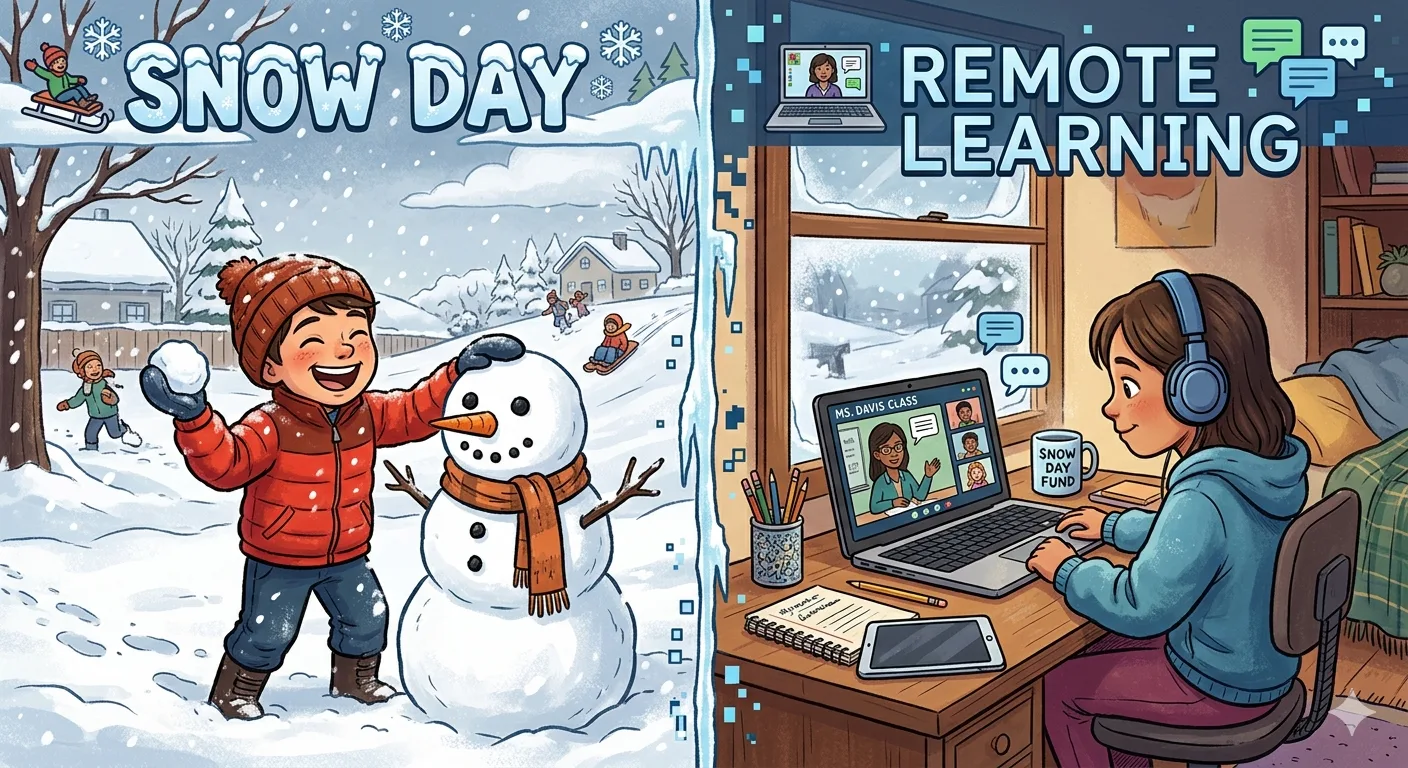
The debate over snow day vs remote learning 2026 is not simply about weather. It touches on the lasting effects of the digital access, student mental health, state rules and the bigger question of what a school day is actually for. After a major winter storm in January 2026 hit than 40 states, school districts from New York City to rural Delmarva made very different choices. Parents, teachers and researchers all had opinions about what happened.
This article explains everything you need to know: what the research says about snow days and student learning how schools responded to the 2026 storm the equity issues with remote learning on snow days what mental health experts think about sudden breaks and the policies that shape these decisions. Whether you are a parent, teacher, school leader or just someone who cares this is the picture.
What Happened During the January 2026 Winter Storm
In January 2026 a strong winter storm moved across the United States bringing heavy snow to more than 40 states. In places snowfall topped 20 inches disrupting travel and daily life.
Some parts of New Mexico recorded over 31 inches. Power outages swept through the South, hitting Tennessee and Mississippi particularly hard. For the first time since the COVID-19 pandemic, school districts faced a mass, simultaneous decision about whether to hold classes virtually or simply close.
The responses were anything but uniform. New York City, the largest school district in the country, announced that roughly 500,000 of its 900,000 students would shift to remote learning. New York City Mayor Zohran Mamdani, acknowledging the unpopularity of the call, humorously told students they could "pelt him in the face" with snowballs for the decision.
Some schools, like those in New York City chose to cancel classes and send students home. Others, like Montgomery County Public Schools in Maryland said they would not switch to learning. They said it was unfair because not all students had devices not all families had internet and there was no approved plan for virtual learning during the winter months.
Many districts in Delmarva, northern Virginia and other areas took a path. They told students to take devices in case of snow but did not require online lessons. The result was a mix of approaches that showed how divided the country still is when it comes to school closures in 2026.
The Research: Do Snow Days Actually Hurt Academic Achievement?
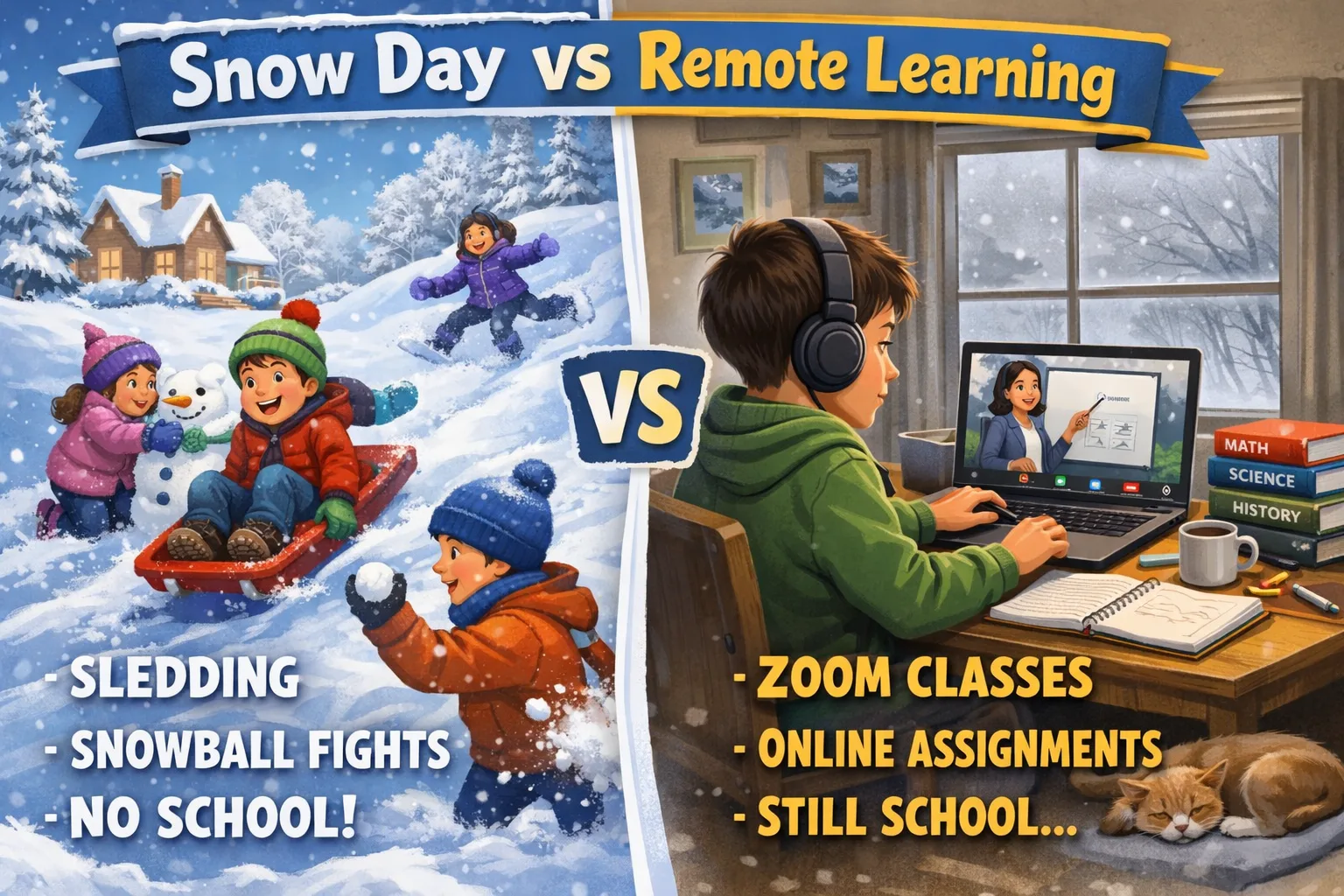
Before weighing in on the snow day vs virtual learning day argument, it is worth asking what the evidence actually shows. The answer is more nuanced than most headlines suggest.
What Studies on Snow Days Have Found
Two landmark studies examined snow day impacts directly. A study of Massachusetts students from 2003 to 2010 found that missed instruction due to snow days did not negatively impact learning, though snow-related absences did. A separate study of Maryland students from 1994 to 2005 reached a different conclusion, finding that students had lower test scores in school years with more snow days. Both studies, however, were conducted before remote learning existed as a viable alternative, which limits how much they can tell us about today's environment.
Research on school disruptions from natural disasters, such as hurricanes and wildfires, has found that missing school for a week or more can meaningfully decrease student learning. But researchers caution against applying these findings too broadly to snowstorms, since those disasters involve long-term community disruption beyond just missed classroom time.
Where you have both disruption to learning in terms of missed instructional days, plus disruption to families and the environment, those can compound into larger losses of academic skills than just a single missed school day. But from those storms, it's hard to generalize from natural disasters to a snowstorm, because most of the time snowstorms don't cause major long-term damage.
A 2014 Study That Changed the Conversation
One of the most cited pieces of evidence in this debate is a major 2014 study that found a small number of snow days had no noticeable effect on test scores. More importantly, the same study found that keeping schools open on snowy days when attendance was already low actually appeared to harm learning outcomes. This finding directly challenges the assumption that remote learning on a snow day is automatically better than taking the day off.
As Chalkbeat's analysis noted, when teachers use a low-attendance virtual day to introduce new material, the students who are absent fall further behind, and the continuity benefit evaporates. The implication for school leaders is significant: if you cannot guarantee high attendance on a remote learning day, it may be academically safer to simply cancel school.
Note: NYC log-in rate (79%) is based on preliminary Education Department estimates from the January 26, 2026 remote learning day. EdWeek survey data from 2024.
NYC's Remote Learning Snow Day: What Actually Happened on the Ground
New York City's January 26, 2026 remote learning day offered a real-world stress test for one of the country's most ambitious pivot-to-virtual decisions. About 395,000 students successfully logged in for virtual instruction, representing roughly 79% of those required to participate, according to preliminary figures from city officials. That sounds impressive, but the classroom-level reality was more complicated.
Bronx social studies teacher Seth Gilman described logging on to find an error message, briefly fearing a repeat of a "disastrous" remote learning pivot during a 2024 snowstorm. His issue was resolved within 20 minutes, but across the city, pockets of Google Classroom outages frustrated students and parents. One Brooklyn parent, Chris Ninman, reported that the server went down while helping his third grader log in, and then found it impossible to access Zoom from the school-issued Chromebook.
Teacher Kate Gutwillig, a fifth grade teacher at P.S. 134 in Manhattan, reported that roughly 70% of her students showed up for virtual instruction, with about half keeping their cameras off. Rather than introduce new material, she wisely pivoted to review lessons and independent reading, a decision aligned with what research recommends for low-attendance days.
You can't teach kids all these social norms on Zoom in a single day. About half the students who logged in kept their cameras off. It proved challenging to quickly pivot to remote learning.
Despite scattered frustrations, NYC Department of Education spokesperson Nicole Brownstein noted that the technical support line received a similar volume of complaints as a typical school day, a sign that the operation, while imperfect, was manageable. United Federation of Teachers president Michael Mulgrew gave Mayor Mamdani an 'A' for his handling of the storm, while pointing out that Google needed to prepare better for the surge.
Why Some Districts Refused to Switch to Remote Learning
While NYC made headlines for going virtual, other major districts held firm on traditional snow days, and their reasons deserve just as much attention. Montgomery County Public Schools (MCPS) in Maryland offered one of the most transparent explanations for why remote learning was not viable for them during the January 2026 storm.
Three Core Reasons MCPS Stuck with Snow Days
- Device equity gaps: MCPS does not currently have one-to-one device access for every student. Without universal hardware, moving to remote learning would create inequities, effectively locking out the students who most need continuity of instruction.
- Mid-semester timing: The storm coincided with the start of a new semester. Many high school students were beginning new courses with new teachers. A brief, disruptive pivot to online-only instruction during this transition was seen as more harmful than beneficial.
- No state-approved virtual learning plan: Maryland did not have a state-approved virtual instruction plan in place for MCPS, meaning the district could not legally count a remote day as instructional time without risking calendar make-up requirements.
Fairfax County Public Schools in northern Virginia chose a middle path: students were encouraged to bring devices home as a precaution, parents were given access to online reading challenges and incomplete assignments, but the district did not mandate remote instruction and explicitly affirmed that it valued the tradition of snow days.
The State Policy Landscape: Remote Learning Days Are Not Uniform
One reason the snow day vs remote learning debate has no clean national answer is that state policy varies dramatically. As of the 2025-26 school year, the landscape breaks down roughly as follows:
| Policy Category | Examples | What It Means | Status |
|---|---|---|---|
| Remote days prohibited as instructional time | Arkansas, Massachusetts, DC | Weather closures require make-up days | Restrictive |
| Remote days fully permitted | Multiple Midwest/South states | Districts may count virtual days toward minimum hours | Flexible |
| Hybrid/capped approach | Various states | Allows a set number of remote days per year | Limited Flex |
| Case-by-case district discretion | Common across Northeast | Districts decide on storm-by-storm basis | Variable |
This fragmented policy environment means that a family moving from one state to another may experience a completely different reality when a snowstorm hits. For school leaders, it also means that "going remote" is not always a free choice: the legal and administrative framework in their state may determine the decision before the first snowflake falls.
Equity Is the Central Problem with Remote Learning Snow Days
The biggest reason to keep snow days of turning them into remote learning days is the issue of equity. Remote learning depends on every student having a working computer, an internet connection, a quiet space to learn and someone at home who can help. In 2026 not every family has those things.
The Digital Divide Has Not Disappeared
Despite massive investments in educational technology during and after the COVID-19 pandemic, the digital divide remains real. Rural communities, low-income urban households, and families experiencing housing instability are all less likely to have the infrastructure needed for a successful remote learning day. When a snowstorm also knocks out power, as it did across Tennessee and Mississippi in January 2026, a remote learning mandate becomes genuinely impossible for some students to fulfill.
One commenter in an Education Week discussion captured the tension perfectly: if weather affects roads but not infrastructure, remote learning to reduce makeup days seems like a reasonable option. But when power is out and internet is down, it becomes a mechanism for widening the achievement gap rather than narrowing it.
Younger Students and Students with Special Needs
Families with very young children face a specific challenge. As one Harlem mother, Maria McCune, noted: "It is particularly unreasonable to ask children under the age of 6 to participate in synchronized remote learning." Similarly, students with speech delays, hyperactivity, or other learning differences may receive little educational benefit from a rushed remote day and may find it more disorienting than a day off.
The child care dimension is equally real. Many parents, particularly those in essential worker jobs, cannot work from home. A snow day without school creates a child care crisis. A remote learning day theoretically keeps children engaged and supervised at home, but in practice it often just adds a layer of stress to families already navigating the same storm that closed the schools.
The Mental Health Case for Keeping Traditional Snow Days
Beyond the academic debate, there is a compelling psychological case for the traditional snow day that frequently goes underdiscussed in policy conversations.
The Value of Unplanned Breaks
Psychologists have long noted that unexpected rewards can significantly boost mood and motivation in ways that planned breaks cannot replicate. A snow day is precisely this kind of spontaneous reward. It interrupts routine, creates a sense of shared community surprise, and gives children permission to rest and play outside structured schedules.
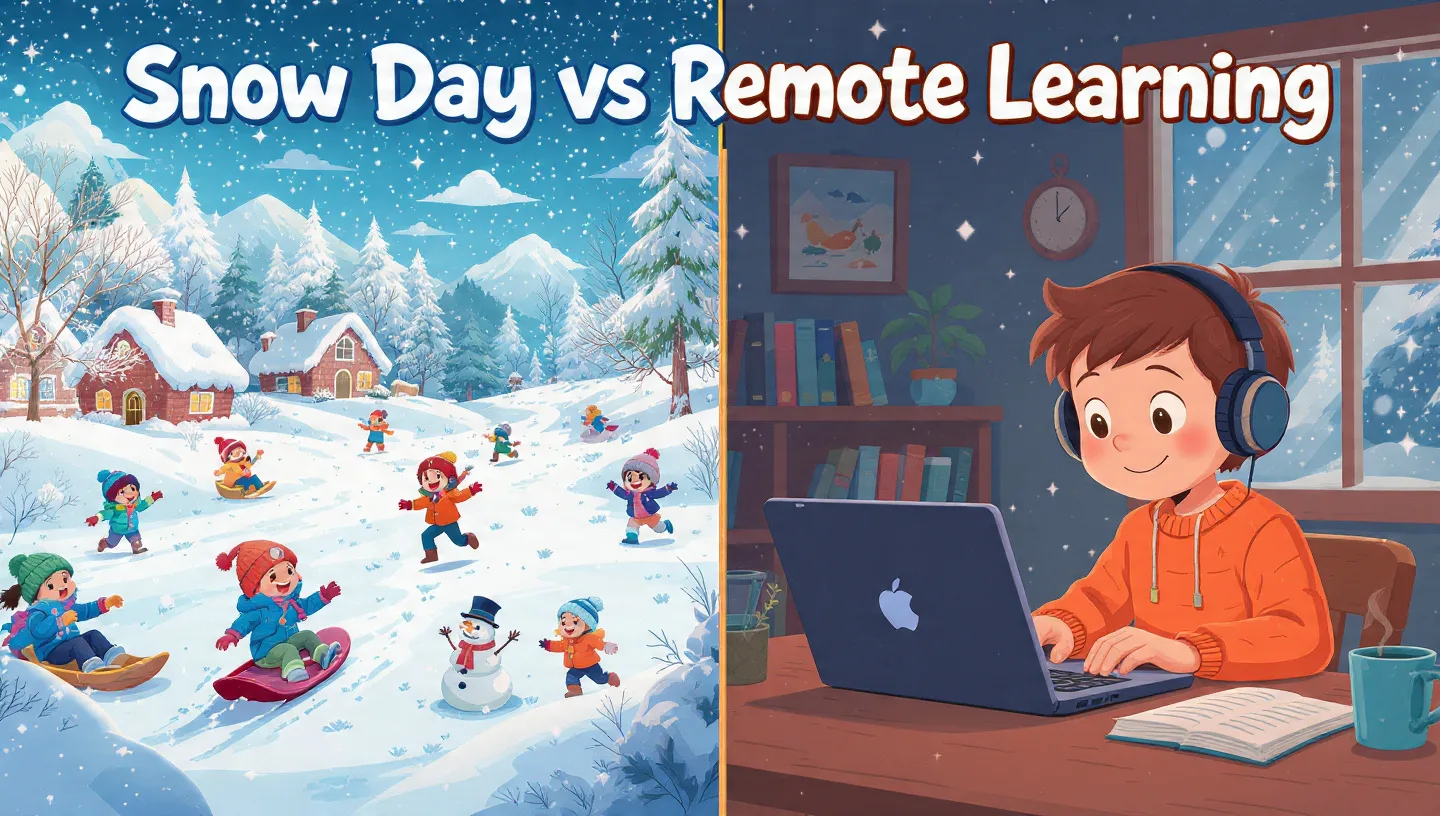
In contrast, a remote learning day on what would have been a snow day can feel psychologically punishing, as if the institution is refusing to acknowledge that something exceptional is happening outside. Students staring at screens while watching snow fall can experience the worst of both worlds: the logistical chaos of storm conditions without any of the joy that historically came with them.
If COVID-19 proved anything, it is that remote learning had detrimental effects on students' social development and mental health. While one day of remote learning may not produce the same results, unplanned days off are far more beneficial to mental health than remote learning days are to academic progress.
Family Bonding and Sibling Relationships
One underrated benefit of traditional snow days is the opportunity for siblings across different age groups to simply spend unstructured time together. Life outside school is busy. Work after-school activities and family duties often pull people in directions. A snow day brings everyone together. It stops the routine. It creates space for kids and families to be together. It gives them time to relax without pressure.
As North Penn Now pointed out in March 2026 snow days offer a break in a world that never slows down. Students need a pause from school schedules and academic stress. Snow days give them that. They create memories that last. Building snowmen, eating lunch at home watching a storm, from the window – these moments matter. They matter for childhood. They matter for health. They matter for what school really means.
Key Takeaway: When Remote Learning Works vs When It Does Not
-
Remote learning works when: the closure is expected to last three or more days; when every student has reliable devices and internet; when teachers have clear protocols; when lessons focus on review rather than new material.
-
Traditional snow days work best when: the storm lasts one or two days; when power outages are likely; when students are in early grades or have special needs; when state policy requires makeup days regardless.
-
The worst outcome: occurs when remote learning is mandated while attendance is low and then new material is taught to part of the class.
- The hybrid approach: some districts now offer optional enrichment activities or reading challenges on snow days without requiring formal instruction, a model that may balance competing interests.
Read More : How Much Snow to Cancel School?
Snow Day vs Remote Learning: A Head-to-Head Comparison
✅ Advantages of Traditional Snow Days
- No equity concerns about device or internet access
- Mental health and family bonding benefits
- Avoids low-attendance virtual instruction pitfalls
- No risk of widening the achievement gap
- Consistent with childhood developmental needs
- Simpler for working parents with reliable childcare
⚠️ Disadvantages of Traditional Snow Days
- Makeup days can disrupt summer or holiday schedules
- Lost instructional time if storm lasts multiple days
- Childcare crisis for parents who cannot work from home
- No access to school meals for food-insecure students
- Potential academic lag if closures are extended
✅ Advantages of Remote Learning Snow Days
- Maintains instructional continuity and calendar flexibility
- Avoids makeup days that disrupt summer plans
- Provides a safe, structured environment for children while parents work
- Technology infrastructure is now more capable than in 2020
- Effective for older, more independent students
⚠️ Disadvantages of Remote Learning Snow Days
- Unequal device and internet access creates inequity
- Low engagement: cameras off, attendance drops
- Harmful if teachers introduce new material to partial classes
- Technical failures can occur on surge days
- Developmentally inappropriate for young children
- Psychologically removes the legitimate joy of a snow day
What Teachers Actually Prefer
Teacher voices often get lost in the policy conversation, but they are doing the real logistical work when a snow day decision is made at 5 a.m. Research and on-the-ground reporting in 2026 suggest that teacher preferences are split, but with important nuances.
Teachers who support remote learning days generally cite curriculum continuity as their primary motivation. Sudden gaps in instruction can be particularly disruptive in courses with tightly sequenced content, such as Advanced Placement classes, math sequences, or project-based units with imminent deadlines.
Teachers who prefer traditional snow days, however, point to the impossibility of effective short-notice instruction when attendance is uncertain and student attention is fragmented. As one commenter in the EdWeek community noted, the pandemic demonstrated the instabilities of remote learning at scale, and a single snow day does not provide enough lead time to set up quality online learning environments.
Perhaps most importantly, a 2024 EdWeek Research Center survey found that nearly six in ten administrators said their snow day calendar had remained unchanged over the previous year, suggesting that even as technology expanded the theoretical option of going remote, most districts have been cautious about mandating it.
What Should Schools Actually Do? A Framework for Decision-Makers
NWEA's Teach. Learn. Grow. Team outlined a decision framework in February 2026 that gives useful guidance to school leaders who are navigating this debate. Rather than prescribing a one‑size‑fits‑all answer Grow. Team identifies critical questions that should drive each decision.
Key Questions for School Leaders
- What does state law require? State policy determines whether remote days can count toward required instructional time. If not, going remote still means making up the day, eliminating one of the main advantages of virtual instruction.
- What are the conditions on the ground? If power outages are likely or internet infrastructure is unreliable in significant portions of the district, remote learning is not equitably feasible regardless of policy preference.
- How long is the closure anticipated to be? For short closures of one to three days, the research suggests that a traditional snow day is unlikely to cause lasting academic harm. For closures of four or more days, the calculus shifts in favor of some form of remote instruction.
- Is the student population ready? Early grades, students with disabilities, and families with complex home situations all reduce the effectiveness of remote learning days.
- Do teachers have clear, prepped expectations? Rushed remote days without lesson plans and technical readiness tend to produce low-quality instructional experiences that may be worse than simply closing school.
NWEA also recommends that if schools do use remote learning days, teachers focus on review of previously learned material rather than new instruction, given that attendance is typically lower and engagement is less reliable than during a normal school day.
The Rise of the Hybrid Model: A Third Path Forward
Between the binary of "snow day" and "mandatory remote learning day," a third option is gaining traction in 2026: the optional enrichment hybrid model. Under this approach, school buildings close for safety, but students are offered optional online reading challenges, enrichment activities, or check-in assignments that count toward participation but are not graded or required.
Fairfax County's approach during the January 2026 storm gestured toward this model, encouraging families to access online reading challenges and incomplete assignments without mandating full virtual instruction. Several districts also built structured snow play time into their schedules. These districts acknowledge that on a virtual day children should have the chance to go outside and experience the storm.
This hybrid approach tries to find a balance between keeping instruction going and honoring the value of an unstructured day. This hybrid approach is unlikely to satisfy either camp. However this hybrid approach may represent the politically and pedagogically sustainable path forward for districts that have mixed device access and diverse student needs.
Conclusion: There Is No One Right Answer
The snow day versus learning 2026 debate does not have a winner. What the evidence, the real‑world experience from the January 2026 storm and the policy landscape all point to is this: the right answer depends entirely on context. National mandates, in either direction would be a mistake.
For districts that have device access, stable internet infrastructure, prepared teachers and a state policy framework that supports remote learning remote learning days can provide meaningful instructional continuity without the disruption of makeup days. For districts without those conditions, and many still lack them, a traditional snow day remains the more equitable, and arguably the more academically sound, option.
What is clear is that covering new material during a low-attendance remote day is the worst of both worlds: it neither preserves the joy and mental health benefits of a genuine snow day nor delivers the academic continuity that justified going remote in the first place. School leaders who understand that distinction, and plan accordingly, are the ones most likely to serve their communities well the next time a storm rolls in.