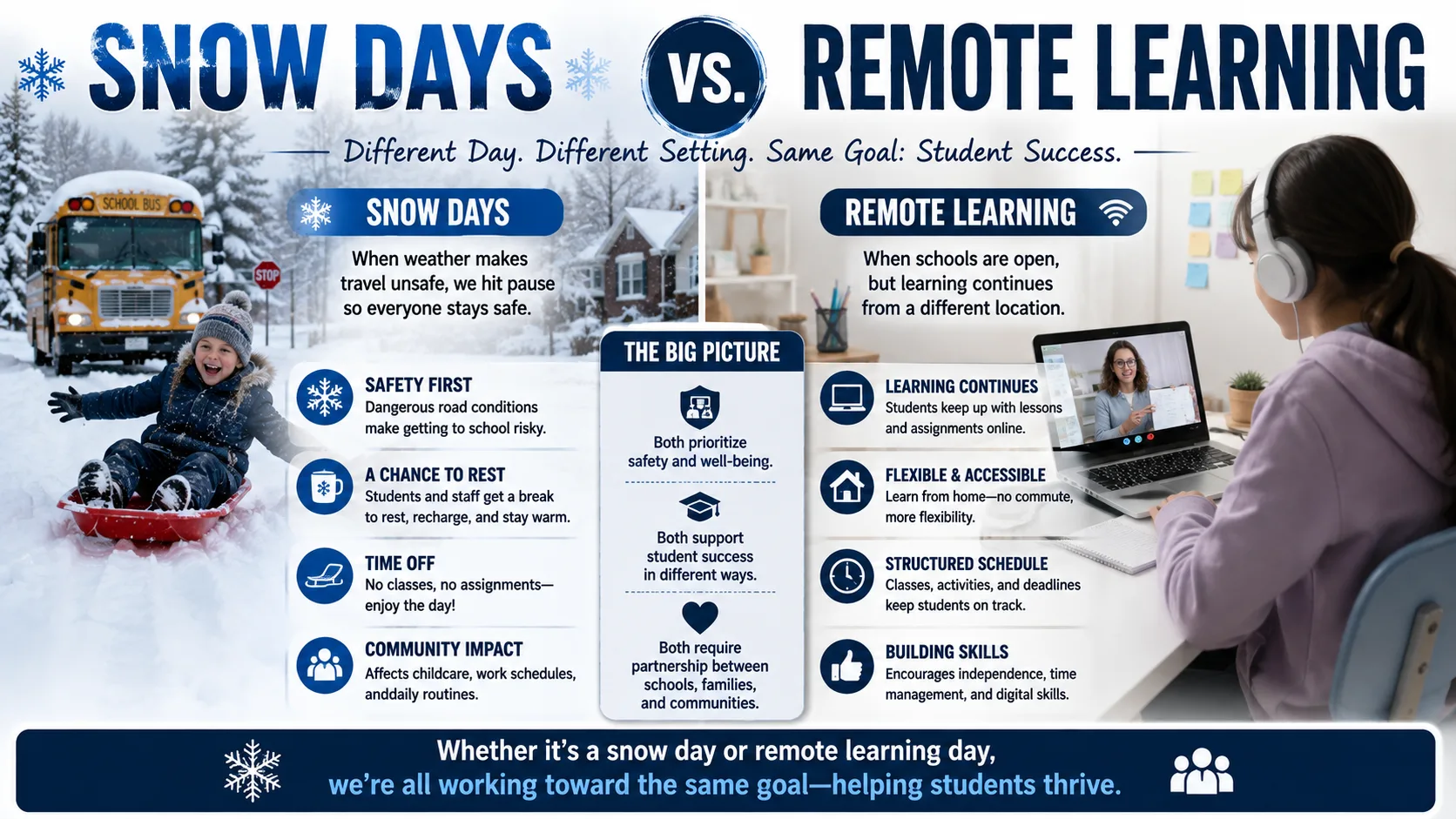
In 2026, the choice between snow days vs remote learning depends almost entirely on your state and district, not on a single national standard. Some of the largest districts in the country, led by New York City, now default to remote instruction whenever school buildings close for weather. Others, especially smaller and rural districts, have kept the traditional day off. There is no single rule, which is exactly why this question keeps coming up every winter.
This guide breaks down how the two approaches actually compare this year, what the research says about which one works better for learning, and how to check what your own state's policy allows. If you just want a fast read on your odds of a closure or a remote day, our snow day calculator can help you plan ahead.
What Is the Snow Days vs Remote Learning Debate
The snow days vs remote learning debate is about whether a winter storm should cancel school entirely, with the missed day made up later, or trigger a switch to virtual instruction that still counts toward the required school year.
Before the pandemic, snow days were simple. Buildings closed, kids stayed home, and the missed day was usually tacked onto the end of the school year. Remote learning changed that math. If a district can run a functional virtual day, it can technically avoid losing instructional time at all, which is why so many large districts have moved in that direction since 2020.
Why This Debate Got Louder in 2026
New York City Public Schools, the largest school system in the country, eliminated traditional snow days for both the 2025-26 and 2026-27 school years and ran its first fully remote storm day in January 2026. That single decision affected roughly 500,000 of the district's 900,000 students during one storm alone, and it pushed the topic back into national headlines.
How We Got Here: A Short History of the Remote Snow Day
Before 2020, the idea of a "remote snow day" barely existed outside of a few pilot programs. A storm meant a closed building, a missed day, and a make-up day tacked onto June.
That changed almost overnight once the pandemic forced every district in the country to build remote-learning infrastructure. By late 2020, a national survey of principals and district officials found that roughly 70% had already converted, or were actively considering converting, snow days into remote learning days, simply because the technology and training were suddenly already in place.
The years since have not followed a straight line, though. Some districts that made the switch have since walked it back. In Maine, one superintendent overseeing a district of roughly 2,300 students chose to keep traditional snow days specifically because a meaningful share of students could not reliably access online learning at home. Other districts have been blocked from making the switch at all by state regulations that simply do not allow remote days to count.
New York City itself is a case study in how bumpy this transition can be. The district first tried a remote snow day in February 2024, only to see the attempt largely fail when large numbers of students could not successfully log in. Officials spent the following months rebuilding the system before rolling it out again, this time successfully, in January 2026.
How Districts Decide Between the Two
The decision is not made on a whim. Districts weigh several factors before choosing a traditional closure or a remote day.
1. State Instructional Day Requirements
Every state sets a minimum number of instructional days or hours. Districts that fall short have to add days later in the year, which is the single biggest reason many switched to remote options in the first place.
2. Technology and Internet Access
A remote day only works if most students actually have a device and reliable internet at home. Districts with large numbers of students lacking consistent access often stick with traditional snow days rather than risk instruction that only reaches part of the class.
3. Attendance Track Record
Some districts have tried remote snow days and seen attendance collapse. Reporting on Pittsburgh-area schools found virtual day attendance ranging from as high as 99% down to as low as 66% depending on the school, which factors heavily into whether a district sticks with the approach.
4. Bus Routes and Building Safety
Even with remote learning available, some closures are unavoidable. If roads are unsafe for staff who still need to report to buildings for meals, custodial work, or emergency planning, a full closure may still be the safer call regardless of the instructional format.
5. Local and State Politics
Snow days carry real nostalgia. Some elected officials and superintendents have pushed back on eliminating them entirely, even where remote learning is technically possible, because of how strongly families feel about keeping the tradition alive.
Key takeaway: There is no single national standard for snow days vs remote learning in 2026. The decision is made state by state and district by district, based on instructional day rules, technology access, and past attendance results.
How State Rules Shape the Decision
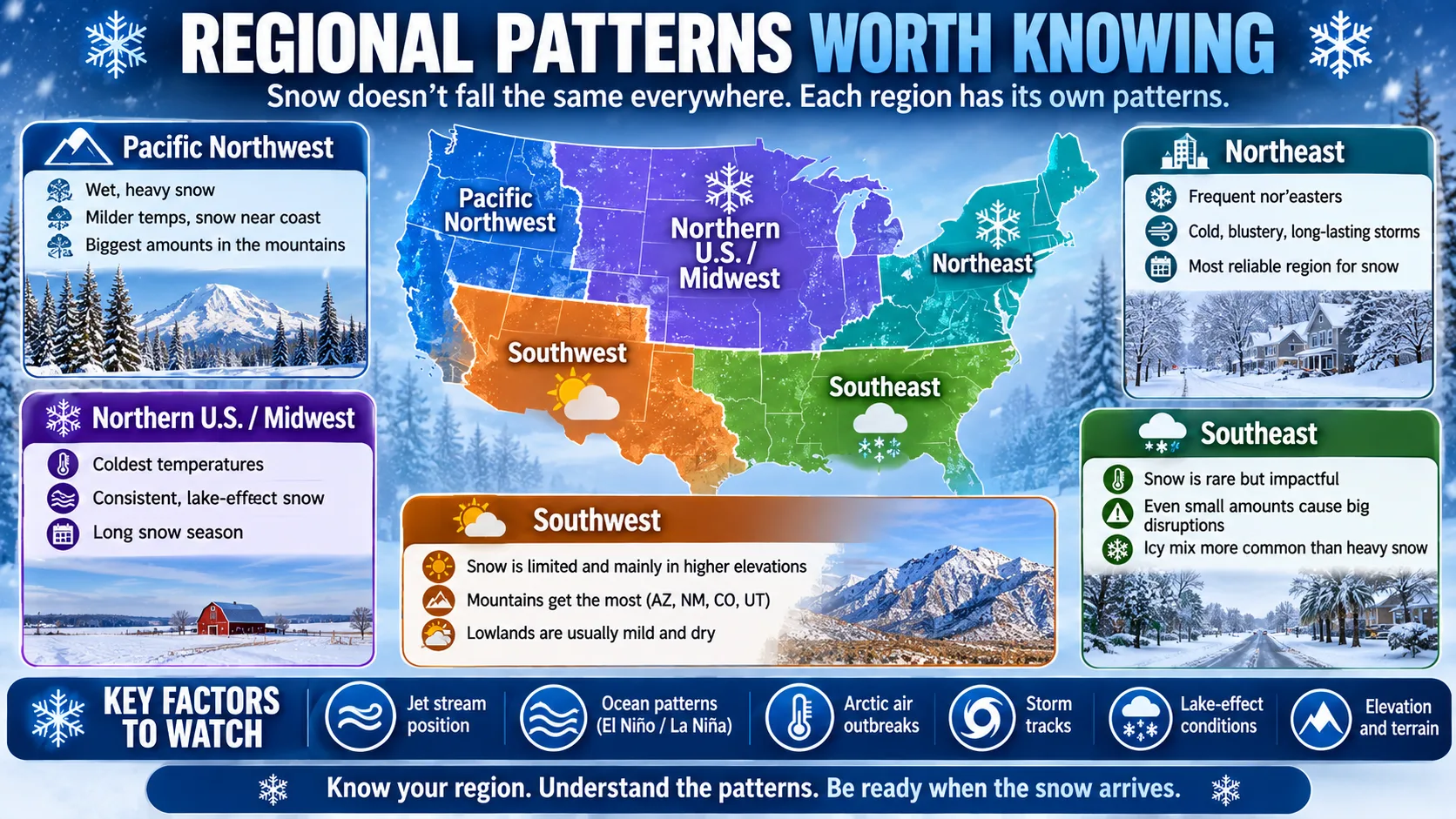
State policy is the biggest single factor behind whether your district can even choose remote learning. As of the 2025-26 school year, state rules generally fall into three groups.
States That Prohibit Counting Remote Days
A small group of states, including Arkansas and Massachusetts, plus Washington, D.C., do not allow remote learning to count toward required instructional time at all. In these places, a weather closure is a weather closure, and the day has to be made up regardless of whether students logged into a virtual class.
States That Cap Remote Days
Roughly two dozen states limit how many remote days can count toward the school year, typically somewhere between three and five days, though a handful of states, including Virginia and Kentucky, allow as many as ten. Once a district goes over that cap, any additional closures require a traditional make-up day.
States That Leave It to District Discretion
Another large group of states, generally ones that see less severe winter weather, leave the decision entirely up to individual districts, with no fixed cap on remote learning days at all.
The Funding Angle
In some states, this is not just an academic question, it is a budget one. Missouri's SB 68, passed in 2025, ties a funding incentive to districts hitting 169 instructional days and 1,044 hours, worth 1% of the prior year's state aid starting in fiscal year 2026 and rising to 2% by fiscal year 2028. That turns every snow day decision into a financial one as much as an educational one.
Step-by-Step: How to Check Your District's Policy
- Check your state's minimum instructional day requirement. This determines how much flexibility your district actually has.
- Look up your district's specific weather policy, usually posted on the district website or family handbook each fall.
- Note how many "snow days" versus "remote days" your district allows before switching approaches or requiring a make-up day.
- Check whether remote days require live instruction or just posted assignments, since the requirements vary by state and district.
- Watch for early communication the night before or early morning of a storm, since most districts announce the format, not just the closure, at that time.
- Cross-check the forecast yourself using our snow day calculators so you are not caught off guard by either a closure or a remote-day announcement.
Benefits and Trade-Offs of Each Approach
Benefits of Traditional Snow Days
- Equal experience for every student, regardless of internet access or home device availability.
- A genuine break that many educators and families still value for kids' mental health and unstructured play.
- Simplicity. No login issues, no partial attendance, no confusion about the day's expectations.
Benefits of Remote Learning Days
- Protects the school calendar, avoiding the need to extend the year into summer or cut into spring break.
- Keeps instructional momentum going, particularly useful in regions with frequent winter closures.
- Helps districts meet state-mandated instructional hours without last-minute schedule changes.
Trade-Offs to Consider
- Remote days depend heavily on reliable home internet and devices, which is not universal even in 2026.
- Attendance and engagement on remote days is often lower and more inconsistent than a normal school day.
- Traditional snow days still require make-up days, which can push the school year later into June.
Weather severity plays into this trade-off too. A district weighing a short delay instead of a full closure or remote day often looks at more than just snowfall. Our rain delay calculator uses similar logic for wintry mix and rain-driven closures, since flooding and ice can trigger the same scheduling debate as snow, just with a different set of variables behind the decision.
Real 2026 Examples With Numbers
Example 1: New York City
New York City Public Schools defaulted to remote instruction during its January 2026 storm response, affecting about 500,000 of its 900,000 students. The mayor later granted one symbolic snow day in February 2026, but remote instruction remains the default policy for the 2025-26 and 2026-27 school years.
Example 2: Maine's Hybrid Model
Districts including Portland, Falmouth, and Auburn built a hybrid system that allows three full traditional snow days before switching to remote learning for any additional closures that year. That approach preserves the classic snow day experience early in the winter while still protecting the calendar if storms keep coming.
Example 3: Attendance Gaps in Practice
In Pittsburgh-area districts, remote day attendance has varied enormously by school, from as high as 99% in some buildings down to as low as 66% in others during the same storm, showing just how unevenly remote learning performs even within one region.
| Policy Type | Approx. Number of States | What It Means |
|---|---|---|
| Prohibits counting remote days | 4 states + D.C. | All weather closures require a traditional make-up day |
| Caps remote days (typically 3 to 5, up to 10) | ~23 states | Remote days count up to a limit, then make-up days are required |
| District discretion, no fixed cap | ~23 states | Districts choose their own approach with no state-imposed ceiling |
Regional Patterns Worth Knowing
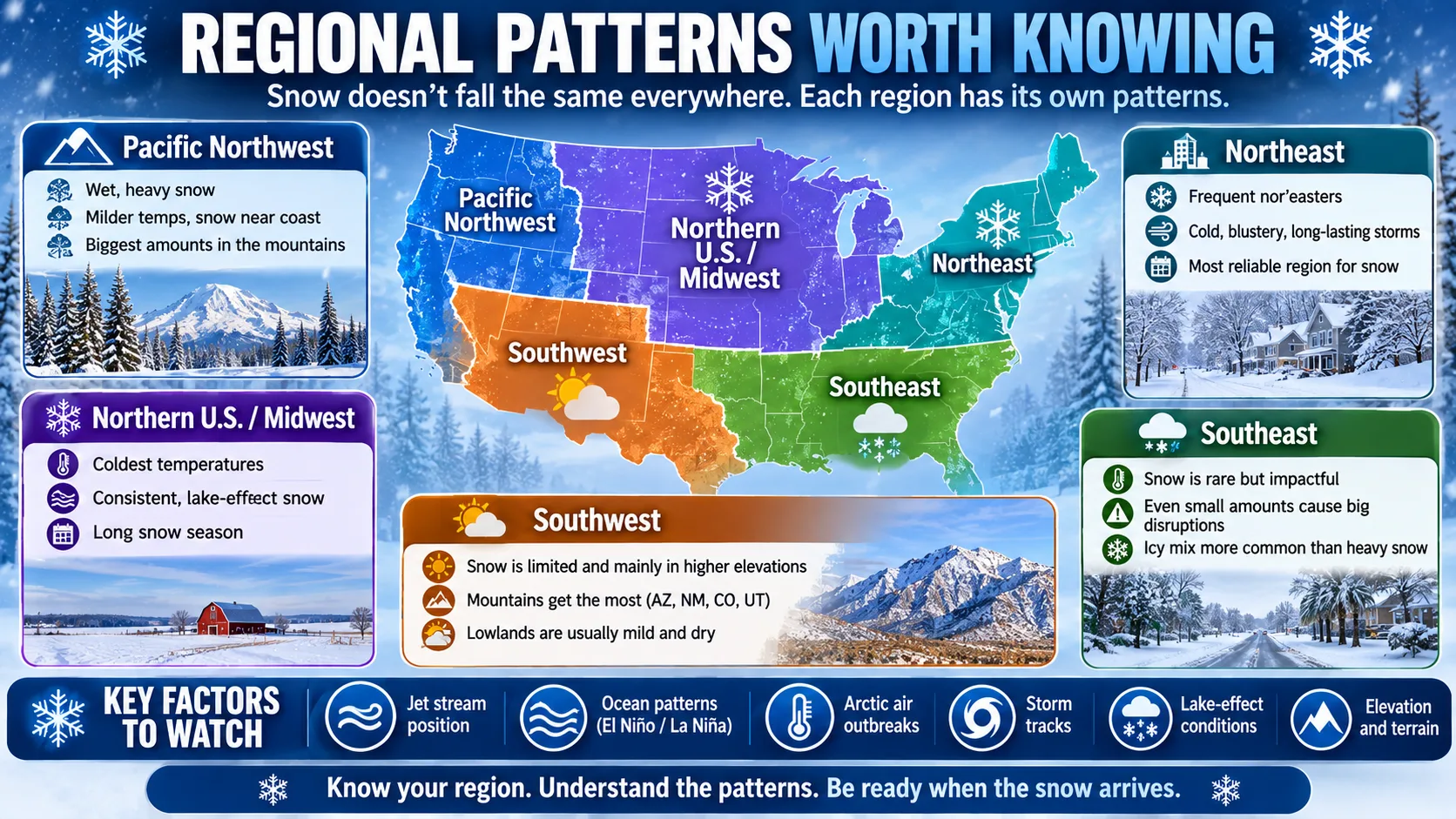
Not every part of the country is dealing with this question equally. Winter storm severity in the 2025-26 season has been unusually uneven, and that has shaped which districts are actually testing their remote-learning plans this year.
The Southeast Has Been Hit Hardest
Relative to typical winters, the Southeast has seen some of the most disruptive weather this season, with several districts facing anywhere from seven to more than twelve total closure days. Many of these districts have far less remote-learning infrastructure than northern districts that deal with snow every year, which has made this winter especially difficult to manage.
Northern and Snow-Belt Districts Have More Practice
Districts in traditionally snowy regions, including much of the Northeast and Upper Midwest, generally have more mature remote-learning systems already in place, simply because they have had more winters to build and test them. That head start shows up in smoother rollouts and, in many cases, better attendance on remote days compared to regions less accustomed to severe winter weather.
Rural Districts Face a Different Calculation
Rural districts often deal with longer bus routes and less consistent broadband access than urban or suburban districts. Even when a state allows remote learning, some rural districts choose to stick with traditional snow days simply because a large share of their students would not be able to participate in a virtual day anyway.
What Researchers and Educators Are Saying
Education researchers at NWEA have noted that a handful of ordinary snow days appears to have little measurable effect on student achievement, and that pushing instruction forward when attendance is unusually low could actually do more harm than the missed day itself.
Education Week's reporting on the shift has pointed out that some states and school systems have started pulling back on remote learning, questioning whether it truly delivers educational value or simply widens gaps for students without a stable home environment.
Coverage from The 74 has highlighted that several superintendents who tried eliminating snow days ultimately reversed course, citing unreliable home internet access as the deciding factor in returning to traditional closures.
Read More : How Meteorologists Predict Snow
Common Mistakes and Pro Tips for Parents
Common Mistakes
- Assuming your district's policy from last year still applies. Many districts changed their approach heading into the 2025-26 winter.
- Waiting for a phone call instead of checking the district app or website, where storm-day announcements are usually posted first.
- Confusing a "remote day" with a true day off. Remote days almost always require some form of login or assignment completion.
- Not having a backup plan for internet outages, which are common during the same storms that trigger remote learning in the first place.
Pro Tips
- Save your district's inclement weather policy page at the start of each school year so you are not searching for it during a storm.
- Ask your school directly how many remote days count before a traditional make-up day kicks in.
- Use a dedicated forecasting tool like our snow day calculator to estimate closure odds a day or two ahead, rather than waiting on a single morning announcement.
Snow Days vs Remote Learning: Side-by-Side Comparison
| Factor | Traditional Snow Day | Remote Learning Day |
|---|---|---|
| Counts toward instructional time | No, usually made up later | Often yes, depending on state rules |
| Requires internet access | No | Yes |
| Typical attendance | Not applicable, school is closed | Highly variable, sometimes far below normal |
| Effect on school calendar | May extend the school year | Usually protects the existing calendar |
| Family experience | Simple, universally understood |
Depends heavily on tech access and childcare needs |
Conclusion
The snow days vs remote learning question does not have one national answer in 2026. Your experience depends on your state's instructional day rules, your district's technology access, and how that district's past remote days have actually gone. Understanding these factors will help you know what to expect the next time a storm rolls in. Try the calculator above to check your own odds before the next winter storm hits.