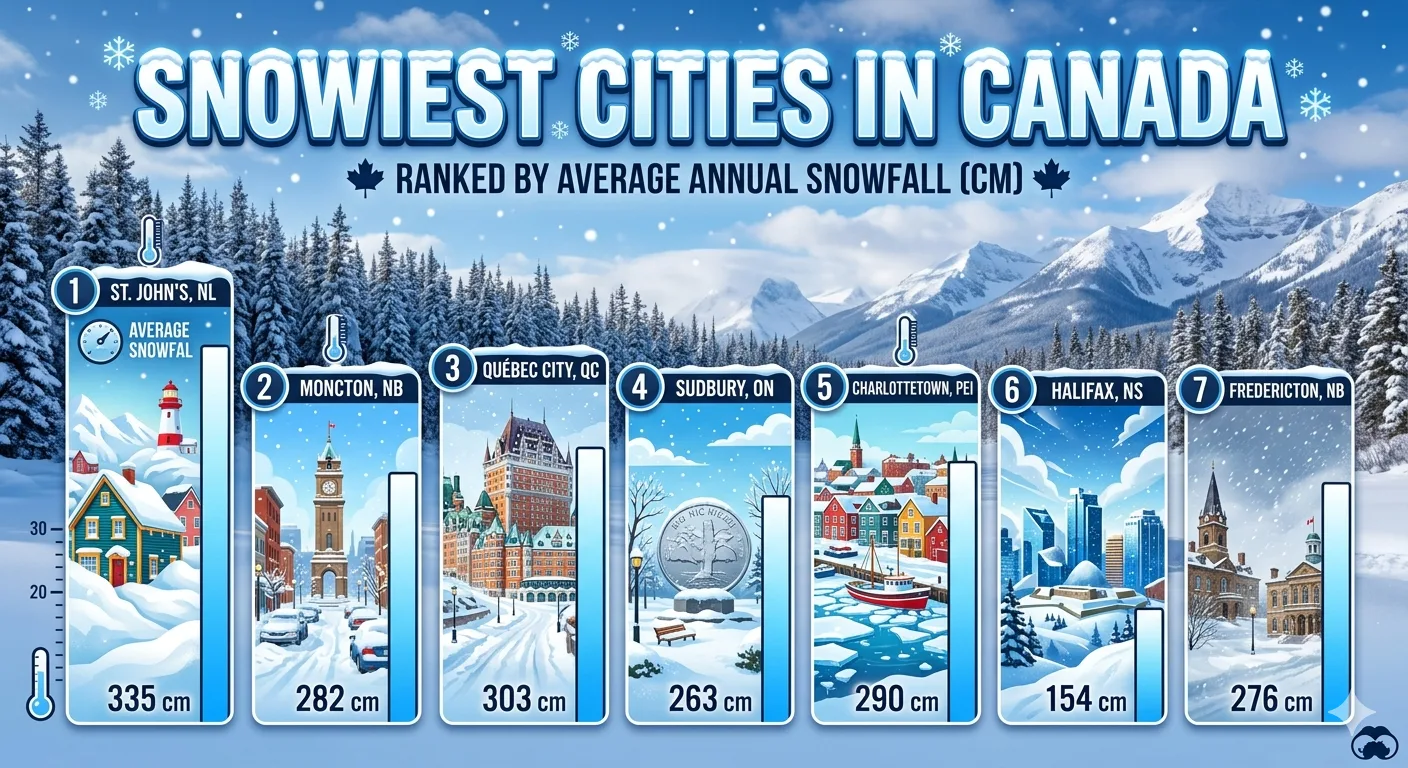
Canada is globally synonymous with winter, and for good reason. With a land area that stretches from the coastal areas of British Columbia to the frozen coasts of Labrador the country has some of the most extreme and stunning snowy places on the planet.. But which cities truly earn the title of the snowiest cities in Canada in 2026? Whether you are a person who loves winter sports someone thinking about moving to Canada and wanting to know about the winters or just someone who finds nature fascinating this guide gives you the supported answer.
Ask ten Canadians which city gets the most snow and you'll get about six different answers. Someone will swear by Quebec City. Someone from Newfoundland will just laugh. A person from Ontario will mention the time their car disappeared in Barrie.
They all have some truth, which's exactly why it is hard to rank the snowiest cities in Canada. It depends on whether you want to know the centimeters of snow how many days it snows or how long the snow stays on the ground. Most online lists blur those together. This one tries not to.
Stick around for the full top 10, the reasons behind the numbers, and some real advice if you're thinking about moving to, or visiting, one of these places. And if you're the type who checks the forecast before bed, keep our snow day calculator handy.
How I Ranked Them (and Why It Matters)
Here's a problem I kept running into. Plenty of lists mix big cities with tiny towns and pull numbers from different decades. You end up reading that one city is both the snowiest and second-snowiest in the same article.
So I stuck to one data set: Environment Canada's 1981 to 2010 climate normals for the 33 largest metro areas, meaning places with over 100,000 people. A "snow day" here means any day with at least 0.2 cm of snow.
One caution. Newer 1991 to 2020 normals exist, and the figures move a bit from one period to the next. Use these numbers to compare cities with each other and check the recent station data if you want more exact information.
The Top 10 at a Glance
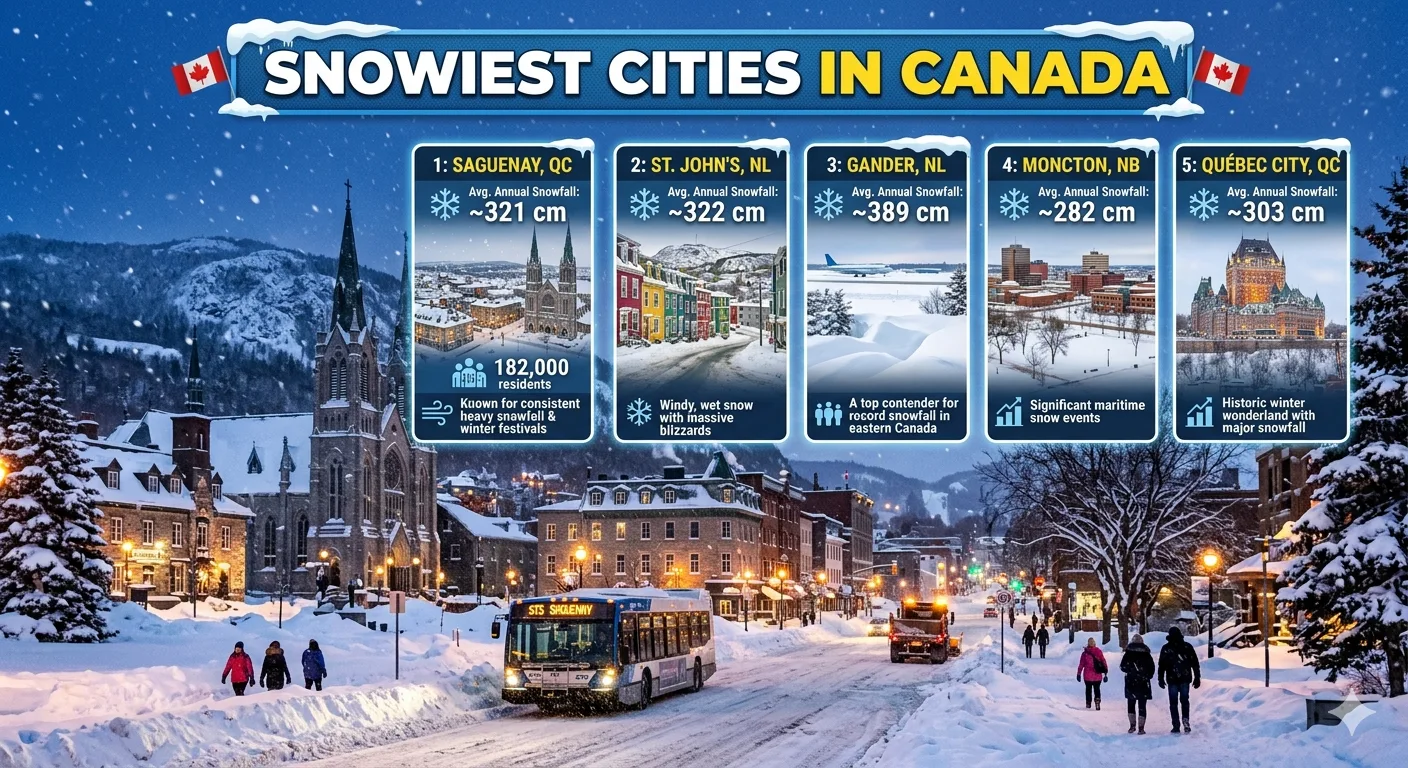
| Rank | City | Province | Avg. Annual Snowfall | Snow Days per Year |
|---|---|---|---|---|
| 1 | St. John's | Newfoundland and Labrador | 335 cm | 79 |
| 2 | Saguenay | Quebec | 322 cm | 93 |
| 3 | Quebec City | Quebec | 303 cm | 70 |
| 4 | Sherbrooke | Quebec | 287 cm | 76 |
| 5 | Moncton | New Brunswick | 282 cm | 50 |
| 6 | Sudbury | Ontario | 263 cm | 75 |
| 7 | Trois-Rivières | Quebec | 259 cm | 50 |
| 8 | Saint John | New Brunswick | 240 cm | 53 |
| 9 | Barrie | Ontario | 223 cm | 46 |
| 10 | Montréal | Quebec | 210 cm | 59 |
Look at the top two. St. John's wins for total snow, but Saguenay gets snow on far more days. That gap tells you a lot about what winter actually feels like in each place. Also note how Quebec fills four of the ten spots.
Why Some Cities Get Buried and Others Don't
The short version: geography does most of the work. Three or four ingredients keep showing up.
The ocean is one. St. John's, Moncton, and Saint John sit in the path of Atlantic storms that carry loads of moisture, so when the temperature dips, the results can be dramatic. Quebec's cities get a different recipe, with cold arctic air colliding with moisture along the St. Lawrence valley.
Then there's the lake effect. Barrie is the classic case. Cold northwest wind crosses Georgian Bay, soaks up moisture, and drops it in thin bands that can leave one town buried while the next is bare. Finally, plain old cold helps. Saguenay's valley traps frigid air, so snow doesn't melt between storms and just keeps stacking.
That's why two cities with similar totals can feel completely different. Coastal snow tends to arrive fast and wet, then disappear. Inland Quebec snow is drier and hangs on for months.
Reading the Numbers Without Panicking
335 cm sounds like a wall of snow. It isn't. That's the total that falls across a whole winter, and it compacts, melts, and gets plowed along the way. Nobody is standing in a three-metre drift.
The number that better predicts your daily life is snow days. Saguenay's 93 means it snows on roughly one day in four. Moncton's 50 means fewer snowy mornings, but they tend to come in big storms that can shut things down for a day.
Barrie is the odd one. Only 46 snow days, yet a single squall can drop 30 cm in a few hours. On paper it looks tame. In person it can feel wild.
The Ten Cities, One at a Time
1. St. John's, Newfoundland and Labrador
This is the volume champ, averaging about 335 cm a year, mostly between December and February. The city sits on the Avalon Peninsula, jutting into the North Atlantic, so storms hit it head-on.
St. John's is also famously windy, and it loves swinging between snow, rain, and thaw. A January 2020 blizzard was so severe it led to a state of emergency, and people there still bring it up. But averages can fool you. Early in the 2024 to 2025 winter, rain outweighed snow for a stretch, a good reminder that one season rarely matches the long-term norm.
If you visit, skating on Quidi Vidi Lake and walking Signal Hill on a clear day are easy wins. Bring a windproof jacket.
2. Saguenay, Quebec
About 322 cm a year, but the real headline is 93 snow days, the most of any big Canadian city. Snow arrives early, stays late, and hardly ever gets a break, because temperatures stay low.
Winter isn't something you survive here. It's the main attraction. Cross-country trails, snowmobile routes that tie into the Trans-Québec network, and ice fishing on the Saguenay Fjord all feel like ordinary weekend plans. I'd say this is the best pick if you want a real, long, reliable winter, and I mean that as a compliment.
3. Quebec City, Quebec
About 303 cm over roughly 70 snow days, and easily the most photogenic snowfall on the list. Fresh snow on the stone walls and narrow streets of Old Quebec, a UNESCO World Heritage site, looks like a movie set.
The city leans in. The Quebec Winter Carnival lasts a weeks from late January into February and it is very popular. Try the toboggan slide at Dufferin Terrace then plan a day skiing at Mont-Sainte-Anne or Le Massif de Charlevoix if you have a car.
4. Sherbrooke, Quebec
Sherbrooke has 287 cm of snow spread over 76 days. It is located in the Eastern Townships, where cold air from the north meets moisture coming from the south and east and nearby hills add a bit snow.
It is a college town, home to the Université de Sherbrooke and Bishops University so the winters are lively and not lonely. Mont Orford and Bromont are close by. Mont-Bellevue Park is good for a quiet snowshoe walk.
5. Moncton, New Brunswick
About 282 cm but only around 50 snow days, so Moncton's winter comes in bursts. A single nor'easter can leave 30 to 50 cm in a day or two, usually in January or February. Then it's back to normal.
Poley Mountain, near Sussex, is the go-to for skiing and snowtubing, and Centennial Park works for cross-country skiing.
6. Sudbury, Ontario
The snowiest big city in Ontario has 263 cm and 75 days of snow. It is cold, northern and gets moisture from the Great Lakes so the months from November to March are usually white.
Sudbury is a mining town so snow removal is treated like a job, not a problem. Kivi Park has trails for skiing, snowshoeing and ice skating and Adanac Ski Hill is for downhill skiing.
7. Trois-Rivières, Quebec
259 cm and 50 days of snow located between Montreal and Quebec City. It has the cold air and river moisture but is not very well known by tourists. The Mauricie region nearby is great for snowshoeing and cross-country skiing. The city is a peaceful and affordable place to be.
8. Saint John, New Brunswick
Saint John is located on the Bay of Fundy. Gets about 240 cm of snow with around 53 days of snowfall. Winter here is a mix of snow freezing rain and fog. Snow can quickly turn to ice making sidewalks and hills more dangerous than the numbers suggest. Rockwood Park is a place for winter walks.
9. Barrie, Ontario
About 223 cm from just 46 snow days. The city sits in the Georgian Bay snowbelt, where squalls can dump 30 cm in hours while a town 50 kilometres away barely sees a flake.
Skiers love this place. Horseshoe Resort, Snow Valley and Mount St. Louis Moonstone are all close. Kempenfelt Bay is a popular spot for ice fishing. One important tip: check for snow squall warnings before driving on Highway 400. Visibility can drop quickly.
10. Montréal, Quebec
Montréal averages about 210 cm across 59 snow days. That's less than the cities above, but the scale is huge. With millions of people, snow removal is a massive operation, and parking bans and towing during clearing are a real thing to watch for.
The city has found clever workarounds, like the underground network that lets you walk between many downtown buildings, and Mount Royal is great for skating and cross-country skiing.
Smaller Places That Would Crush This List
Because this ranking only covers larger cities, it skips smaller communities that get even more snow. Gander and Corner Brook in Newfoundland are often described as extremely snowy, and so is Timmins in northern Ontario. Revelstoke, a mountain town in British Columbia, is sometimes quoted at close to 400 cm a year.
Figures for these places vary by station and source, so treat any number you see with some caution, mine included.
Some Cities That Surprise People
Snow reputation doesn't always match the data. A few examples:
-
Ottawa has 175 cm of snow less than many people expect for a city that is famous for skating on the Rideau Canal.
-
Halifax has 154 cm of snow. Its storms are dramatic, but mild spells keep the total down.
- Toronto sees around 121 cm, about a third of St. John's.
- Vancouver gets about 45 cm, and yes, the city grinds to a halt whenever it happens.
Cold can matter more than snow. Some prairie cities see modest snowfall but brutal air, and a wind chill calculator tells you far more about a January morning there than a snowfall chart ever will.
If You're Moving to a Snowy City
Nobody warns you about the small stuff, so here's the stuff that actually matters.
Tires first. Winter tires are legally required in Quebec from December 1 to March 15, and they're smart anywhere that gets real snow. All-seasons struggle in deep cold. Keep a kit in your car: a scraper, a shovel, sand or cat litter for traction a blanket and jumper cables.
Learn the parking rules. Many cities have parking bans during snow removal and cars get towed quickly. Check your citys app or website before parking.
Look after the house.
-
Clear your eavestroughs before the big snow so ice dams don't form.
-
Insulate pipes that are exposed as long cold periods below -20°C can freeze them.
-
Plan for snow removal. A snow blower or a plowing service is worth it for a driveway.
-
Use a shovel carefully. Heavy wet snow can be hard on the heart for older people.
Dress in layers. Use a base layer that wicks moisture (avoid cotton) a layer of fleece or wool and a windproof waterproof outer layer. Add waterproof boots mittens instead of gloves a hat that covers your ears and ice cleats that you can slip on. Icy sidewalks send people to the emergency room than most realize.
Read More : What Is Wind Chill and Why Does It Close Schools
When to Visit for the Best Snow
January and February are the safest bets. It's cold enough to keep the snow crisp, and most winter festivals happen then. Late February into early March can be lovely too, with longer days and thinner crowds.
I'd steer clear of early December and late March if snow is the whole point of the trip. Thaws happen, especially near the coast. And if your plans depend on school schedules or storm days, a quick check with our snow day calculator can help you judge the odds before you book.
Snow Isn't the Only Story
Funny thing about these cities: they don't stay cold. Southern Quebec and Ontario can turn seriously muggy in July, and a heat index calculator shows how heavy that humidity really feels. In spring, rain on melting snow can wreck outdoor plans, and a rain delay calculator helps you plan around it.
If you want tools for every season, our full set of weather calculators is worth a browse.
Will Canada Stay This Snowy?
For a long time but it is becoming less predictable. Environment and Climate Change Canada has recorded snow seasons and earlier spring melts in many places while big storms can still hit strongly. Warmer air holds moisture so a single storm can be bigger even if there are fewer snowy days overall.
You can already see the change. Ski areas are working harder on snowmaking cities are preparing for freeze-and-thaw changes and homeowners are thinking more about ice and roof loads.
Honorable Mentions: Cities Outside the Top 10
Several other Canadian cities just miss the top 10 but are worth recognizing for their strong winter conditions:
-
Thunder Bay, Ontario (~200 cm): The effect of Lake Superior combined with a latitude gives reliable heavy snowfall every winter.
-
Halifax, Nova Scotia (~225 cm): The city in Atlantic Canada and a regular candidate for the top 10 Halifax deals with strong nor'easters and Atlantic storms.
-
Ottawa-Gatineau, Ontario/Quebec (~235 cm): The capital region surprises with snowfall home to the worlds largest outdoor skating rink on the Rideau Canal.
-
Revelstoke, British Columbia (~400+ cm if smaller communities are counted): This small mountain city in British Columbia is likely the place in Canada with snow from the mountains often exceeding 400 cm yearly though its smaller population keeps it from being in the top cities.
-
Montreal, Quebec (~86 inches/218 cm): Canadas largest city has a lot of snow but is balanced by its more southern location and the heat from the city itself.
Conclusion
The top 10 snowiest cities in Canada in 2026 show a variety of the countrys dramatic and resilient places. From Saguenays record 342 cm of snow each year to Barries short lake-effect snow each city has a different story about how geography, climate and culture meet with snow.
What they all have in common is a shared identity shaped by the snow not in spite of it. Whether you are choosing where to move, planning a winter trip or just curious about the impressive places, in Canada during winter these 10 cities show the best and snowiest parts of Canadian winter.
Also Checkout :