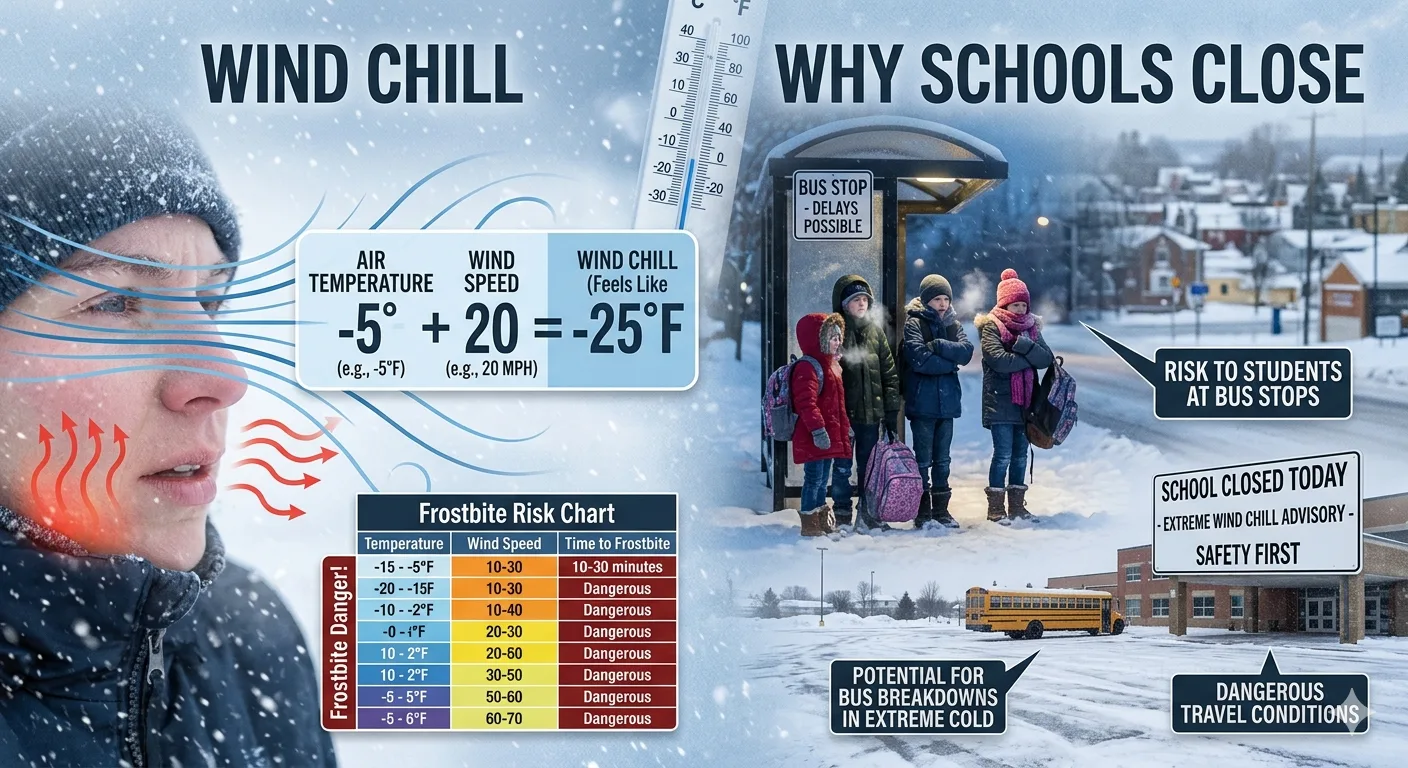
You know the scene. It is six in the morning. I stand in the kitchen wearing one sock and I keep refreshing the district website for the fourth time. The thermometer reads three degrees below zero. The weather app says it feels like minus twenty‑seven degrees. Across the town a superintendent is making a call that will rearrange the day.
So, what wind chill closes school? For a lot of northern districts, the magic zone is somewhere between -25°F and -35°F. In milder states it can be as high as -15°F. But the number alone doesn't tell the whole story, and this guide will show you why. If you just want a fast gut check before you go to bed, our snow day calculator is a decent place to start.
Wind chill in plain English
Wind chill is not the temperature. Your car doesn't feel it, and neither do your pipes. It's an estimate of how quickly bare skin loses heat when cold air is moving past it.
Think about the layer of warm air that clings to my skin. When the air is still that layer stays. Acts like a very light coat. Add wind and it blows away over and over so my body keeps burning energy to rebuild it. That is why ten degrees below zero with no wind feels fine in a jacket and ten degrees below zero with a thirty‑mile‑per‑hour gust makes my face ache.
One quirk knowing: the formula only applies when the temperature is fifty degrees below zero or colder and the wind exceeds three miles per hour. Also frostbite needs the real air temperature to be below freezing. A windy 45°F day is unpleasant, but it's not going to freeze anyone's cheeks.
Where the number comes from
Back in 1945, two Antarctic researchers, Paul Siple and Charles Passel, tested how fast water froze in plastic containers in different winds. It was clever work, but it made the cold seem worse than people actually experience it.
The version we use now arrived in 2001, when the National Weather Service and Environment Canada rebuilt the index using wind tunnel tests and human volunteers. It also assumes wind at about 5 feet up, which is roughly face height. Here's the formula, mostly for the curious:
Wind Chill (°F) = 35.74 + 0.6215T - 35.75(V0.16) + 0.4275T(V0.16)
T is air temperature in °F and V is wind speed in mph. Please don't do this by hand at 5 AM. Type your forecast numbers into our wind chill calculator and you'll have the answer in a few seconds.
One more thing about the formula. It was built around a healthy adult walking straight into the wind under a clear sky. A six-year-old standing still at a bus stop is a very different situation, and honestly, the real risk for kids is probably higher than the chart says.
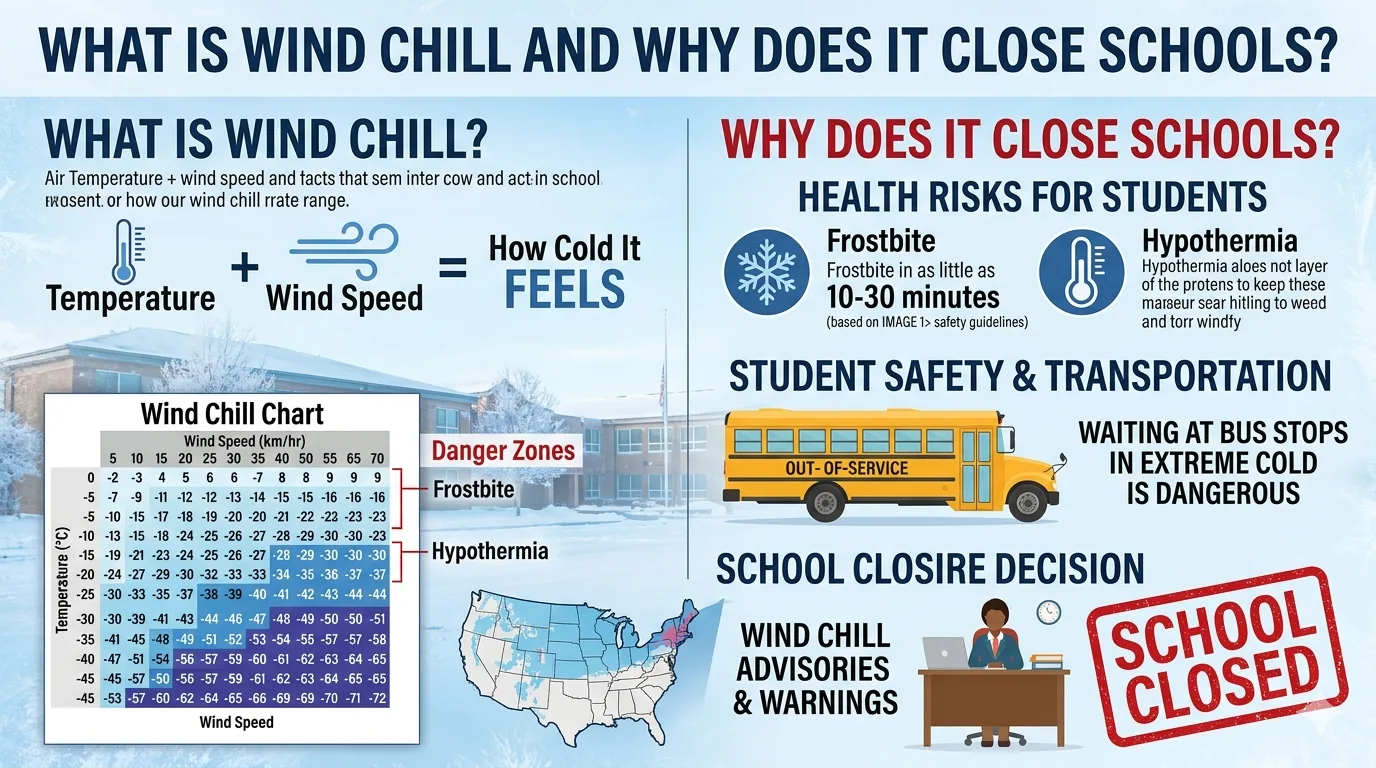
A quick cheat sheet
| Air Temp | 10 mph wind | 20 mph wind | 30 mph wind | 40 mph wind |
|---|---|---|---|---|
| 30°F | 21°F | 17°F | 15°F | 13°F |
| 20°F | 9°F | 4°F | 1°F | -1°F |
| 10°F | -4°F | -9°F | -12°F | -15°F |
| 0°F | -16°F | -22°F | -26°F | -29°F |
| -10°F | -28°F | -35°F | -39°F | -43°F |
| -20°F | -41°F | -48°F | -53°F | -57°F |
These are rounded NWS values. Notice how quickly things fall apart once I am near zero degrees: a twenty‑mile‑per‑hour breeze turns a zero‑degree morning into minus twenty‑two degrees.
As for how exposed skin can last the rough numbers are about thirty minutes near minus twenty degrees wind chill about ten minutes near minus thirty‑five degrees and five minutes or less at around minus forty‑eight degrees and colder. Now imagine a child waiting for a bus. Ten minutes is a long time in that setting.
Heads up: the alert names changed
If you learned the old system, some of this will look unfamiliar. On October 1, 2024, the National Weather Service dropped its wind chill alerts and swapped in new ones:
- Wind Chill Advisory became a Cold Weather Advisory.
- Wind Chill Warning became an Extreme Cold Warning.
- Wind Chill Watch became an Extreme Cold Watch.
It isn't only a new label. The old alerts needed a certain amount of wind. The new ones can go out for very low air temperatures on a dead-calm night too. As one NWS meteorologist put it, cold is cold, wind or no wind.
Also, there's no single national trigger. Each local forecast office picks its own. In West Michigan for example an advisory means three or more hours at minus fifteen degrees or colder and a warning means minus degrees or colder. In Wisconsin the advisory begins at minus twenty degrees and a warning comes around minus thirty to minus thirty‑five degrees. Down in Middle Tennessee alerts start at numbers that would seem mild up north.
Many district policies still use the old "wind chill warning" wording. When you read one, just mentally translate it to "extreme cold warning" and you'll be fine.
What districts really use
There's no federal or state rule that says "close at X degrees." Every district writes its own, so the range is wide. A few examples of how it looks in practice:
| District Type | Typical Closure Trigger | Notes |
|---|---|---|
| Northern Illinois district | Sustained wind chill of -30°F, or an actual temperature of -15°F | Checked during morning and afternoon travel times |
| Northeast Wisconsin district | Sustained wind chill of -35°F | Closure or delayed start; recess still happens above 0°F |
| Central Wisconsin district | -35°F wind chill with wind of 4+ mph for 3 or more hours | Advisory-level cold usually means school is open |
| Ohio districts | Around -20°F wind chill is a common benchmark | Lower thresholds where deep cold is rare |
| Some large city systems | Decided case by case | Officials have said cold by itself rarely closes schools |
The pattern is easy to spot once you see it. Places that get -20°F every January have buses, boots, and habits that handle it, so they wait for a colder line. Places where that kind of cold is a once-in-a-decade event close sooner, because nothing there is set up for it.
Can't find your district's number? Search its website for "severe weather," "inclement weather," or "extreme cold." It's usually buried in a policy PDF.
Why one number isn't the whole story
Wind chill gets the headline, but superintendents are weighing a pile of other things at the same time. Here's what's going on behind that 5:30 AM decision.
Kids get cold faster
Children have more skin compared to their body size, so they lose heat quicker than adults. Their bodies are also still getting the hang of temperature control. That's a big reason districts play it safe.
Buses hate the cold
Diesel engines don't love it when it drops far below zero. Untreated fuel can thicken, batteries weaken, and brake systems get cranky. Most districts run winter-blend fuel, but extreme cold still leads to no-starts. That's why transportation crews are often out testing buses at 4 or 5 AM.
One stranded bus with kids on board is enough to change a whole district's mind, and I think that's a fair reason to lean cautious.
Buildings can fail
A multi-day cold snap pushes heating systems hard. Frozen pipes, cold gyms, and drafty portable classrooms are all real concerns. If even one campus can't stay warm, that can tip the decision for everyone.
Roads and staff
Deep cold often comes with black ice and blowing snow. Road salt also works poorly as it gets extremely cold, so a road that looks treated can still be slick. If teachers and drivers can't get to work safely, there's nobody to run the day.
Not every kid has a real coat
Some students show up in sneakers and a light hoodie no matter what. Schools often run coat and glove drives, which is great, but a region-wide event is too big to fix one student at a time.
Wind Chill Reference Table by Temperature and Wind Speed
| Air Temp (°F) | Wind 10 mph | Wind 20 mph | Wind 30 mph | Wind 40 mph | Frostbite Risk |
|---|---|---|---|---|---|
| 30°F | 21°F | 17°F | 15°F | 13°F | Low |
| 20°F | 9°F | 4°F | 1°F | -1°F | Low |
| 10°F | -4°F | -9°F | -12°F | -15°F | Moderate |
| 0°F | -16°F | -22°F | -26°F | -29°F | High (30 min) |
| -10°F | -28°F | -35°F | -39°F | -43°F | Danger (10-30 min) |
| -20°F | -41°F | -48°F | -53°F | -57°F | Extreme (<5 min) |
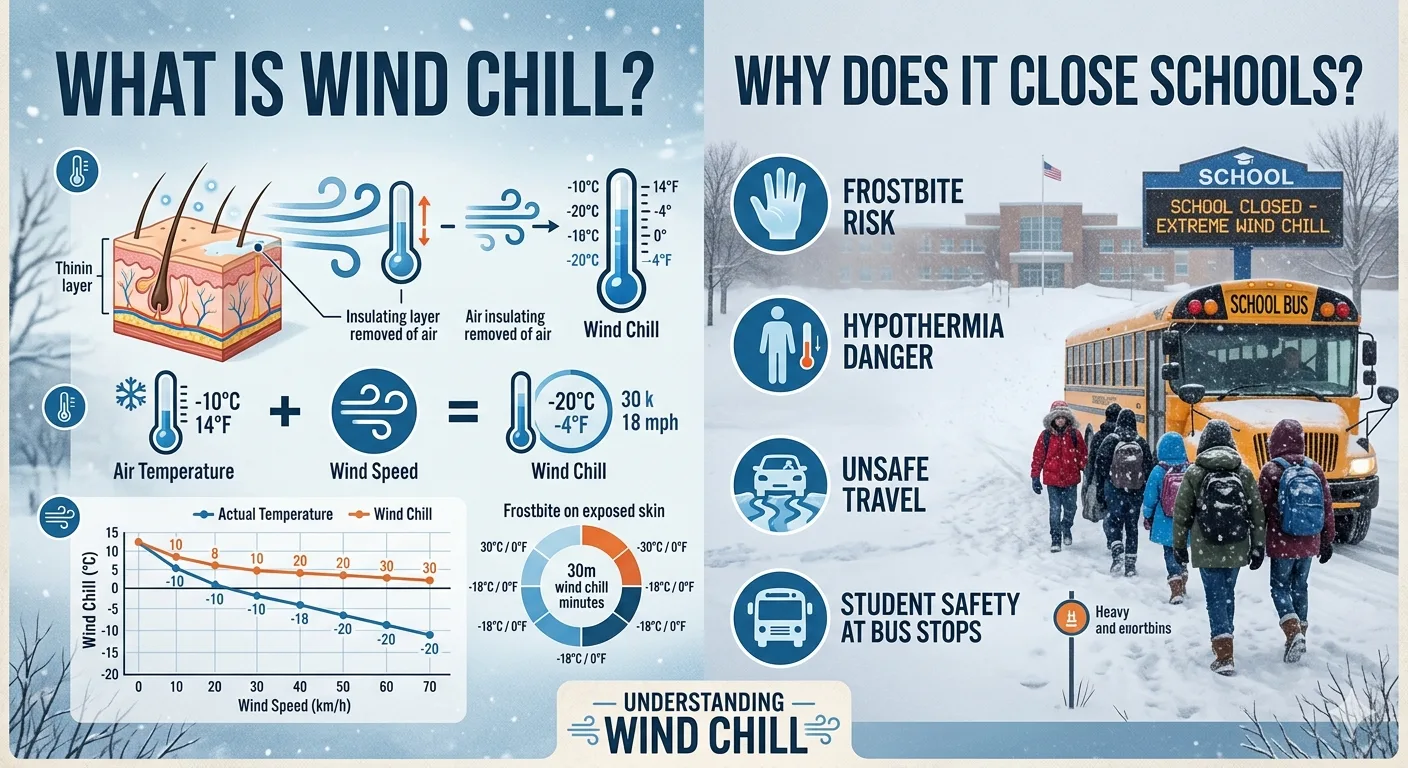
How the decision plays out
Most districts follow roughly the same script. The night before, leaders keep an eye on NWS forecasts, and if the cold is obviously going to be dangerous, they may announce a closure that evening. Otherwise, mechanics and facilities staff start testing buses and buildings around 4 to 5 AM. By about 5:30 or 6:00, the superintendent has usually checked in with neighboring districts and made a call. Families typically hear by 6:30 through an app, text, email, or local news.
Two-hour delays have become a popular middle option. A short delay gives crews time to confirm buses will run and lets the morning warm up a touch. And many districts now switch to remote learning on cold days, so they don't have to tack a make-up day onto June. Honestly, that one change has made closing for cold an easier choice for a lot of schools.
Frostbite and hypothermia, briefly
These are the two injuries behind every closure so it helps to recognize them.
Frostbite is when skin and the tissue underneath actually freeze. My body protects its core by pulling blood from fingers, toes, ears and the nose, which leaves them exposed. It starts as frostnip with red, numb tingling skin that usually recovers if I warm it up gently. It can progress to skin that blisters, to skin that turns hard, waxy and pale. That last stage can mean damage.
Hypothermia is when core body temperature falls below degrees. It does not need freezing weather. A wet child in a wind can get there surprisingly fast. Early signs are heavy shivering, confusion and clumsy movements. If the shivering stops and the child becomes sleepy I treat it as an emergency get them inside and call for help.
Read More : How Do Snow Days Affect Students
Getting ready before the call comes
I cannot control the closure. I can make the morning less chaotic. Here is a simple routine that works.
- Check the real numbers. Look up tomorrow's temperature and wind speed, then run them through the wind chill calculator.
- Look for an alert. Watch for a Cold Weather Advisory or Extreme Cold Warning from your local NWS office.
- Confirm your notifications. Make sure the school has your current phone number, and know where closures get posted.
- Lay out the gear. Hats, mittens, boots, scarf, all in one spot. Nobody finds a missing mitten at six forty in the morning without a panic.
For clothing I think in layers. I start with a moisture‑wicking base (polyester or merino never cotton) add fleece or wool in the middle and top it with a shell. Then I finish with a hat that covers the ears mittens than gloves, a neck gaiter and waterproof boots with dry socks.
If school is open but the day still looks rough a few small moves help a lot. I drive my child to the stop or school if I can. I pick a backup place along the route like a neighbors porch or a nearby shop. Teach kids to tell you right away if their fingers, ears, or cheeks start to burn or go numb. And read your district's attendance policy before you need it, since many allow families to keep kids home in dangerous weather, but the rules aren't the same everywhere.
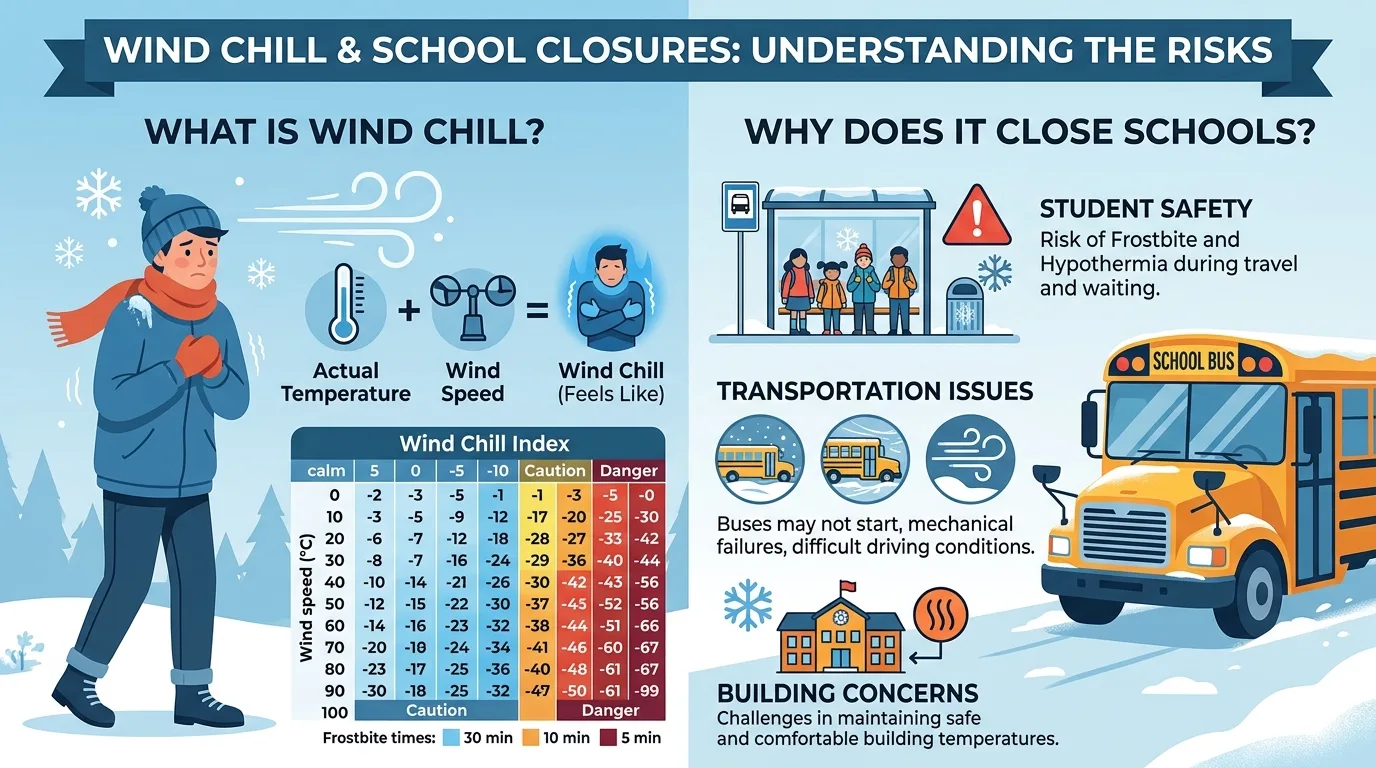
The polar vortex factor
The biggest waves of closures tend to come from a polar vortex slipping out of place. Normally the jet stream keeps Arctic air bottled up near the pole. When it weakens or gets wavy, that air can spill south into the Midwest and Northeast.
In January 2019 some parts of the Midwest hit wind chills below minus fifty degrees and entire city school systems shut down. Researchers are still studying how a warming Arctic might change these events so there is no answer yet about whether they will become more or less common.
Other weather that disrupts school
Winter isn't the only troublemaker. Scorching late-summer days can lead to early dismissals, and a heat index calculator helps you see what those afternoons really feel like. Storm days are their own headache, and a rain delay calculator can tell you whether that game or field trip is likely to go ahead.
If you enjoy having a tool for every kind of weather day, our full set of weather and school calculators is worth a look.
The short version
Most northern districts close between minus twenty‑five and minus thirty‑five degrees wind chill and warmer regions can close at minus fifteen to minus twenty degrees. The two things that really matter are the NWS alert (now a Cold Weather Advisory or Extreme Cold Warning) and the exact wording, in the district policy.
I will say it plainly: a school day can be made up. A child’s frostbitten face cannot be undone. So when a district closes for dangerous cold, I think that's the right call, even if it's inconvenient.
Before the next cold snap, take five minutes to find your district's policy, check tomorrow's forecast, and set out warm gear tonight. And when you want a quick read on your chances of a closure, run your forecast through our snow day calculator. Stay warm out there.
Also Checkout :