Introduction
If you've spent any time training Horse Girls in Uma Musume Pretty Derby, you already know that raw stats alone don't win races. One of the most underrated and often overlooked systems in the game is the affinity system, a mechanic that governs how well your trainer bonds with each Uma Musume character. Understanding and calculating affinity can be the difference between a Horse Girl who merely performs and one who dominates every race track.
The Uma Musume Affinity Calculator has become an essential tool for serious players who want to optimize their training runs, plan support card combinations, and unlock the full potential of their roster. Whether you're a newcomer trying to understand the basics or a veteran player looking to min-max your build, this comprehensive guide will walk you through everything you need to know about affinity mechanics and how to use an affinity calculator effectively.
What Is Affinity in Uma Musume Pretty Derby?
Before diving into the calculator itself, it's important to understand what affinity actually means within the game's systems.
Affinity (also referred to as bond or friendship level in some translations) represents the relationship level between your trainer character and a specific Uma Musume. It is a numerical value that builds over the course of a training scenario and has a direct impact on several important in-game outcomes.
At its core, affinity determines:
- How often and how powerfully a support card character activates their training bonuses
- The likelihood of receiving special "motivated" training events
- Whether you unlock character-specific story events and hidden stat boosts
- The overall synergy between your support card deck and your Uma Musume's stat growth
Think of it like a trust meter. The higher your affinity with a particular character or support card, the more willing they are to go above and beyond during training sessions, granting you bonus stats, skill hints, and energy replenishment that lower-affinity bonds simply cannot offer.
How Affinity Is Built During a Training Run
Affinity does not start at its maximum. Instead, it grows through specific in-game actions and events throughout your training scenario. Understanding how affinity accumulates is the first step to using an Uma Musume Affinity Calculator effectively.
Training Together
Every time you select a training type (Speed, Stamina, Power, Guts, or Intelligence) where a support card character is stationed, your affinity with that character increases. The more frequently you train alongside a specific character, the faster the relationship grows.
Random Events
The game features a wide array of random events tied to specific support cards and Uma Musume characters. Many of these events provide affinity boosts as one of their selectable outcomes. Choosing the right response in these events is essential to maximizing bond growth efficiently.
Outings and Vacations
Some training scenarios include outing or vacation mechanics where you can spend a turn interacting with characters outside of formal training. These outings often provide large chunks of affinity at the cost of a training turn, making them a calculated trade-off that the Uma Musume Affinity Calculator can help you evaluate.
Support Card Skills
Certain support cards have passive skills that grant affinity bonuses automatically or under specific conditions. Cards with the "Friendship" or "Bond" type skills are particularly valuable for affinity-focused strategies.
What Is the Uma Musume Affinity Calculator and Why Do You Need One?
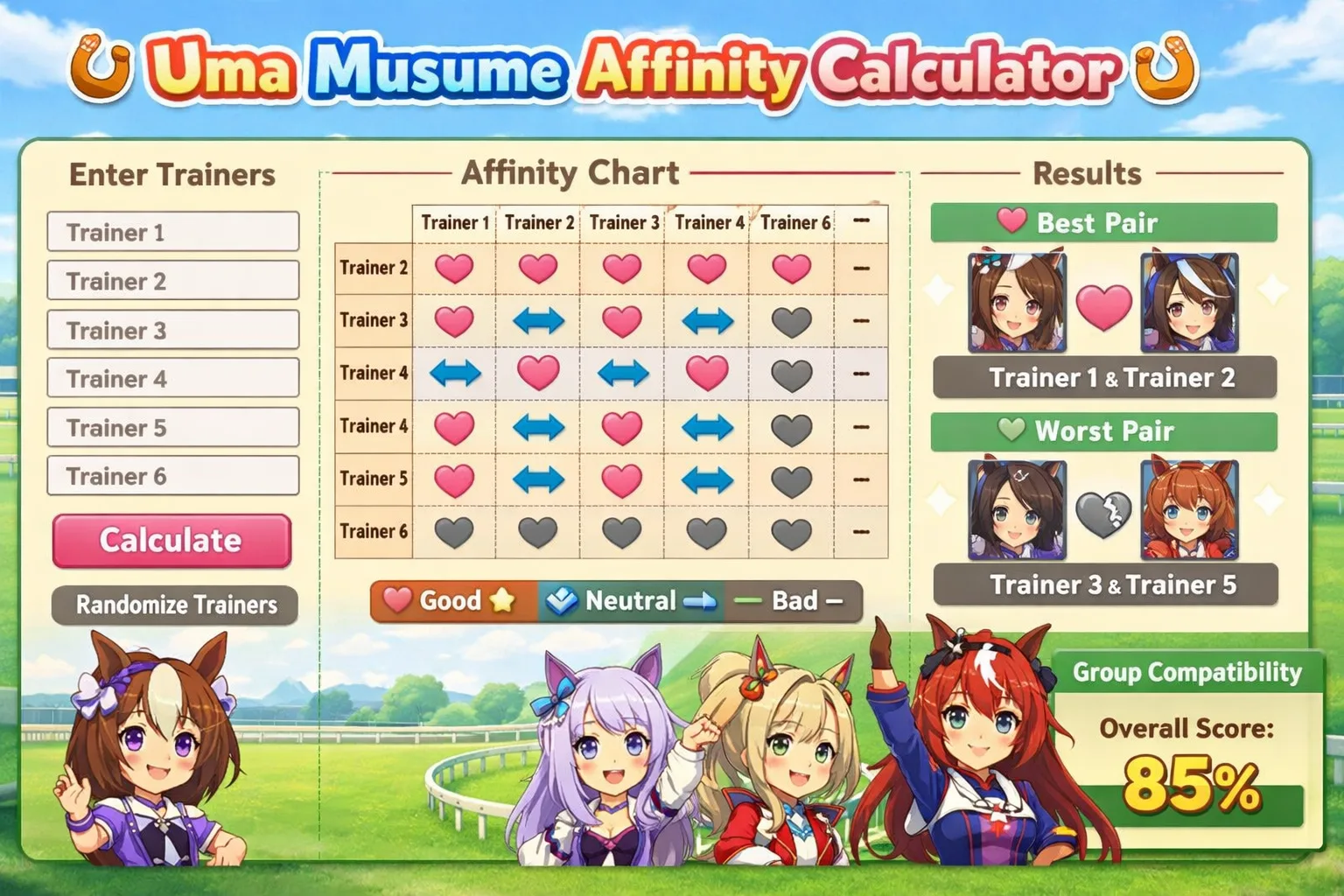
The Uma Musume Affinity Calculator is an external tool usually a web-based application or spreadsheet designed to help players model, predict, and optimize their affinity growth during a training scenario.
Because affinity interacts with so many different systems support card composition, training selection, event choices, and scenario mechanics it can be extremely difficult to intuitively grasp how your choices ripple forward across an entire training run. The affinity calculator takes the guesswork out of this process by allowing you to:
1. Simulate Affinity Growth Over Time By inputting your support card lineup, training preferences, and scenario type, the calculator can project when you are likely to reach key affinity thresholds for each character. This lets you plan training turns strategically rather than reactively.
2. Identify the Optimal Training Schedule Not every training turn needs to be spent grinding stats. Sometimes, spending a turn in a lower-stat training slot to raise affinity with a powerful support card pays enormous dividends later in the run. The calculator helps you identify these pivot points.
3. Compare Support Card Combinations Different support card lineups have different affinity-building profiles. An Uma Musume Affinity Calculator lets you compare two or more deck compositions side by side to see which one reaches affinity breakpoints faster and more reliably.
4. Minimize Wasted Turns In Uma Musume, every training turn is precious. Using the affinity calculator to pre-plan your turns means you're never spending actions inefficiently every choice moves you closer to both your stat targets and your affinity targets simultaneously.
5. Unlock Hidden Bonuses Many support cards have hidden bonus events that only trigger once affinity reaches a specific threshold (commonly around 60, 80, or 100 out of 100). These bonuses can include massive stat boosts, rare skill acquisitions, and energy refills. Missing them is leaving enormous value on the table.
Key Affinity Thresholds You Should Know
In Uma Musume Pretty Derby, affinity does not scale linearly in terms of its rewards. Instead, there are specific threshold values where bonus effects unlock. Knowing these thresholds is critical to using the Uma Musume Affinity Calculator intelligently.
Threshold 1: Affinity 40 Increased Event Frequency
Once you cross the 40-affinity mark with a support card character, the frequency of their training events increases noticeably. You'll begin seeing their special training bonuses more reliably, and their chance of granting skill hints goes up.
Threshold 2: Affinity 60 Bonus Stat Events Unlock
At 60 affinity, many support cards unlock a special bonus event or training effect that wasn't available at lower bond levels. For Speed-type support cards, this often manifests as additional Speed stat bonuses layered on top of the standard training output.
Threshold 3: Affinity 80 Energy Restore and Motivation Boost
The 80-affinity threshold is widely considered one of the most impactful in the game. At this level, support card characters begin offering energy restoration effects and motivation-boosting events, both of which dramatically improve your training efficiency in the late stages of a run.
Threshold 4: Affinity 100 Maximum Bond Effects
Reaching 100 affinity the maximum with a support card unlocks that card's most powerful passive effects, including their highest-tier training stat contributions and their rarest story events. Not every run will allow you to reach 100 affinity with all cards in your deck, which is why the Uma Musume Affinity Calculator is so valuable for prioritizing which characters to bond with first.
How to Use an Uma Musume Affinity Calculator: Step-by-Step
Using an Uma Musume Affinity Calculator is straightforward once you understand the inputs the tool requires. Here is a general step-by-step process for getting the most out of these tools.
Step 1: Select Your Scenario
Different training scenarios have different turn lengths, event pools, and outing mechanics. Always begin by selecting the scenario you're planning to run. Common scenarios include the original URA Finals, Aoharu Cup, Grand Masters, and the more recent scenario additions. Each has unique affinity-building opportunities baked into its structure.
Step 2: Input Your Support Card Lineup
Enter each support card in your current deck. Most affinity calculators will ask for the card's name, rarity level, and the level of its bond-related skills. If your card has been leveled up or has specific friendship-boosting skills activated, make sure to reflect that in the tool.
Step 3: Set Your Training Priorities
Tell the calculator which stats you're primarily targeting (e.g., prioritizing Speed and Intelligence for a long-distance Uma Musume). This allows the tool to calculate how often your training selection will naturally overlap with your support card characters' stationed positions, which in turn affects organic affinity growth.
Step 4: Review Affinity Projections
The calculator will display projected affinity timelines for each support card in your deck. Look for any cards that are unlikely to reach their key thresholds (especially 80 or 100) under your current plan. These are your optimization targets.
Step 5: Adjust Your Training Schedule
Based on the projections, consider shifting some training turns toward sessions where lagging-behind support cards are stationed. Even one or two additional training sessions with a key support card can be the difference between hitting the 80-affinity threshold and falling short of it.
Step 6: Factor in Outing Turns
If your scenario includes outing events, the calculator can help you determine whether spending an outing turn on a specific character is worth the lost training turn. Generally, outings are most valuable for characters you're struggling to bond with organically.
Step 7: Iterate and Refine
The Uma Musume Affinity Calculator is not a one-and-done tool. Use it iteratively after each significant training run, review your affinity outcomes against the calculator's projections and adjust your strategy accordingly. Over time, you'll develop an intuitive feel for which support card combinations naturally produce the strongest affinity curves.
Support Card Types and Their Impact on Affinity Calculations
Not all support cards contribute to affinity equally. Understanding the different card types and how they interact with the affinity system will sharpen your use of any Uma Musume Affinity Calculator.
Speed Support Cards
Speed cards are the most commonly used support type, and many of the game's most powerful affinity-granting effects are found in high-rarity Speed cards. Look for cards with the "Training Partner" and "Race Strategist" skills, as these often include hidden affinity boosts tied to their training activation rates.
Stamina Support Cards
Stamina cards tend to have affinity growth that is tied more heavily to race events and mid-scenario training checks. If you're running a stamina-heavy Uma Musume, investing in Stamina-type support cards with strong affinity skills can create a smooth, consistent bond curve throughout the run.
Power Support Cards
Power cards often feature event-based affinity bonuses that trigger through random story events rather than pure training frequency. This makes them slightly less predictable in affinity calculators, so it's worth adding a small variance buffer when projecting Power card affinity growth.
Intelligence Support Cards
Intelligence support cards are unique because they often provide energy restoration effects that indirectly support affinity building. By keeping your Uma Musume's energy high, you can afford to select more training turns alongside specific support characters, accelerating bond growth across your entire deck.
Friend-Type Support Cards
Friend-type cards are specifically designed around affinity and relationship mechanics. These cards often reach key affinity thresholds faster than other types and provide some of the most generous bond-related event rewards in the game. Any serious Uma Musume Affinity Calculator will give Friend-type cards their own dedicated affinity-scaling parameters.
Common Mistakes Players Make When Ignoring Affinity
Understanding the Uma Musume Affinity Calculator is only useful if you also understand the consequences of poor affinity management. Here are some of the most common mistakes players make when they neglect the affinity system.
Focusing Exclusively on Raw Stat Gains Many players instinctively choose the training option that provides the highest immediate stat gain. While this seems logical, it often results in support cards never reaching their key affinity thresholds, costing significantly more in long-term stat efficiency than the short-term gains were worth.
Ignoring Friend-Type Cards Friend-type support cards are sometimes dismissed because their direct stat contributions appear lower than Speed or Stamina cards. However, their superior affinity growth rates translate into more training events, more skill hints, and more energy restoration over the course of a full scenario outcomes that dwarf what a slightly higher direct stat card would have provided.
Skipping Outing Events Some players treat outing events as pure opportunity cost. In reality, the affinity gained during an outing especially when targeting a key support card close to a threshold can unlock bonus events worth several times the value of the skipped training turn.
Not Adapting to RNG Training scenarios involve a degree of randomness. Sometimes, a support card character simply doesn't appear in your desired training slots as frequently as expected. A good Uma Musume Affinity Calculator helps you identify when you're falling behind on affinity targets early enough to correct course, rather than discovering the problem only in the final race preparation phase.
Advanced Tips for Maximizing Affinity in Every Run
For players who want to push their Uma Musume builds to their absolute ceiling, here are advanced strategies that pair well with affinity calculator usage.
Stack Friend-Type Cards With Speed Cards
Running two Friend-type cards alongside high-stat Speed cards creates a hybrid strategy where you build affinity quickly through the Friend cards while the Speed cards do the heavy lifting on stat contribution. This combination tends to produce smooth affinity curves that reach 80 on both Friend cards before the final race segment.
Prioritize Affinity-Boosting Skills When Leveling Cards
When you have resources to level up support cards, prioritize unlocking skills that provide affinity bonuses during training events. These skills compound across an entire scenario and become exponentially more valuable in longer or harder scenarios.
Use the Calculator Before Starting Each Run
The biggest mistake players make is using the affinity calculator reactively rather than proactively. Spend five minutes with the tool before beginning a new training run to model your expected affinity curves. This upfront investment consistently pays off in better final stat totals and more consistent race performance.
Read More : Loan Calculator
Track Affinity Alongside Stat Growth
Create a simple mental or written checklist that tracks both your stat targets and your affinity targets at each stage of the training scenario (early, mid, and late game). Treat affinity milestones with the same seriousness as stat thresholds, and your overall training efficiency will improve dramatically.
Best Resources for Uma Musume Affinity Calculators
The Uma Musume community has produced a range of high-quality affinity calculator tools, primarily developed by dedicated fans in Japan and localized or adapted by international players. When looking for a reliable calculator, prioritize tools that:
- Are updated to reflect the current game version and the latest support card additions
- Allow full customization of support card lineups and skill levels
- Provide threshold tracking alongside projected affinity timelines
- Include notes on scenario-specific mechanics that affect affinity growth
Community hubs such as the game's official Reddit community, dedicated Discord servers, and fan wikis are the best starting points for finding currently maintained Uma Musume Affinity Calculator resources. Because the game receives regular content updates, always verify that a calculator reflects the most current game version before relying on its projections.
Conclusion
Affinity is not a side system in Uma Musume Pretty Derby it is one of the foundational pillars of efficient training strategy. Players who treat bond-building as an afterthought are consistently leaving significant stat value, skill acquisition opportunities, and race performance on the table.
The Uma Musume Affinity Calculator gives you a tangible, data-driven way to bring affinity management into the core of your training planning. By modeling your support card lineup before each run, tracking affinity projections alongside stat targets, and making calculated decisions about training selection and outing usage, you can build stronger Horse Girls with more well-rounded skill sets and better race performance across every scenario.