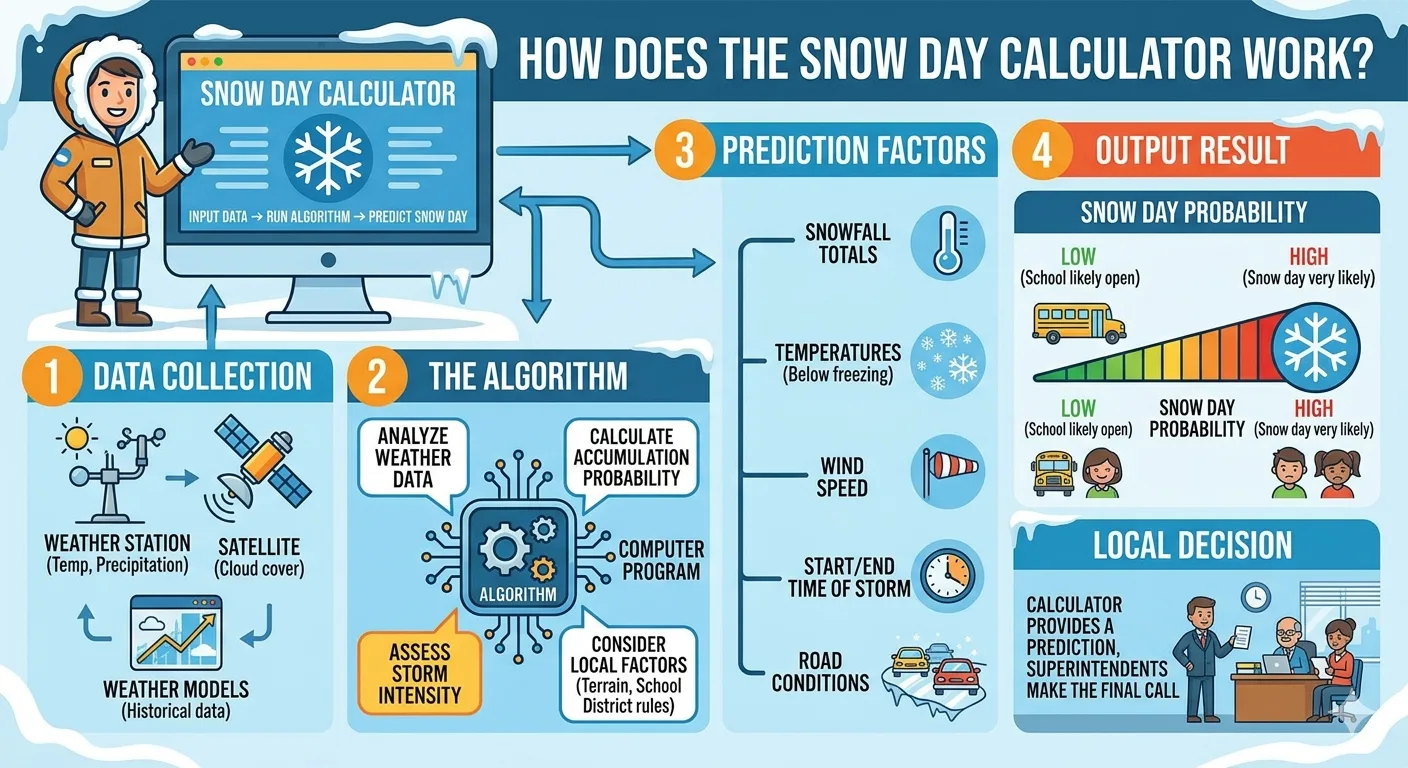
You type in your ZIP code tap a button and a number appears. Maybe it says 70%. Maybe it says 15%. Either way, your next question is the same: what does that number actually mean?
That is exactly what this guide covers. I built my snow day calculator after seeing parents in my area confused about school closures, and I would rather you understand the number than just trust it.
Below, you will see what the tool looks at, how the percentage is scored, where it works well, where it falls short, and how to turn a prediction into a real plan for tomorrow morning.
What Is the Snow Day Calculator?
The snow day calculator is a free online tool that estimates the chance of a school closure from the weather forecast for a location. You enter a city or ZIP code. It returns a percentage for the days ahead.
A normal weather app tells you how much snow is coming. A snow day calculator takes the next step and asks the question families actually care about: will school be closed?
That makes it a planning tool. It is not an official announcement, and it never will be. Only your school or district can confirm a closure, which I will come back to later because it matters.
How the Snow Day Calculator Works, Step by Step
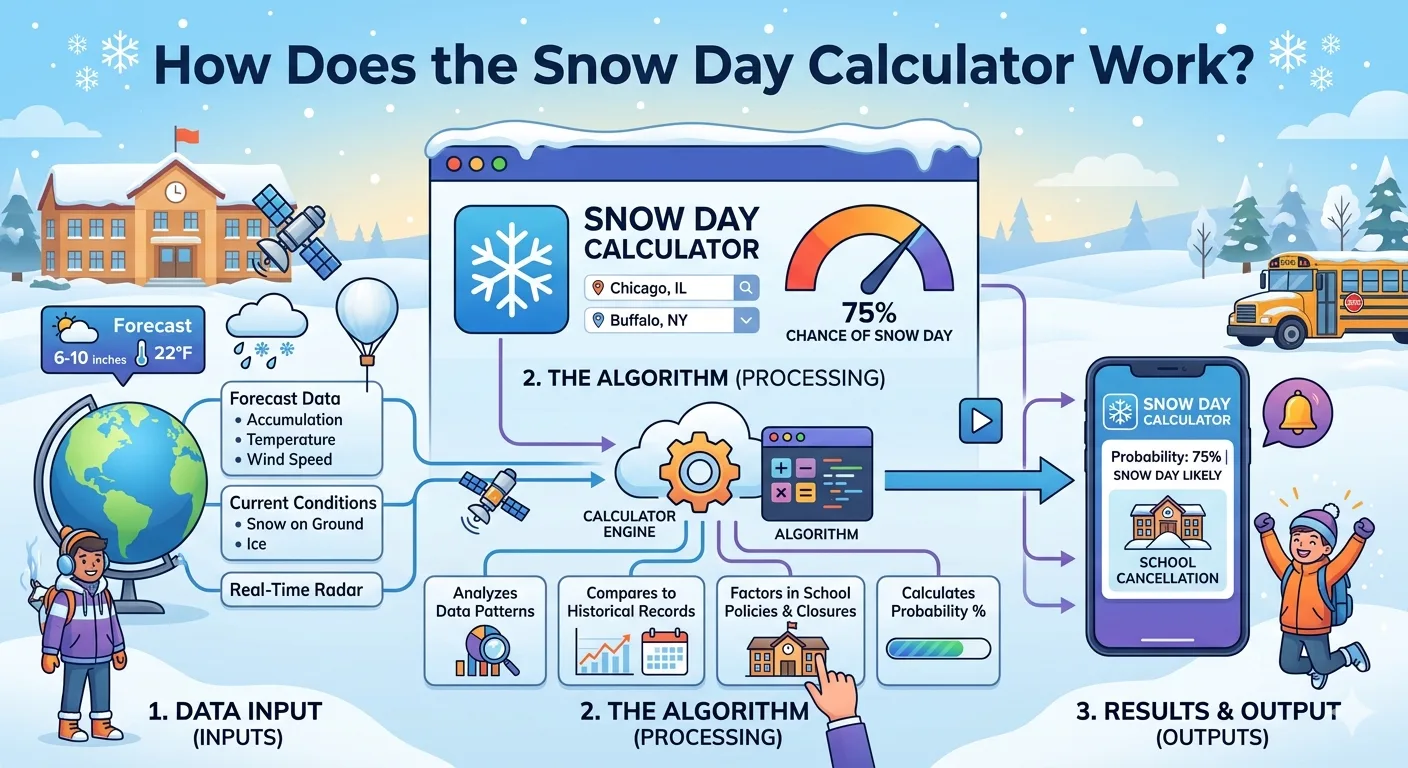
The process is simple on your side and a bit more involved behind the scenes. Here is the full sequence.
- You enter a location. Use a city name or ZIP code. For the most useful result, enter the location of the school rather than your home if they are in different areas.
- You can pick a school level. This step is optional. The choices are elementary, middle school, high school, and college.
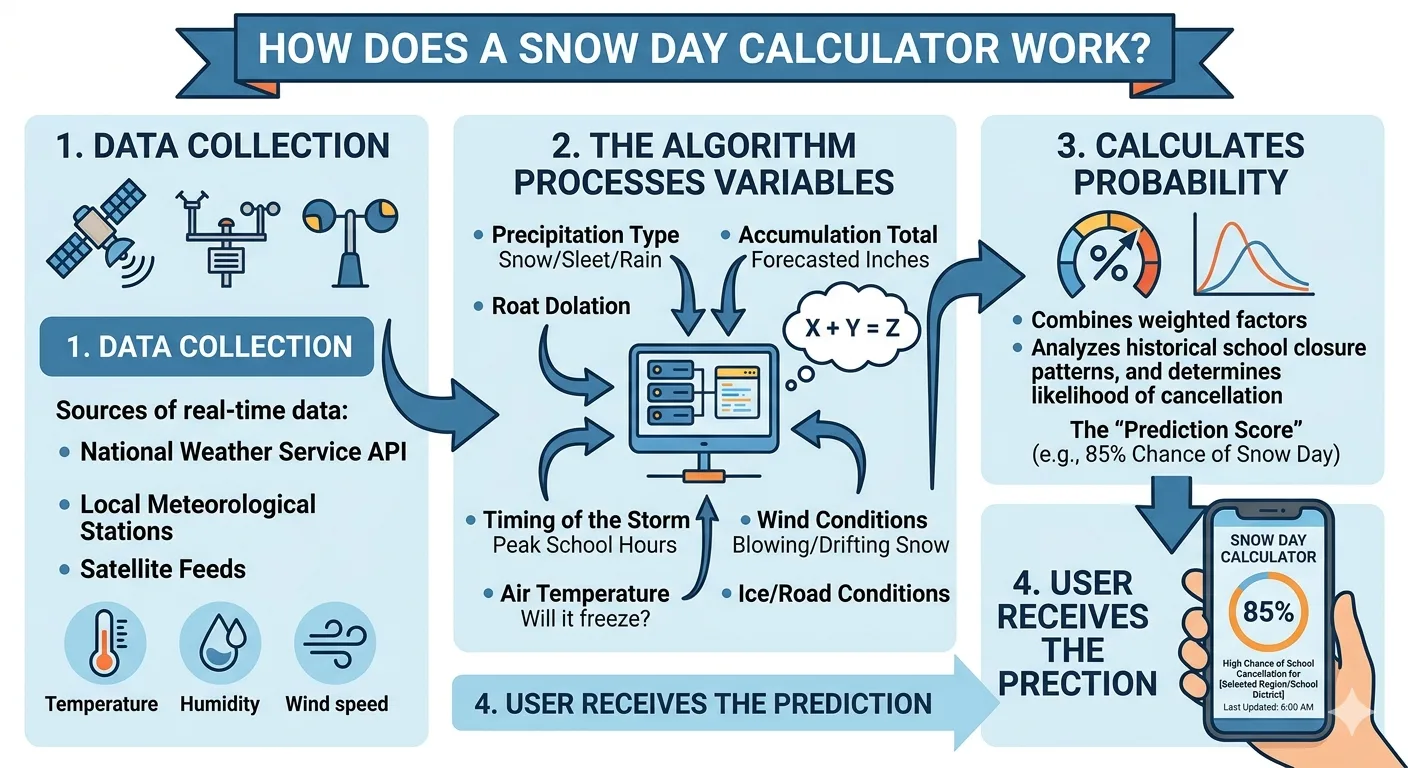
- The tool pulls forecast data. It uses real-time weather data from official meteorological services for your location, in the United States and Canada.
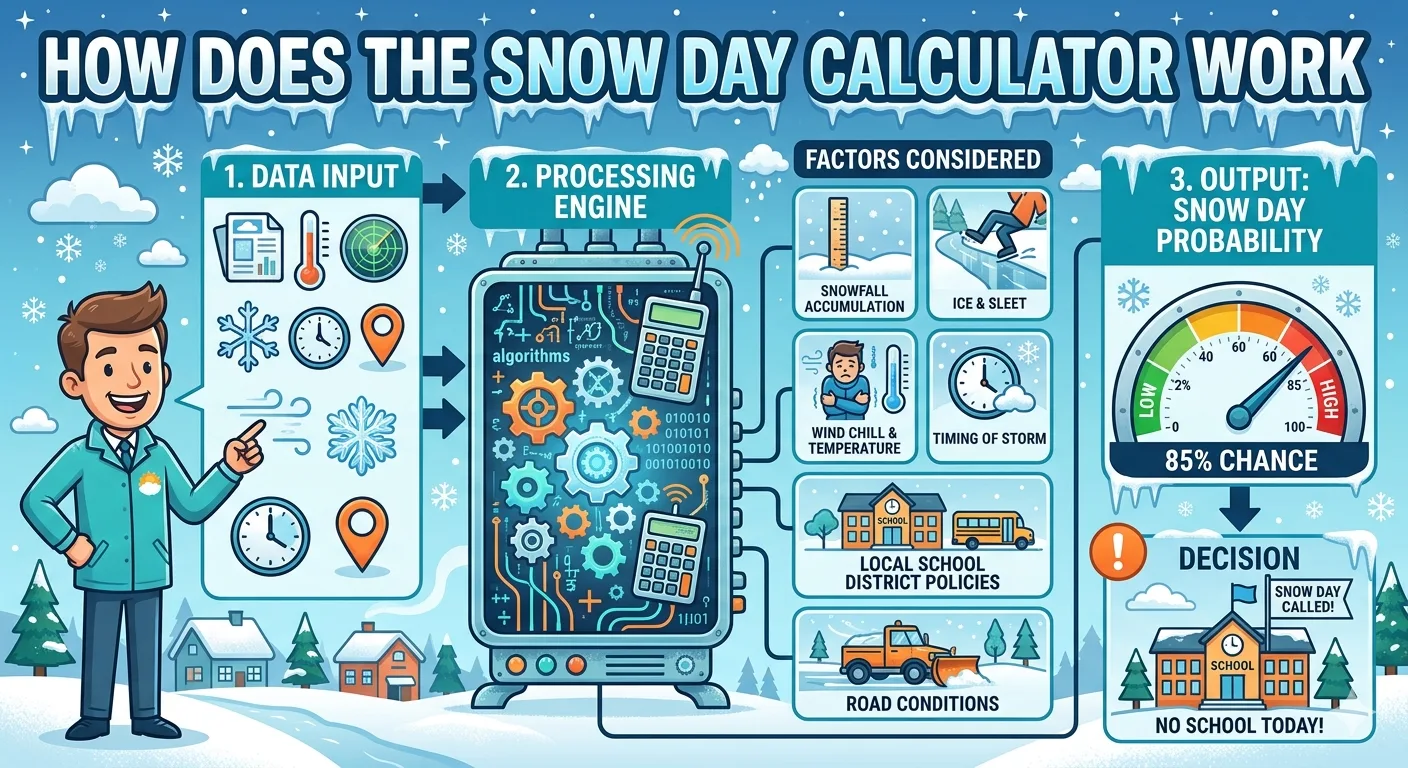
- The forecast is checked against scoring rules. Snowfall, cold, and wind are tested against set thresholds, and each one that applies adds to the chance of a closure.
- The result is adjusted. School level and the day of the week change the outcome. A weekend day scores 0%, because there is no school anyway.
- You get a forecast by day. You see the likelihood for the days ahead, so you can spot the riskiest morning instead of guessing.
The whole thing takes a few seconds. The real value comes from understanding what sits behind the percentage.
The Scoring Rules in Plain English
The calculator uses a rule-based approach. Each weather condition either triggers a rule or it does not. Here are the main ones published on the site.
| Factor | Trigger | Effect on closure chance |
|---|---|---|
| Heavy snowfall | 5 inches or more forecast | Adds about 40% |
| Extreme cold | Temperature below 20°F | Adds about 20% |
| High winds | Wind above 15 mph | Adds about 10% |
| School level | Elementary, middle, high school, college | Elementary schools are treated as more likely to close |
| Weekend days | Saturday or Sunday | 0%, since there is no school |
Why these three weather factors?
They are the conditions that most often turn a normal morning into a risky one for buses and walkers.
- Snowfall: More snow means slower plowing and harder stops for heavy vehicles. Five inches is a common point where trouble starts for many districts.
- Cold: Very low temperatures can close schools even with no new snow, because of bus stop exposure and heating risks in older buildings.
-
Wind: Gusts drift snow back onto cleared roads. Cut visibility on open stretches.
On a bitter morning, the "feels like" temperature matters even more than the thermometer. The National Weather Service gives a handy example: at 0°F with a 15 mph wind, the wind chill is about -19°F, and exposed skin can freeze in roughly 30 minutes. You can check your own forecast with the wind chill calculator to see how a morning will really feel at the bus stop.
Worked Examples: What the Number Looks Like
Here are four quick scenarios built from the scoring rules above. They are simplified illustrations, and your own result may differ because school level and live forecast details also play a part.
Example 1: A hard-hitting storm
Forecast: 6 inches of snow, 8°F, and 22 mph winds on a school day.
All three weather rules apply. The chances stack up to a high result, roughly in the 70% range before the school level is considered. This is the kind of morning when families should plan for a closure.
Example 2: A moderate snow, mild cold
Forecast: 3 inches of snow, 26°F, and 10 mph winds.
None of the main triggers fire, so the number stays low. This is exactly the situation where you should look beyond the percentage and check the forecast for ice or the timing of the snow, because those can change the outcome fast.
Example 3: Cold with no snow
Forecast: no snow, 5°F, and 12 mph winds.
Only the cold rule applies,. The result sits in the low to moderate range.. If the wind chill is dangerous some districts will still delay or close. In a case like this, cross-check the wind chill and your district's own cold-weather guidance.
Example 4: A Saturday storm
Forecast: 8 inches of snow on a Saturday.
Result: 0%. The storm may be huge, but there is no school to cancel. The tool is built to say so clearly.
How to Read the Percentage
A percentage can feel precise when it really is a signal. Here is a practical way to read it. This is my rule of thumb not an official scale.
- 0% to 20%: School is very likely to run as normal. Keep an eye on the forecast anyway.
- 20% to 40%: A delay or a close call is possible. Make sure alerts are on.
- 40% to 60%: A real toss-up. Prepare both versions of tomorrow.
- 60% to 80%: Closure or delay is likely. Line up childcare or a work plan tonight.
- 80% and above: Conditions look severe. Still wait for the official word before you finalize anything.
Think of it like a rain chance. A 70% rain forecast does not mean it will rain for 70% of the day. In the same way, a 70% snow day chance does not guarantee anything. It tells you how favorable the weather looks for a closure.
How Accurate Is a Snow Day Calculator?
Let me be direct here. I do not publish an accuracy percentage for this tool, and I would be cautious about any snow day calculator that does.
Accuracy claims you see around the web vary wildly, and few come with evidence. A number like 97% sounds impressive. A school closure is a human decision, not a measurement. A fair test would need years of matched forecasts and real district decisions, for every district.
What drives accuracy up or down
- Forecast quality: If the forecast changes, the prediction changes. A storm that shifts 50 miles can turn 8 inches into a dusting.
-
Time horizon: Forecasts are generally more reliable close to the event. A prediction days out is a rough guide while the night before is far firmer.
- Local variation: A forecast covers an area, but a hilltop road or a lake effect band can behave differently from a town a few miles away.
-
The human decision: Superintendents, school boards and headteachers weigh things no forecast can show.
What the Calculator Cannot See (But You Can Check)
This is where you can beat any prediction tool: by checking what it cannot measure. Four things deserve a look whenever a storm is coming.
- Ice and freezing rain. A thin glaze on a bus route can be more dangerous than several inches of snow. If freezing rain is in the forecast treat any result as a minimum.
- Timing. Snow that falls between 4 AM and 8 AM hits right when buses roll. Snow that ends at midnight gives crews hours to roads.
- Your district's own policy. Some districts close early and cautiously. Others work hard to stay open. Their posted winter weather policy, and their habits in past storms, tell you a lot.
- Building and bus problems. A heating failure, a power outage or a shortage of drivers can close school when the roads look fine.
Districts also usually announce decisions early between about 5:00 and 5:30 AM so buses and staff can be alerted. That is the window you are really waiting on.
Snow Day Calculator Tips for the US, Canada, and the UK
In the United States
The decision usually belongs to the superintendent. Neighboring districts often compare notes so you may see closures in clusters. Sign up for your district's text, email, or app alerts, which often arrive before the morning news does.
In Canada
School boards and shared bus consortia often work together, and bus cancellations can come first. In some regions freezing rain triggers bus cancellations and then closures even when little snow falls. Check your board's current bus cancellation page along with the calculator.
In the United Kingdom
Headteachers usually make the call for their own school, often after speaking with governors, the local authority or trust, and site staff. Staffing and site safety matter as much as roads. The calculator currently covers the US and Canada, so UK readers can use the same checklist above and rely on their school's own message for the final word.
When to Check: A Simple Timing Plan
- Three to five days ahead: Run a quick check to see whether a risky day is on the horizon. Treat this as a heads-up only.
- The evening before: This is the most useful check. The forecast is firmer and you still have time to arrange childcare or work plans.
- Early the next morning: Check again before 5 AM if you can, then watch your district's alerts. Overnight forecasts can shift.
- After the official message: Once your school or district announces its decision, that is the answer. The prediction has done its job.
Read More : school district snow day policy
Snow Day Calculator vs a Weather App
Both use forecast data so why bother with a tool? Because they answer different questions.
- A weather app tells you what the sky will do: how much snow, how cold, how windy.
- A snow day calculator translates those numbers into what they could mean for school, and shows the likelihood day by day.
Here is a simple example. A forecast of 4 inches sounds minor to one family and alarming to another. The number alone cannot tell you whether a closure is likely. The calculator is built to bridge that gap, which is why I suggest using both together: the app for the weather, the calculator for the school question.
Weather Terms That Change the Number
A little weather vocabulary goes a long way when you read a forecast. These are the terms worth knowing before the next storm.
- Snowfall rate: How fast snow piles up, usually in inches per hour. A common rule of thumb says plows start to struggle once it passes about an inch an hour.
- Wind chill: The "feels like" temperature on exposed skin. It applies to people and animals, not to cars or pipes.
- Freezing rain: Rain that freezes on contact with cold surfaces. It can coat roads in a thin sheet of ice.
- Black ice: A nearly invisible layer of ice on pavement. It often forms on bridges and shaded stretches first.
- Drifting: Wind pushing loose snow across open ground and back onto cleared roads.
- Wet vs dry snow: Wet snow is heavy and can bring down branches and power lines. Dry snow is light and blows around easily.
If you spot freezing rain or a rapid drop to below freezing after a period in the forecast take extra notice. These are the conditions that surprise people, because the snow total looks small while the road is slick.
Why Two Neighboring Towns Get Different Results
It is common to see one place at 60% and a town twenty minutes away at 30%. This is not a glitch. Forecast data is location specific, and small changes in temperature, elevation, or storm track matter.
With identical forecasts two districts can still choose differently. One may have long, hilly rural bus routes. The other may have a compact area with quick plow access. That is why the prediction is where your planning starts, not where it ends.
It Is Not Only Snow: Other Weather That Affects School Days
Hot fall or late-spring days can lead to early dismissals or canceled outdoor activities and the heat index calculator shows how hot it feels once humidity is added. Heavy rain can delay buses and outdoor events too. For that the rain delay calculator gives you a read, on how a downpour might disrupt the day.
What to Do With the Prediction
If you are a parent
- At 40% or higher, ask your workplace about flexibility and confirm backup childcare.
- Check you have food at home in case it turns into a long weekend.
- Set out coats, boots, hats, and gloves in case school opens anyway.
If you are a student
- Charge your device and check what work is due, in case remote learning is announced.
- Do not skip homework on a high percentage. A delay is just as likely as a full day off.
If you are a teacher or staff member
- Plan your commute around the earlier forecast, especially for ice.
- Keep a simple remote-learning or catch-up plan ready for the days you may need it.
Common Mistakes When Using a Snow Day Calculator
- Treating the percentage as a promise. It is a likelihood, not an announcement.
- Checking only once. Forecasts move. A second check the next morning can change everything.
- Using the wrong location. If your school is in a different area from your home, use the school's location.
- Ignoring ice and wind chill. A low snow total does not mean a road.
- Comparing to the next district over. Different roads, buses and policies lead to decisions.
- Skipping official alerts. Every family should be signed up for their school's notifications.
Conclusion: Use the Number to Prepare, Use the Announcement to Decide
The snow day calculator works by checking the forecast for your location against a clear set of rules: heavy snowfall, extreme cold, and strong winds, adjusted for school level and the day of the week. That gives you a percentage you can plan around, and it explains why the number moves when the forecast does.
In my opinion no calculator can replace the school district announcement. Use the prediction to prepare tonight, then wait for your school's message before you act on it. Add a check for ice, timing, and your district's habits, and you will be ahead of most families.
Also Checkout :