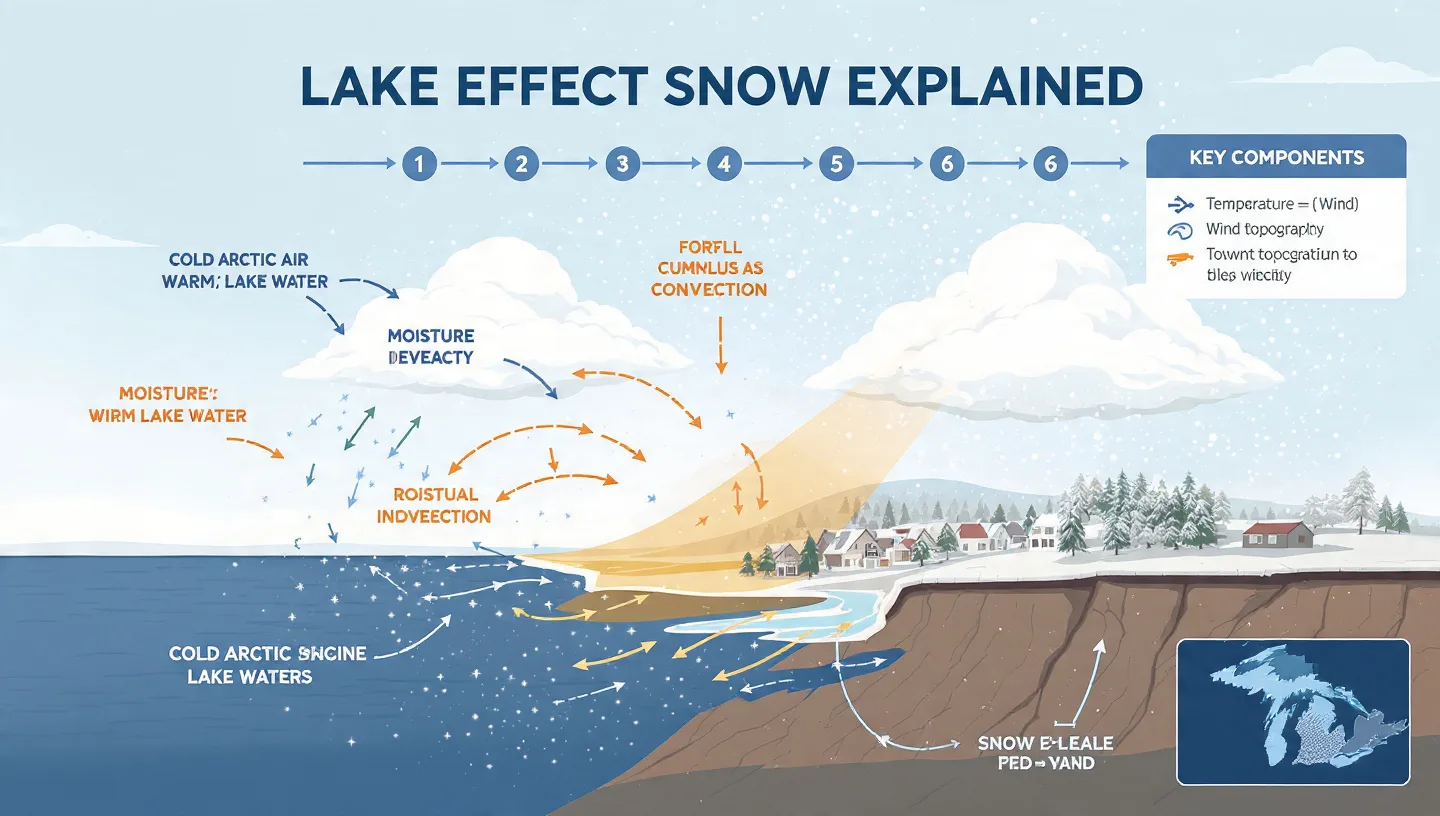
Lake effect snow is one of the dramatic, misunderstood and scientifically fascinating weather phenomena in North America. It can bury a town under five feet of snow in 24 hours while the city just ten miles away barely sees a flurry. It shuts down highways grounds flights and transforms communities into winter islands overnight.
In this complete guide, we break down lake effect snow explained from its basic definition through the advanced science, its most destructive historical events, the snowbelt regions it dominates and what climate change means for its future. Whether you are a weather enthusiast, a student or someone planning a winter trip through upstate New York this is the resource.
What Is Lake Effect Snow?
At its core lake effect snow is a snowfall event triggered when cold, dry air moves across the relatively warm open surface of a large lake. The lake. Moistens the air from below. That warmed moisture-laden air rises rapidly cools as it climbs and condenses into snow clouds that then dump their load on the downwind (leeward) shore.
The result is snowfall that is hyper-localized, intense, and sometimes violent. A snowband of fewer than three miles wide can produce two to three inches of snow per hour, and in extreme cases far more. Towns directly in the band get buried; communities just outside it see sunshine.
This phenomenon is most famous around North Americas Great Lakes (Superior, Michigan, Huron, Erie and Ontario). It also occurs around the Great Salt Lake in Utah Lake Baikal in Russia the western coasts of Japan and even some large saline bodies of water where a similar process is called ocean-effect or bay-effect snow.
How it differs from an ordinary snowstorm
A regular winter storm is big. It rolls in from a large low-pressure system, covers several states, and meteorologists can see it coming days ahead. Lake effect snow is the opposite. A band might be only a few miles wide, it can park itself over one spot for hours, and forecasters often can't say exactly where it will land until the day of.
| Feature | Regular winter storm | Lake effect snow |
|---|---|---|
| Width | Hundreds of miles | Often just a few miles |
| Typical snowfall rate | About an inch per hour | 2 to 4 inches per hour, sometimes more |
| How long it lasts | Roughly 12 to 36 hours | A few hours, or days if it stalls |
| Forecast confidence | Good days ahead | Exact location often unclear until hours before |
How It Forms, From Canada to Your Driveway
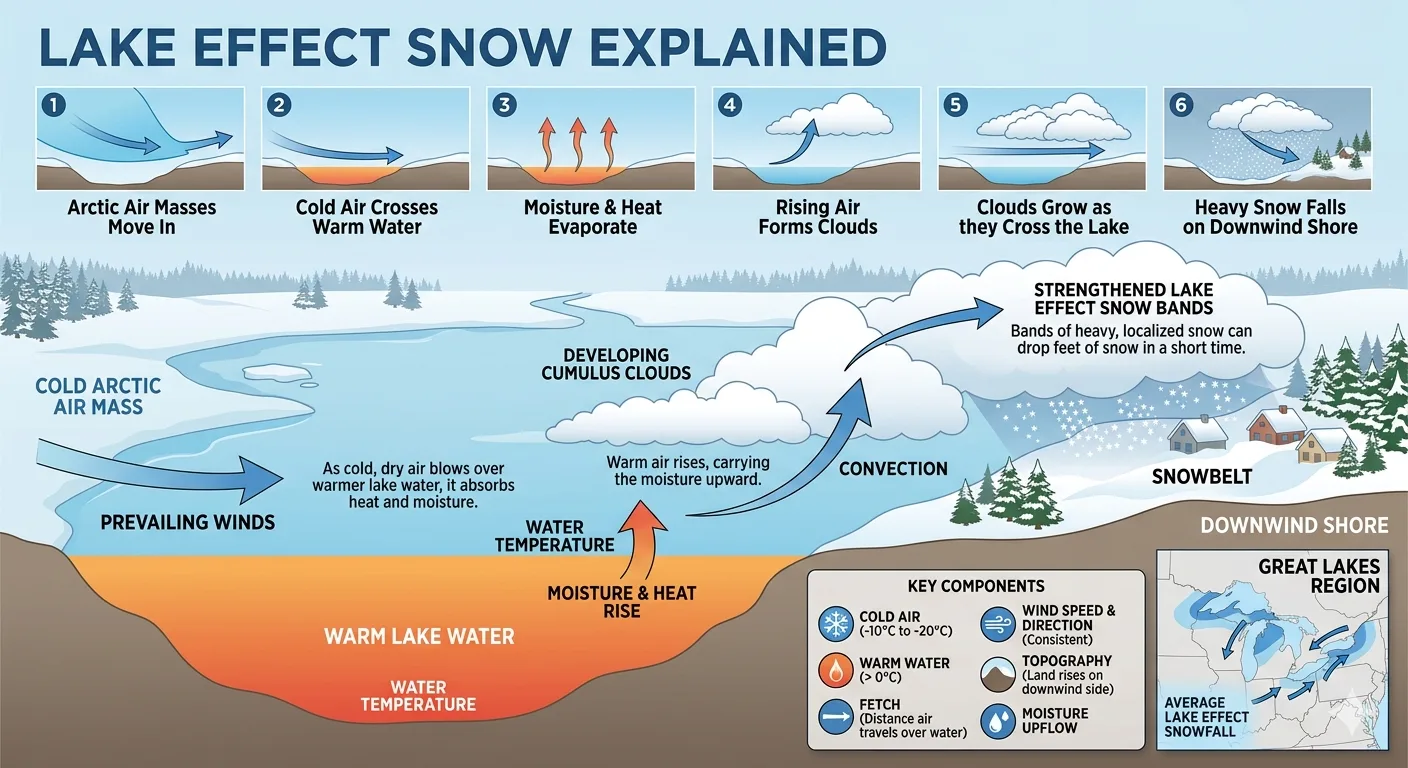
It usually starts after a storm system has passed through. Cold air from Canada follows behind it and pours southeast over the Great Lakes. In late fall and early winter, those lakes are still holding a lot of summer heat, often sitting in the 40s or 50s Fahrenheit while the air above them is well below freezing.
That contrast is everything. The lake warms the layer of air and loads it with water vapor. Warm air is lighter than air so it rises and as it climbs it cools and the vapor turns into cloud. The wind lines those clouds up into long streaks pointed downwind.
When the streaks reach land, two things happen. Friction slows the air down, so it piles up. And if there are hills, the air gets shoved upward, which squeezes out even more snow. Most of the heavy stuff falls within about 25 miles of the shore, although a strong band can push snow much farther inland.
People sometimes assume the lake just supplies moisture. I'd say the heat matters at least as much. The warm water makes the air unstable, and unstable air is what builds tall, snow-producing clouds in the first place.
The Ingredients Forecasters Check
A cold day alone won't do it. Forecasters look for a few things to line up at the same time.
The first is the temperature gap. The lake surface generally needs to be at least 23°F (13°C) warmer than the air about 5,000 feet up, which meteorologists call the 850 millibar level. Say Lake Erie is at 50°F. Then the air at 5,000 feet has to be around 27°F or colder for real lake effect snow to get going. If it drops to 20°F, expect much stronger bands.
The second is distance over water, known as fetch. Air needs to travel roughly 60 miles or more across open water to collect enough heat and moisture. A wind running along the length of a lake is far more dangerous than one crossing the narrow side.
Third, the wind has to be steady. If it holds its direction as you go up through the atmosphere, everything gets funneled into one intense band. If it changes a lot, the snow gets smeared out into weaker streaks over a wider area.
Fourth, the lake has to be open. Once ice covers the surface, the supply of heat and moisture gets cut off. That's why shallow Lake Erie, which freezes most often, has a shorter season than deep Lake Ontario, which rarely freezes over completely.
And fifth, terrain. The Tug Hill Plateau east of Lake Ontario is the classic example, and it's a big reason that region racks up totals other parts of the country can only dream about (or have nightmares about, depending on who you ask).
One band or many?
When the wind blows along a lake's long axis and stays steady, you usually get a single strong band. That's the dangerous version, with rates of 2 to 4 inches per hour and occasionally more. If it stalls, one small area can pick up feet of snow while everywhere else stays fine.
When the wind crosses the short way, you get several weaker bands that share the snow around. Less dramatic, but spread over more people.
Now and then, a band stretches from one lake across land and over the next lake, picking up extra energy on the way. Researchers call these lake-to-lake bands, and they tend to boost totals.
Thundersnow is real
When the contrast between water and air is extreme, the atmosphere gets unstable enough for lightning and thunder inside a snow squall. If you ever hear thunder during a snowstorm near the lakes, you're probably standing under a very productive band.
Where It Hits the Hardest
The areas that get hit over and over are called snowbelts. Some of the official numbers surprise people, because they come from airport weather stations, and the snowiest spots are rarely at airports.
| City | Lake | Average yearly snowfall (1991-2020) |
|---|---|---|
| Syracuse, NY | Ontario | About 128 inches |
| Erie, PA | Erie | About 104 inches |
| Rochester, NY | Ontario | About 102 inches |
| Buffalo, NY | Erie | About 95 inches |
Buffalo gets the reputation, but Syracuse actually beats it on the averages. For real extremes, though, you have to go to the Tug Hill Plateau. Some spots there see more than 20 feet in a winter, and the town of Hooker holds New York's seasonal record at about 467 inches, set in 1976-77.
The Keweenaw Peninsula on Lake Superior is the other heavyweight. Totals well over 200 inches are normal in its snowiest areas, which makes it one of the snowiest places east of the Rockies. Erie, Pennsylvania, the eastern shore of Lake Michigan, and northern Utah near the Great Salt Lake (home of that famously dry, light powder) round out the list.
Records, Big Storms, and a Warning About Numbers
Some of the most famous snow events in North America were lake effect. In February 2007, a stubborn 10-day siege left roughly 141 inches at Redfield, New York. In November 2014, Buffalo's "Snowvember" dropped up to about 88 inches in four days, with rates near 6 inches an hour, and more than a dozen people died. Erie was buried under several feet over Christmas 2017, setting a Pennsylvania two-day record. And in November 2022, parts of Buffalo's southern suburbs got more than 6 feet, while Buffalo itself set a daily record of 21.5 inches on the 19th.
A word of caution if you ever go digging for records. Measuring snow in a band a few miles wide is hard, and the record books are messier than you'd expect. A reported 77 inches in 24 hours at Montague, New York, in 1997 was thrown out after a federal review because of how it was measured. Camden, New York, with about 50 inches in 1966, was long treated as the state benchmark. When you see a giant number, it's worth asking whether it's official or just a spotter's report.
Rate records are equally absurd. Copenhagen, New York, has been credited with 12 inches in a single hour (back in 1966), and West Seneca with 7 inches in half an hour.
Last Winter (2025-26) in Numbers
If you want proof of how uneven this stuff is, last winter is a good case study.
On December 30, 2025, Syracuse picked up 24.2 inches of lake effect snow in one day, the most in a single day since records began in 1902. Then it kept going. Between December 31 and January 4, up to 58.5 inches fell east of Lake Ontario and up to 38.9 inches east of Lake Erie, at rates of 3 to 4 inches an hour. A few weeks later, bands from January 18 to 21 left up to 42 inches east of Lake Ontario and caused several pileups along about six miles of Interstate 90.
Farther west, northern Michigan had a persistent, snowy season, and Sault Ste. Marie finished with its second snowiest winter on record at 146.7 inches.
The lakes themselves were interesting too. After several winters of very little ice, Great Lakes ice cover peaked at 58.3 percent, the highest since 2019. Ice caves showed up around the Apostle Islands for the first time in a decade. And on December 29, winds of 60 to 80 mph caused a seiche on Lake Erie, which is basically the lake sloshing from one end to the other like water in a bathtub.
What Might 2026-27 Look Like?
As of late September 2026, El Niño is the headline. NOAA's Climate Prediction Center says it's strengthening and gives better than a 90 percent chance of a very strong event this fall and winter.
Strong El Niño winters tend to push the jet stream north, which usually means milder and drier weather around the Great Lakes. Several seasonal outlooks lean that way for this year, particularly early in the season.
Don't put the shovel away yet, though. Lake effect snow doesn't need a cold winter overall. It needs one cold outbreak crossing open water. A mild fall can actually help by keeping the lakes warm and ice-free for longer. Seasonal outlooks give you odds, not a promise about any given Tuesday, and a mild winter can still include one ugly band in November or December.
Read More : Snow Day vs Remote Learning
Is Climate Change Making It Better or Worse?
Both, depending on where you live and when you're asking.
In the near term, warmer lakes and less ice mean a longer lake effect season and more fuel for each event. Researchers have found snowfall increasing in northern zones, like around Lake Superior, as ice cover has shrunk. Over the long run, the southern edges of the snowbelts are expected to see more rain and less snow as winter air warms. Same setup, different precipitation.
That change affects more than snow lovers. If you plan outdoor events or construction in the shoulder seasons, the rain delay calculator can help you think through what a wet day might do to your schedule. And since those same warm lakes make late summer feel muggy, the heat index calculator is worth a look when the weather flips the other way.

When Is Lake Effect Season?
Mostly November through January. Late fall is when the lakes are warmest compared with the air, and that's when the biggest single-event totals tend to show up. December and January bring stronger cold outbreaks while the lakes are still mostly open. By February, ice usually starts taking over, especially on Lake Erie, and activity fades.
Some years scramble that pattern. Lake Erie stayed mostly open into early 2025 before freezing late, while last winter had far more ice. Every season has its own personality.
Reading a Lake Effect Forecast Without a Meteorology Degree
Start with the alert names. A watch means conditions might develop. A warning means significant snow is expected or already happening. An advisory sits below that, meaning it will be a nuisance but probably not a crisis.
Then look at wind direction, because that's what decides who gets hit. A shift of even a few degrees can move a band 20 miles or more. If the forecast mentions winds turning, assume the snow will move with them.
Skip the regional headline and pull up the forecast for your actual town. Look at radar too, not just the little snowflake icon on your phone. Bands look like long streaks, and if one is pointed at you and not moving, that's your answer.
Finally plan for the top of the range. If a forecast says 6 to 18 inches get ready for 18. Check again a few hours later because the last update before the band arrives is usually the most accurate.
Parents get a challenge here. One school district can be flattened while the next one over is fine and a band can shift during the morning commute. Use the snow day calculator for a quick read on your chances, but always check your district's official announcement before you make plans.
Staying Safe When the Band Arrives
Get ready before the warning is issued. Keep a kit in your car with a blanket, flashlight, shovel, sand or kitty litter, water, snacks, a phone charger, and jumper cables. Fill the gas tank when a warning goes up, not after. At home, have enough food, water and medication for two to four days, plus a charged power bank in case the electricity goes out.
If you have to drive, slow down before you reach open, exposed stretches, since that's where whiteouts hit first. If visibility disappears, ease off the gas rather than slamming the brakes, and keep your headlights on. Then pull off the road as far as you safely can, turn on the hazards, and stay in the car. Run the engine only now and then, and make sure the tailpipe isn't blocked by snow.
The scariest thing about a band is how fast it changes things. Drivers can go from dry pavement to zero visibility in seconds, which is why pileups on roads like I-90 keep making the news.
Shoveling deserves respect too. Heavy snow removal is a real risk for anyone with heart problems, and for plenty of people without them. Push the snow instead of lifting it, take breaks, and drink water. Before you head out, check how cold it really feels with the wind chill calculator, since wind changes how long exposed skin can safely stay out.
Afterward check on neighbors keep exhaust vents and hydrants clear and stay off the roads until crews have had time to work. Drifts and ice hang around long after the snow stops. If snow is piling up on your roof, remember that wet lake effect snow is heavy, so have it cleared by someone qualified before it becomes a structural problem.
A Few Myths Worth Clearing Up
"If it's snowing next door, it's snowing here" is the big one, and it's often wrong. Bands are narrow and can miss you by a few miles.
Another is that lake effect only happens on the Great Lakes. It doesn't, as the Great Salt Lake and the Sea of Japan coast prove. People also assume a warm winter means no lake effect, when in reality an early cold snap over warm water can produce some of the season's worst events. And it isn't just a blizzard by another name. Different cause, different scale, different forecasting headaches.
Conclusion
Lake effect snow is far more than a regional curiosity. It is a powerful meteorological machine driven by the interplay between arctic air masses, warm lake water, wind, and terrain, capable of paralyzing cities with snowfall totals that rival anything a major winter storm can produce, but concentrated into a zone so narrow it might not even span a single county.
From the record-shattering snows of the Tug Hill Plateau to the thundersnow-laced blizzards of Buffalo, lake effect events define winter life for millions of Americans and Canadians across the Great Lakes basin. And as climate change warms the lakes while altering the cold air patterns that drive lake effect activity, the phenomenon is evolving in ways that will continue to challenge forecasters, planners, and communities for decades to come.
Also Checkout :