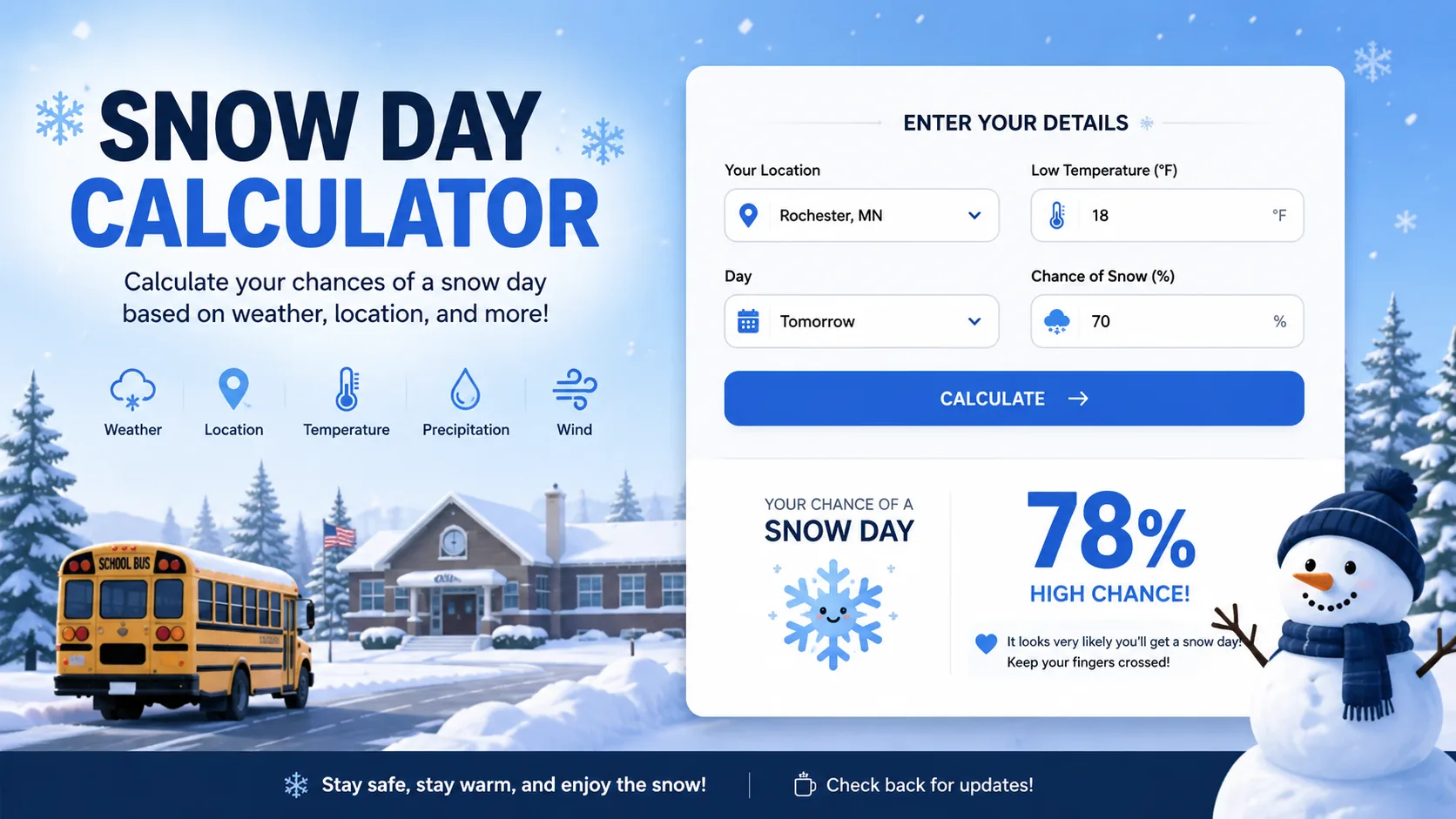
Snow day calculator AccuWeather is one of the most searched winter phrases every December through February, and for good reason. When snow starts falling, everyone wants the same answer: will school be closed tomorrow? The truth is a little more complicated than most search results let on. AccuWeather does not run its own snow day calculator, but it does provide some of the most detailed winter weather data available, and that data is exactly what powers the best snow day prediction formulas.
In this guide, you will learn what a snow day calculator actually is, how AccuWeather fits into the picture, the real formula behind these predictions, and how to combine AccuWeather's forecast data with a snow day calculator to get the most accurate closure prediction possible. We will also walk through real examples, common mistakes, and answer the most frequently asked questions parents, students, and teachers have every winter.
What Is a Snow Day Calculator?
A snow day calculator is an online tool that estimates the probability of a school closing due to winter weather. Instead of just showing you a forecast, it converts weather data into a single, easy-to-read percentage, something like "78% chance of a snow day tomorrow."
These tools typically pull data from weather sources such as the National Weather Service, Open-Meteo, WeatherAPI, or AccuWeather, then run that data through an algorithm that weighs several factors together. The output is a probability score, sometimes broken into categories like High, Medium, Low, or None.
Snow day calculators became popular because raw weather forecasts do not answer the one question people actually care about. Knowing that 5 inches of snow is expected does not tell a parent in Georgia the same thing it tells a parent in Minnesota. A calculator translates weather into a real-world outcome.
Does AccuWeather Have a Snow Day Calculator?
This is the part most articles get wrong. AccuWeather does not currently offer a dedicated snow day calculator or school closure predictor. What AccuWeather does provide is extremely detailed, hyperlocal winter weather forecasting, which happens to be the exact raw material snow day calculators need.
AccuWeather previously experimented with a "Snow Days Forecast" feature, launched back in 2010, which gave a five point scale showing how likely school closures were in a given area. That standalone feature is no longer AccuWeather's focus, but the company's forecasting tools have only gotten more precise since then, particularly around short-range, minute-by-minute snow timing.
So when people search "snow day calculator AccuWeather," they are usually looking for one of two things:
- A calculator that uses AccuWeather-quality forecast data to predict closures, or
- AccuWeather's own snow and winter storm forecast pages to manually judge the odds themselves
Either approach works, but understanding the difference will save you a lot of confusion this winter.
How Does a Snow Day Calculator Work?
Every snow day calculator, regardless of which website hosts it, is built around the same core idea: take several weather inputs, assign each one a weight, and combine them into a single probability score. Here is what typically goes into that calculation.
1. Forecasted Snowfall Total
This is the single biggest factor. The more snow expected, the higher the base probability. Most calculators pull this number directly from sources like AccuWeather, NOAA, or the National Weather Service.
2. Storm Timing
Snow that falls overnight and continues into the early morning commute carries far more weight than snow that starts at noon. A storm that wraps up by 4 AM is treated very differently from one still dumping snow at 7 AM.
3. Temperature
Snow needs freezing or near-freezing air to form and to stick. Calculators also check for the freezing threshold around 32°F (0°C), since temperatures hovering near freezing create dangerous icy conditions even with modest snowfall.
4. Wind Chill and Wind Speed
Strong wind can turn a manageable snow event into a genuine safety hazard, especially at bus stops. High wind chill readings push probability upward even when snow totals are moderate.
5. Ice and Freezing Rain Risk
Ice is often more dangerous than snow. Many districts will close for a quarter inch of ice sooner than they would for several inches of snow, because roads become nearly impossible to treat safely.
6. Regional and District History
This is the factor generic weather apps completely miss. A town in Alabama might cancel school for a light dusting, while a town in Vermont stays open through 8 inches. Good snow day calculators adjust their predictions based on how a specific region or district has historically responded to similar conditions.
The Snow Day Calculator Formula Explained
While every website guards its exact algorithm, most snow day probability formulas follow a similar weighted structure. Here is a simplified version you can use to understand, or even manually estimate, your own snow day odds.
| Factor | Weight in Score | What Increases Probability |
|---|---|---|
| Snowfall Amount | 35% | Higher totals, especially above your region's local threshold |
| Storm Timing | 20% | Snow falling during the overnight and early morning commute window |
| Temperature | 15% | At or below 32°F (0°C), increasing icing risk |
| Ice or Freezing Rain | 15% | Any measurable ice accumulation on roads |
| Wind Chill | 10% | Wind chill readings below 0°F, especially for bus dependent districts |
| District History | 5% | Prior closures under similar conditions in your specific district |
A simplified version of the underlying formula looks like this:
Each individual score is usually rated on a 0 to 100 scale before being weighted. You do not need to run this math yourself, since calculators automate it, but understanding the formula helps you sanity check any prediction you see online.
How to Use a Snow Day Calculator With AccuWeather Data
Here is the step by step process to get the most accurate possible prediction by combining AccuWeather's forecast strength with a dedicated snow day calculator.
Step 1: Check the AccuWeather Hourly Forecast
Open AccuWeather and look at the hourly breakdown for your area, not just the daily summary. You are looking for exact timing of when snow starts, when it becomes heaviest, and when it tapers off.
Step 2: Note the Snowfall Total and Ice Risk
AccuWeather provides an expected accumulation range along with a separate ice accumulation forecast when freezing rain is involved. Write both numbers down, since ice matters as much as snow.
Step 3: Check RealFeel Temperature and Wind Chill
AccuWeather's RealFeel metric factors in temperature, wind, humidity, and sun angle. A RealFeel well below freezing, especially in the single digits or negative numbers, pushes closure probability higher regardless of snow totals.
Step 4: Enter Your ZIP Code Into a Snow Day Calculator
Once you have the raw weather picture, plug your ZIP code or city into a dedicated snow day calculator. This step converts the raw AccuWeather data into a district-adjusted probability score.
Step 5: Compare the Timing Against the "Morning Crunch" Window
The most important window for most districts is between 4 AM and 7 AM, when superintendents make their final call. If AccuWeather's MinuteCast or hourly forecast shows snow easing before 5 AM, probability usually drops, even with solid totals overnight.
Step 6: Recheck the Night Before and Early Morning
Winter forecasts change fast. Recheck both AccuWeather and your snow day calculator the evening before, and again first thing in the morning, since a shifted storm track can change everything in a few hours.
Snow Threshold by Region: How Much Snow Actually Closes Schools
One of the biggest content gaps in most snow day guides is regional context. A number that shuts down one city barely registers in another. The table below gives a general regional breakdown based on typical climate expectations and infrastructure readiness.
| Region Type | Example Areas | Typical Snow Needed to Close Schools |
|---|---|---|
| Southern / Snow Rare Areas | Atlanta, Dallas, Charlotte | 0.5 to 2 inches, or any ice |
| Mid-Atlantic / Moderate Snow Areas | Virginia, Maryland, Ohio Valley | 3 to 5 inches |
| Northeast / High Snow Areas | Boston, New York suburbs, Pennsylvania | 5 to 8 inches |
| Upper Midwest / Snow Belt | Minnesota, Wisconsin, Upstate New York | 8 to 12 inches, or extreme wind chill |
| Mountain / High Altitude Areas | Colorado, Utah, Rockies | Varies widely, often tied to road and avalanche risk more than totals |
This regional gap is exactly why a single snowfall number from AccuWeather can never tell the full story on its own. The same forecast can mean a full closure in one district and a two hour delay one county over.
Real Life Examples With Calculations
Example 1: The Classic Overnight Storm
AccuWeather forecasts 6 inches of snow for a Pennsylvania suburb, with snow starting at 11 PM and continuing until 6 AM. Temperature is 28°F, wind chill is 18°F, and this district has closed for similar storms three of the last four times.
Snowfall score is high, timing score is high because snow overlaps the morning commute, temperature and wind chill both add risk, and district history strongly supports closure. Combined, this scenario typically produces a probability in the 85% to 95% range.
Example 2: The Southern Ice Event
AccuWeather forecasts only 1 inch of snow for an Atlanta suburb, but with a quarter inch of ice accumulation overnight and temperatures sitting at 30°F. Snowfall alone looks minor, but ice risk and this region's low tolerance for icy roads push the probability up sharply, often landing between 75% and 90%, despite the small snow total.
Example 3: The Daytime Flurry
AccuWeather forecasts 3 inches of snow for a Minnesota town, but the snow falls entirely between 10 AM and 2 PM on a weekday, well after buses have already run. Because this region routinely handles far more snow than this, and the timing misses the critical morning window entirely, probability typically stays low, often under 20%.
These three examples show why blindly reading an AccuWeather snowfall number is never enough. The same 3 to 6 inch range can mean anything from a guaranteed day off to a completely normal school day, depending on timing, temperature, ice, and regional tolerance.
Benefits of Using a Snow Day Calculator
- Saves time by turning a complicated forecast into one clear percentage
- Reduces morning stress for parents arranging childcare or work schedules
- Helps students plan whether to finish homework or set an earlier alarm
- Supports safer decisions around road conditions and bus stop wait times
- Adds local context that a generic weather app or forecast alone cannot provide
Common Mistakes People Make
- Only checking snowfall totals and ignoring timing, ice, or wind chill entirely
- Using a national or regional average instead of a district specific tool
- Checking too early, days before a storm, when the forecast is still likely to shift
- Assuming a calculator's percentage is a guarantee rather than an estimate
- Ignoring official district announcements in favor of a calculator's prediction
AccuWeather Data vs Dedicated Snow Day Calculators
It helps to think of these as two different tools working together rather than competitors. AccuWeather is the meteorology engine. It tells you what the sky is going to do, including snowfall totals, precise timing through tools like MinuteCast, temperature, and RealFeel wind chill.
A dedicated snow day calculator is the decision engine. It takes that same weather picture and layers in regional closure thresholds, district history, and weighted scoring to estimate what a superintendent is actually likely to decide.
Relying on AccuWeather alone leaves out the human and local policy side of the equation. Relying on a generic calculator without checking detailed AccuWeather data leaves out precise timing that can make or break a prediction. The most accurate approach uses both together, exactly as outlined in the step by step section above.
Read More : Ohio Snow Day Calculator
What Meteorologists and Experts Say
Weather professionals have long recognized the value of translating raw forecasts into practical, decision-ready information. When AccuWeather first introduced its localized school forecasting feature, an AccuWeather senior meteorologist described the goal as giving families a personalized sense of when closures were likely, rather than leaving them to interpret a generic weather report on their own.
Independent snow day prediction services echo this same idea from the other direction. According to Perry Weather, snow day tools are best understood as a helpful planning aid rather than a guaranteed outcome, since final closure decisions always rest with school administrators rather than any algorithm. This consistent message across both meteorology companies and dedicated prediction tools reinforces the core lesson of this guide: use the data to prepare, not to replace the official announcement.
Snow Day Probability Trend Example
To visualize how a typical storm's probability shifts as new AccuWeather data comes in, here is a simplified 48 hour trend based on a common winter storm scenario.
| Time Before Storm | Forecast Confidence | Typical Snow Day Probability |
|---|---|---|
| 48 hours out | Low, models still shifting | 20% to 40% |
| 24 hours out | Moderate, storm track firming up | 40% to 65% |
| 12 hours out | High, hourly data available | 60% to 85% |
| Overnight into early morning | Very high, live snowfall reports | 75% to 95% |
| 5 AM to 6 AM morning of | Near certain, districts deciding | Final decision window |
This trend illustrates why checking a calculator two days before a storm gives you a rough idea at best, while checking again the morning of gives you the most reliable read.
How to Set Up Snow Day Alerts and Notifications
Checking a calculator manually every few hours works, but setting up alerts is faster and less stressful during an active storm. Here is how to build a simple alert system using AccuWeather alongside your snow day calculator.
- Enable AccuWeather push notifications for severe weather alerts, winter storm warnings, and advisories in your saved location.
- Turn on text or email alerts from your snow day calculator if the tool offers them, so you get an updated probability without checking manually.
- Follow your school district's official app or website, since this is the only source that confirms an actual closure rather than an estimate.
- Set a phone alarm around 5 AM during an active storm to check both AccuWeather's hourly forecast and your calculator's latest score before the district announcement window closes.
Combining automated alerts with a quick manual check the morning of a storm gives you the earliest possible warning without needing to refresh a browser tab all night.
Snow Day Calculator Tips for Parents, Students, and Teachers
Different groups use snow day predictions for different reasons, and a little context helps each group get more value from the same data.
For Parents
Focus on the overnight and early morning probability trend rather than a single number checked two days out. If probability is climbing above 60% by the evening before, it is reasonable to start lining up backup childcare just in case.
For Students
Use the calculator to decide how much homework urgency is realistic for the next morning, but never skip an assignment based purely on a predicted percentage, since official closures can still go either way.
For Teachers and Staff
Cross reference your snow day calculator with AccuWeather's hourly timeline for your specific commute route, not just your home ZIP code, since road conditions along the way to school often matter more than conditions at either endpoint.
Conclusion
The search for a "snow day calculator AccuWeather" usually comes from wanting one simple answer to a genuinely complex question. AccuWeather gives you the most detailed and reliable winter weather data available, from hourly snowfall timing to RealFeel wind chill, but it does not make the closure call itself.
A dedicated snow day calculator fills that gap by translating AccuWeather-quality data into a district-adjusted probability you can actually plan around. By checking AccuWeather's hourly forecast, understanding the six core factors behind every calculation, and running your ZIP code through a snow day calculator closer to the storm, you will get the most accurate read possible on whether tomorrow brings a snow day.
Always remember that these tools provide an estimate, not a guarantee. Keep an eye on your school district's official communication channels for the final word, and use your snow day calculator to plan ahead with confidence rather than guesswork.
Also Checkout :