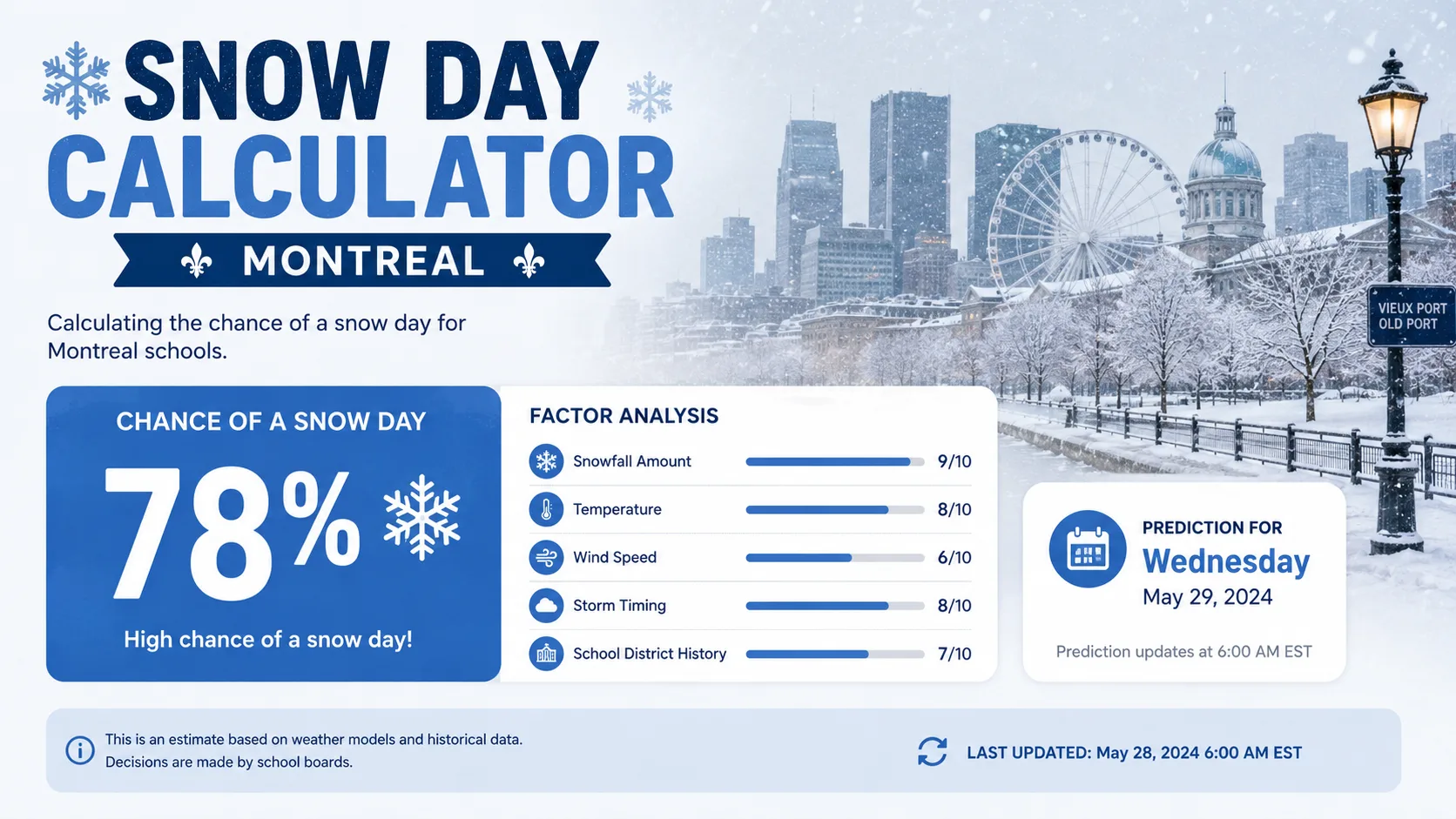
Montreal gets more snow than almost any major city in Canada, yet its schools close far less often than you might expect. A snow day calculator Montreal tool exists precisely because the city's snow removal system, metro network and bilingual board structure make it behave very differently from other Canadian cities under the same storm.
This guide breaks down how a Montreal-specific snow day calculator works, why CSSDM and EMSB rarely close despite roughly 210 cm of annual snowfall, and how to use the tool step by step so you are never caught off guard the morning of a storm.
What Is a Snow Day Calculator for Montreal?
A snow day calculator Montreal tool estimates the probability that Montreal-area school boards, primarily the Centre de services scolaire de Montréal (CSSDM) and the English Montreal School Board (EMSB), will cancel classes or transportation due to snow, ice or extreme cold.
It converts a weather forecast into a single percentage, calibrated specifically to how Montreal boards historically respond, rather than relying on a generic national average that would badly overestimate the city's real closure risk.
Why Montreal Rarely Closes Schools, Even With Heavy Snow
This is the part most generic calculators get wrong, and it is the single most important thing to understand before checking your odds.
Montreal's Snow Removal Machine
- The city operates roughly 3,000 snow removal vehicles in a coordinated ploughing, collection, and removal-to-dump system.
- A major storm dropping 30 cm can have major arterial roads cleared within roughly 12 to 18 hours.
- Montreal averages about 210 cm of snowfall per year, comparable to Ottawa, yet typically sees only 2 to 4 closure days per year, among the lowest rates of any major snowy Canadian city.
The Metro Advantage
Montreal's extensive metro system operates largely underground, which means it keeps running regardless of surface snow conditions. This gives staff and many older students a reliable way to reach school even during storms that would otherwise disrupt surface bus routes entirely.
How the Calculator Works for Montreal Specifically
The scoring model follows a similar structure to other Canadian tools, but with thresholds pushed noticeably higher to reflect Montreal's infrastructure.
| Factor | Approximate Weight | Montreal-Specific Trigger |
|---|---|---|
| Snowfall accumulation | Up to 45% | Often needs 30+ cm before scores climb sharply |
| Freezing rain / ice risk | Up to 25% | Any significant freezing rain event, weighted heavily |
| Wind / blizzard conditions | Up to 20% | Sustained high wind with blowing snow and low visibility |
| Storm timing | Up to 10%+ | Heaviest snow overlapping the 6 to 8 a.m. commute |
Because Montreal's real closure threshold sits well above the provincial or national average, a calculator that reuses a generic Ontario or U.S. formula will consistently overpredict closures for the city. This is exactly the gap most province-agnostic tools miss.

How Montreal's Snow Day Decision Timeline Works
- Evening before: During major forecast storms, watch board and municipal social channels for early advisories.
- Early morning: Snow removal crews and transportation staff assess live road and metro conditions across the island.
- Between 6:00 and 7:00 a.m.: CSSDM, EMSB and other Montreal-area boards post their confirmed decisions.
- Media confirmation: Announcements are also carried through Radio-Canada, TVA Nouvelles, 98.5 FM, and CTV Montreal for English-language coverage.
French-language boards typically use the phrase "fermeture des écoles" in their official announcements, so it is worth knowing that term if you are monitoring French media directly.
How to Use a Snow Day Calculator for Montreal (Step by Step)
- Enter your Montreal borough or postal code rather than just "Montreal," since outer boroughs can differ from the central island.
- Check the evening before for an early planning estimate, especially ahead of a forecast major storm.
- Look for freezing rain warnings specifically, since ice is weighted more heavily than snowfall alone in the Montreal model.
- Recheck close to 6 a.m., once the overnight forecast has updated with fresh data.
- Confirm with CSSDM or EMSB's official channel directly, since the two boards can differ.
Montreal Closure Rate vs. Other Major Canadian Cities
The chart below illustrates typical relative closure frequency per winter, showing why raw snowfall totals alone are a poor predictor across Canadian cities.
Illustrative relative closure frequency per average winter, reflecting snow removal infrastructure and board policy rather than snowfall totals alone.
Real Montreal Examples With Calculations
Example 1: Routine Winter Storm
- Forecast: 15 cm overnight, temperature -9°C, arterials pre-treated
- Snowfall score: 20/45
- Ice risk score: 2/25
- Wind score: 4/20
- Estimated probability: around 15 to 20%, normal school day expected
Example 2: Major Snow Event
- Forecast: 32 cm overnight, heaviest snow overlapping the morning commute
- Snowfall score: 42/45
- Ice risk score: 5/25
- Wind score: 12/20
- Timing score: 8/10
- Estimated probability: around 65 to 75%, closure becomes realistic, especially for outer boroughs
Example 3: Freezing Rain Event
- Forecast: only 5 cm snow, but significant freezing rain coating roads and sidewalks
- Snowfall score: 8/45
- Ice risk score: 23/25
- Wind score: 6/20
- Estimated probability: around 55 to 60%, despite a very low snowfall total
These examples show why freezing rain is treated as seriously as heavy snowfall in the Montreal model. A storm with modest snow but significant ice can produce a higher risk score than a much larger snow event with dry, manageable roads.
Read More : Snow Day Calculator Toronto
CSSDM vs. EMSB: Do They Always Match?
Not necessarily. CSSDM, the largest French-language board with over 110,000 students on the island of Montreal, and EMSB, the largest English-language public board, make independent decisions.
- In genuinely extreme conditions, both boards typically close together.
- In marginal or borderline conditions, one board can close while the other stays open.
- Private schools generally follow public board decisions but are not obligated to, so always confirm directly for private institutions.
A Note on Montreal's Winter Weather History
Montreal's approach to winter weather is shaped in part by memory. The January 1998 ice storm remains the most significant winter weather event in the city's modern history, and it still informs how seriously boards and municipal crews treat freezing rain forecasts today.
This history is part of why ice risk carries such heavy weight in Montreal's closure model, even when the associated snowfall total looks unremarkable on its own.

Benefits and Use Cases
- Parents across CSSDM and EMSB households can plan childcare with a Montreal-specific estimate instead of a generic national guess.
- Students get a realistic sense of whether tonight's homework will still matter tomorrow.
- Commuters using surface roads, as opposed to the metro, can anticipate delays even on days schools stay open.
- Families near the edge of the island or in outer boroughs get a more accurate read than a downtown-only estimate.
- Anyone comparing CSSDM and EMSB can see how the same storm can affect each board differently.
Common Mistakes to Avoid
- Assuming heavy snowfall automatically closes Montreal schools. The city's infrastructure regularly absorbs snow totals that would close other Canadian cities.
- Underweighting freezing rain. Ice risk matters as much as, or more than, raw snowfall in Montreal's model.
- Assuming CSSDM and EMSB always match. They are separate boards with separate announcements.
- Using a generic national snow day percentage for Montreal. The city's real threshold sits well above the average.
- Checking only the night before. The most accurate number comes from a recheck close to the 6 to 7 a.m. announcement window.
Pro Tips
- Bookmark both CSSDM and EMSB's official pages if your household includes students in either system.
- Follow Radio-Canada or 98.5 FM for the fastest French-language confirmation, or CTV Montreal for English updates.
- Remember that the metro largely bypasses surface snow disruption, which is part of why staff and school access often holds up even in heavy storms.
- Treat any freezing rain warning as seriously as a large snowfall total, even if the centimetre count looks small.
Conclusion
A snow day calculator Montreal tool is only useful if it accounts for what actually makes the city different: an enormous snow removal fleet, a metro system immune to surface conditions, and a bilingual board structure where CSSDM and EMSB can make separate calls on the same morning.
Check your estimate the evening before, recheck close to the 6 to 7 a.m. announcement window, and always confirm directly with CSSDM or EMSB before finalizing your plans. Given Montreal's snow removal capacity and winter resilience, a closure almost always signals genuinely severe conditions rather than a routine storm.
Also Checkout :